Beeswax Market Size
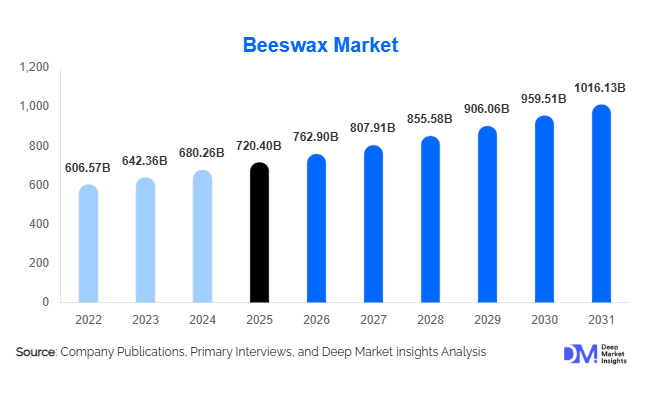
According to Deep Market Insights, the global beeswax market size was valued at USD 720.4 million in 2025 and is projected to grow from USD 762.90 million in 2026 to reach USD 1,016.13 million by 2031, expanding at a CAGR of 5.9% during the forecast period (2026–2031). The market is witnessing steady expansion due to the increasing utilization of beeswax across cosmetics, pharmaceuticals, food processing, candle manufacturing, and industrial applications. Growing consumer preference for natural, biodegradable, and sustainably sourced ingredients is accelerating product adoption worldwide. Continuous improvements in beekeeping practices, refining technologies, and premium-grade beeswax production are further supporting industry expansion, while increasing investments in organic personal care formulations continue to strengthen long-term market demand.
Key Market Insights
- Europe dominated the global beeswax market, accounting for nearly 36.8% of total revenue in 2025 owing to its well-established cosmetics and pharmaceutical manufacturing industries.
- Asia-Pacific is projected to register the fastest growth, supported by expanding beekeeping activities, increasing natural cosmetic production, and rising consumer awareness regarding sustainable ingredients.
- Yellow beeswax remains the leading product segment, contributing approximately 61.4% of global consumption due to its extensive use in candles, cosmetics, food coatings, and industrial formulations.
- Cosmetics & Personal Care accounted for the largest application share at nearly 47.2%, driven by growing demand for clean-label skincare, lip care, hair care, and premium beauty products.
- India is emerging as a high-growth market, supported by government initiatives promoting apiculture, increasing exports, and expanding domestic demand for natural ingredients across multiple industries.
- Advancements in purification technologies, traceability systems, and organic certification are improving product quality while strengthening international trade and consumer confidence.
Beeswax Market Trends
Growing Preference for Sustainable and Natural Ingredients
Manufacturers across cosmetics, pharmaceuticals, and food processing industries are increasingly replacing petroleum-based ingredients with naturally derived alternatives such as beeswax. More than 65% of premium cosmetic formulations now incorporate natural waxes, while global consumption of cosmetic-grade beeswax continues to increase steadily every year. Organic skincare products, clean-label lip balms, body creams, moisturizers, and natural ointments are driving significant product demand. The growing popularity of environmentally friendly packaging, biodegradable ingredients, and sustainable production methods has encouraged manufacturers to invest in certified organic beeswax sourcing. International cosmetic brands are also strengthening partnerships with certified apiaries to ensure consistent raw material quality and long-term supply security.
Technological Advancements in Beeswax Processing
Modern refining technologies are significantly improving the quality and commercial value of beeswax products. Advanced filtration systems, automated purification equipment, vacuum processing, and laboratory-based quality testing are enabling manufacturers to achieve pharmaceutical-grade purity exceeding 99%. Digital traceability platforms and blockchain-enabled supply chain monitoring are also enhancing transparency throughout the production process. Manufacturers are increasingly investing in automated processing facilities capable of improving production efficiency while reducing impurities and waste generation. These technological developments are helping producers meet stringent international quality standards while expanding the use of beeswax across high-value pharmaceutical, medical, food-grade, and premium cosmetic applications.
Beeswax Market Drivers
Increasing Demand for Natural Ingredients in Cosmetics and Personal Care
The rapid expansion of the global natural cosmetics industry continues to be one of the strongest growth drivers for the beeswax market. Consumers are increasingly seeking skincare and beauty products formulated with renewable, biodegradable, and chemical-free ingredients. Beeswax provides excellent emulsifying, moisturizing, thickening, and protective properties, making it an essential ingredient in lip balms, lotions, creams, foundations, mascaras, and hair styling products. Growing awareness regarding synthetic chemical alternatives has encouraged manufacturers to expand their portfolios of naturally formulated products. The premium beauty segment, organic skincare brands, and clean-label personal care manufacturers continue to increase their procurement of pharmaceutical-grade and cosmetic-grade beeswax, supporting long-term market expansion across both developed and emerging economies.
Expansion of Pharmaceutical and Healthcare Applications
The pharmaceutical industry is steadily increasing the use of beeswax in ointments, topical creams, capsule coatings, controlled drug delivery systems, medicated balms, and wound-care formulations. Its excellent biocompatibility, stability, moisture resistance, and non-toxic properties make it suitable for numerous healthcare applications. Increasing investments in natural pharmaceutical excipients and bio-based medical formulations are encouraging manufacturers to utilize highly refined beeswax in premium healthcare products. Rising demand for herbal medicines, natural therapeutic products, and organic medicinal formulations is further supporting product consumption, particularly across Europe, North America, and Asia-Pacific where demand for sustainable healthcare ingredients continues to rise.
Beeswax Market Restraints
Fluctuating Raw Material Supply and Climate-Related Challenges
The availability of beeswax largely depends on healthy honeybee populations, seasonal honey production, and favorable climatic conditions. Bee colony diseases, pesticide exposure, habitat degradation, and climate change continue to affect global apiculture activities, resulting in fluctuations in raw material availability. These supply-side uncertainties contribute to price volatility and create procurement challenges for large-scale manufacturers. Seasonal production limitations, inconsistent harvest volumes, and rising operational costs also impact international trade, making long-term supply planning difficult for cosmetic, pharmaceutical, and food manufacturers that rely heavily on consistent supplies of high-quality beeswax.
Availability of Low-Cost Synthetic Alternatives
Several industrial manufacturers continue to utilize synthetic waxes, paraffin wax, microcrystalline wax, and plant-based substitutes due to their lower production costs and stable supply chains. These alternatives remain attractive for cost-sensitive applications, particularly in industrial coatings, candles, and packaging materials. While premium consumer products increasingly favor natural ingredients, the price difference between refined beeswax and synthetic substitutes remains a limiting factor for broader adoption in certain commercial sectors. Maintaining consistent quality standards while remaining cost competitive continues to be a major challenge for global beeswax producers.
Beeswax Market Opportunities
Growing Demand for Sustainable Packaging and Bio-Based Materials
The global shift toward environmentally sustainable packaging solutions is creating significant opportunities for beeswax manufacturers. Food producers are increasingly utilizing beeswax as a natural edible coating for fruits, vegetables, confectionery products, and cheese to improve shelf life while reducing dependence on synthetic preservatives and plastic packaging. The development of reusable beeswax food wraps has gained considerable popularity among environmentally conscious consumers seeking alternatives to single-use plastics. Governments across Europe, North America, and Asia-Pacific are promoting biodegradable materials through sustainability initiatives and regulatory policies, encouraging greater adoption of natural wax products. As companies continue investing in eco-friendly packaging technologies and circular economy practices, beeswax is expected to witness expanding commercial applications across food preservation, biodegradable packaging, and specialty coatings.
Expansion of Organic Personal Care and Premium Healthcare Products
The rapid growth of the organic beauty and wellness industry presents substantial opportunities for the beeswax market. Premium skincare manufacturers are increasingly incorporating pharmaceutical-grade beeswax into anti-aging creams, moisturizers, lip care products, facial masks, sunscreens, and baby care formulations due to its natural moisturizing and protective properties. At the same time, pharmaceutical companies are expanding the use of highly refined beeswax in topical medications, herbal ointments, wound-care products, and controlled-release drug delivery systems. Increasing consumer spending on clean-label cosmetics, organic healthcare products, and naturally formulated therapeutic solutions is expected to create long-term demand across developed as well as emerging economies.
Report Scope
| Report Metric | Details |
|---|---|
| Market Size in 2025 | USD 720.4 Billion |
| Market Size in 2026 | USD 762.90 Billion |
| Market Size in 2031 | USD 1016.13 Billion |
| CAGR | 5.9% (2026-2031) |
| Base Year for Estimation | 2025 |
| Historical Data | 2022-2024 |
| Forecast Period | 2026-2031 |
| Report Coverage | Revenue Forecast, Competitive Landscape, Supply Chain Disruption, Growth Factors, Environment & Regulatory Landscape and Trends |
| Geographies Covered | North America, Europe, APAC, Middle East and Africa, LATAM |
| Countries Covered | U.S., Canada, U.K., Germany, France, Spain, Italy, Russia, Nordic, Benelux, Rest of Europe, China, Korea, Japan, India, Australia, Singapore, Taiwan, South East Asia, Rest of Asia-Pacific, UAE, Turky, Saudi Arabia, South Africa, Egypt, Nigeria, Rest of MEA, Brazil, Mexico, Argentina, Chile, Colombia, Rest of LATAM |
Explore more data points, trends and opportunities Download Free Sample Report
Product Type Insights
Yellow beeswax represents the largest product segment in the global market, accounting for approximately 61.4% of total revenue in 2025. Produced directly from honeycomb with minimal refining, yellow beeswax retains its natural color, aroma, and beneficial compounds, making it highly suitable for candle manufacturing, cosmetics, food glazing, leather treatment, woodworking, and industrial polishing applications. Its excellent flexibility, water resistance, and melting point ranging between 62°C and 65°C contribute to widespread industrial utilization. Growing demand from artisanal candle manufacturers and natural cosmetic brands continues to support steady consumption of yellow beeswax across international markets.
White beeswax is the second-largest segment and continues to experience healthy demand due to its refined appearance, superior purity, and versatility. Produced through filtration and bleaching processes, white beeswax is widely utilized in premium cosmetics, pharmaceutical ointments, medical creams, capsule coatings, luxury skincare formulations, and high-end personal care products. Manufacturers prefer white beeswax because of its neutral color, improved formulation compatibility, and ability to blend efficiently with active pharmaceutical ingredients and cosmetic emulsions. Rising production of clean-label beauty products and dermatologically tested skincare formulations continues to strengthen demand for refined white beeswax globally.
Beeswax absolute represents a premium specialty segment primarily utilized within the fragrance and luxury cosmetics industries. Extracted using specialized solvent-processing techniques, beeswax absolute possesses a rich honey-like aroma and exceptional aromatic characteristics, making it a preferred ingredient in perfumes, scented candles, aromatherapy oils, luxury soaps, and premium skincare products. Although this segment contributes a comparatively smaller market share, increasing consumer preference for natural fragrances and botanical ingredients is expected to accelerate demand over the forecast period. Expanding luxury cosmetic manufacturing and niche fragrance development continue to create attractive opportunities for beeswax absolute producers.
Application Insights
Cosmetics & Personal Care remains the largest application segment, accounting for nearly 47.2% of global market revenue. Beeswax is extensively incorporated into lip balms, moisturizers, foundations, mascaras, body lotions, facial creams, hair styling products, sunscreens, and anti-aging formulations due to its natural emulsifying, moisturizing, stabilizing, and protective properties. Growing consumer awareness regarding clean-label beauty products, combined with increasing demand for organic skincare solutions, continues to drive product adoption across premium cosmetic brands. Manufacturers are also introducing vegan-inspired formulations that combine beeswax with botanical ingredients to improve product performance while maintaining sustainability standards.
Pharmaceuticals represent one of the fastest-growing application segments, supported by increasing utilization in topical creams, medicinal ointments, wound healing products, capsule coatings, herbal medicines, and controlled drug-release systems. Beeswax provides excellent structural stability, moisture resistance, and compatibility with active pharmaceutical ingredients, making it suitable for a wide range of medical formulations. Rising investments in bio-based pharmaceutical excipients, natural healthcare products, and herbal therapeutic solutions continue to expand commercial opportunities within the healthcare industry.
Food & Beverages continues to emerge as an important application area due to growing demand for natural food preservation technologies. Beeswax is commonly used as an edible coating for fruits, vegetables, chocolates, confectionery products, bakery items, and cheese to reduce moisture loss and extend product shelf life. Increasing consumer preference for chemical-free food preservation, biodegradable packaging materials, and natural glazing agents is encouraging food manufacturers to incorporate food-grade beeswax into premium product formulations. Expanding regulatory acceptance of edible natural waxes is expected to further strengthen long-term demand across the global food industry.
Explore more data points, trends and opportunities Download Free Sample Report
Beeswax Market Segmentations
By Product Type
- Yellow Beeswax
- White Beeswax
- Beeswax Absolute
By Application
- Cosmetics & Personal Care
- Pharmaceuticals
- Food & Beverages
By Distribution Channel
- Direct Sales
- Distributors & Wholesalers
- Online Retail
- Specialty Chemical Suppliers
- Industrial Procurement
Regional Insights
North America
North America accounted for approximately 24.5% of the global beeswax market in 2025, supported by the strong presence of premium cosmetic manufacturers, pharmaceutical companies, and natural food producers. The United States represents the largest regional market, contributing more than 80% of North American consumption, followed by Canada. Rising consumer preference for organic skincare products, clean-label cosmetics, herbal medicines, and environmentally friendly packaging continues to stimulate product demand across the region. The growing popularity of handcrafted candles, natural lip balms, and premium wellness products has also increased domestic consumption of cosmetic-grade and pharmaceutical-grade beeswax.
Manufacturers across North America are investing heavily in sustainable sourcing, certified organic ingredients, and advanced refining technologies to meet evolving regulatory requirements and consumer expectations. The pharmaceutical industry continues expanding the utilization of beeswax in topical formulations, capsule coatings, and medical ointments, while food manufacturers increasingly adopt edible beeswax coatings to improve product shelf life. Rising investments in premium personal care brands and environmentally responsible packaging solutions are expected to support stable market expansion throughout the forecast period.
Europe
Europe dominated the global beeswax market with approximately 36.8% revenue share in 2025 and remains one of the most mature regional markets. Germany, France, Italy, Spain, and the United Kingdom collectively account for the majority of regional demand due to their well-established cosmetics, pharmaceutical, and food processing industries. The region benefits from stringent environmental regulations encouraging the adoption of biodegradable raw materials, while consumers increasingly prefer naturally derived ingredients in skincare, beauty, and healthcare products. Strong demand for certified organic cosmetics continues to strengthen commercial opportunities for beeswax suppliers throughout Europe.
European manufacturers are emphasizing sustainable production, traceable sourcing, and premium-quality refinement processes to satisfy strict regulatory standards. Growing investments in organic personal care products, luxury cosmetics, pharmaceutical excipients, and eco-friendly food packaging continue driving market expansion. In addition, increasing consumer awareness regarding chemical-free formulations and environmentally sustainable lifestyles is encouraging manufacturers to replace petroleum-derived waxes with renewable natural alternatives such as beeswax across numerous industrial applications.
Asia-Pacific
Asia-Pacific is projected to register the fastest market growth during the forecast period, supported by rapidly expanding cosmetics manufacturing, rising pharmaceutical production, and increasing government support for commercial apiculture. China and India represent the largest producers and consumers within the region, while Japan, South Korea, Australia, and Southeast Asian countries continue expanding their demand for premium natural ingredients. Rising disposable income, growing middle-class populations, and increasing awareness regarding organic personal care products are significantly strengthening regional consumption.
The region also benefits from abundant honey production, improving beekeeping infrastructure, and expanding export activities. Government initiatives promoting sustainable agriculture and rural beekeeping are helping improve beeswax availability while supporting income generation for local producers. Cosmetic manufacturers are increasingly incorporating beeswax into skincare, haircare, and baby care formulations, while pharmaceutical companies continue expanding production of herbal medicines and naturally formulated therapeutic products. These factors collectively position Asia-Pacific as the fastest-growing regional market over the coming years.
Latin America
Latin America represents an emerging market for beeswax, supported by expanding beekeeping activities, increasing exports, and growing utilization across cosmetics and food processing industries. Brazil, Argentina, and Mexico remain the leading contributors to regional production and consumption, benefiting from favorable climatic conditions for apiculture and expanding agricultural sectors. Rising consumer demand for natural cosmetics, handcrafted candles, and organic food products continues creating new opportunities for regional manufacturers and exporters.
Governments and agricultural organizations are increasingly promoting sustainable beekeeping practices through technical assistance, financial incentives, and export development programs. Growing participation in international trade, combined with rising investments in certified organic production and value-added beeswax processing, is expected to improve the region's competitiveness within global markets. Increasing awareness regarding environmentally friendly products is further encouraging commercial adoption across multiple end-use industries.
Middle East & Africa
The Middle East & Africa region continues to witness steady growth due to expanding pharmaceutical manufacturing, increasing demand for natural cosmetic ingredients, and improving commercial beekeeping activities. Turkey, South Africa, Egypt, Kenya, and Ethiopia are among the major regional producers, benefiting from favorable climatic conditions and well-established apiculture sectors. Growing utilization of beeswax in traditional medicines, premium skincare products, and natural food preservation applications continues supporting regional demand.
Governments across several African countries are investing in modern beekeeping techniques, rural development initiatives, and export-oriented honey production to improve industry competitiveness. At the same time, rising disposable income and increasing consumer awareness regarding sustainable personal care products are encouraging higher domestic consumption. Continued expansion of organic cosmetic manufacturing and international trade is expected to create additional long-term opportunities for beeswax producers across the Middle East and Africa.
Key Players in the Beeswax Market
- Koster Keunen Inc.
- A.A. Sayia & Company
- Poth Hille & Co. Ltd.
- Strahl & Pitsch Inc.
- Akrochem Corporation
- Frank B. Ross Co. Inc.
- Paramold Manufacturing LLC
- Roger A. Reed Inc.
- M.C. Balgobin Wax Products Pvt. Ltd.
- Arjun Bees Wax Industries
- Apis India Limited
- Kahl GmbH & Co. KG