Home Decor Market Size
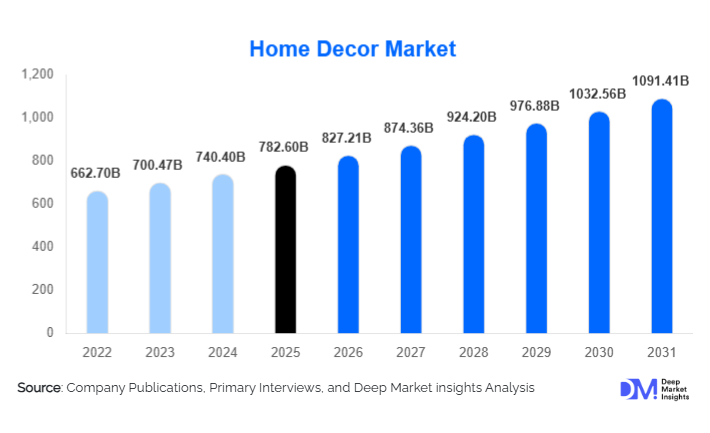
According to Deep Market Insights, the global home decor market size was valued at USD 782.6 billion in 2025 and is projected to grow from USD 827.21 billion in 2026 to reach USD 1,091.41 billion by 2031, expanding at a CAGR of 5.7% during the forecast period (2026–2031). The home decor market growth is primarily driven by increasing residential construction, rising disposable incomes, rapid urbanization, growing home renovation activities, and expanding consumer preference for premium, sustainable, and aesthetically appealing interior products. The report provides comprehensive market segmentation, competitive benchmarking, regional assessment, and detailed analysis of evolving consumer purchasing patterns across global markets.
Key Market Insights
- Furniture remains the largest product category, accounting for nearly 46.8% of total market revenue, supported by strong residential and commercial furnishing demand.
- Offline retail continues to dominate distribution, contributing approximately 63.1% of total sales, while online platforms are witnessing the fastest expansion driven by digital commerce.
- Asia-Pacific dominates the global market, holding nearly 38.9% of overall revenue due to strong manufacturing capabilities, rapid urbanization, and increasing consumer spending.
- Middle East & Africa is projected to be the fastest-growing regional market, supported by luxury residential developments, hospitality investments, and smart city initiatives.
- India is emerging as a high-potential country, with the market expected to reach nearly USD 122.5 billion by 2031 owing to expanding middle-class income and housing development.
- Digital technologies, including AI-powered room visualization, AR-based product placement, and personalized furniture customization, are transforming consumer engagement and purchase decisions.
Home Decor Market Trends
Sustainable and Eco-Friendly Home Décor Products Becoming Mainstream
Manufacturers are increasingly investing in environmentally responsible product development by utilizing recycled wood, reclaimed metals, bamboo, organic textiles, and low-emission materials. Consumers are actively choosing sustainable furniture, reusable decorative accessories, and eco-certified home textiles as environmental awareness continues to increase worldwide. Companies are also expanding circular economy initiatives by introducing furniture refurbishment, product recycling, and carbon-neutral manufacturing programs. Government regulations promoting sustainable construction materials and green buildings further encourage adoption of eco-friendly home décor products across residential and commercial sectors.
Digital Shopping and Smart Interior Solutions Accelerating Market Evolution
The rapid expansion of e-commerce platforms and digital interior design technologies is reshaping purchasing behavior within the home décor industry. Retailers are integrating augmented reality room visualization, AI-driven design recommendations, virtual consultations, and 3D product customization into their online platforms. Smart lighting systems, connected decorative devices, and multifunctional furniture are also gaining widespread popularity among urban consumers. These innovations enhance customer convenience while enabling personalized interior solutions that improve overall shopping experiences across both premium and mass-market segments.
Home Decor Market Drivers
Growing Residential Construction and Home Renovation Activities
Rapid urbanization, increasing home ownership, and rising investments in residential remodeling continue to drive demand for furniture, home textiles, decorative accessories, and lighting products. Consumers are allocating larger household budgets toward improving living spaces as interior aesthetics become increasingly important. Growth in apartment construction, premium housing projects, and home improvement spending has significantly increased purchases of modular furniture, customized décor products, and multifunctional home furnishings. Commercial infrastructure development across hospitality, healthcare, and corporate sectors further supports long-term market expansion.
Rising Consumer Preference for Premium Lifestyle Products
Consumers are increasingly investing in premium home décor products that combine aesthetics, comfort, functionality, and sustainability. Luxury furniture, designer lighting, handcrafted accessories, smart home furnishings, and customized décor solutions are experiencing strong demand among affluent households. Expanding disposable incomes, evolving lifestyle preferences, and greater exposure to global interior design trends through social media platforms continue to encourage premium product adoption across developed and emerging economies.
Home Decor Market Restraints
Volatile Raw Material Prices and Supply Chain Challenges
Fluctuations in the prices of wood, steel, aluminum, textiles, foam, and transportation services continue to impact manufacturing costs across the home décor industry. Supply chain disruptions, import dependency for specialty materials, labor shortages, and increasing freight expenses create pricing uncertainties for manufacturers and retailers. These factors often reduce profit margins while limiting affordability for price-sensitive consumers, particularly in developing markets.
Intense Market Competition and Counterfeit Products
The presence of numerous regional manufacturers, private-label brands, and low-cost imported products creates highly competitive pricing conditions across global markets. Counterfeit furniture, imitation decorative accessories, and substandard home furnishing products affect brand reputation while reducing revenue opportunities for established manufacturers. Maintaining product quality, innovation, and brand differentiation remains a significant challenge for market participants.
Home Decor Market Opportunities
Rapid Expansion of Online Home Furnishing Platforms
Growing internet penetration, smartphone adoption, and digital payment infrastructure are creating significant opportunities for online home décor retailers. Companies are expanding omnichannel strategies by combining physical stores with digital platforms offering AI-assisted recommendations, virtual showrooms, and personalized shopping experiences. Subscription-based furniture services, flexible financing options, and direct-to-consumer business models are further strengthening online market opportunities.
Increasing Demand for Smart and Multifunctional Furniture
Urban consumers are increasingly seeking space-saving furniture integrated with smart technologies, modular storage, wireless charging, and multifunctional features. Compact living spaces, rising apartment construction, and evolving work-from-home lifestyles continue to increase demand for innovative furniture solutions. Manufacturers investing in intelligent furniture design and connected home ecosystems are expected to benefit from expanding premium consumer demand throughout the forecast period.
Report Scope
| Report Metric | Details |
|---|---|
| Market Size in 2025 | USD 782.6 Billion |
| Market Size in 2026 | USD 827.21 Billion |
| Market Size in 2031 | USD 1091.41 Billion |
| CAGR | 5.7% (2026-2031) |
| Base Year for Estimation | 2025 |
| Historical Data | 2022-2024 |
| Forecast Period | 2026-2031 |
| Report Coverage | Revenue Forecast, Competitive Landscape, Supply Chain Disruption, Growth Factors, Environment & Regulatory Landscape and Trends |
| Geographies Covered | North America, Europe, APAC, Middle East and Africa, LATAM |
| Countries Covered | U.S., Canada, U.K., Germany, France, Spain, Italy, Russia, Nordic, Benelux, Rest of Europe, China, Korea, Japan, India, Australia, Singapore, Taiwan, South East Asia, Rest of Asia-Pacific, UAE, Turky, Saudi Arabia, South Africa, Egypt, Nigeria, Rest of MEA, Brazil, Mexico, Argentina, Chile, Colombia, Rest of LATAM |
Explore more data points, trends and opportunities Download Free Sample Report
Product Type Insights
Furniture dominates the global home décor market and accounts for the largest revenue share due to sustained demand from residential, commercial, hospitality, and institutional sectors. Rising housing construction, increasing home renovation activities, expanding urban populations, and growing consumer spending on premium interiors continue to strengthen the leadership of this segment. Living room furniture, bedroom furniture, dining sets, modular kitchens, office furniture, storage cabinets, and multifunctional furniture remain the primary revenue-generating categories. The growing popularity of space-saving furniture, smart furniture integrated with charging and connectivity features, and customizable modular solutions is further supporting segment growth. Manufacturers are also introducing sustainable products made from engineered wood, recycled materials, and certified timber to address rising consumer preference for environmentally responsible home furnishings.
Home textiles represent the second-largest product segment, supported by increasing consumer focus on comfort, interior aesthetics, and seasonal home upgrades. Products including bedding, curtains, rugs, carpets, cushions, blankets, upholstery fabrics, towels, and decorative linens continue to witness healthy demand across both residential and hospitality applications. Rising disposable incomes, growing demand for premium fabrics, increasing renovation activities, and the popularity of coordinated interior themes are driving market expansion. The adoption of organic cotton, recycled fabrics, antimicrobial textiles, and digitally printed home furnishing products is also creating new growth opportunities for manufacturers.
Decorative accessories are witnessing strong growth as homeowners increasingly personalize living spaces with aesthetically appealing interior products. Wall art, decorative mirrors, indoor plants, sculptures, candles, clocks, lighting fixtures, planters, photo frames, vases, and decorative storage products continue to gain popularity among consumers seeking affordable interior transformation solutions. The rapid influence of social media, home improvement television programs, online interior design platforms, and changing lifestyle preferences has significantly accelerated consumer spending on decorative accessories. Premium handcrafted décor, artisanal products, and sustainable decorative collections are also experiencing rising demand across developed and emerging markets.
Distribution Channel Insights
Offline retail remains the leading distribution channel as consumers continue to prefer physically evaluating furniture quality, comfort, material, durability, finish, dimensions, and color before making purchasing decisions. Furniture showrooms, department stores, home improvement centers, specialty retailers, and branded experience stores remain the primary sales channels, particularly for premium and customized furniture. Professional consultation services, installation support, after-sales assistance, and product demonstrations further strengthen consumer confidence and continue to drive offline sales, especially for high-value furniture purchases.
Online retail is the fastest-growing distribution channel owing to increasing internet penetration, smartphone adoption, digital payment infrastructure, and rapid expansion of e-commerce marketplaces. Manufacturer websites, direct-to-consumer platforms, and online furniture retailers provide extensive product assortments, competitive pricing, AI-powered recommendations, augmented reality room visualization, virtual consultations, customer reviews, and doorstep delivery services. Flexible financing options, easy product returns, and omnichannel retail strategies are further encouraging consumers to purchase home décor products through digital platforms.
Specialty stores continue to serve premium consumer segments by offering luxury furniture, designer collections, customized interior solutions, imported décor products, and handcrafted decorative accessories. These retailers differentiate themselves through exclusive product portfolios, personalized design consultation, bespoke furniture manufacturing, and premium customer service. Growing demand for high-end residential interiors, luxury hospitality projects, and customized commercial spaces continues to support the expansion of specialty home décor retailers worldwide.
Explore more data points, trends and opportunities Download Free Sample Report
Home Decor Market Segmentations
By Product Type
- Furniture
- Home Textiles
- Decorative Accessories
By Distribution Channel
- Offline Retail
- Online Retail
- Specialty Stores
By End User
- Residential
- Commercial
- Hospitality
- Institutional
Regional Insights
Asia-Pacific
Asia-Pacific dominates the global home décor market owing to its extensive manufacturing ecosystem, rapidly expanding urban population, increasing disposable incomes, and continuous residential construction activities. China remains the world's largest producer and exporter of furniture, home furnishings, and decorative accessories, supported by well-established manufacturing clusters, strong supply chain infrastructure, and competitive production costs. India is emerging as one of the fastest-growing markets due to rising middle-class income, government-supported affordable housing initiatives, rapid urbanization, increasing nuclear families, and expanding home ownership. Japan and South Korea continue to generate significant demand through premium furniture, technologically advanced home products, and compact living solutions, while Vietnam and other Southeast Asian countries are strengthening their position as major manufacturing and export hubs. The rapid growth of e-commerce, expanding organized retail, rising consumer awareness regarding interior aesthetics, and increasing adoption of smart homes continue to drive regional market growth.
North America
North America represents one of the most mature home décor markets, supported by high consumer expenditure on home improvement, premium furniture, customized interiors, and technologically advanced home products. The United States accounts for the largest regional share due to strong residential remodeling activities, increasing replacement demand for furniture, widespread adoption of smart home technologies, and growing consumer preference for sustainable furnishings. Canada contributes significantly through rising investments in residential construction, luxury housing developments, and environmentally certified furniture. Strong purchasing power, the presence of leading global furniture manufacturers, rapid digital commerce expansion, and increasing demand for multifunctional furniture designed for hybrid work environments continue to drive market growth throughout the region. Consumer preference for premium brands, personalized interior design, and eco-friendly home décor products further supports long-term expansion.
Europe
Europe maintains a prominent position in the global home décor market through its established furniture manufacturing industry, strong design heritage, premium craftsmanship, and increasing emphasis on sustainability. Germany, Italy, France, the United Kingdom, and Spain remain the primary revenue contributors, supported by strong consumer spending on luxury interiors and high-quality furniture. Growing demand for environmentally certified products, recycled materials, energy-efficient lighting, and circular economy manufacturing practices continues to reshape regional product development. Increasing renovation of aging residential properties, government initiatives promoting sustainable construction, and rising adoption of minimalist and Scandinavian interior design styles are further supporting market expansion. The region also benefits from strong exports of premium furniture and designer home décor products to international markets.
Latin America
Latin America is experiencing steady growth in the home décor market, driven by expanding residential construction, urban housing development, improving household income levels, and increasing consumer awareness of modern interior design trends. Brazil represents the largest regional market owing to its sizeable furniture manufacturing industry and strong domestic consumption, while Mexico continues to benefit from growing urbanization, rising middle-class purchasing power, and expanding retail infrastructure. Increasing penetration of e-commerce platforms, greater availability of affordable furniture collections, and investments by international retailers are improving product accessibility across metropolitan areas. Rising demand for multifunctional furniture suitable for compact urban homes and increasing renovation activities continue to create favorable opportunities across the region.
Middle East & Africa
The Middle East & Africa is projected to witness the fastest growth during the forecast period, supported by rapid luxury residential developments, hospitality expansion, large-scale infrastructure projects, and increasing investments in smart cities. The United Arab Emirates and Saudi Arabia continue to experience strong demand for premium furniture, luxury decorative accessories, designer lighting, and customized interior solutions due to expanding tourism, commercial real estate development, and high disposable incomes. South Africa remains an important regional market driven by residential construction and growing home improvement spending. Rising government investments in urban development, increasing demand for luxury residential projects, expanding organized retail networks, and growing adoption of international interior design trends are expected to accelerate regional market growth over the coming years.
Key Players in the Home Decor Market
- IKEA
- Ashley Furniture Industries
- Wayfair Inc.
- Williams-Sonoma Inc.
- Herman Miller Inc.
- Steelcase Inc.
- La-Z-Boy Incorporated
- Haverty Furniture Companies Inc.
- Kimball International
- Inter IKEA Systems B.V.
- Home Centre
- Pepperfry
- Godrej Interio
- Crate & Barrel
- RH (Restoration Hardware)