Bamboo Products Market Size
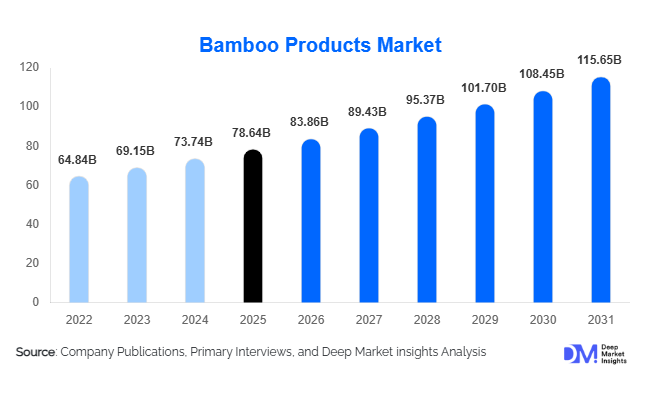
According to Deep Market Insights, the global bamboo products market size was valued at USD 78.64 billion in 2025 and is projected to grow from USD 83.86 billion in 2026 to reach USD 139.72 billion by 2031, expanding at a CAGR of 6.64% during the forecast period (2026–2031). The bamboo products market growth is primarily driven by increasing demand for sustainable materials, expanding adoption of eco-friendly consumer goods, rising green building activities, and favorable government initiatives supporting renewable resources. Growing investments in engineered bamboo manufacturing, environmentally responsible packaging, and modern furniture production continue to strengthen the market across residential, commercial, and industrial applications.
Key Market Insights
- Asia-Pacific dominates the global bamboo products market, accounting for nearly 47.8% of total revenue owing to abundant bamboo cultivation, strong manufacturing infrastructure, and large-scale exports.
- Europe is projected to be the fastest-growing regional market, supported by increasing green construction activities, sustainable furniture demand, and stringent environmental regulations promoting renewable materials.
- Furniture remains the leading product segment, contributing approximately 38.6% of total market revenue, while bamboo household products continue witnessing rapid adoption across global consumer markets.
- Residential applications account for the largest share, representing nearly 49.4% of overall consumption due to increasing demand for eco-friendly flooring, furniture, décor, and kitchen products.
- India is emerging as one of the fastest-growing national markets, supported by expanding bamboo cultivation, government-backed rural development initiatives, and rising investments in sustainable manufacturing.
- Advanced bamboo processing technologies, including engineered bamboo panels, laminated boards, automated manufacturing systems, and precision treatment processes, are improving product quality and expanding commercial applications worldwide.
Bamboo Products Market Trends
Growing Adoption of Engineered Bamboo Products
Engineered bamboo materials are becoming increasingly popular across construction, interior decoration, furniture manufacturing, and commercial infrastructure projects. Manufacturers are investing in laminated bamboo boards, compressed bamboo flooring, structural bamboo panels, and engineered beams that provide higher strength, improved dimensional stability, and enhanced durability compared to conventional bamboo products. Continuous improvements in treatment technologies have increased moisture resistance and extended product lifespan, making engineered bamboo suitable for high-performance applications. Architects and builders are increasingly specifying engineered bamboo materials in green-certified commercial buildings because of their lower carbon footprint and renewable characteristics. The growing preference for environmentally responsible construction materials continues to accelerate commercial adoption across both developed and emerging economies.
Rising Demand for Sustainable Consumer Products
Consumers worldwide are rapidly replacing single-use plastic products with biodegradable bamboo alternatives. Bamboo toothbrushes, reusable straws, kitchen utensils, storage containers, tableware, tissue products, personal care accessories, and household goods are experiencing strong retail demand through supermarkets, specialty stores, and e-commerce platforms. Large retailers are expanding eco-friendly product portfolios to satisfy environmentally conscious consumers seeking renewable alternatives. Digital commerce has further accelerated market penetration by improving product accessibility and expanding brand visibility across international markets. Manufacturers are also introducing innovative product designs, premium finishes, and recyclable packaging to strengthen consumer appeal, making sustainability one of the most influential purchasing factors within the global bamboo products industry.
Bamboo Products Market Drivers
Growing Preference for Sustainable Construction and Renewable Materials
Rapid urbanization, rising environmental awareness, and stricter sustainability regulations are significantly increasing the demand for renewable construction materials. Bamboo reaches commercial maturity within only three to five years, making it substantially more renewable than traditional hardwood species that require several decades to mature. Governments are promoting green buildings through tax incentives, sustainability certifications, and low-carbon infrastructure programs, encouraging greater utilization of bamboo flooring, structural components, wall panels, furniture, and decorative products. Commercial builders increasingly prefer bamboo due to its high strength-to-weight ratio, attractive appearance, and lower environmental impact. Growing investment in sustainable housing projects and environmentally responsible commercial developments continues to drive long-term expansion of the global bamboo products market.
Expanding Consumer Preference for Eco-friendly Lifestyle Products
Consumers are increasingly prioritizing environmentally responsible purchasing decisions, creating significant demand for bamboo-based household goods, reusable consumer products, personal care accessories, and biodegradable packaging solutions. Rising awareness regarding plastic pollution and climate change has encouraged manufacturers to replace petroleum-based materials with renewable bamboo alternatives. Lifestyle brands are expanding sustainable product collections while multinational retailers continue increasing shelf space dedicated to environmentally friendly merchandise. Growing corporate sustainability commitments, combined with favorable consumer perception of renewable materials, are supporting continuous product innovation and wider commercialization across multiple industries.
Bamboo Products Market Restraints
Supply Chain Limitations and Product Standardization Challenges
The bamboo products industry faces supply chain constraints associated with inconsistent raw material quality, seasonal harvesting cycles, fragmented farming practices, and transportation infrastructure limitations across several producing countries. Variations in species characteristics, moisture content, harvesting techniques, and treatment methods often create inconsistencies in finished product performance. International manufacturers must also comply with varying quality certifications, phytosanitary regulations, and sustainability standards across export destinations, increasing operational complexity and production costs. Limited processing infrastructure in several emerging economies further restricts value-added manufacturing capacity, slowing market expansion despite abundant raw material availability.
Competition from Alternative Sustainable Materials
Although bamboo offers numerous environmental advantages, manufacturers compete with several renewable materials including recycled wood, reclaimed timber, cork composites, hemp-based products, recycled plastics, and bio-composite materials. Many competing products possess well-established supply chains, standardized certification systems, and mature manufacturing ecosystems, creating pricing pressure within the bamboo industry. Fluctuating transportation expenses, processing costs, and international trade regulations may also reduce the price competitiveness of bamboo products in certain regional markets. These competitive pressures continue to challenge market penetration across selected industrial applications.
Bamboo Products Market Opportunities
Expansion of Green Building and Sustainable Infrastructure
The rapid expansion of green construction presents substantial opportunities for bamboo product manufacturers. Governments, developers, and infrastructure investors are increasingly incorporating renewable materials into residential housing, commercial buildings, hospitality projects, educational institutions, and public infrastructure developments. Bamboo flooring, wall panels, ceilings, structural beams, and decorative products are gaining acceptance within green certification programs because of their low embodied carbon and renewable sourcing. Continued investment in environmentally responsible urban development is expected to create significant long-term demand for engineered bamboo products across both developed and developing economies.
Growing Adoption of Bamboo-based Packaging and Consumer Goods
The transition toward biodegradable packaging solutions is opening new growth opportunities for bamboo manufacturers. Food service companies, cosmetic brands, personal care manufacturers, retailers, and e-commerce businesses are increasingly replacing plastic packaging with renewable bamboo alternatives. Simultaneously, rising demand for sustainable home décor, reusable household products, premium kitchen accessories, and eco-friendly lifestyle products continues expanding addressable markets worldwide. Product innovation, improved manufacturing technologies, and expanding international distribution networks are expected to support sustained commercialization of bamboo-based solutions across multiple consumer and industrial sectors.
Report Scope
| Report Metric | Details |
|---|---|
| Market Size in 2025 | USD 78.64 Billion |
| Market Size in 2026 | USD 83.86 Billion |
| Market Size in 2031 | USD 115.65 Billion |
| CAGR | 6.64% (2026-2031) |
| Base Year for Estimation | 2025 |
| Historical Data | 2022-2024 |
| Forecast Period | 2026-2031 |
| Report Coverage | Revenue Forecast, Competitive Landscape, Supply Chain Disruption, Growth Factors, Environment & Regulatory Landscape and Trends |
| Geographies Covered | North America, Europe, APAC, Middle East and Africa, LATAM |
| Countries Covered | U.S., Canada, U.K., Germany, France, Spain, Italy, Russia, Nordic, Benelux, Rest of Europe, China, Korea, Japan, India, Australia, Singapore, Taiwan, South East Asia, Rest of Asia-Pacific, UAE, Turky, Saudi Arabia, South Africa, Egypt, Nigeria, Rest of MEA, Brazil, Mexico, Argentina, Chile, Colombia, Rest of LATAM |
Explore more data points, trends and opportunities Download Free Sample Report
Product Type Insights
Furniture represents the largest product segment in the bamboo products market, accounting for nearly 38.6% of global revenue in 2025. Rising consumer preference for sustainable home décor, premium interior designs, and eco-friendly office furniture has significantly increased demand for bamboo chairs, tables, cabinets, beds, wardrobes, and modular furniture. Engineered bamboo furniture offers excellent durability, high load-bearing capacity, moisture resistance, and an attractive natural finish, making it suitable for residential as well as commercial environments. Manufacturers are introducing contemporary designs and customizable solutions to attract environmentally conscious consumers while expanding exports across North America and Europe.
Flooring remains one of the fastest-growing product categories due to increasing adoption in residential construction, commercial buildings, hotels, educational institutions, and office spaces. Bamboo flooring is recognized for its hardness, dimensional stability, scratch resistance, and lower environmental impact compared to traditional hardwood flooring. The growing number of green-certified buildings and sustainable infrastructure projects continues to accelerate demand. Advanced carbonized and strand-woven bamboo flooring products are further expanding market penetration across premium construction projects worldwide.
Household products are witnessing robust demand as consumers increasingly replace plastic-based products with biodegradable alternatives. Bamboo kitchen utensils, cutting boards, storage containers, tissue papers, reusable straws, toothbrushes, tableware, laundry baskets, organizers, and decorative accessories are becoming mainstream consumer products. Continuous product innovation, premium packaging, and expanding online retail channels are strengthening sales while encouraging manufacturers to diversify their eco-friendly product portfolios.
Application Insights
Residential applications account for the largest share of the global bamboo products market owing to increasing demand for sustainable furniture, flooring, home décor, kitchenware, and household accessories. Rising environmental awareness, higher disposable incomes, and growing consumer preference for renewable materials continue supporting adoption. Urban housing projects and home renovation activities are also creating strong opportunities for bamboo-based interiors and decorative solutions.
Commercial applications continue expanding rapidly across hotels, restaurants, offices, retail stores, educational institutions, healthcare facilities, and hospitality infrastructure. Architects and interior designers increasingly specify bamboo products to achieve green building certifications while improving aesthetic appeal and reducing carbon footprints. Commercial demand is further supported by corporate sustainability initiatives and increasing investment in environmentally responsible workplace designs.
Industrial applications include bamboo panels, engineered boards, construction materials, pulp and paper manufacturing, packaging products, textile fibers, and industrial composites. Continuous technological advancements in engineered bamboo processing are improving structural performance and expanding utilization across manufacturing industries. Growing investments in renewable industrial materials are expected to strengthen this segment throughout the forecast period.
Explore more data points, trends and opportunities Download Free Sample Report
Bamboo Products Market Segmentations
By Product Type
- Furniture
- Flooring
- Household Products
By Application
- Residential
- Commercial
- Industrial
By Distribution Channel
- Online Retail
- Specialty Stores
- Supermarkets & Hypermarkets
- Home Improvement Stores
- Direct Sales
Regional Insights
Asia-Pacific
Asia-Pacific dominates the global bamboo products market due to extensive bamboo cultivation, abundant raw material availability, well-established manufacturing infrastructure, and strong export capabilities. China remains the world's largest producer and exporter of bamboo products, followed by India, Vietnam, Indonesia, and Thailand. Government initiatives supporting rural employment, sustainable forestry, and bamboo-based industries continue accelerating market development. Increasing domestic demand for eco-friendly construction materials, furniture, and consumer goods further strengthens regional growth. Rising investments in advanced bamboo processing technologies are expected to reinforce Asia-Pacific's leadership throughout the forecast period.
North America
North America represents one of the largest import markets for bamboo products owing to growing environmental awareness, increasing green building activities, and strong demand for sustainable furniture and household goods. The United States dominates regional consumption, supported by expanding residential renovation projects, premium interior design trends, and widespread adoption of eco-friendly consumer products. Retail chains and online marketplaces continue expanding bamboo product offerings, creating significant opportunities for international manufacturers.
Europe
Europe is projected to witness the fastest market growth during the forecast period due to stringent environmental regulations, circular economy initiatives, and increasing consumer preference for sustainable lifestyles. Germany, France, the United Kingdom, Italy, and the Netherlands remain key markets for bamboo flooring, furniture, construction materials, and biodegradable consumer products. Green building certifications, carbon reduction strategies, and corporate sustainability programs continue driving adoption across residential and commercial sectors.
Latin America
Latin America is gradually emerging as an attractive market supported by increasing bamboo cultivation, government-backed sustainable agriculture initiatives, and rising investments in environmentally friendly construction materials. Brazil, Colombia, Ecuador, and Peru are expanding bamboo plantations while encouraging local manufacturing of value-added products. Growing awareness regarding renewable materials is expected to support future market expansion across residential and industrial applications.
Middle East & Africa
The Middle East & Africa region is witnessing steady growth driven by increasing investments in sustainable infrastructure, hospitality projects, and luxury residential developments. Countries including the United Arab Emirates, Saudi Arabia, and South Africa are experiencing rising demand for bamboo flooring, decorative products, and premium furniture. Growing government focus on sustainable urban development and environmentally responsible construction practices is expected to create long-term opportunities across the region.
Key Players in the Bamboo Products Market
- Moso International B.V.
- Dasso Group
- Bamcore LLC
- Teragren LLC
- Smith & Fong Co.
- EcoPlanet Bamboo Group
- Jiangxi Feiyu Bamboo Products Group
- Xingli Bamboo Products Company
- Anji Tianzhen Bamboo Flooring Co., Ltd.
- Kang Ti Long Bamboo Products Co., Ltd.
- Bamboo Australia Pty Ltd.
- China Bamboo Industry Group