Outdoor Louvres Market Size
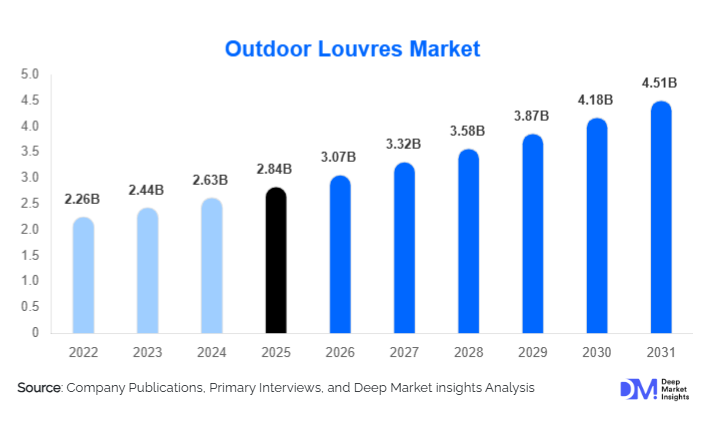
According to Deep Market Insights, the global outdoor louvres market size was valued at USD 2.84 billion in 2025 and is projected to grow from USD 3.07 billion in 2026 to reach USD 5.61 billion by 2031, expanding at a CAGR of 8.0% during the forecast period (2026–2031). The outdoor louvres market growth is primarily driven by increasing investments in energy-efficient buildings, rising adoption of automated façade systems, and expanding commercial construction activities worldwide. Growing emphasis on sustainable architecture, smart building integration, and climate-responsive building envelopes continues to accelerate demand for advanced outdoor louvre systems across residential, commercial, and industrial applications.
Key Market Insights
- Adjustable outdoor louvres account for the largest product share, supported by superior airflow control, solar shading performance, and increasing demand in commercial buildings.
- Motorized outdoor louvres represent the fastest-growing segment, driven by smart building automation, IoT integration, and energy management systems.
- Asia-Pacific dominates the global market, led by rapid urbanization, infrastructure development, and expanding construction activities across China and India.
- The Middle East & Africa is the fastest-growing regional market, supported by high investments in commercial infrastructure and climate-adaptive building solutions.
- Commercial buildings remain the leading application segment, owing to widespread adoption in offices, hotels, airports, healthcare facilities, and educational institutions.
- Smart technologies, including weather sensors, automated blade adjustment, and building management system integration, are reshaping modern outdoor louvre installations.
Outdoor Louvres Market Trends
Growing Adoption of Smart Automated Louvre Systems
Automation is becoming a defining trend across the outdoor louvres industry as commercial developers increasingly integrate intelligent façade systems capable of automatically responding to sunlight, wind speed, rainfall, and temperature fluctuations. Motorized louvres connected with IoT-enabled sensors improve indoor comfort while reducing HVAC energy consumption through optimized daylight and ventilation management. Building owners are increasingly deploying automated shading systems to improve operational efficiency, enhance occupant comfort, and comply with green building certifications. Integration with centralized building management systems further enables predictive maintenance, remote monitoring, and energy optimization, making automated outdoor louvres an attractive solution for premium residential and commercial developments.
Increasing Preference for Sustainable Building Materials
Manufacturers are increasingly utilizing recyclable aluminum, corrosion-resistant coatings, and powder-coated finishes to improve durability while supporting sustainable construction practices. Lightweight aluminum louvres continue to replace conventional materials because of their lower maintenance requirements, longer service life, and superior weather resistance. Demand for environmentally responsible building products is encouraging manufacturers to develop recyclable, low-carbon solutions that align with LEED, BREEAM, and other green building standards. Continuous innovation in extrusion technology, surface finishing, and weather-resistant coatings is further strengthening the adoption of outdoor louvre systems across modern construction projects.
Outdoor Louvres Market Drivers
Growing Investments in Green and Energy-Efficient Buildings
Rising investments in sustainable commercial and residential infrastructure continue to drive demand for outdoor louvres globally. Governments are strengthening energy efficiency regulations while developers increasingly adopt passive cooling technologies to reduce electricity consumption. Outdoor louvre systems help minimize solar heat gain, improve natural ventilation, and reduce dependence on air conditioning systems, making them an essential component of energy-efficient buildings. Increasing construction of smart cities, commercial complexes, hospitals, airports, and educational institutions further supports long-term market expansion.
Expansion of Commercial Infrastructure Worldwide
Rapid urbanization and increasing investments in office buildings, hotels, retail centers, transportation hubs, and mixed-use developments are creating sustained demand for architectural façade solutions. Outdoor louvres improve ventilation, weather protection, and aesthetic appeal while contributing to building sustainability objectives. Continuous growth in infrastructure spending across emerging economies is encouraging large-scale adoption of adjustable and motorized louvre systems in newly constructed commercial facilities.
Outdoor Louvres Market Restraints
High Installation and Automation Costs
The relatively high initial investment required for premium aluminum and motorized outdoor louvre systems limits adoption among budget-sensitive residential consumers. Automated installations require specialized actuators, weather sensors, electrical components, and professional installation, significantly increasing overall project costs. Ongoing maintenance requirements for electronic systems and periodic servicing further increase lifecycle costs, particularly for complex commercial installations.
Raw Material Price Volatility
Fluctuations in aluminum, steel, and electronic component prices continue to affect manufacturing costs and profit margins. Global supply chain disruptions, transportation costs, and fluctuating commodity prices create pricing uncertainty for manufacturers and contractors. These challenges may delay project execution and influence purchasing decisions across cost-sensitive construction projects.
Outdoor Louvres Market Opportunities
Expansion of Smart Cities and Intelligent Buildings
The rapid development of smart cities worldwide creates significant opportunities for intelligent outdoor louvre systems integrated with building automation platforms. Developers increasingly seek automated shading solutions capable of optimizing energy consumption, indoor comfort, and environmental performance. Government investments in sustainable infrastructure continue to create favorable conditions for advanced façade technologies incorporating sensors, remote controls, and predictive maintenance capabilities.
Growing Demand for Premium Residential Construction
Luxury residential developments increasingly incorporate architectural louvre systems to improve aesthetics, privacy, natural ventilation, and energy efficiency. Homeowners are investing in automated outdoor living spaces featuring motorized pergolas, retractable roofs, and adjustable louvre systems controlled through smartphones and home automation platforms. This trend is creating substantial opportunities for premium manufacturers worldwide.
Report Scope
| Report Metric | Details |
|---|---|
| Market Size in 2025 | USD 2.84 Billion |
| Market Size in 2026 | USD 3.07 Billion |
| Market Size in 2031 | USD 4.51 Billion |
| CAGR | 8% (2026-2031) |
| Base Year for Estimation | 2025 |
| Historical Data | 2022-2024 |
| Forecast Period | 2026-2031 |
| Report Coverage | Revenue Forecast, Competitive Landscape, Supply Chain Disruption, Growth Factors, Environment & Regulatory Landscape and Trends |
| Geographies Covered | North America, Europe, APAC, Middle East and Africa, LATAM |
| Countries Covered | U.S., Canada, U.K., Germany, France, Spain, Italy, Russia, Nordic, Benelux, Rest of Europe, China, Korea, Japan, India, Australia, Singapore, Taiwan, South East Asia, Rest of Asia-Pacific, UAE, Turky, Saudi Arabia, South Africa, Egypt, Nigeria, Rest of MEA, Brazil, Mexico, Argentina, Chile, Colombia, Rest of LATAM |
Explore more data points, trends and opportunities Download Free Sample Report
Type Insights
Adjustable louvres dominate the outdoor louvres market owing to their superior flexibility in regulating sunlight, natural ventilation, and indoor thermal comfort according to changing weather conditions. These systems are increasingly preferred in commercial offices, hospitality buildings, healthcare facilities, educational institutions, and premium residential developments because they help reduce solar heat gain while improving building energy efficiency. The growing adoption of green building certifications such as LEED and BREEAM, coupled with stringent energy-efficiency regulations, continues to drive demand for adjustable louvre systems worldwide. Their compatibility with aluminum, steel, and composite materials, along with low maintenance requirements and architectural versatility, further strengthens their market leadership.
Fixed louvres continue to maintain a significant market share due to their simple design, cost-effectiveness, and long service life. These systems are extensively installed across industrial facilities, warehouses, manufacturing plants, utility buildings, parking structures, and ventilation shafts where continuous airflow and weather protection are required without the need for automated adjustment. Their robust construction, lower installation costs, and minimal maintenance requirements make them an economical solution for large-scale infrastructure and industrial projects. Increasing investments in logistics hubs, manufacturing expansion, and public infrastructure continue supporting demand for fixed outdoor louvres.
Motorized louvres are projected to witness the fastest growth during the forecast period as intelligent building technologies become increasingly integrated into modern construction. These systems utilize automated blade positioning, weather sensors, IoT connectivity, and building management systems to optimize daylight utilization, ventilation, and cooling efficiency. Growing adoption of smart homes, commercial automation, and high-end architectural projects is accelerating demand for motorized louvres across developed and emerging economies. Rising investments in smart cities, luxury residential communities, and premium commercial developments are expected to further strengthen the adoption of automated façade solutions over the coming years.
Application Insights
Commercial buildings account for the largest share of the outdoor louvres market owing to widespread deployment across office complexes, shopping malls, airports, hotels, hospitals, educational institutions, government buildings, and mixed-use developments. Commercial facilities increasingly utilize outdoor louvre systems to improve natural ventilation, reduce HVAC energy consumption, enhance occupant comfort, and achieve sustainability certifications. The growing construction of energy-efficient commercial infrastructure, combined with stricter building energy regulations and increasing investments in smart buildings, remains the primary driver supporting the dominance of this segment.
Residential applications are experiencing steady growth as homeowners increasingly invest in outdoor living spaces, balconies, patios, pergolas, terraces, and energy-efficient housing solutions. Rising consumer awareness regarding passive cooling technologies, modern architectural aesthetics, and smart home automation has significantly increased the installation of adjustable and motorized outdoor louvre systems. Growth in luxury residential construction, home renovation activities, and premium villa developments continues to create favorable opportunities across this segment.
Industrial applications represent an important segment driven by the growing need for effective ventilation, environmental control, and equipment protection within manufacturing plants, logistics centers, warehouses, power generation facilities, and processing industries. Outdoor louvres improve airflow management while protecting buildings against rain, dust, and harsh environmental conditions. Expanding industrial infrastructure, increasing warehouse construction, and rapid growth of the global logistics sector continue supporting demand for industrial outdoor louvre installations.
Explore more data points, trends and opportunities Download Free Sample Report
Outdoor Louvres Market Segmentations
By Type
- Fixed Louvres
- Adjustable Louvres
- Motorized Louvres
By Application
- Residential
- Commercial
- Industrial
Regional Insights
North America
North America represents a mature and technologically advanced market for outdoor louvres, supported by strong commercial renovation activities, increasing adoption of green building standards, and rising investments in intelligent building technologies. The United States accounts for the largest share of regional demand, followed by Canada, owing to continuous development of commercial office buildings, healthcare facilities, educational institutions, airports, and premium residential projects. Growing replacement of conventional façade systems with energy-efficient architectural solutions is further supporting market expansion.
Regional growth is primarily driven by stringent building energy-efficiency regulations, widespread adoption of LEED-certified buildings, increasing investments in smart commercial infrastructure, and growing demand for automated shading systems that improve HVAC efficiency. Rising retrofit projects across aging commercial buildings, coupled with increasing deployment of building automation systems and sustainable construction practices, continue to accelerate the adoption of advanced outdoor louvre solutions throughout North America.
Europe
Europe maintains a significant position in the global outdoor louvres market owing to strict environmental regulations, strong emphasis on carbon reduction, and widespread implementation of sustainable building standards. Germany, France, the United Kingdom, Italy, and Spain represent the major regional markets where architects and developers increasingly integrate high-performance façade systems into commercial, institutional, and residential construction projects. Growing adoption of recyclable aluminum products and advanced architectural shading technologies further supports regional demand.
The region's market growth is largely driven by the European Union's ambitious energy-efficiency targets, increasing renovation of existing buildings, rising investments in nearly zero-energy buildings (NZEBs), and favorable government policies promoting sustainable construction materials. In addition, growing adoption of smart buildings, expansion of premium commercial infrastructure, and increasing awareness regarding passive cooling technologies continue creating strong demand for outdoor louvre installations across Europe.
Asia-Pacific
Asia-Pacific dominates the global outdoor louvres market owing to rapid urbanization, large-scale infrastructure development, and continuous growth in residential and commercial construction activities across China, India, Japan, South Korea, and Australia. The region benefits from a strong manufacturing ecosystem, cost-effective aluminum production, expanding exports of architectural building products, and increasing investments in modern façade technologies. Rising disposable income and growing adoption of premium housing further strengthen regional market demand.
The region's leadership is primarily driven by large government infrastructure programs, smart city initiatives, expanding commercial real estate development, rapid industrialization, and increasing foreign direct investment in construction projects. Growing awareness regarding energy-efficient buildings, supportive building regulations, and continuous investments in airports, metro stations, hospitals, educational institutions, and mixed-use developments are expected to sustain Asia-Pacific's dominant position throughout the forecast period.
Middle East & Africa
The Middle East & Africa is projected to register the fastest market growth during the forecast period owing to rising investments in commercial real estate, hospitality projects, luxury residential developments, airports, healthcare facilities, and mixed-use infrastructure. Countries including the UAE, Saudi Arabia, Qatar, and South Africa are witnessing increasing adoption of outdoor louvre systems as architects prioritize passive cooling technologies suitable for hot climatic conditions. High solar exposure throughout the region significantly increases demand for effective shading and ventilation solutions.
Regional growth is supported by government-led diversification initiatives such as Saudi Vision 2031, large-scale smart city developments including NEOM, expanding tourism infrastructure, and increasing investments in sustainable commercial buildings. Rising construction of luxury hotels, business districts, entertainment destinations, and premium residential communities, along with growing implementation of smart building technologies, continues creating substantial opportunities for manufacturers of automated and high-performance outdoor louvre systems across the Middle East & Africa.
Key Players in the Outdoor Louvres Market
- Renson
- Hunter Douglas
- Colt International
- Levolux
- Construction Specialties
- CS Group
- Louvretec
- Sun Louvre Systems
- Alspec
- Lindab
- Greenlam Industries
- Durmi
- Rainier Industries
- ShadeFX
- Saxun