Skin Care Market Size
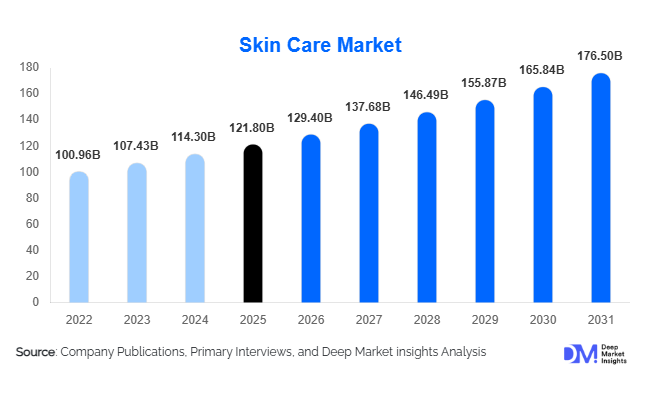
According to Deep Market Insights, the global skin care market size was valued at USD 121.8 billion in 2025 and is projected to grow from USD 129.4 billion in 2026 to reach USD 176.5 billion by 2031, expanding at a CAGR of 6.4% during the forecast period (2026–2031). The skin care market growth is primarily driven by increasing consumer awareness regarding skin health, rising adoption of preventive skin care routines, growing demand for anti-aging and dermatological products, and expanding penetration of premium beauty products across emerging economies. The convergence of wellness, beauty, and dermatological science has transformed skin care from a cosmetic category into a health-oriented consumer segment. Growing disposable incomes, urbanization, digital beauty ecosystems, and the rapid expansion of e-commerce channels continue to accelerate market expansion globally.
Key Market Insights
- Facial care products account for nearly 48% of global skin care revenues, supported by strong demand for serums, moisturizers, cleansers, and anti-aging solutions.
- Asia-Pacific dominates the global market with approximately 52% market share, led by China, Japan, South Korea, and India.
- Premium and science-backed skin care products are gaining significant traction, as consumers increasingly seek clinically validated formulations and dermatologist-recommended products.
- E-commerce has become the fastest-growing distribution channel, accounting for nearly 24% of global skin care sales in 2025.
- Biotechnology-derived ingredients and personalized skin care solutions are emerging as major innovation areas across developed markets.
- Sustainability, clean beauty, and environmentally responsible packaging are increasingly influencing consumer purchasing decisions and product development strategies.
Skin Care Market Trends
Personalized Skin Care and AI-Powered Diagnostics
The skin care industry is increasingly adopting artificial intelligence and digital skin analysis technologies to deliver personalized beauty solutions. Consumers are seeking products tailored to their age, skin type, environmental conditions, and lifestyle factors. AI-powered skin assessments, virtual consultations, and customized formulations are becoming mainstream among premium brands. Digital beauty platforms are leveraging machine learning algorithms to recommend product regimens, improve customer engagement, and enhance purchase conversion rates. Subscription-based personalized skin care services are further strengthening consumer loyalty while creating recurring revenue streams for manufacturers.
Rise of Biotechnology and Microbiome-Based Formulations
Biotechnology-derived ingredients, peptides, probiotics, and microbiome-friendly formulations are transforming product development across the skin care industry. Consumers increasingly prioritize efficacy, safety, and scientific validation over traditional beauty claims. Manufacturers are investing heavily in biotechnology research to develop active ingredients that improve skin barrier function, hydration, pigmentation control, and anti-aging performance. The trend is particularly prominent within premium and medical-grade skin care categories, where clinical evidence and dermatological endorsement significantly influence purchasing behavior. Microbiome-focused skin care is expected to become one of the most influential innovation segments throughout the forecast period.
Skin Care Market Drivers
Growing Consumer Focus on Preventive Skin Health
Consumers increasingly view skin care as an essential component of overall health and wellness. Growing awareness regarding UV protection, skin barrier repair, hydration, and anti-aging prevention has increased the adoption of daily skin care routines globally. Younger consumers are entering the category earlier than previous generations, creating long-term revenue opportunities for manufacturers. Increased dermatological education through social media and healthcare professionals has further accelerated product adoption across all age groups.
Premiumization and Demand for Clinically Proven Products
The increasing preference for premium products containing active ingredients such as retinol, niacinamide, ceramides, peptides, and hyaluronic acid is supporting higher market value growth. Consumers are willing to pay premium prices for products supported by scientific evidence, dermatologist recommendations, and visible efficacy. Premiumization trends are particularly strong in North America, Europe, Japan, South Korea, and increasingly in urban centers across emerging economies. As consumers prioritize quality and performance, manufacturers continue to expand their premium portfolios to capture higher-margin opportunities.
Skin Care Market Restraints
Regulatory Complexity and Product Compliance Requirements
Skin care manufacturers face increasingly stringent regulations related to ingredient safety, product testing, sustainability claims, and labeling requirements. Regulatory frameworks vary significantly across regions, creating compliance challenges for global brands. Continuous reformulation efforts, certification costs, and evolving ingredient restrictions increase operational complexity and development timelines for manufacturers. Smaller companies often face greater barriers due to limited regulatory resources and expertise.
Volatility in Raw Material and Packaging Costs
Many skin care products rely on specialty chemicals, botanical extracts, active pharmaceutical ingredients, and premium packaging materials. Fluctuations in raw material prices can significantly affect manufacturing costs and profit margins. Supply chain disruptions, geopolitical uncertainties, and climate-related impacts on natural ingredient sourcing continue to create cost pressures throughout the industry. Manufacturers must balance pricing strategies with consumer affordability to maintain competitiveness.
Skin Care Market Opportunities
Expansion in Emerging Markets
Emerging economies including India, Indonesia, Vietnam, Saudi Arabia, Brazil, and Nigeria present substantial growth opportunities due to rising disposable incomes, urbanization, and increasing beauty consciousness. Per-capita spending on skin care products remains significantly lower than developed markets, creating considerable room for market expansion. Global brands are increasingly investing in localized product development, manufacturing facilities, and distribution networks to capitalize on these high-growth regions. The growing middle-class population in these markets is expected to contribute significantly to future industry revenues.
Medical and Dermatological Skin Care Innovation
The growing intersection between dermatology and cosmetics presents significant opportunities for market participants. Consumers increasingly seek clinically validated products targeting acne, pigmentation, sensitive skin, rosacea, and anti-aging concerns. Dermatologist-endorsed formulations, prescription-strength cosmetic products, and professional-grade skin care solutions are gaining popularity globally. The expansion of medical aesthetics clinics and dermatological treatment centers is creating additional demand for specialized skin care products, supporting growth in the cosmeceutical segment.
Report Scope
| Report Metric | Details |
|---|---|
| Market Size in 2025 | USD 121.8 Billion |
| Market Size in 2026 | USD 129.4 Billion |
| Market Size in 2031 | USD 176.5 Billion |
| CAGR | 6.4% (2026-2031) |
| Base Year for Estimation | 2025 |
| Historical Data | 2022-2024 |
| Forecast Period | 2026-2031 |
| Report Coverage | Revenue Forecast, Competitive Landscape, Supply Chain Disruption, Growth Factors, Environment & Regulatory Landscape and Trends |
| Geographies Covered | North America, Europe, APAC, Middle East and Africa, LATAM |
| Countries Covered | U.S., Canada, U.K., Germany, France, Spain, Italy, Russia, Nordic, Benelux, Rest of Europe, China, Korea, Japan, India, Australia, Singapore, Taiwan, South East Asia, Rest of Asia-Pacific, UAE, Turky, Saudi Arabia, South Africa, Egypt, Nigeria, Rest of MEA, Brazil, Mexico, Argentina, Chile, Colombia, Rest of LATAM |
Explore more data points, trends and opportunities Download Free Sample Report
Product Type Insights
Facial care products dominated the global skin care market, accounting for approximately 48% of total revenues in 2025, making it the largest product category worldwide. The segment's leadership is primarily driven by the growing consumer emphasis on facial appearance, skin health maintenance, anti-aging prevention, and treatment-oriented skincare routines. Facial skin is more exposed to environmental stressors such as UV radiation, pollution, blue light exposure, and climatic changes than other body areas, resulting in higher product usage frequency and spending per consumer. Cleansers, serums, moisturizers, anti-aging creams, toners, and facial masks collectively account for the majority of category sales.
The strongest growth within facial care is being observed in serums and targeted treatment products containing clinically proven active ingredients such as hyaluronic acid, niacinamide, retinol, peptides, ceramides, and vitamin C derivatives. Consumers are increasingly adopting multi-step skincare regimens inspired by Korean and Japanese beauty trends, further expanding demand for specialized facial care products. In addition, the rapid growth of preventive skincare among younger consumers and anti-aging solutions among aging populations continues to strengthen segment performance globally.
Sun care products are emerging as one of the fastest-growing categories, supported by increasing awareness regarding UV-induced skin damage, premature aging, hyperpigmentation, and skin cancer prevention. Meanwhile, body care products maintain steady demand due to growing consumer focus on hydration, skin barrier repair, and wellness-oriented skincare routines. Specialty skincare products addressing acne, sensitive skin, rosacea, pigmentation disorders, and post-procedure skin recovery are witnessing above-average growth as consumers increasingly seek personalized and dermatologically validated solutions.
Ingredient Insights
Synthetic and formulated ingredients accounted for approximately 45% of global skin care revenues in 2025, maintaining their position as the leading ingredient category due to superior efficacy, formulation stability, manufacturing scalability, and regulatory consistency. Major active ingredients including retinoids, alpha hydroxy acids (AHAs), beta hydroxy acids (BHAs), peptides, and advanced moisturizing compounds continue to dominate premium and mass-market product formulations. Their proven clinical performance and extensive scientific validation have made them essential components of modern skincare products.
The segment's leadership is further supported by growing consumer demand for evidence-based skincare solutions capable of delivering measurable outcomes in anti-aging, hydration, pigmentation control, acne treatment, and skin barrier restoration. Dermatologist recommendations and clinical studies continue to reinforce consumer confidence in scientifically formulated products.
However, natural and botanical ingredients are experiencing strong growth as consumers increasingly prioritize clean-label, environmentally responsible, and sustainably sourced products. Ingredients such as aloe vera, green tea extracts, centella asiatica, chamomile, and plant-derived antioxidants are gaining widespread acceptance across premium product categories. Biotechnology-derived ingredients represent one of the fastest-growing innovation segments, driven by advancements in microbiome science, peptide engineering, bio-fermentation technologies, and sustainable ingredient production methods. These innovations are enabling manufacturers to develop high-performance products while reducing environmental impact.
Distribution Channel Insights
E-commerce emerged as the fastest-growing distribution channel, accounting for approximately 24% of global skin care revenues in 2025. The segment's rapid expansion is being driven by increasing internet penetration, smartphone adoption, digital payment infrastructure, and changing consumer purchasing behaviors. Online platforms provide consumers with broader product access, transparent pricing, product reviews, educational content, and personalized recommendations, significantly improving the shopping experience.
The growth of social commerce, influencer marketing, livestream shopping, and AI-powered product recommendation engines has further strengthened online sales. Consumers increasingly rely on digital platforms for skincare research, product comparisons, and dermatological education before making purchasing decisions. Direct-to-consumer (DTC) business models are also gaining momentum as brands seek stronger customer relationships, improved margins, and enhanced consumer data collection capabilities.
Despite rapid online growth, specialty beauty retailers continue to maintain a strong market position, particularly within premium and luxury skincare categories where consumers value expert consultation and product testing. Pharmacies and drug stores remain critical distribution channels due to growing consumer trust in dermatologist-recommended and medically positioned skincare products. Supermarkets and hypermarkets continue to dominate mass-market sales through broad product accessibility, competitive pricing strategies, and strong consumer convenience.
Consumer Group Insights
Women remained the largest consumer segment, accounting for approximately 62% of global skin care expenditure in 2025. The segment's dominance is supported by broader product usage, greater engagement with beauty and wellness routines, higher adoption of anti-aging products, and stronger spending on premium skincare solutions. Women generally utilize multiple skincare products daily across cleansing, hydration, treatment, protection, and anti-aging categories, resulting in significantly higher per-capita spending compared to other consumer groups.
The female skincare segment is also benefiting from increasing awareness of preventive skincare, personalized beauty solutions, and dermatologist-guided treatment regimens. Premiumization trends remain particularly strong among female consumers, supporting growth in high-margin product categories such as serums, specialty treatments, and medical-grade skincare products.
Meanwhile, men's skincare represents one of the fastest-growing consumer segments globally. Changing social attitudes, growing awareness of skin health, increased disposable incomes, and the expansion of male-focused product portfolios are accelerating market penetration. Demand is particularly strong for facial cleansers, moisturizers, sunscreen products, anti-aging solutions, and beard-care-related skincare products. Additionally, the emergence of gender-neutral skincare brands is supporting the growth of the unisex category by emphasizing simplicity, efficacy, and inclusivity. Baby skincare continues to represent a stable niche segment, driven by increasing parental preference for dermatologist-tested, hypoallergenic, and sensitive-skin formulations.
Explore more data points, trends and opportunities Download Free Sample Report
Skin Care Market Segmentations
By Product Type
- Facial Care
- Body Care
- Sun Care
- Baby Skin Care
- Specialty Skin Care
By Ingredient Type
- Synthetic & Formulated Ingredients
- Natural & Botanical Ingredients
- Organic Ingredients
- Biotechnology-Derived Ingredients
- Active Dermatological Ingredients
By Consumer Group
- Women
- Men
- Children & Infants
- Unisex
By Distribution Channel
- E-commerce
- Hypermarkets & Supermarkets
- Specialty Beauty Stores
- Pharmacies & Drug Stores
- Department Stores
- Brand-Owned Stores
- Direct Selling
By End User
- Individual Consumers
- Beauty Salons & Spas
- Dermatology Clinics
- Cosmetic Surgery Centers
- Hospitality Industry
Regional Insights
Asia-Pacific
Asia-Pacific accounted for approximately 52% of the global skin care market in 2025, making it the largest regional market worldwide. The region's leadership is driven by its large consumer base, rising disposable incomes, strong beauty culture, and continuous product innovation. China remains the world's largest national skincare market, contributing nearly 23% of global demand, supported by premiumization trends, expanding domestic beauty brands, and strong digital commerce adoption. Japan and South Korea continue to lead global skincare innovation through advanced formulations, cosmeceutical products, biotechnology-based ingredients, and highly sophisticated consumer skincare routines.
India represents one of the fastest-growing skincare markets globally, supported by rapid urbanization, increasing middle-class spending, growing awareness of preventive skincare, and expanding e-commerce penetration. Southeast Asian markets including Indonesia, Vietnam, Thailand, and the Philippines are also witnessing strong growth due to favorable demographics, increasing female workforce participation, rising beauty consciousness, and growing influence of K-beauty trends. The region additionally benefits from a highly developed manufacturing ecosystem and strong export-oriented skincare production capabilities.
North America
North America accounted for approximately 23% of global skin care revenues in 2025, led overwhelmingly by the United States. The region's growth is driven by strong consumer spending power, widespread adoption of premium skincare products, high awareness regarding skin health, and increasing demand for clinically validated formulations. Consumers in the United States exhibit a strong preference for anti-aging products, dermatologist-recommended solutions, medical-grade skincare, and personalized beauty technologies.
The growing influence of dermatologists, cosmetic procedures, and medical aesthetics clinics continues to create demand for advanced skincare products. Additionally, the rapid adoption of AI-powered skincare diagnostics, subscription-based beauty services, and direct-to-consumer business models supports innovation across the region. Canada contributes stable growth through increasing demand for sustainable beauty, clean-label formulations, and environmentally responsible packaging solutions.
Europe
Europe remains one of the most mature and profitable skincare markets globally, supported by high consumer awareness, premium product adoption, and stringent product quality standards. Germany, France, the United Kingdom, Italy, and Spain collectively account for the majority of regional demand. France continues to serve as a global hub for luxury skincare innovation and premium cosmetic manufacturing, while Germany leads demand for dermatological and pharmacy-based skincare products.
The primary drivers of regional growth include increasing demand for natural and organic products, sustainability-focused purchasing behavior, ingredient transparency requirements, and rising adoption of clean beauty formulations. European consumers place strong emphasis on product safety, efficacy, and environmental responsibility, encouraging manufacturers to invest heavily in sustainable packaging, eco-friendly formulations, and circular economy initiatives. Aging populations across Western Europe further support demand for anti-aging and skin rejuvenation products.
Latin America
Latin America represents a steadily expanding skincare market, led by Brazil, Mexico, and Argentina. Brazil remains the largest regional market due to its deeply embedded beauty culture, strong personal care spending, and growing demand for premium skincare products. Consumers increasingly prioritize facial care, sun protection, anti-aging solutions, and dermatological skincare products.
Regional growth is supported by rising urbanization, expanding middle-class populations, increasing participation of women in the workforce, and greater accessibility to international skincare brands through both retail and digital channels. The tropical climate prevalent across many Latin American countries also supports strong demand for sunscreen products, hydration-focused formulations, and skin protection solutions.
Middle East & Africa
The Middle East and Africa region is emerging as one of the fastest-growing skincare markets globally, supported by rising disposable incomes, premium beauty consumption, and increasing awareness regarding skin health. Saudi Arabia and the United Arab Emirates represent the largest markets within the Middle East, driven by strong luxury spending, growing beauty consciousness, and substantial demand for premium international skincare brands.
Climate-related factors such as intense sun exposure, high temperatures, and low humidity levels significantly increase consumer demand for sun protection, hydration, pigmentation treatment, and skin repair products. Government initiatives supporting retail diversification, e-commerce expansion, and beauty sector investments are further contributing to regional growth. In Africa, South Africa remains the largest skincare market, while countries such as Nigeria, Kenya, and Egypt are witnessing increasing demand driven by urbanization, population growth, and improving consumer purchasing power.
Key Players in the Skin Care Market
- L'Oréal
- Estée Lauder Companies
- Unilever
- Procter & Gamble
- Shiseido
- Beiersdorf
- Johnson & Johnson
- Kao Corporation
- Amorepacific
- Coty
- Natura & Co
- LG Household & Health Care
- Mary Kay
- Clarins
- Oriflame