Printed Signage Market Size
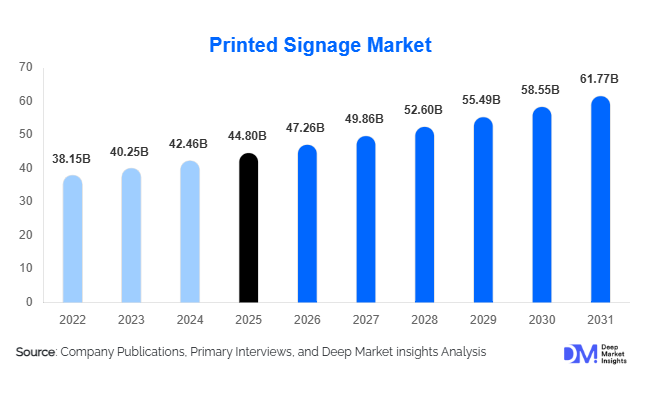
According to Deep Market Insights, the global printed signage market size was valued at USD 44.8 billion in 2025 and is projected to grow from USD 47.26 billion in 2026 to reach USD 61.77 billion by 2031, expanding at a CAGR of 5.5% during the forecast period (2026–2031). The printed signage market growth is primarily driven by increasing investments in retail branding, expansion of commercial infrastructure, rising outdoor advertising demand, and advancements in digital large-format printing technologies. Despite the emergence of digital signage alternatives, printed signage continues to remain highly relevant due to its cost-effectiveness, visual impact, ease of customization, and broad applicability across retail, transportation, hospitality, events, and public infrastructure sectors.
Growing urbanization and retail modernization across emerging economies are significantly boosting demand for promotional graphics, billboards, point-of-sale displays, and wayfinding signage. In addition, the rapid recovery of the events, exhibitions, hospitality, and tourism industries is accelerating the deployment of temporary and permanent signage solutions globally. Sustainability trends are also reshaping the market landscape, with increasing adoption of recyclable materials, eco-solvent inks, PVC-free media, and fabric-based soft signage solutions. Technological advancements in UV-curable, latex, and dye-sublimation printing are enabling higher print quality, faster production cycles, and cost-efficient customization, further supporting market expansion.
Key Market Insights
- Retail and consumer goods remain the largest end-use industry, accounting for nearly 31% of global printed signage demand due to rising investments in in-store branding and promotional advertising.
- Asia-Pacific dominates the printed signage market, supported by rapid urbanization, infrastructure investments, and retail expansion in China and India.
- Inkjet printing technologies account for the largest market share, driven by advancements in UV-curable, latex, and eco-solvent printing systems.
- Outdoor printed signage continues to lead globally, representing nearly 58% of market demand due to strong adoption in billboards, transit advertising, and construction branding.
- Sustainable signage materials are gaining significant traction, with increasing demand for recyclable substrates, water-based inks, and environmentally compliant graphics.
- Technological integration with QR codes, NFC, and augmented reality is enhancing customer engagement and transforming traditional printed signage into interactive marketing platforms.
Printed Signage Market Trends
Sustainable Signage Solutions Becoming Mainstream
Sustainability is becoming a defining trend across the printed signage market as corporations, retailers, and governments increasingly prioritize environmentally responsible branding solutions. Demand for recyclable substrates, biodegradable media, PVC-free films, and water-based inks has increased substantially over recent years. Major retail chains and global brands are actively transitioning toward eco-certified signage materials to align with corporate sustainability targets and evolving environmental regulations. Fabric-based soft signage and paper-based display systems are witnessing strong adoption as alternatives to traditional vinyl applications.
Manufacturers are also investing heavily in low-emission printing technologies such as latex and UV-curable printing systems, which reduce volatile organic compound (VOC) emissions and energy consumption. Sustainability-focused procurement policies across Europe and North America are accelerating adoption of green signage solutions in retail stores, airports, shopping malls, exhibitions, and public infrastructure projects. In addition, recycling programs for large-format graphics and reusable exhibition displays are becoming increasingly common within the commercial printing industry.
Digitally Integrated Printed Signage Expanding Rapidly
Printed signage is increasingly being integrated with digital engagement technologies to enhance customer interaction and improve campaign effectiveness. QR-enabled graphics, NFC-based displays, augmented reality overlays, and personalized printed campaigns are transforming static signage into interactive marketing tools. Retailers, event organizers, transportation hubs, and hospitality operators are adopting digitally connected signage solutions to bridge physical and digital customer experiences.
Advancements in variable data printing and high-resolution digital printing technologies are enabling brands to produce highly customized campaigns with faster turnaround times. Smart printed graphics integrated with mobile applications and customer analytics platforms are also helping businesses measure consumer engagement more effectively. This trend is particularly strong in retail promotions, experiential marketing campaigns, and transit advertising applications, where brands seek immersive and measurable advertising solutions.
Printed Signage Market Drivers
Expansion of Organized Retail and Commercial Infrastructure
The rapid growth of organized retail infrastructure globally is one of the strongest drivers supporting the printed signage market. Shopping malls, supermarkets, franchise chains, convenience stores, luxury retail outlets, and quick-service restaurants rely extensively on printed signage for customer engagement, product promotions, visual merchandising, and brand communication. Emerging economies such as India, Indonesia, Vietnam, and Saudi Arabia are witnessing significant investments in commercial real estate and retail modernization, creating strong demand for point-of-sale displays, window graphics, banners, and backlit signage.
Retailers are also increasing the frequency of promotional campaigns and seasonal branding activities, generating recurring demand for customizable signage products. The rise of experiential retail concepts and omni-channel marketing strategies has further increased the importance of visually impactful in-store communication systems.
Advancements in Digital Printing Technologies
Continuous innovation in digital printing technologies has significantly improved the efficiency, quality, and affordability of printed signage production. Inkjet printing systems, including UV-curable, latex, and eco-solvent technologies, now support short production runs, high-resolution graphics, variable data printing, and rapid customization capabilities. These advancements have reduced setup costs and enabled smaller businesses to access premium-quality signage solutions.
Automation in large-format printing, finishing systems, and color management software is improving production speed and reducing material wastage. Technological improvements are also enabling print service providers to expand into high-margin applications such as vehicle wraps, architectural graphics, textile signage, and illuminated displays.
Printed Signage Market Restraints
Competition from Digital Signage Systems
The increasing adoption of digital signage systems represents one of the key restraints affecting the printed signage market. LED displays, interactive kiosks, electronic billboards, and real-time content management systems are increasingly being deployed across retail stores, transportation hubs, airports, and premium urban advertising locations. Digital signage offers dynamic content capabilities, real-time updates, and multimedia engagement, which can reduce reliance on static printed graphics in certain applications.
Although printed signage remains significantly more cost-effective for many businesses, especially in temporary promotions and outdoor advertising, digital alternatives continue to gain traction in premium commercial environments. The transition toward smart retail ecosystems and interactive customer engagement platforms may gradually limit growth potential in some traditional signage categories.
Raw Material Price Volatility and Environmental Regulations
Fluctuations in raw material prices remain a major challenge for signage manufacturers and print service providers. Vinyl, specialty films, aluminum composites, inks, acrylic sheets, and paper substrates are highly sensitive to petrochemical price volatility and global supply chain disruptions. Rising logistics and energy costs have further increased operational expenses across the printing industry.
At the same time, tightening environmental regulations related to plastic waste management, solvent emissions, and recyclability standards are increasing compliance costs for manufacturers. Smaller printing companies often face margin pressures due to rising input costs and intense pricing competition, particularly within commoditized banner and promotional signage categories.
Printed Signage Market Opportunities
Smart City and Transportation Infrastructure Development
Global investments in smart cities, transportation infrastructure, airports, metro rail systems, highways, and tourism projects are creating substantial growth opportunities for printed signage suppliers. Wayfinding systems, transit advertising, public information graphics, and safety signage are becoming critical components of modern urban infrastructure development. Countries across Asia-Pacific and the Middle East are aggressively investing in urban modernization programs that require large-scale deployment of printed visual communication systems.
Major transportation hubs are increasingly adopting premium backlit graphics, architectural wraps, and branded navigational systems to improve passenger experience and commercial advertising opportunities. Infrastructure modernization projects are expected to generate long-term recurring demand for both indoor and outdoor signage solutions.
Growth of Sustainable and Premium Signage Applications
The transition toward sustainable and premium-quality signage solutions presents significant opportunities for market participants. Large corporations and retail brands are seeking environmentally responsible signage systems that align with ESG goals and sustainability reporting frameworks. Companies offering recyclable substrates, textile-based soft signage, reusable exhibition systems, and low-emission printing technologies are expected to benefit from premium pricing opportunities.
Premium applications such as architectural graphics, illuminated signage, experiential branding, and customized vehicle wraps are also expanding rapidly due to increasing investments in brand differentiation and experiential marketing campaigns. High-margin specialty graphics are becoming increasingly attractive for print service providers seeking to improve profitability and reduce exposure to commodity pricing pressures.
Report Scope
| Report Metric | Details |
|---|---|
| Market Size in 2025 | USD 44.8 Billion |
| Market Size in 2026 | USD 47.26 Billion |
| Market Size in 2031 | USD 61.77 Billion |
| CAGR | 5.5% (2026-2031) |
| Base Year for Estimation | 2025 |
| Historical Data | 2022-2024 |
| Forecast Period | 2026-2031 |
| Report Coverage | Revenue Forecast, Competitive Landscape, Supply Chain Disruption, Growth Factors, Environment & Regulatory Landscape and Trends |
| Geographies Covered | North America, Europe, APAC, Middle East and Africa, LATAM |
| Countries Covered | U.S., Canada, U.K., Germany, France, Spain, Italy, Russia, Nordic, Benelux, Rest of Europe, China, Korea, Japan, India, Australia, Singapore, Taiwan, South East Asia, Rest of Asia-Pacific, UAE, Turky, Saudi Arabia, South Africa, Egypt, Nigeria, Rest of MEA, Brazil, Mexico, Argentina, Chile, Colombia, Rest of LATAM |
Explore more data points, trends and opportunities Download Free Sample Report
Product Type Insights
Banners and backdrops continue to dominate the printed signage market, accounting for nearly 24% of total market demand in 2025. Their affordability, portability, and flexibility make them highly preferred across retail promotions, exhibitions, sports events, political campaigns, and hospitality branding applications. Billboards and outdoor advertising signage remain critical growth segments due to rising urban advertising investments and transportation infrastructure expansion. Backlit and illuminated printed signage is also witnessing rapid growth, particularly in airports, shopping malls, luxury retail stores, and transit stations where premium visual impact is essential.
Vehicle and fleet graphics are expanding steadily as businesses increasingly adopt mobile advertising strategies to improve local brand visibility. Architectural wraps and building façade graphics are becoming popular in commercial construction and urban redevelopment projects. Meanwhile, point-of-purchase displays continue to generate strong demand from retailers focused on improving in-store customer engagement and impulse purchasing behavior.
Printing Technology Insights
Inkjet printing technologies dominate the global printed signage market, accounting for approximately 46% of total market revenue in 2025. UV-curable and latex inkjet systems are particularly popular due to their ability to deliver high-resolution graphics, rapid production speeds, and compatibility with diverse substrates. Digital printing technologies have significantly improved customization capabilities and reduced turnaround times, making them ideal for short-run promotional campaigns and variable data applications.
Screen printing remains relevant for high-volume outdoor graphics and durable industrial signage applications, while dye-sublimation printing is gaining popularity in textile signage and soft display systems. Hybrid digital printing systems combining automation and high-speed finishing technologies are also expanding rapidly as commercial printers seek operational efficiency and scalability.
Material Type Insights
Vinyl remains the dominant material segment within the printed signage market, representing approximately 32% of global demand due to its durability, weather resistance, and versatility across indoor and outdoor applications. Vinyl-based graphics are widely used in banners, vehicle wraps, billboards, and retail displays because of their long lifespan and compatibility with multiple printing technologies.
However, sustainable materials such as recyclable paperboard, textile media, and PVC-free films are gaining substantial traction as environmental regulations intensify. Fabric-based soft signage solutions are particularly popular in exhibitions, retail branding, and interior décor applications due to their lightweight properties, premium aesthetics, and reusability.
End-Use Industry Insights
Retail and consumer goods remain the largest end-use industry for printed signage, contributing nearly 31% of global market demand in 2025. Retailers continue to invest heavily in visual merchandising, seasonal promotions, storefront branding, and point-of-sale displays to improve customer engagement and store traffic. Hospitality and tourism also represent strong growth sectors due to increasing demand for event branding, directional signage, and customized promotional graphics.
Transportation and logistics is among the fastest-growing end-use industries, supported by expanding investments in airports, metro systems, rail infrastructure, and transit advertising. Healthcare facilities are increasingly adopting printed signage solutions for patient communication, navigation systems, and safety compliance applications. Sports venues, entertainment facilities, and exhibition centers are also generating rising demand for large-format promotional graphics and experiential branding installations.
Explore more data points, trends and opportunities Download Free Sample Report
Printed Signage Market Segmentations
By Product Type
- Banners and Backdrops
- Billboards and Outdoor Advertising Signage
- Point-of-Purchase (POP) and Point-of-Sale (POS) Displays
- Corporate and Commercial Graphics
- Trade Show and Exhibition Signage
- Vehicle and Fleet Graphics
- Backlit and Illuminated Printed Signage
- Wayfinding and Directional Signage
- Architectural and Building Wrap Signage
- Posters and Promotional Prints
By Material Type
- Vinyl
- Fabric and Textile Media
- Paper and Paperboard
- Corrugated Plastic
- Acrylic Sheets
- Foam Boards
- Metal-based Signage Materials
- Wood-based Signage Materials
- Sustainable and Recyclable Media
By Application
- Indoor Printed Signage
- Outdoor Printed Signage
- Promotional Advertising
- Brand Communication
- Informational and Regulatory Signage
- Event and Entertainment Promotion
- Transportation and Transit Advertising
By End-Use Industry
- Retail and Consumer Goods
- Transportation and Logistics
- Real Estate and Construction
- Hospitality and Tourism
- Healthcare and Pharmaceuticals
- BFSI
- Government and Public Infrastructure
- Education Institutions
- Sports and Entertainment
- Automotive
- Manufacturing and Industrial Facilities
- Telecom and IT Infrastructure
By Distribution Channel
- Direct Sales
- Commercial Print Service Providers
- Advertising and Branding Agencies
- Online Print Ordering Platforms
- Franchise Signage Networks
Regional Insights
North America
North America accounted for approximately 27% of the global printed signage market in 2025, with the United States representing the largest country-level market globally. Strong spending on retail advertising, sports sponsorships, commercial branding, exhibitions, and transportation advertising continues to support regional demand. The region also demonstrates high adoption of advanced digital printing technologies and premium-quality graphics applications. Canada is witnessing stable growth driven by retail modernization and public infrastructure development projects.
Europe
Europe remains a technologically advanced market with strong demand for sustainable signage materials and environmentally compliant printing systems. Germany leads regional demand due to its strong industrial base, retail sector, and global exhibition industry. The United Kingdom and France also contribute significantly through retail branding, transportation graphics, and hospitality-related signage applications. Sustainability regulations across Europe are accelerating adoption of recyclable substrates and low-emission printing technologies.
Asia-Pacific
Asia-Pacific dominates the global printed signage market, accounting for nearly 38% of total revenue in 2025. China remains the largest regional market due to massive infrastructure investments, manufacturing activity, urbanization, and outdoor advertising demand. India is emerging as one of the fastest-growing markets globally, driven by organized retail expansion, smart city initiatives, transportation modernization, and rapid commercial construction activity.
Southeast Asian countries such as Indonesia, Vietnam, Thailand, and the Philippines are also experiencing rising demand for retail graphics, tourism branding, and transit advertising systems. The growth of export-oriented manufacturing and rising consumer spending continue to support long-term market expansion across the region.
Latin America
Latin America represents a developing but steadily growing market led primarily by Brazil and Mexico. Demand is supported by retail modernization, urban advertising, sports events, and transportation infrastructure development. Increasing commercial real estate investments and expansion of franchise retail chains are contributing to stronger adoption of promotional signage solutions across major metropolitan areas.
Middle East & Africa
The Middle East and Africa region is emerging as a high-growth market due to large-scale infrastructure projects, tourism investments, smart city initiatives, and entertainment sector expansion. Saudi Arabia and the UAE are leading regional demand through mega infrastructure developments, commercial real estate projects, and international event hosting activities. Rising investments in airports, transportation systems, hospitality facilities, and urban redevelopment are creating strong opportunities for outdoor advertising and wayfinding signage applications.
Key Players in the Printed Signage Market
- Avery Dennison Corporation
- ORAFOL Europe GmbH
- 3A Composites Holding AG
- Spandex Ltd.
- FASTSIGNS International
- Lintec Corporation
- AGFA-Gevaert Group
- Cimpress plc
- Signs Express
- FedEx Office
- Kelly Signs Inc.
- EHKo Sign Industries
- Landmark Sign Group
- IGEPA Group
- Gannett Outdoor