Global Pigeon Eggs Market Size
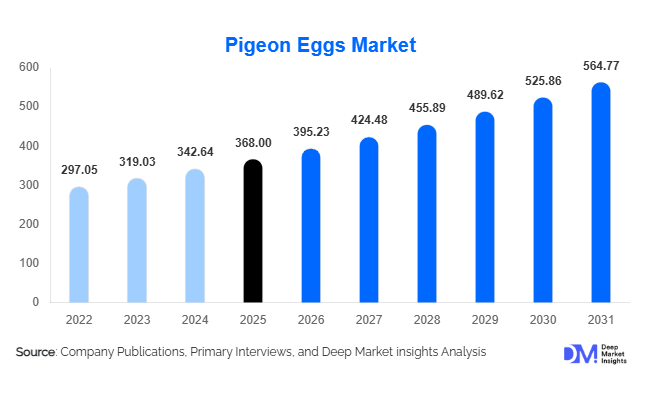
According to Deep Market Insights, the global pigeon eggs market size was valued at approximately USD 368 million in 2026 and is projected to grow to reach USD 527 million by 2031, expanding at a CAGR of 7.4% during the forecast period (2026–2031). The pigeon eggs market growth is primarily driven by increasing demand for premium and specialty protein products, rising consumer interest in traditional nutritional foods, expansion of gourmet food applications, and gradual commercialization of pigeon farming practices across emerging economies.
Key Market Insights
- Asia-Pacific dominates the global pigeon eggs market, accounting for the largest share due to established pigeon farming practices, cultural acceptance, and strong domestic consumption in China and Southeast Asian countries.
- China represents the leading country-level market, supported by large-scale commercial pigeon farms, developed breeding infrastructure, and strong demand for pigeon-derived food products.
- Fresh pigeon eggs remain the dominant product category, accounting for the majority of market revenue due to consumer preference for freshly harvested eggs and traditional culinary applications.
- Commercial pigeon farming is expanding globally, as producers adopt improved breeding systems, automated feeding technologies, and better disease management practices to increase productivity.
- Premium foodservice applications are emerging as a major growth opportunity, with luxury restaurants, specialty cuisines, and gourmet food retailers increasingly incorporating pigeon eggs into premium menus.
- Functional nutrition and specialty egg products are gaining attention, supported by rising consumer interest in high-protein foods, natural nutrition, and traditional wellness products.
global pigeon eggs market latest trends
Commercialization of Specialty Pigeon Farming
The pigeon eggs market is witnessing a gradual transition from traditional household-level production toward organized commercial farming. Historically, pigeon egg production has been dominated by small farmers and local breeders; however, rising demand for premium protein products is encouraging investments in dedicated pigeon farming operations. Commercial producers are increasingly adopting controlled breeding environments, improved feed management, veterinary monitoring, and biosecurity measures to improve egg production consistency.
This commercialization trend is particularly prominent in Asia-Pacific, where countries such as China are developing specialized pigeon breeding clusters. Larger farms are focusing on improving productivity, reducing mortality rates, and establishing reliable supply chains for restaurants, specialty retailers, and direct consumers. The shift toward organized production is expected to enhance market availability and support wider adoption of pigeon eggs beyond traditional consumption markets.
Premiumization and Specialty Food Applications
Consumer preferences are shifting toward unique, premium, and culturally distinctive food products, creating new opportunities for pigeon eggs. Unlike conventional chicken eggs, pigeon eggs are positioned as a specialty ingredient due to their limited availability, unique taste characteristics, and association with traditional cuisines.
Luxury restaurants, ethnic food establishments, and gourmet retailers are increasingly using pigeon eggs to differentiate their offerings. This trend is particularly visible in urban markets where consumers are willing to pay premium prices for exclusive culinary experiences. The expansion of premium food channels is encouraging producers to focus on quality certification, attractive packaging, and direct-to-consumer sales strategies.
global pigeon eggs market drivers
Growing Demand for Alternative Protein Sources
Increasing consumer interest in diversified protein sources is one of the major factors supporting the growth of the pigeon eggs market. Rising health awareness, changing dietary patterns, and demand for nutrient-rich foods are encouraging consumers to explore specialty animal protein products beyond traditional chicken and duck eggs.
Pigeon eggs are gaining attention among premium consumers due to their perceived nutritional value, including high-quality protein content and essential micronutrients. Although pigeon eggs represent a smaller market compared with conventional egg categories, their premium positioning enables producers to capture higher-value opportunities. The broader global shift toward protein diversification is expected to continue supporting market growth.
Expansion of Gourmet Food and Ethnic Cuisine Markets
The growth of gourmet dining, ethnic cuisine restaurants, and specialty food markets is positively influencing demand for pigeon eggs. Pigeon eggs are traditionally consumed in several Asian markets and are increasingly being introduced to international consumers through restaurants specializing in regional cuisines.
Migration patterns and globalization of food culture are helping introduce pigeon-based food products to new markets in North America, Europe, and the Middle East. Restaurants are using pigeon eggs as premium menu ingredients, creating additional demand from the hospitality sector. This trend is expected to support higher-value consumption and improve market visibility globally.
Advancements in Pigeon Farming Technologies
Technological improvements in livestock management are strengthening the commercial potential of pigeon egg production. Farmers are increasingly adopting automated feeding systems, improved breeding programs, digital farm monitoring solutions, and better disease prevention methods.
These advancements help producers improve operational efficiency, maintain product quality, and reduce production losses. As commercial farming expands, technology adoption is expected to play a critical role in increasing supply availability and supporting international market development.
global pigeon eggs market restraints
Limited Production Capacity and Lower Productivity
A major challenge affecting the pigeon eggs market is limited production capacity compared with conventional egg industries. Pigeons produce significantly fewer eggs per breeding cycle than chickens, making large-scale commercialization more challenging. The lower productivity results in higher production costs and restricts market accessibility among price-sensitive consumers.
Producers must overcome biological limitations through improved breeding techniques, optimized nutrition programs, and efficient farm management systems. Without significant productivity improvements, pigeon eggs are likely to remain positioned primarily as a premium specialty product.
Lack of Consumer Awareness and Standardized Market Frameworks
Limited consumer awareness outside traditional markets remains a key restraint for global pigeon egg adoption. Many consumers in Western markets are unfamiliar with pigeon eggs as a food product, reducing potential demand expansion.
Additionally, the market lacks globally standardized grading systems, quality classifications, and dedicated regulatory frameworks compared with conventional poultry eggs. Establishing stronger quality standards, improving labeling practices, and increasing consumer education will be important for expanding international acceptance.
Report Scope
| Report Metric | Details |
|---|---|
| Market Size in 2025 | USD 368.00 |
| Market Size in 2026 | USD 395.23 |
| Market Size in 2031 | USD 564.77 |
| CAGR | 7.4% (2026-2031) |
| Base Year for Estimation | 2025 |
| Historical Data | 2022-2024 |
| Forecast Period | 2026-2031 |
| Report Coverage | Revenue Forecast, Competitive Landscape, Supply Chain Disruption, Growth Factors, Environment & Regulatory Landscape and Trends |
| Geographies Covered | North America, Europe, APAC, Middle East and Africa, LATAM |
| Countries Covered | U.S., Canada, U.K., Germany, France, Spain, Italy, Russia, Nordic, Benelux, Rest of Europe, China, Korea, Japan, India, Australia, Singapore, Taiwan, South East Asia, Rest of Asia-Pacific, UAE, Turky, Saudi Arabia, South Africa, Egypt, Nigeria, Rest of MEA, Brazil, Mexico, Argentina, Chile, Colombia, Rest of LATAM |
Explore more data points, trends and opportunities Download Free Sample Report
Product Type Insights
Fresh pigeon eggs dominate the global pigeon eggs market, accounting for approximately 68.5% of market revenue in 2025. The segment maintains leadership due to strong consumer preference for freshly harvested eggs, traditional culinary usage, and premium positioning. In major producing markets such as China and Southeast Asia, fresh pigeon eggs are primarily sold through local markets, specialty retailers, and direct farm channels.Processed pigeon egg products represent an emerging segment, including boiled, seasoned, pickled, and vacuum-packed variants. This category is expected to grow faster than fresh eggs due to improved shelf life and suitability for wider distribution. Frozen and powdered pigeon egg products are also gaining attention among food processors and export-oriented suppliers seeking to overcome geographical limitations.Although processed products currently represent a smaller market share, technological improvements in food preservation and packaging are expected to increase their contribution over the forecast period.
Production System Insights
Commercial pigeon farms represent the leading production system segment, accounting for approximately 46.2% of global market revenue in 2025. The segment dominates due to increasing professionalization of pigeon breeding activities and rising demand for consistent supply from restaurants, retailers, and institutional buyers.Commercial farms offer advantages including improved disease control, standardized feeding practices, better breeding management, and higher quality consistency. China has emerged as a major hub for commercial pigeon farming, supported by specialized breeding facilities and established domestic demand.Small and medium-scale farms remain important contributors, particularly in developing countries where pigeon farming provides rural income opportunities. These farms benefit from lower entry costs and local consumer networks but face challenges related to productivity, scalability, and market access.Organic and free-range pigeon production is an emerging premium segment. Growing consumer interest in animal welfare, sustainable farming practices, and chemical-free food products is encouraging some producers to adopt certified production methods.
Egg Type Insights
Conventional pigeon eggs represent the largest egg type category, accounting for approximately 74.8% of the global market revenue in 2025. The segment dominates because most consumers purchase pigeon eggs for traditional food consumption rather than specialized nutritional benefits.Conventional eggs remain popular due to their wider availability, comparatively lower prices, and established consumer acceptance. Local markets and household buyers primarily drive demand for this category.However, organic and fortified pigeon eggs are expected to register faster growth during the forecast period. Premium consumers are increasingly interested in traceable food products, sustainable production methods, and enhanced nutritional benefits. Producers are exploring opportunities to introduce specialty pigeon eggs with improved labeling, certification, and health-oriented positioning.
Distribution Channel Insights
Direct farm sales remain the dominant distribution channel, accounting for approximately 39.6% of global pigeon eggs market revenue in 2025. The channel leads due to the localized nature of pigeon egg production, consumer preference for freshness, and the importance of direct relationships between farmers and buyers.Direct sales allow producers to maintain higher margins while providing customers with fresher products. Farmers' markets, local agricultural outlets, and community-based selling networks remain important distribution channels across major producing countries.Supermarkets, specialty food stores, and online retail channels are gradually expanding as cold-chain infrastructure improves. E-commerce platforms provide opportunities for producers to reach urban consumers and premium buyers beyond traditional local markets.Foodservice distributors are also becoming increasingly important as restaurants and hospitality businesses seek reliable suppliers of specialty ingredients. The expansion of organized retail and digital commerce is expected to improve accessibility and support future market growth.
End-Use Insights
Household consumption remains the largest end-use segment in the global pigeon eggs market, accounting for approximately 58.3% of market revenue in 2025. The segment dominates due to traditional consumption patterns across Asia-Pacific, where pigeon eggs are considered specialty food products incorporated into regional cuisines and household meals. Consumers in China, Vietnam, Thailand, and other Southeast Asian markets continue to purchase fresh pigeon eggs through local markets, farms, and specialty food retailers.The traditional medicine and nutraceutical segment represents another emerging opportunity. In several Asian countries, pigeon-derived products have historically been associated with nutritional recovery and wellness applications. Increasing consumer interest in natural health products is encouraging companies to explore pigeon egg-based functional foods, protein supplements, and specialty nutrition products.The food processing industry remains a smaller application area due to limited supply volumes but offers long-term potential through products such as powdered pigeon eggs, frozen egg ingredients, and ready-to-eat products. Export-oriented demand is expected to increase as producers improve packaging technology, refrigeration systems, and international distribution capabilities.
Explore more data points, trends and opportunities Download Free Sample Report
Pigeon Eggs Market Segmentations
By Product Type
- Fresh Pigeon Eggs
- Processed Pigeon Eggs
- Frozen Pigeon Eggs
- Powdered Pigeon Egg Products
By Production System
- Commercial Pigeon Farms
- Small & Medium-Scale Farms
- Backyard & Household Production
- Organic & Free-Range Production
By Egg Type
- Conventional Pigeon Eggs
- Organic Pigeon Eggs
- Fortified / Specialty Pigeon Eggs
By Distribution Channel
- Wholesale Markets
- Supermarkets & Hypermarkets
- Specialty Food Stores
- Online Retail & E-commerce
- Direct Farm Sales
- Foodservice Distributors
By End Use
- Household Consumption
- Hotels, Restaurants & Catering (HoReCa)
- Traditional Medicine & Nutraceutical Applications
- Food Processing Industry
- Research & Educational Institutions
Regional Insights
Asia-Pacific
Asia-Pacific dominates the global pigeon eggs market, accounting for approximately 61.5% of market share in 2025. The region’s leadership is supported by strong cultural acceptance, established pigeon farming traditions, and high domestic consumption. Unlike Western markets where pigeon eggs remain niche products, several Asian countries have long-standing consumption patterns and commercial breeding networks.India is emerging as a high-growth market due to increasing interest in alternative livestock farming, rising protein consumption, and rural entrepreneurship opportunities. Although commercial pigeon egg production remains smaller compared with China, improving agricultural awareness and diversification programs are expected to support future expansion.Other important markets include Vietnam, Thailand, Indonesia, and Malaysia. These countries benefit from traditional consumption patterns, growing urban populations, and expanding specialty food markets. Southeast Asia is expected to remain a key growth region as premium food demand increases.
North America
North America accounted for approximately 11.8% of global pigeon eggs market revenue in 2025. The region remains a niche market but is experiencing gradual growth due to rising interest in specialty foods, multicultural cuisine, and premium protein products.The United States represents the largest North American market, driven by demand from Asian restaurants, specialty food retailers, and urban consumers seeking unique culinary experiences. Growth is concentrated in metropolitan areas with diverse populations and strong demand for imported specialty foods.Canada is also witnessing increasing demand through multicultural food channels, particularly in cities with established Asian communities. However, limited domestic production means that imports and specialty suppliers continue to play an important role in market development.
Europe
Europe accounted for approximately 14.2% of the global pigeon eggs market in 2025. Demand remains concentrated among gourmet restaurants, specialty food retailers, and ethnic food markets rather than mainstream consumers.Countries including the United Kingdom, France, Germany, and Italy represent key European markets. Growing consumer interest in premium ingredients, sustainable food production, and unique culinary experiences is supporting gradual adoption.European consumers increasingly prioritize traceability, food safety, and animal welfare standards, creating opportunities for suppliers offering certified premium pigeon eggs. However, limited consumer awareness and low domestic production continue to restrict large-scale market expansion.
Middle East & Africa
The Middle East & Africa region accounted for approximately 7.4% of global pigeon eggs market revenue in 2025. Demand is primarily concentrated in Gulf countries such as Saudi Arabia and the UAE, where premium imported food products have strong consumer acceptance.Luxury hospitality, international cuisine expansion, and high purchasing power are supporting demand for specialty food products. However, regional production infrastructure remains limited, making imports an important supply source.African markets remain relatively small but offer future potential through agricultural diversification programs and increasing interest in alternative livestock farming.
Latin America
Latin America represented approximately 5.1% of global market revenue in 2025. The market remains underdeveloped but is gradually expanding through specialty restaurants, immigrant communities, and premium food consumers.Brazil, Mexico, and Argentina represent the leading markets in the region. Demand is primarily driven by niche culinary applications and growing consumer curiosity toward alternative protein products. Limited awareness and low domestic production continue to restrict adoption, but future opportunities exist through specialty imports and premium food distribution networks.
Key Players in the Global Pigeon Eggs Market
- Wens Foodstuff Group Co., Ltd.
- Guangdong Shennong Pigeon Industry Co., Ltd.
- Jiangsu Pigeon King Agricultural Development Co., Ltd.
- China Pigeon Industry Group
- Shandong Poultry Development Group
- Fujian Agricultural Development Group
- Hunan Xiangtan Pigeon Breeding Enterprises
- Guangzhou Commercial Pigeon Farming Enterprises
- Vietnam Specialty Pigeon Farming Cooperatives
- Thai Specialty Poultry Producers
- Indonesia Specialty Bird Farming Companies
- Indian Commercial Pigeon Farming Enterprises
- European Specialty Poultry Producers
- Middle East Premium Poultry Farms
- North American Specialty Bird Farms