Global Shaggy Mane Market Size
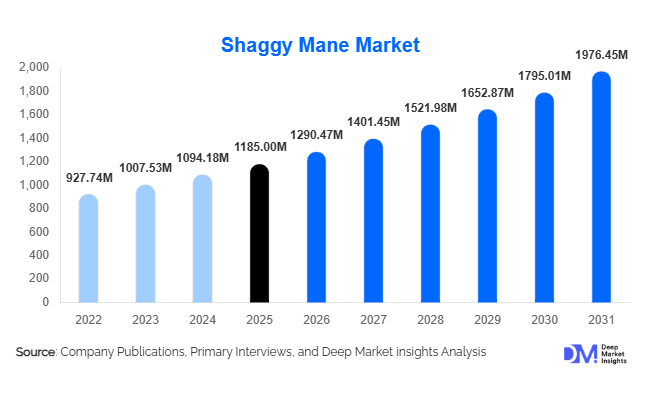
According to Deep Market Insights, the global Shaggy Mane (Coprinus comatus) market was valued at approximately USD 1,185 million in 2026 and is projected to grow from USD 1,290.47 million in 2026 to reach USD 1,976.45 million by 2031, expanding at a CAGR of 8.9% during the forecast period (2026–2031). The Shaggy Mane market growth is primarily driven by increasing demand for specialty and functional mushrooms, rising adoption of plant-based diets, and expanding controlled-environment cultivation technologies that improve yield stability and reduce post-harvest losses.
Shaggy Mane mushrooms are transitioning from a niche foraged product into a structured commercial category within the broader specialty mushroom industry. Their growing popularity in gourmet culinary applications, combined with emerging interest in nutraceutical extracts for metabolic and digestive health, is accelerating global demand. In addition, advancements in vertical farming and indoor cultivation systems are enabling consistent year-round production, reducing dependency on seasonal harvesting. Europe and Asia-Pacific currently dominate consumption and production, while North America is witnessing rapid growth due to rising demand for organic and functional foods. Overall, the market is evolving into a high-value niche segment supported by innovation in cultivation, processing, and cold-chain logistics.
Key Market Insights
- Shift toward specialty mushrooms is driving demand beyond traditional varieties like button and oyster mushrooms.
- Functional food integration is increasing, with Shaggy Mane extracts entering nutraceutical and supplement formulations.
- APAC dominates production, led by China, Japan, and South Korea, supported by advanced mushroom farming infrastructure.
- Europe leads premium consumption, particularly in gourmet and organic food sectors.
- North America is the fastest-growing consumption market, driven by plant-based diet adoption and wellness trends.
- Controlled-environment agriculture (CEA) is improving scalability and reducing perishability challenges.
Shaggy Mane Market Latest Trends
Expansion of Controlled Indoor Mushroom Farming
Indoor cultivation systems are transforming Shaggy Mane production by enabling controlled humidity, temperature, and substrate composition. This reduces spoilage risk and improves yield consistency. Vertical farming and automated mycology systems are increasingly being adopted in Europe, Japan, and urban centers in North America. These technologies are helping transition Shaggy Mane from a seasonal wild mushroom into a commercially stable crop, improving supply chain reliability and enabling large-scale commercialization.
Growth of Functional Mushroom Extracts
Shaggy Mane mushrooms are gaining traction in the nutraceutical industry due to their potential antioxidant and metabolic health properties. Manufacturers are increasingly producing powdered extracts, capsules, and fortified food ingredients. Demand is rising in wellness-focused markets such as the United States, Germany, and Japan, where consumers actively seek plant-based supplements. This trend is expanding the market beyond foodservice into health and pharmaceutical-adjacent applications.
Shaggy Mane Market Drivers
Rising Demand for Plant-Based and Functional Foods
Global dietary shifts toward plant-based nutrition are significantly boosting demand for mushrooms as meat substitutes and functional food ingredients. Shaggy Mane mushrooms are increasingly used in gourmet plant-based dishes due to their delicate texture and flavor profile. Rising vegan and flexitarian populations across North America and Europe are accelerating market penetration.
Technological Advancements in Cultivation Systems
Improved mushroom farming technologies, including sterilized substrate systems, controlled humidity chambers, and AI-based cultivation monitoring, are enhancing production efficiency. These advancements are reducing production losses and enabling year-round cultivation, which is critical for highly perishable mushrooms like Shaggy Mane.
Expansion of Gourmet and Specialty Food Industry
The global gourmet food industry is increasingly incorporating exotic mushrooms into high-end cuisine. Shaggy Mane mushrooms are gaining popularity in Michelin-level restaurants and premium culinary chains, particularly in Europe and North America. This premiumization trend is supporting higher price realization and stable demand growth.
Shaggy Mane Market Restraints
High Perishability and Storage Constraints
Shaggy Mane mushrooms have an extremely short shelf life, often degrading within 24–48 hours after harvest. This creates logistical challenges, increases cold-chain dependency, and limits large-scale international distribution. Without advanced preservation methods such as freeze-drying or vacuum packaging, wastage rates remain high.
Limited Consumer Awareness and Market Penetration
Compared to mainstream mushrooms, Shaggy Mane remains relatively unknown among mass consumers. Limited awareness restricts retail penetration in emerging economies and slows down adoption in supermarket chains, confining demand primarily to niche gourmet and specialty food segments.
Shaggy Mane Industry Key Opportunities
Nutraceutical and Dietary Supplement Expansion
The integration of Shaggy Mane extracts into dietary supplements represents a major growth opportunity. Rising global demand for immunity-boosting and metabolic health products is driving supplement manufacturers to explore mushroom-based bioactive compounds. This is expected to significantly expand the addressable market beyond culinary applications.
Premium Culinary Export Growth
Increasing global demand for exotic gourmet ingredients is opening export opportunities from APAC to Europe and North America. Improved cold-chain logistics and vacuum-sealed packaging technologies are enabling long-distance trade, allowing producers in China, Japan, and South Korea to capture premium pricing in Western markets.
Report Scope
| Report Metric | Details |
|---|---|
| Market Size in 2025 | USD 1185.00 Million |
| Market Size in 2026 | USD 1290.47 Million |
| Market Size in 2031 | USD 1976.45 Million |
| CAGR | 8.6% (2026-2031) |
| Base Year for Estimation | 2025 |
| Historical Data | 2022-2024 |
| Forecast Period | 2026-2031 |
| Report Coverage | Revenue Forecast, Competitive Landscape, Supply Chain Disruption, Growth Factors, Environment & Regulatory Landscape and Trends |
| Geographies Covered | North America, Europe, APAC, Middle East and Africa, LATAM |
| Countries Covered | U.S., Canada, U.K., Germany, France, Spain, Italy, Russia, Nordic, Benelux, Rest of Europe, China, Korea, Japan, India, Australia, Singapore, Taiwan, South East Asia, Rest of Asia-Pacific, UAE, Turky, Saudi Arabia, South Africa, Egypt, Nigeria, Rest of MEA, Brazil, Mexico, Argentina, Chile, Colombia, Rest of LATAM |
Explore more data points, trends and opportunities Download Free Sample Report
Product Type Insights
Fresh Shaggy Mane mushrooms continue to dominate the global market, accounting for approximately 60–62% share in 2025. This dominance is primarily driven by strong culinary demand across restaurants, gourmet kitchens, and local fresh produce supply chains, where chefs prefer fresh mushrooms for their superior texture, aroma, and flavor profile. The segment is further supported by the growing preference for locally sourced ingredients and the expansion of farm-to-table dining concepts. However, its growth is inherently constrained by short shelf life, seasonal availability, and logistical limitations in long-distance distribution.Processed formats, including dried mushrooms, frozen variants, and concentrated extracts, hold around 38–40% market share but are expanding at a faster pace compared to fresh products. The leading growth driver for this segment is its extended shelf life combined with increasing suitability for global trade and industrial applications. Rising demand from nutraceutical and functional food industries, where bioactive compounds are extracted for supplements and health formulations, is further accelerating adoption. Additionally, improvements in dehydration technologies, cold-chain logistics, and value-added processing are enabling manufacturers to scale exports and reduce wastage, positioning processed variants as the primary long-term growth engine of the market.
Application Insights
Culinary applications remain the dominant segment, accounting for approximately 70–72% share of the Shaggy Mane market. This leadership is driven by the rapid expansion of gourmet cuisine, increasing popularity of plant-based diets, and rising incorporation of specialty mushrooms in premium restaurant menus. The segment benefits further from shifting consumer preferences toward natural, organic, and umami-rich food ingredients, which position Shaggy Mane mushrooms as a versatile ingredient in both traditional and modern culinary formats.Nutraceutical applications contribute nearly 18–20% of the market, with growth primarily driven by rising global health consciousness, increasing demand for immune-boosting supplements, and expanding use of mushroom-derived bioactive compounds in preventive healthcare products. Pharmaceutical and research applications account for around 5–7%, supported by ongoing scientific exploration into antioxidant, antimicrobial, and anti-inflammatory properties of mushroom extracts. Cosmetic applications and animal feed usage collectively represent emerging niches, gaining traction due to the global shift toward natural ingredients in personal care formulations and sustainable protein alternatives in feed systems.
Distribution Channel Insights
Offline retail channels, including specialty stores and organic food outlets, continue to lead the market with approximately 50–55% share. This dominance is driven by consumer preference for physically inspecting fresh produce, particularly in regions where mushroom consumption is deeply integrated into traditional diets. Strong presence of local wet markets and specialty grocery formats in both developed and emerging economies further reinforces this channel’s leadership.Online retail is the fastest-growing distribution channel, accounting for 25–30% share. Its expansion is driven by the rapid penetration of e-commerce platforms, improved cold-chain logistics, and the rise of direct-to-consumer specialty food brands. Digital marketplaces are increasingly enabling access to niche and exotic food products, including specialty mushrooms, even in non-producing regions, thereby significantly broadening market reach. Foodservice distribution accounts for the remaining share and is primarily driven by growth in hospitality, quick-service restaurants, and fine dining establishments where demand for premium ingredients continues to rise.
Explore more data points, trends and opportunities Download Free Sample Report
Shaggy Mane Market Segmentations
By Form
- Fresh Shaggy Mane Mushrooms
- Frozen Shaggy Mane Mushrooms
- Dried Shaggy Mane Mushrooms
- Shaggy Mane Extracts & Powders
By Application
- Culinary & Foodservice
- Nutraceuticals & Dietary Supplements
- Pharmaceutical & Research Applications
- Cosmetics & Personal Care
- Animal Nutrition & Feed Additives
By Distribution Channel
- Offline Retail (Supermarkets, Specialty Stores)
- Online Retail & E-commerce Platforms
- Foodservice & HoReCa Supply Chains
- Direct Farm-to-Business Sales
By Cultivation Type
- Indoor Controlled Environment Agriculture (CEA)
- Outdoor Wild Harvesting
- Greenhouse-Based Cultivation
- Hybrid Cultivation Systems
Regional Insights
Asia-Pacific
Asia-Pacific dominates the global Shaggy Mane mushroom market with approximately 45–47% share, supported by strong production capacity and deeply rooted consumption patterns. The region’s leadership is primarily driven by advanced cultivation infrastructure, favorable climatic conditions, and cost-efficient production systems. Strong demand from foodservice industries and increasing incorporation of functional foods further reinforce market expansion. In China, large-scale mushroom farming ecosystems and export-oriented production models continue to strengthen supply capabilities. Japan exhibits steady demand supported by its culinary culture that emphasizes seasonal and specialty ingredients, while South Korea shows rising consumption driven by wellness-oriented diets and expanding retail penetration. India is emerging as a high-growth market due to increasing adoption of organic farming practices, rising awareness of functional foods, and expanding urban demand for gourmet and health-focused dietary products, positioning the country as a key future growth hub in the region.
Europe
Europe accounts for approximately 25–27% of the global market, with growth strongly driven by high demand for organic, sustainable, and gourmet food products. The region benefits from well-established specialty food retail networks and strong culinary traditions that emphasize premium ingredients. Increasing consumer inclination toward plant-based and environmentally sustainable diets continues to support market expansion. Germany, France, and the Netherlands serve as major consumption centers, driven by sophisticated food cultures and strong retail infrastructure. Regulatory emphasis on organic certification and sustainable agriculture further accelerates adoption, while the presence of high-income consumers supports consistent demand for specialty mushroom varieties in both retail and foodservice sectors.
North America
North America holds approximately 18–20% share of the global market, with the United States representing the primary demand center. Growth in this region is driven by rising adoption of plant-based diets, increasing wellness awareness, and strong expansion of organic grocery retail chains. The market also benefits from rapid innovation in alternative food systems and growing integration of specialty mushrooms into functional food and supplement categories. Canada contributes steadily to regional demand, supported by increasing health consciousness and rising preference for natural and minimally processed food products across urban populations.
Latin America
Latin America contributes around 4–6% of the global market, with growth primarily driven by gradual dietary diversification and increasing exposure to exotic and premium food products. Brazil and Mexico represent the key consumption markets, supported by rising urbanization, expanding middle-class populations, and growing interest in international culinary trends. The region’s growth is also influenced by the expansion of modern retail infrastructure and increasing penetration of premium foodservice outlets catering to urban consumers seeking diverse and high-quality ingredients.
Middle East & Africa
The Middle East & Africa region accounts for approximately 3–4% of the global market and remains largely import-dependent. Growth is primarily driven by strong demand from luxury hospitality sectors, premium dining establishments, and high-income consumer groups. UAE and Saudi Arabia serve as key consumption hubs, supported by rapid expansion of tourism, hospitality infrastructure, and fine dining experiences. Increasing diversification of food imports and rising interest in gourmet and healthy food options are further contributing to steady market development across the region.
Key Players in the Shaggy Mane Market
- Monaghan Mushrooms
- Bonduelle Group
- Phillips Mushroom Farms
- Costa Group Holdings
- Smithy Mushrooms Group
- South Mill Champs
- Giorgio Fresh Co.
- Okechamp S.A.
- Greenyard NV
- Korea Mushroom Corp