Brown Rice Powder Market Size
According to Deep Market Insights, the global brown rice powder market size was valued at USD 585 million in 2025 and is projected to grow from USD 631.22 million in 2026 to reach USD 923.18 million by 2031, expanding at a CAGR of 7.9% during the forecast period (2026–2031). The brown rice powder market growth is primarily driven by rising consumer demand for gluten-free ingredients, increasing adoption of plant-based nutrition, and the growing use of clean-label functional ingredients in food and beverage applications. Brown rice powder has gained considerable popularity owing to its nutritional profile, including high dietary fiber, vitamins, minerals, and antioxidants, making it a preferred ingredient in bakery products, infant nutrition, dairy alternatives, sports nutrition, and nutraceutical formulations.
The market has evolved from a niche specialty ingredient segment into a mainstream component of the global health and wellness food industry. Food manufacturers are increasingly replacing conventional wheat and refined flour ingredients with brown rice powder to address changing consumer preferences toward minimally processed and allergen-free products. Furthermore, rapid expansion of the functional food industry, increasing prevalence of gluten intolerance, and rising demand for organic and non-GMO ingredients continue to create new opportunities for market participants. Technological advancements in rice milling and the development of sprouted and germinated brown rice powder products are further supporting market expansion globally.
Key Market Insights
- Food and beverage applications account for nearly 58% of global demand, making the segment the largest consumer of brown rice powder worldwide.
- Asia-Pacific dominates the global market with approximately 44% market share, supported by abundant rice production and expanding functional food industries.
- Conventional brown rice powder represents around 67% of the market owing to its cost competitiveness and widespread industrial applications.
- North America remains one of the fastest-growing markets, driven by increasing demand for gluten-free and plant-based food products.
- Nutraceutical and sports nutrition applications are witnessing accelerated growth due to increasing consumer focus on preventive healthcare and healthy lifestyles.
- Organic and clean-label product innovations are emerging as key competitive differentiators among global manufacturers.
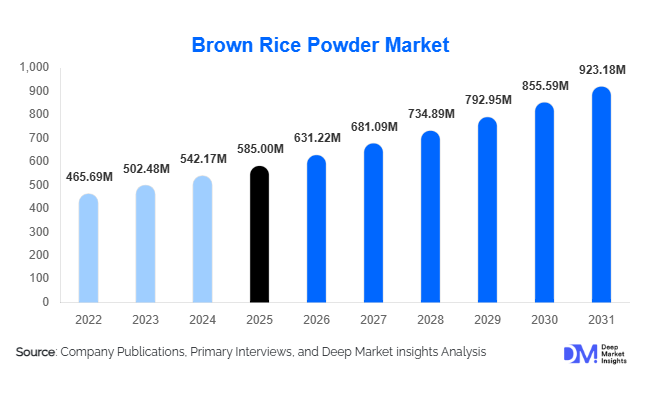
Brown Rice Powder Market Latest Trends
Growing Demand for Clean-Label and Organic Ingredients
Consumers are increasingly scrutinizing ingredient labels and preferring products that are minimally processed and free from synthetic additives. Brown rice powder aligns well with these preferences due to its natural nutritional profile and clean-label positioning. Food manufacturers are therefore incorporating organic and non-GMO brown rice powder into bakery products, plant-based beverages, snacks, and nutritional supplements. The demand for certified organic variants has increased significantly across North America and Europe, allowing manufacturers to command premium pricing and improve margins. Retailers and foodservice companies are also expanding their portfolios of gluten-free and organic products, further accelerating demand for brown rice powder ingredients.
Expansion of Plant-Based Nutrition Applications
The rapid growth of plant-based diets and vegan food products is creating substantial opportunities for brown rice powder manufacturers. Brown rice powder is increasingly utilized in dairy alternatives, protein shakes, meal replacement products, and functional beverages because of its nutritional value and hypoallergenic properties. Product developers are introducing sprouted and protein-enriched formulations to cater to consumers seeking natural and sustainable nutrition. The ingredient's compatibility with clean-label and allergen-free formulations is positioning it as a key component within the global plant-based food ecosystem.
Brown Rice Powder Market Drivers
Rising Demand for Gluten-Free Foods
The growing prevalence of celiac disease, gluten intolerance, and consumer preference for healthier dietary alternatives are driving significant demand for gluten-free ingredients. Brown rice powder has emerged as one of the most preferred substitutes for wheat flour because of its excellent nutritional profile and versatility across applications. Food manufacturers are increasingly incorporating brown rice powder into bakery products, cereals, snacks, and infant foods to meet evolving consumer requirements.
Rapid Expansion of Functional Foods and Nutraceuticals
The global functional food industry continues to expand rapidly as consumers increasingly prioritize preventive healthcare and nutrition-focused lifestyles. Brown rice powder's high fiber content, low glycemic index, and antioxidant properties make it highly suitable for functional food formulations. Nutraceutical companies are increasingly utilizing brown rice powder in meal replacements, digestive health products, and dietary supplements, thereby creating sustained demand across developed and emerging markets.
Increasing Adoption of Plant-Based Ingredients
Growing consumer preference for plant-derived ingredients and sustainable food systems has accelerated demand for brown rice powder. The ingredient is increasingly used in vegan products, dairy alternatives, and sports nutrition formulations. The continued expansion of the global plant-based food industry is expected to provide long-term growth opportunities for manufacturers.
Brown Rice Powder Market Restraints
Volatility in Raw Material Prices
The market remains highly dependent on rice production and agricultural conditions. Weather fluctuations, export restrictions, and changes in government agricultural policies can significantly impact rice prices, affecting the profitability of brown rice powder manufacturers. Supply chain disruptions and inflationary pressures also contribute to pricing uncertainty.
Competition from Alternative Functional Flours
The increasing popularity of alternative ingredients such as oat flour, almond flour, chickpea flour, and quinoa flour poses competitive challenges to market growth. These ingredients offer similar health benefits and are increasingly being adopted by food manufacturers, thereby intensifying competition within the specialty flour industry.
Brown Rice Powder Industry Key Opportunities
Expansion of Gluten-Free Product Categories
The continuous growth of the global gluten-free food industry presents significant opportunities for brown rice powder manufacturers. Product developers are increasingly introducing gluten-free bakery products, snacks, breakfast cereals, and nutritional beverages that incorporate brown rice powder as a primary ingredient. Manufacturers that develop specialty formulations with enhanced nutritional profiles are expected to gain competitive advantages and capture higher market shares.
Increasing Demand from Emerging Economies
Countries across Asia-Pacific, Latin America, and the Middle East are witnessing rising health awareness and growing consumption of functional food products. Rapid urbanization, rising disposable incomes, and government initiatives promoting healthier dietary habits are creating substantial opportunities for market participants. Expansion of local food processing industries is also increasing demand for functional ingredients such as brown rice powder.
Report Scope
| Report Metric | Details |
|---|---|
| Market Size in 2025 | USD 585.00 Million |
| Market Size in 2026 | USD 631.22 Million |
| Market Size in 2031 | USD 923.18 Million |
| CAGR | 7.9% (2026-2031) |
| Base Year for Estimation | 2025 |
| Historical Data | 2022-2024 |
| Forecast Period | 2026-2031 |
| Report Coverage | Revenue Forecast, Competitive Landscape, Supply Chain Disruption, Growth Factors, Environment & Regulatory Landscape and Trends |
| Geographies Covered | North America, Europe, APAC, Middle East and Africa, LATAM |
| Countries Covered | U.S., Canada, U.K., Germany, France, Spain, Italy, Russia, Nordic, Benelux, Rest of Europe, China, Korea, Japan, India, Australia, Singapore, Taiwan, South East Asia, Rest of Asia-Pacific, UAE, Turky, Saudi Arabia, South Africa, Egypt, Nigeria, Rest of MEA, Brazil, Mexico, Argentina, Chile, Colombia, Rest of LATAM |
Explore more data points, trends and opportunities Download Free Sample Report
Product Type Insights
The conventional brown rice powder segment dominated the global market and accounted for approximately 67% of total revenue in 2025. The segment's leadership is primarily attributed to its cost-effectiveness, broad commercial availability, and extensive adoption across bakery products, snacks, processed foods, and ready-to-eat applications. Food manufacturers continue to prefer conventional variants due to established supply chains, ease of formulation, and compatibility with large-scale production processes. Furthermore, increasing utilization of brown rice powder as a gluten-free alternative to wheat-based ingredients has reinforced demand across mainstream food and beverage applications.Organic brown rice powder is projected to register the fastest growth over the forecast period, supported by rising consumer preference for clean-label, non-GMO, and chemical-free ingredients. Growing awareness regarding the adverse effects of synthetic additives and pesticides has accelerated the adoption of certified organic ingredients across functional foods, infant nutrition, and premium dietary supplements. The rapid expansion of organic retail channels and increasing regulatory support for organic food production are further creating favorable growth opportunities for the segment.Sprouted and germinated brown rice powder products are also witnessing significant demand growth owing to their superior nutritional profile, including enhanced bioavailability of vitamins, minerals, amino acids, and antioxidants. The increasing popularity of functional nutrition, sports nutrition products, and premium wellness formulations is driving the adoption of these value-added variants, particularly among health-conscious consumers seeking minimally processed and nutrient-dense ingredients.
Processing Insights
Heat-treated brown rice powder accounted for nearly 39% of global demand in 2025, making it the leading processing segment. The segment's dominance is primarily driven by its superior microbial safety, extended shelf stability, and enhanced product consistency, making it highly suitable for infant nutrition, nutritional beverages, and ready-to-mix food applications. The increasing emphasis on food safety regulations and the growing demand for shelf-stable ingredients among food manufacturers continue to support the widespread adoption of heat-treated products.Pre-gelatinized brown rice powder is experiencing robust growth due to its improved water absorption characteristics, instant dispersibility, and superior thickening properties, making it increasingly popular in convenience foods, bakery applications, and instant nutritional formulations. Similarly, enzyme-modified brown rice powder is gaining traction in specialized applications requiring enhanced functionality, improved digestibility, and customized texture profiles, particularly in medical nutrition products, sports nutrition formulations, and premium functional beverages.
Application Insights
The food and beverage segment dominated the global brown rice powder market and accounted for nearly 58% of total demand in 2025. The segment's leadership is primarily driven by the increasing consumer preference for gluten-free, plant-based, and clean-label food products. Brown rice powder has become a highly versatile ingredient in bakery products, breakfast cereals, dairy alternatives, nutritional beverages, snacks, and infant foods due to its nutritional value, neutral flavor profile, and functional characteristics. Rising demand for fortified foods and healthy convenience products continues to support the segment's expansion.Nutraceuticals and dietary supplements represent one of the fastest-growing application areas, supported by increasing consumer focus on preventive healthcare, immunity enhancement, and functional nutrition. The ingredient's rich fiber content, naturally occurring vitamins, and antioxidant properties have contributed to its growing incorporation into protein powders, meal replacements, and wellness supplements. In addition, brown rice powder is witnessing increasing adoption in cosmetics and personal care products owing to its hypoallergenic nature, skin-conditioning properties, and rising consumer preference for naturally derived cosmetic ingredients.
Distribution Channel Insights
Direct business-to-business (B2B) sales dominated the market and accounted for approximately 61% of total revenue in 2025. The segment's leadership is driven by the strong procurement requirements of large food manufacturers, infant nutrition companies, and nutraceutical producers that rely on long-term supply agreements and bulk ingredient sourcing arrangements. Direct procurement channels offer advantages such as supply security, cost efficiency, product customization, and quality assurance, making them the preferred distribution model for industrial consumers.Specialty ingredient distributors continue to play a critical role in serving small and medium-sized manufacturers that require technical support, lower order volumes, and access to specialized formulations. Meanwhile, online channels and health food retailers are witnessing increasing demand from household consumers, specialty food producers, and emerging nutraceutical brands. The expansion of e-commerce platforms and growing consumer interest in organic and functional ingredients are further contributing to the development of alternative distribution channels.
End User Insights
Food manufacturers accounted for nearly 48% of global demand in 2025 and remained the largest end-user segment. The segment's dominance is primarily supported by the increasing incorporation of brown rice powder into gluten-free, organic, and functional food formulations. Rising demand for healthier processed foods, clean-label ingredients, and plant-based products has encouraged food manufacturers to expand the use of brown rice powder across multiple product categories, including bakery products, beverages, snacks, and dairy alternatives.Nutraceutical companies and infant nutrition manufacturers are emerging as high-growth end-user categories due to increasing demand for fortified, hypoallergenic, and nutrient-dense products. Growing consumer awareness regarding preventive healthcare and early-life nutrition is creating significant opportunities for brown rice powder incorporation into dietary supplements and infant food formulations. Cosmetic manufacturers are also increasingly utilizing brown rice powder in natural skincare and beauty products owing to its gentle exfoliating properties, antioxidant content, and compatibility with clean beauty formulations.
Explore more data points, trends and opportunities Download Free Sample Report
Brown Rice Powder Market Segmentations
By Product Type
- Conventional Brown Rice Powder
- Organic Brown Rice Powder
- Sprouted Brown Rice Powder
- Germinated Brown Rice Powder
- Instantized Brown Rice Powder
- Fortified/Enriched Brown Rice Powder
By Processing Type
- Raw Brown Rice Powder
- Heat-Treated Brown Rice Powder
- Pre-Gelatinized Brown Rice Powder
- Enzyme-Modified Brown Rice Powder
By Particle Size
- Fine Powder
- Medium Powder
- Coarse Powder
By Functionality
- Standard Functional Powder
- High-Fiber Powder
- Protein-Enriched Powder
- Gluten-Free Functional Powder
- Low-Glycemic Powder
- Clean-Label Powder
By Application
- Food & Beverage
- Dietary Supplements
- Nutraceuticals
- Clinical Nutrition
- Cosmetics & Personal Care
- Animal Nutrition & Pet Food
- Industrial Applications
Regional Insights
Asia-Pacific
Asia-Pacific accounted for approximately 44% of the global brown rice powder market in 2025 and remains both the largest producer and consumer worldwide. The region benefits from abundant rice production, well-established food processing industries, and strong cultural acceptance of rice-based ingredients. Increasing urbanization, rising disposable incomes, and growing awareness regarding healthy dietary choices continue to accelerate market expansion across the region.China represented nearly 16% of global demand in 2025, supported by its extensive food processing industry, expanding functional food sector, and increasing consumer interest in natural and nutritional ingredients. The country's rapidly growing health and wellness industry, coupled with rising demand for plant-based and gluten-free products, continues to support brown rice powder consumption.India accounted for approximately 11% of global demand and is expected to remain the fastest-growing country during the forecast period. Strong growth is being driven by the rapid expansion of functional foods, increasing health-conscious consumption patterns, and government initiatives promoting value-added agricultural processing and food manufacturing under various food processing development programs. Rising investments in nutraceutical production and increasing demand for clean-label ingredients are also contributing to market growth.Japan and South Korea continue to exhibit strong demand for premium and organic brown rice powder products due to increasing consumer preference for functional nutrition, healthy aging products, and high-quality natural ingredients. The region's sophisticated food industry and strong demand for premium health foods continue to create opportunities for specialty brown rice powder manufacturers.
North America
North America represented approximately 24% of global market revenue in 2025, with the United States accounting for nearly 20% of worldwide demand. Market growth is primarily supported by the rising prevalence of gluten intolerance and celiac disease, increasing adoption of plant-based dietary patterns, and strong consumer demand for organic and clean-label food products. The region's highly developed functional food and dietary supplement industries continue to generate substantial demand for brown rice powder across multiple applications.The United States remains the largest market in the region due to increasing demand for natural ingredients in bakery products, protein supplements, meal replacements, and plant-based beverages. Growing investments in organic food production and rising consumer preference for minimally processed ingredients further support market expansion.Canada is also witnessing increasing utilization of brown rice powder in functional foods and nutritional supplements, supported by growing health awareness, rising demand for plant-based nutrition, and expanding consumer interest in organic and specialty food ingredients.
Europe
Europe accounted for approximately 20% of global demand and remains one of the fastest-growing regions for organic and clean-label ingredients. The market is being driven by increasing consumer preference for natural and sustainable food products, stringent food quality standards, and growing demand for gluten-free formulations across both retail and food service sectors.Germany, the United Kingdom, France, and Italy represent the leading markets due to strong demand for functional foods and premium organic products. The region's stringent regulatory framework governing food safety and ingredient transparency has encouraged manufacturers to increasingly incorporate naturally derived ingredients such as brown rice powder into product formulations.Furthermore, Europe's expanding vegan and plant-based consumer base, rising investments in organic food manufacturing, and increasing focus on sustainable ingredient sourcing continue to create significant opportunities for premium brown rice powder producers throughout the region.
Latin America
Latin America accounted for approximately 7% of the global market in 2025. The region is gradually emerging as an attractive market for functional ingredients and nutritional products due to improving consumer purchasing power, increasing urbanization, and rising awareness regarding healthy dietary practices.Brazil and Mexico are the leading consumers owing to their expanding food processing industries and increasing demand for fortified and natural food ingredients. The growing popularity of functional foods, rising incidence of lifestyle-related health concerns, and increasing investments in packaged food production are supporting the adoption of brown rice powder across the region.In addition, the expansion of modern retail infrastructure and increasing penetration of health and wellness products are expected to create favorable growth opportunities for brown rice powder manufacturers in Latin America over the forecast period.
Middle East & Africa
The Middle East and Africa represented approximately 5% of global demand in 2025. The market is witnessing steady expansion due to increasing health awareness, growing demand for premium food products, and rising dependence on imported specialty ingredients. Increasing urbanization and changing dietary preferences are also contributing to the adoption of functional and natural food ingredients across the region.Saudi Arabia, the United Arab Emirates, and South Africa are emerging as important markets due to growing consumer spending on health and wellness products, rapid expansion of organized retail channels, and increasing demand for premium nutritional products. Government initiatives aimed at strengthening food security and diversifying food manufacturing capabilities are further supporting demand for value-added food ingredients.The region's expanding food processing industry, increasing prevalence of lifestyle diseases, and rising popularity of functional and plant-based nutrition are expected to create long-term growth opportunities for brown rice powder manufacturers in the Middle East and Africa.
Key Players in the Brown Rice Powder Market
- ADM
- Ingredion Incorporated
- Ebro Foods
- Bob's Red Mill Natural Foods
- Thai Flour Industry Co., Ltd.
- Burapa Prosper Co., Ltd.
- BIF Co., Ltd.
- Pornkamon Rice Flour Mills Co., Ltd.
- Koda Farms
- Cho Heng Rice Vermicelli Factory Co., Ltd.
- LT Foods Limited
- Lundberg Family Farms
- Aryan International
- General Mills, Inc.
- Shipton Mill Ltd.