Dried Lychee Market Size
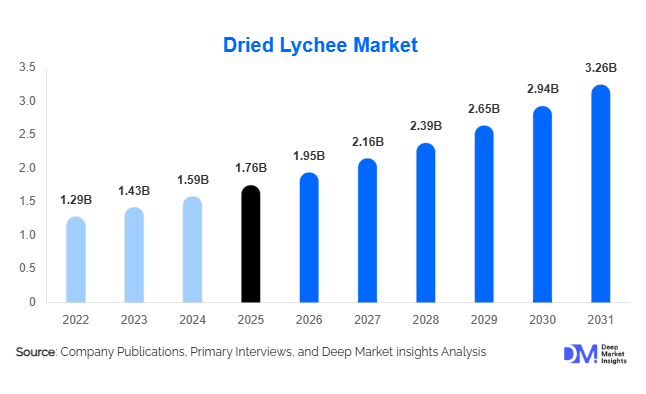
According to Deep Market Insights, the global dried lychee market size was valued at USD 1.76 billion in 2025 and is projected to grow from USD 1.95 billion in 2026 to reach USD 3.26 billion by 2031, expanding at a CAGR of 10.8% during the forecast period (2026–2031). The dried lychee market growth is primarily driven by rising demand for premium dried fruit snacks, increasing consumer preference for natural and clean-label food products, and expanding utilization of dried lychee in food processing, nutraceuticals, confectionery, and beverage applications. Growing awareness of the nutritional benefits associated with tropical fruits, coupled with improvements in freeze-drying and dehydration technologies, is further supporting global market expansion.
Key Market Insights
- Whole dried lychee remains the dominant product category, accounting for approximately 42% of global market revenue due to strong consumer preference for traditional fruit formats.
- Asia-Pacific dominates global production and consumption, holding nearly 55% of the market, supported by extensive lychee cultivation across China, India, Thailand, and Vietnam.
- Freeze-dried lychee products are witnessing the fastest growth, driven by premium positioning, superior nutrient retention, and increasing demand from functional food manufacturers.
- E-commerce channels are rapidly transforming market access, enabling producers to directly reach consumers across North America, Europe, and the Middle East.
- Food and beverage manufacturers are emerging as key demand generators, utilizing dried lychee in bakery products, beverages, cereals, confectionery, and snack formulations.
- Organic and clean-label dried lychee products are gaining traction, particularly in developed markets where consumers increasingly prioritize transparency, sustainability, and natural ingredients.
Dried Lychee Market Latest Trends
Premium Freeze-Dried Products Driving Market Evolution
The dried lychee industry is increasingly shifting toward premium freeze-dried products that offer superior flavor retention, enhanced texture, and higher nutritional preservation compared to conventional drying methods. Manufacturers are investing heavily in advanced dehydration technologies to cater to health-conscious consumers seeking minimally processed fruit snacks. Freeze-dried lychee is gaining popularity across North America, Europe, Japan, and South Korea, where premium fruit products command higher retail prices. The trend is also being supported by food manufacturers utilizing freeze-dried lychee powder and fruit pieces in cereals, nutritional supplements, bakery products, and beverage formulations. As consumers become more willing to pay premium prices for high-quality dried fruits, processors are expanding freeze-drying capacities and introducing value-added product variants.
Expansion of Clean-Label and Functional Food Applications
Growing demand for clean-label food products is creating new opportunities for dried lychee manufacturers. Consumers increasingly prefer snacks and ingredients free from artificial preservatives, additives, and excessive sugar content. As a result, natural and organic dried lychee products are experiencing strong growth globally. Functional food manufacturers are incorporating dried lychee into energy bars, dietary supplements, immunity products, breakfast cereals, and wellness beverages due to its antioxidant and polyphenol content. Nutraceutical companies are also exploring lychee-derived ingredients for health-focused formulations. This trend is broadening the application base of dried lychee beyond traditional snacking and positioning the fruit as a premium functional ingredient across multiple industries.
Dried Lychee Market Drivers
Growing Demand for Healthy and Natural Snacks
Consumers worldwide are increasingly replacing conventional processed snacks with healthier alternatives that offer natural ingredients and nutritional benefits. Dried lychee aligns well with this trend due to its naturally sweet taste, convenient shelf life, and absence of artificial ingredients in premium formulations. Rising awareness of healthy eating habits, growing interest in tropical fruit products, and expanding demand for plant-based snacks are supporting market growth. Retailers are dedicating more shelf space to premium dried fruit categories, further improving product visibility and accessibility. The trend is particularly pronounced in North America, Europe, and affluent Asia-Pacific markets where health-conscious consumers actively seek clean-label snack options.
Expansion of Food Processing and Ingredient Applications
Dried lychee is increasingly being utilized as an ingredient across bakery products, confectionery, dairy products, beverages, breakfast cereals, and functional foods. Food manufacturers value dried lychee for its distinctive flavor profile, natural sweetness, and ability to enhance premium product positioning. The expansion of specialty beverage markets, including bubble tea and fruit-infused beverages, is further driving demand. Growing investment in innovative food formulations and premium product launches is creating consistent industrial demand for dried lychee ingredients worldwide.
Technological Advancements in Drying and Preservation
Advancements in dehydration technologies have significantly improved the quality and consistency of dried lychee products. Modern freeze-drying, vacuum drying, and hybrid drying systems allow manufacturers to preserve flavor, color, texture, and nutritional value more effectively than traditional methods. These technological improvements support higher export prices, enhanced shelf stability, and greater acceptance among premium consumers. Increasing automation and efficiency improvements are also reducing production losses and enabling processors to scale operations for international markets.
Dried Lychee Market Restraints
Seasonal Raw Material Availability and Price Volatility
The dried lychee industry remains heavily dependent on seasonal fruit harvests concentrated in a limited number of producing countries. Weather fluctuations, pest outbreaks, droughts, and climate-related disruptions can significantly impact fresh lychee availability and pricing. These supply-side risks affect processor margins and create challenges in maintaining stable year-round production schedules. Producers often face difficulties securing sufficient raw material volumes during weaker harvest seasons, leading to increased procurement costs and potential supply shortages.
Premium Product Pricing Limits Mass-Market Adoption
Dried lychee remains relatively expensive compared to more established dried fruits such as raisins, dates, apricots, and dried mangoes. Higher raw material costs, labor-intensive processing requirements, and advanced drying technologies contribute to elevated product prices. While premium consumers continue to support demand growth, price-sensitive consumers in developing markets may opt for lower-cost alternatives. Expanding affordability without compromising product quality remains a key challenge for industry participants seeking broader market penetration.
Dried Lychee Industry Key Opportunities
Expansion into Functional Foods and Nutraceuticals
The global functional food and nutraceutical industries present significant opportunities for dried lychee manufacturers. The fruit contains antioxidants, polyphenols, and beneficial plant compounds that align with consumer demand for immunity support, wellness products, and natural nutrition. Manufacturers are increasingly incorporating freeze-dried lychee powder into supplements, meal replacements, energy bars, and sports nutrition products. As personalized nutrition and preventive healthcare trends continue gaining momentum, dried lychee suppliers have opportunities to establish long-term partnerships with functional food producers and nutraceutical companies.
Export-Led Growth in Emerging Consumer Markets
Emerging demand across the Middle East, Eastern Europe, and Latin America is creating attractive opportunities for exporters. Rising disposable incomes, growing exposure to Asian cuisines, and increasing availability of premium food products are encouraging consumption of exotic dried fruits. Governments in major producing countries such as China, India, Vietnam, and Thailand continue investing in food processing infrastructure, export certification programs, and agricultural modernization initiatives. Export-oriented processors can capitalize on these developments by expanding distribution networks, strengthening international certifications, and leveraging e-commerce platforms to reach consumers directly.
Report Scope
| Report Metric | Details |
|---|---|
| Market Size in 2025 | USD 1.76 Billion |
| Market Size in 2026 | USD 1.95 Billion |
| Market Size in 2031 | USD 3.26 Billion |
| CAGR | 10.8% (2026-2031) |
| Base Year for Estimation | 2025 |
| Historical Data | 2022-2024 |
| Forecast Period | 2026-2031 |
| Report Coverage | Revenue Forecast, Competitive Landscape, Supply Chain Disruption, Growth Factors, Environment & Regulatory Landscape and Trends |
| Geographies Covered | North America, Europe, APAC, Middle East and Africa, LATAM |
| Countries Covered | U.S., Canada, U.K., Germany, France, Spain, Italy, Russia, Nordic, Benelux, Rest of Europe, China, Korea, Japan, India, Australia, Singapore, Taiwan, South East Asia, Rest of Asia-Pacific, UAE, Turky, Saudi Arabia, South Africa, Egypt, Nigeria, Rest of MEA, Brazil, Mexico, Argentina, Chile, Colombia, Rest of LATAM |
Explore more data points, trends and opportunities Download Free Sample Report
Product Form Insights
The whole dried lychee segment dominates the global dried lychee market, accounting for approximately 42% of total revenue in 2024. Its leadership position is supported by strong consumer preference for traditional fruit formats, particularly across Asia-Pacific markets where authenticity, natural appearance, and cultural familiarity significantly influence purchasing decisions. Whole dried lychee is widely utilized for direct consumption, festive gifting, and premium retail packaging, benefiting from its visual appeal and perceived product quality. Growing demand for minimally processed fruit snacks and increasing consumer interest in naturally preserved products continue to reinforce segment growth. Furthermore, the expansion of premium packaged fruit offerings across supermarkets and specialty stores has strengthened demand for whole dried lychee products.Freeze-dried lychee is emerging as the fastest-growing product form segment due to its superior ability to retain flavor, texture, color, and nutritional content compared to conventional drying methods. The segment is benefiting from increasing consumer demand for clean-label, minimally processed, and nutrient-dense snacks. Premium positioning, longer shelf life, and growing utilization in functional foods, sports nutrition products, and high-end snack applications are accelerating adoption globally. Advances in freeze-drying technology and expanding investments in value-added fruit processing are further supporting market penetration.Lychee powder is gaining substantial traction across nutraceutical, beverage, and functional food industries. Manufacturers are increasingly utilizing lychee powder in dietary supplements, powdered beverages, flavoring systems, health drinks, and wellness formulations due to its convenience, extended shelf life, and ease of transportation. Growing demand for natural fruit-derived ingredients, combined with increasing innovation in functional nutrition products, is creating new revenue opportunities for powder manufacturers. The segment is expected to witness robust growth as companies continue to develop value-added applications targeting health-conscious consumers.
Application Insights
Direct consumption and snack products represent the largest application segment, accounting for approximately 39% of global market demand. The segment's dominance is driven by increasing consumer preference for healthier snacking alternatives, rising awareness regarding the nutritional benefits of dried fruits, and growing demand for convenient on-the-go food products. Dried lychee offers a naturally sweet taste profile without the need for extensive processing, making it an attractive substitute for traditional confectionery and processed snacks. Expanding availability across retail channels and premium packaging innovations are further strengthening consumer adoption.Nutraceutical and functional food applications represent one of the fastest-growing segments within the market. The primary growth driver for this segment is the increasing consumer focus on preventive healthcare and demand for natural antioxidant-rich ingredients. Dried lychee contains bioactive compounds, vitamins, and polyphenols that align with growing wellness trends, encouraging its inclusion in dietary supplements, immunity-support products, and functional nutrition formulations. The expanding global nutraceutical industry is expected to accelerate demand for fruit-based ingredients such as dried lychee.Additional demand is being generated from breakfast cereals, granola products, protein bars, dairy formulations, frozen desserts, and meal replacement products. Manufacturers are increasingly seeking premium fruit ingredients that provide both nutritional value and flavor enhancement, creating favorable opportunities for dried lychee utilization across multiple food categories.
Distribution Channel Insights
Supermarkets and hypermarkets remain the leading distribution channel, accounting for approximately 36% of global sales. The segment benefits from extensive consumer reach, established retail infrastructure, broad product visibility, and the ability to offer multiple product variants under one roof. Consumers frequently purchase dried fruits through organized retail outlets due to convenience, product assortment, and trust associated with recognized retail brands. Growing shelf space allocation for healthy snacks and premium dried fruit categories continues to support channel growth.Online retail represents the fastest-growing distribution channel, supported by rapid expansion of e-commerce platforms, increasing internet penetration, and changing consumer purchasing behavior. The leading growth driver for this segment is the growing consumer preference for convenient access to specialty and imported food products through digital channels. Online platforms provide manufacturers with broader geographic reach, direct consumer engagement opportunities, and enhanced product visibility. Subscription-based purchasing models, targeted digital marketing, and growing cross-border e-commerce activity are further accelerating segment growth.Direct-to-consumer business models are becoming increasingly important as manufacturers seek to improve profit margins, strengthen customer relationships, and build brand loyalty. These models enable greater control over pricing strategies, product positioning, and consumer feedback collection while facilitating international market expansion.Foodservice operators and business-to-business ingredient suppliers also represent a significant distribution segment. Demand from industrial food manufacturers, hospitality operators, bakeries, beverage producers, and confectionery companies continues to expand as dried lychee gains acceptance as a premium ingredient across diverse food applications.
End User Insights
Retail consumers account for approximately 54% of global dried lychee demand, making them the largest end-user segment. The segment's leadership is primarily driven by increasing consumer demand for healthy snacking options, premium dried fruit products, and culturally significant gifting items. Rising disposable incomes, growing health awareness, and increasing availability through organized retail channels are supporting sustained consumption growth. The popularity of dried fruits as convenient, shelf-stable, and naturally sweet snacks continues to strengthen retail demand globally.Food and beverage manufacturers represent the fastest-growing end-user category. The key growth driver for this segment is the increasing incorporation of dried lychee into value-added food and beverage formulations. Manufacturers are utilizing dried lychee across bakery products, confectionery, beverages, cereals, dairy products, snack bars, and functional foods to enhance flavor profiles and product differentiation. Growing innovation within the processed food industry is expected to generate significant demand from industrial users.Foodservice operators are increasingly incorporating dried lychee into premium desserts, specialty beverages, gourmet menu offerings, and Asian-inspired culinary applications. Rising consumer interest in unique flavor experiences and premium dining concepts is supporting demand from restaurants, cafés, hotels, and catering establishments.Nutraceutical manufacturers are emerging as an important customer base due to increasing utilization of fruit-derived ingredients in dietary supplements, wellness products, and functional nutrition formulations. Growing consumer focus on preventive healthcare and natural ingredient sourcing is expected to create additional opportunities within this end-user segment.The continued diversification of dried lychee applications beyond traditional snacking remains one of the most important long-term growth factors supporting overall market expansion and revenue generation.
Explore more data points, trends and opportunities Download Free Sample Report
Dried Lychee Market Segmentations
By Product Form
- Whole Dried Lychee
- Dried Lychee Pieces
- Lychee Powder
- Freeze-Dried Lychee
By Processing Technology
- Sun-Dried
- Hot-Air/Dehydrator Dried
- Vacuum-Dried
- Freeze-Dried
- Hybrid Drying Technologies
By Product Positioning
- Conventional Dried Lychee
- Organic Certified Dried Lychee
- Clean-Label/Additive-Free Dried Lychee
- Premium Gourmet Dried Lychee
By Flavor Type
- Natural/Unflavored
- Sweetened
- Flavored Dried Lychee
By Packaging Format
- Flexible Pouches
- Stand-Up Resealable Pouches
- Sachets/Single-Serve Packs
- Rigid Containers/Jars
- Bulk Industrial Packs
Regional Insights
Asia-Pacific
Asia-Pacific dominates the global dried lychee market, accounting for approximately 55% of total market revenue. The region benefits from extensive lychee cultivation, established processing infrastructure, strong domestic consumption patterns, and deep cultural integration of lychee products across numerous countries. China represents the largest individual market, contributing nearly 28% of global demand due to its substantial production capacity, mature supply chain network, and widespread consumer acceptance of dried fruit products. India accounts for approximately 9% of global demand and continues to expand processing capabilities through government-supported food processing initiatives, cold chain investments, and agricultural value-addition programs.The primary growth drivers for the Asia-Pacific market include abundant raw material availability, expanding food processing industries, increasing disposable incomes, growing urbanization, rising health awareness, strong cultural acceptance of dried fruit consumption, and continued investments in advanced fruit preservation technologies. The rapid expansion of e-commerce platforms and premium gifting culture across several Asian economies is further supporting regional market growth.
North America
North America accounts for approximately 16% of global dried lychee market demand, led by the United States, which contributes roughly 13% of worldwide consumption. The market is benefiting from increasing consumer interest in healthy snacks, exotic fruit products, plant-based nutrition, and clean-label food ingredients. Growing awareness of dried fruit health benefits and rising demand for natural alternatives to processed snacks continue to support market expansion.Key growth drivers in North America include increasing multicultural consumer demographics, expansion of Asian diaspora populations, growing demand for functional and nutrient-rich foods, rapid growth of e-commerce food retailing, rising premium snack consumption, and increasing adoption of fruit-based ingredients by food and beverage manufacturers. Continued innovation in wellness products and clean-label formulations is expected to further stimulate regional demand.
Europe
Europe holds approximately 14% of global market share, with Germany, the United Kingdom, France, Italy, and the Netherlands serving as major import destinations. Demand is supported by a mature health and wellness sector, increasing consumer preference for natural food products, and growing interest in exotic fruit ingredients across both retail and industrial applications.The major drivers supporting market growth in Europe include increasing demand for organic foods, stringent focus on clean-label ingredients, rising vegan and plant-based dietary trends, expanding functional food consumption, growing awareness of nutritional benefits associated with dried fruits, and strong sustainability preferences among consumers. Increasing imports of specialty food products and premiumization trends across the food industry are expected to sustain long-term market growth.
Latin America
Latin America accounts for approximately 7% of global market demand and continues to exhibit steady growth potential. Brazil remains the largest market within the region due to increasing health-conscious consumer populations, expanding premium food retail infrastructure, and growing demand for convenient fruit-based snacks. Mexico is emerging as an attractive market supported by rising exposure to international food trends and increasing availability of imported specialty products.The primary growth drivers for the region include rising urbanization, increasing disposable incomes, growing health and wellness awareness, expansion of organized retail channels, increasing demand for premium snack products, and greater exposure to global food consumption trends. The growing popularity of functional foods and natural fruit ingredients is expected to create additional opportunities over the forecast period.
Middle East & Africa
The Middle East and Africa region accounts for approximately 8% of global market demand and is projected to register the fastest growth rate through 2031. The United Arab Emirates and Saudi Arabia serve as major import and distribution hubs supported by strong premium gifting traditions, high disposable incomes, and increasing demand for premium healthy snack products. South Africa remains an important regional consumer market, while broader growth across Gulf Cooperation Council countries is generating substantial opportunities for exporters.The leading drivers supporting regional growth include rising disposable incomes across Gulf economies, expanding expatriate populations, increasing demand for premium gifting products during religious and cultural festivals, rapid growth of modern retail infrastructure, rising health-conscious consumer behavior, and growing penetration of international food brands. Additionally, increasing tourism activity, hospitality sector expansion, and strong demand for premium packaged foods are expected to accelerate dried lychee consumption throughout the Middle East and Africa region.
Key Players in the Dried Lychee Market
- Dole plc
- Sun-Maid Growers of California
- Bestore Co., Ltd.
- Three Squirrels Inc.
- Baihua Food Co., Ltd.
- ChaCheer Group
- Guangxi Hongli Food
- Vinamit JSC
- Cầu Đất Farm
- Jinyuan Agriculture
- Nutradry Pty Ltd.
- Brover & Brover
- Royal Nut Company
- Dragon King Food Group
- Nam Viet Foods & Beverage