Paleo Flour Market Size
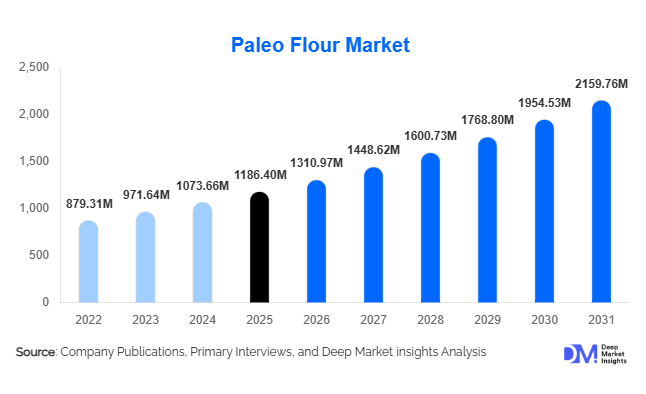
According to Deep Market Insights, the global paleo flour market size was valued at approximately USD 1,310.97 million in 2026 and is projected to grow to reach USD 2,159.76 million by 2031, expanding at a CAGR of 10.5% during the forecast period (2026–2031). The paleo flour market growth is primarily driven by increasing consumer adoption of gluten-free and grain-free diets, rising demand for clean-label and functional food ingredients, growing popularity of paleo and keto lifestyles, and expanding use of alternative flours across bakery, nutritional food, and specialty food applications.
Key Market Insights
- Almond flour dominates the paleo flour market, accounting for the largest revenue share due to its nutritional profile, premium positioning, and extensive use in gluten-free bakery applications.
- North America represents the leading regional market, supported by high consumer awareness of paleo diets, strong natural food retail infrastructure, and widespread adoption of functional nutrition products.
- Asia-Pacific is emerging as the fastest-growing region, driven by rising health awareness, expanding middle-class populations, increasing fitness culture, and growing demand for imported specialty food ingredients.
- Organic and non-GMO paleo flour products are gaining significant traction, as consumers increasingly prioritize ingredient transparency, sustainable sourcing, and chemical-free food production.
- Bakery and functional food manufacturers are becoming major growth contributors, with companies incorporating paleo flour into bread alternatives, snacks, protein bars, and premium food formulations.
- E-commerce and direct-to-consumer channels are reshaping distribution, enabling specialty paleo flour brands to reach global consumers while supporting subscription-based purchasing models.
paleo flour market latest trends
Expansion of Grain-Free and Functional Food Applications
The paleo flour market is witnessing increasing adoption across functional food categories as manufacturers respond to growing consumer demand for healthier alternatives to traditional wheat-based ingredients. Paleo flours derived from almonds, coconut, cassava, tigernut, and other botanical sources are being incorporated into bakery products, snacks, breakfast foods, and nutritional products due to their high fiber content, favorable nutritional profiles, and compatibility with gluten-free and low-carbohydrate diets. Food manufacturers are increasingly developing grain-free bread, cookies, crackers, protein bars, and ready-to-eat products using paleo flour blends to improve nutritional value while maintaining consumer appeal. This trend is expanding the market beyond traditional paleo diet followers and positioning paleo flour as a mainstream specialty ingredient.
Rise of Organic, Sustainable, and Clean-Label Paleo Flour Products
Consumers are increasingly evaluating food products based on ingredient transparency, environmental impact, and sourcing practices. This has accelerated demand for organic-certified, non-GMO, and sustainably sourced paleo flour products. Manufacturers are investing in regenerative agriculture partnerships, ethical sourcing programs, recyclable packaging, and supply chain traceability systems to strengthen consumer trust. Premium paleo flour brands are leveraging sustainability certifications as a key differentiating factor, particularly in North America and Europe where consumers demonstrate higher willingness to pay for environmentally responsible food products. The shift toward clean-label nutrition is also encouraging manufacturers to eliminate additives and preservatives while highlighting natural ingredient benefits.
Increasing Adoption Through Digital Commerce and Personalized Nutrition
Digital commerce has become an important growth channel for paleo flour brands as consumers increasingly purchase specialty food products online. E-commerce platforms allow manufacturers to reach niche consumer groups, provide educational content, and offer subscription-based purchasing options. The growth of personalized nutrition platforms and digital health communities is further supporting demand by connecting consumers with dietary recommendations based on wellness goals such as weight management, digestive health, athletic performance, and metabolic wellness. Brands are increasingly using digital marketing, influencer partnerships, and online communities to educate consumers about paleo flour benefits and encourage repeat purchases.
paleo flour market drivers
Growing Demand for Gluten-Free and Grain-Free Diets
The increasing prevalence of gluten intolerance, celiac disease awareness, and digestive health concerns is one of the strongest drivers supporting paleo flour market expansion. Consumers are actively seeking alternatives to traditional wheat flour that provide similar cooking functionality without gluten content. Paleo flour products such as almond flour, coconut flour, and cassava flour have gained popularity because they support gluten-free lifestyles while providing nutritional benefits such as higher fiber, healthy fats, and essential minerals. The growing acceptance of gluten-free diets among consumers without diagnosed medical conditions has significantly expanded the addressable market beyond traditional allergy-related demand.
Rising Popularity of Paleo, Keto, and Health-Focused Diet Patterns
The increasing adoption of paleo, ketogenic, and low-carbohydrate dietary patterns is accelerating demand for alternative flour products. Health-conscious consumers are increasingly reducing refined carbohydrate consumption and seeking nutrient-dense ingredients that support weight management and overall wellness. Paleo flour aligns strongly with these preferences because it enables consumers to prepare familiar foods while maintaining dietary restrictions. The influence of fitness communities, nutrition experts, social media platforms, and wellness influencers has further accelerated awareness and adoption of paleo-friendly ingredients among younger consumers.
Expansion of Premium Bakery and Functional Food Manufacturing
Food manufacturers are increasingly incorporating paleo flour into premium bakery products, functional snacks, and nutritional foods to capture demand for healthier alternatives. The bakery industry is experiencing strong growth in gluten-free and specialty product categories, with manufacturers launching innovative formulations using almond, cassava, and coconut flour. Functional food producers are also adopting paleo flour as an ingredient in protein bars, meal replacements, and breakfast products due to its nutritional characteristics. This expansion into commercial food manufacturing is increasing demand volumes and creating opportunities beyond household consumption.
paleo flour market restraints
High Raw Material Costs and Premium Product Pricing
The relatively high production cost of paleo flour remains a significant challenge limiting broader consumer adoption. Raw materials such as almonds, coconuts, cassava, and tigernuts generally involve higher agricultural costs compared with conventional cereal grains. Additional expenses associated with organic certification, specialized processing, quality testing, and sustainable sourcing further increase production costs. As a result, paleo flour products are typically priced at a premium compared with traditional wheat flour, which can restrict adoption among price-sensitive consumers, particularly in developing markets.
Raw Material Supply Volatility and Agricultural Constraints
The paleo flour market is exposed to fluctuations in agricultural supply chains due to dependence on specific crops and geographic production regions. Climate variability, changing weather patterns, crop diseases, labor shortages, and international trade disruptions can impact raw material availability and pricing stability. Almond production faces sustainability concerns related to water consumption, while tropical crops such as coconut and cassava remain vulnerable to weather-related supply disruptions. Manufacturers must increasingly diversify sourcing strategies, invest in supplier partnerships, and improve supply chain resilience to manage these challenges.
paleo flour industry key opportunities
Expansion into Emerging Health Food Markets
Emerging markets across Asia-Pacific, Latin America, and the Middle East represent significant growth opportunities for paleo flour manufacturers. Rising disposable incomes, increasing urbanization, growing fitness awareness, and expanding premium food retail channels are creating demand for specialty health ingredients. Countries such as China, India, Brazil, South Korea, and the UAE are witnessing increased consumer interest in gluten-free, organic, and functional foods. Companies that establish local partnerships, develop region-specific products, and strengthen distribution networks can capture significant future growth opportunities in these markets.
Innovation in Paleo Flour Blends and Commercial Food Applications
Product innovation represents a major opportunity for market participants as manufacturers seek to overcome the functional limitations of individual paleo flour types. Multi-ingredient blends combining almond, coconut, cassava, and other paleo-compatible ingredients can improve baking performance, texture, taste, and nutritional value. Developing application-specific flour blends for bread, cakes, snacks, pasta alternatives, and ready-to-cook products can expand adoption among commercial food manufacturers. Companies investing in research and development capabilities are expected to gain competitive advantages by creating versatile products suitable for mainstream food applications.
Technology Integration and Sustainable Supply Chain Development
Advanced technologies such as digital traceability systems, blockchain-based sourcing verification, automated processing, and AI-driven consumer nutrition platforms create new opportunities within the paleo flour market. Consumers increasingly demand transparency regarding ingredient origin, farming practices, and processing methods. Manufacturers implementing digital supply chain solutions can strengthen brand credibility while improving operational efficiency. Additionally, investments in sustainable agriculture, renewable energy processing facilities, and environmentally friendly packaging can support premium positioning and improve long-term market competitiveness.
Report Scope
| Report Metric | Details |
|---|---|
| Market Size in 2025 | USD 1186.40 Million |
| Market Size in 2026 | USD 1310.97 Million |
| Market Size in 2031 | USD 2159.76 Million |
| CAGR | 10.5% (2026-2031) |
| Base Year for Estimation | 2025 |
| Historical Data | 2022-2024 |
| Forecast Period | 2026-2031 |
| Report Coverage | Revenue Forecast, Competitive Landscape, Supply Chain Disruption, Growth Factors, Environment & Regulatory Landscape and Trends |
| Geographies Covered | North America, Europe, APAC, Middle East and Africa, LATAM |
| Countries Covered | U.S., Canada, U.K., Germany, France, Spain, Italy, Russia, Nordic, Benelux, Rest of Europe, China, Korea, Japan, India, Australia, Singapore, Taiwan, South East Asia, Rest of Asia-Pacific, UAE, Turky, Saudi Arabia, South Africa, Egypt, Nigeria, Rest of MEA, Brazil, Mexico, Argentina, Chile, Colombia, Rest of LATAM |
Explore more data points, trends and opportunities Download Free Sample Report
Product Type Insights
Almond flour dominates the global paleo flour market, accounting for approximately 34.7% of the overall market revenue in 2025. Its leadership position is supported by strong consumer awareness, superior nutritional value, and extensive application across bakery and confectionery products. Almond flour contains high levels of protein, healthy fats, fiber, and essential micronutrients, making it a preferred ingredient among paleo, keto, and gluten-free consumers. The product is widely used in cookies, cakes, bread alternatives, muffins, pancakes, and protein-based snacks. North America and Europe remain the largest markets for almond flour due to strong demand for premium health foods and established natural food retail networks. However, rising almond prices, environmental concerns related to almond cultivation, and increasing demand for nut-free alternatives are encouraging manufacturers to expand product portfolios toward cassava, coconut, and tigernut-based flour products.Cassava flour is emerging as one of the fastest-growing product categories due to its neutral flavor, grain-like texture, and suitability for consumers with nut allergies. Coconut flour continues to maintain strong demand due to its high fiber content and lower carbohydrate profile. Tigernut flour is gaining popularity among premium consumers seeking unique nutrient-dense alternatives. Meanwhile, mixed paleo flour blends are becoming increasingly important as manufacturers develop application-specific formulations designed to improve baking performance and consumer convenience.
Source Insights
Nut-based paleo flour represents the leading source category, accounting for approximately 42.3% of global market revenue in 2025. Almond and coconut-based flours dominate this segment due to widespread consumer familiarity, strong nutritional positioning, and extensive usage across household and commercial applications. Nut-based paleo flours benefit from established supply chains, premium brand recognition, and strong demand from health-conscious consumers.Root and tuber-based paleo flours represent the fastest-growing source category, supported by increasing demand for allergen-free alternatives. Cassava flour and sweet potato flour are gaining adoption among consumers seeking grain-free options without nut-based ingredients. These products are increasingly used in commercial food manufacturing due to their functional similarity to traditional flour. Fruit-based paleo flours, including plantain and green banana flour, are also expanding as manufacturers explore innovative sources of resistant starch and functional fiber.
Nature Insights
Organic paleo flour products represent the leading nature segment, accounting for approximately 38.5% of the global market in 2025. Demand for organic products is increasing due to growing consumer preference for chemical-free farming practices, environmentally responsible sourcing, and transparent ingredient labeling. Organic certification enables manufacturers to achieve premium pricing and strengthen brand differentiation, particularly in developed markets such as the United States, Germany, the United Kingdom, and Canada.Non-GMO and sustainably sourced paleo flour products are also gaining momentum as consumers increasingly evaluate environmental and ethical considerations before purchasing food products. Manufacturers are investing in regenerative farming partnerships and traceable supply chains to address growing demand for responsible food production.
Processing Method Insights
Mechanically milled paleo flour accounted for approximately 52.6% of global market revenue in 2025, making it the dominant processing method. Mechanical milling remains widely adopted due to scalability, cost efficiency, and suitability for large-volume commercial production. It enables manufacturers to produce consistent particle sizes required for bakery and food processing applications.Cold-milled and stone-ground paleo flour products are gaining popularity in premium segments due to consumer perception regarding nutritional preservation and minimal processing. These methods are increasingly marketed toward health-focused consumers seeking traditional production techniques and higher-quality ingredients. Although these processes involve higher production costs, they allow brands to achieve premium positioning and stronger profit margins.
Packaging Insights
Stand-up resealable bags represent the largest packaging category, accounting for approximately 46.1% of market revenue in 2025. Their popularity is driven by convenience, extended shelf life, moisture protection, and suitability for online retail distribution. Resealable packaging is particularly important for paleo flour products because consumers often purchase larger quantities for repeated household use.E-commerce growth has accelerated adoption of flexible packaging formats due to lower transportation costs, reduced breakage risk, and improved storage efficiency. Sustainable packaging solutions, including recyclable pouches and compostable materials, are gaining traction as consumers increasingly prioritize environmentally responsible products.
Price Category Insights
Premium-priced paleo flour products accounted for approximately 49.4% of total market revenue in 2025. The premium segment dominates due to the specialized nature of paleo ingredients, higher raw material costs, organic certifications, and consumer willingness to pay for nutritional benefits. Premium products are particularly popular among health-conscious consumers with higher disposable incomes.Mid-range products are expanding as manufacturers optimize production processes and improve supply chain efficiency. Economy products remain limited due to the inherently higher cost structure of paleo ingredients compared with conventional wheat flour. However, increasing production capacity and expanding regional sourcing may gradually improve affordability over the forecast period.
Distribution Channel Insights
Online retail and e-commerce represent the fastest-growing distribution channel, accounting for approximately 27.8% of global paleo flour sales in 2025. Digital platforms provide consumers access to a broader range of specialty flour products compared with traditional retail channels. Online purchasing is particularly important for niche paleo brands that rely on direct-to-consumer models, subscription programs, and digital marketing.Supermarkets and specialty health food stores continue to represent important sales channels, especially in North America and Europe. Health-focused retailers provide consumers with product education and allow brands to establish credibility through premium shelf placement. Direct-to-consumer websites are also expanding as manufacturers seek higher margins and stronger relationships with end users.
End-Use Insights
Household consumption represents the largest end-use segment, contributing approximately 39.6% of global paleo flour market revenue in 2025. Growing adoption of home baking, meal preparation trends, and dietary customization continues driving household demand. Consumers increasingly use paleo flour products to prepare gluten-free bread, pancakes, desserts, and snacks at home.The bakery and confectionery sector represents one of the fastest-growing commercial applications. Food manufacturers are incorporating paleo flour into premium bakery products to meet rising demand for gluten-free and clean-label alternatives. Functional food manufacturers are also expanding usage in protein bars, meal replacements, breakfast products, and nutritional snacks.Emerging applications include restaurants, wellness cafes, infant nutrition products, and ready-to-cook food categories. These new applications are expanding the market beyond traditional paleo diet consumers and increasing commercial demand.
Consumer Group Insights
Paleo diet consumers represent the core consumer group for the market, supported by increasing adoption of grain-free eating patterns and wellness-focused lifestyles. This group continues to drive demand for almond, coconut, and cassava flour products used in home cooking and baking.Gluten-free consumers represent another significant segment, as paleo flour provides alternatives for individuals avoiding gluten due to medical conditions or personal dietary preferences. Growth in gluten-free awareness has expanded the market beyond traditional paleo followers.Keto consumers are becoming an increasingly important customer segment due to the compatibility of paleo flour products with low-carbohydrate diets. Sports and fitness consumers are also contributing to demand through increased interest in nutrient-dense ingredients used in performance nutrition products.Health and wellness consumers represent the broadest emerging opportunity as clean-label food preferences become mainstream. This segment is expected to support long-term growth by expanding paleo flour adoption into everyday food consumption.
Explore more data points, trends and opportunities Download Free Sample Report
Paleo Flour Market Segmentations
By Product Type
- Almond Flour
- Coconut Flour
- Cassava Flour
- Tigernut Flour
- Plantain Flour
- Mixed Paleo Flour Blends
- Other Paleo-Based Flours
By Source
- Nut-Based Paleo Flour
- Root & Tuber-Based Paleo Flour
- Fruit-Based Paleo Flour
- Seed-Based Paleo Flour
- Other Plant-Based Sources
By Nature
- Organic Paleo Flour
- Conventional Paleo Flour
- Non-GMO Paleo Flour
- Sustainably Sourced Paleo Flour
By Processing Method
- Mechanically Milled Paleo Flour
- Stone-Ground Paleo Flour
- Cold-Milled Paleo Flour
- Other Specialized Processing Methods
By Packaging Type
- Stand-Up Resealable Bags
- Pouches
- Bulk Packaging
- Jars & Containers
- Other Packaging Formats
Regional Insights
North America
North America represents the largest regional market for paleo flour, accounting for approximately 46.8% of global market revenue in 2025. The region’s leadership is primarily driven by strong consumer awareness of paleo, keto, gluten-free, and clean-label diets, along with well-established natural food retail infrastructure. The United States is the dominant country market, contributing approximately 39.7% of global paleo flour market revenue in 2025, supported by high disposable income, strong demand for specialty food products, and widespread adoption of functional nutrition trends.Canada represents another important North American market, supported by increasing demand for organic foods, sustainable ingredients, and gluten-free alternatives. Canadian consumers show strong preference for transparent sourcing, environmentally responsible production, and premium food products. Expansion of specialty retailers and online health food platforms continues supporting market growth.
Europe
Europe accounted for approximately 28.6% of the global paleo flour market in 2025 and remains one of the most developed markets for organic and specialty food ingredients. Consumer preference for clean-label products, sustainable agriculture, and natural ingredients has accelerated adoption of paleo flour across the region.Germany is another significant market, driven by strong organic food consumption, environmental awareness, and preference for sustainably sourced ingredients. German consumers demonstrate high acceptance of certified organic and non-GMO paleo flour products. France is experiencing increasing demand through premium bakery innovation, where manufacturers are incorporating alternative flours into specialty bread, desserts, and functional food products.Other important European markets include Italy, Spain, the Netherlands, Sweden, and Denmark. These countries are witnessing increasing demand from health-conscious consumers and food manufacturers seeking alternatives to conventional wheat-based ingredients. Strong regulatory support for organic certification and sustainable food production continues strengthening regional growth.
Asia-Pacific
Asia-Pacific is the fastest-growing regional market for paleo flour, projected to expand at approximately 13.2% CAGR during 2026–2031. Growth is driven by rising disposable incomes, increasing urbanization, expanding health awareness, and growing adoption of international dietary trends.India is another high-growth market, supported by increasing health awareness, expanding fitness communities, and growing interest in alternative food ingredients. Rising urban incomes and expansion of premium supermarkets and e-commerce platforms are improving access to paleo flour products.Japan represents a mature but stable market due to strong consumer preference for premium-quality food products, functional ingredients, and imported specialty foods. South Korea is witnessing increasing demand from younger consumers influenced by wellness trends, while Australia continues to show steady demand due to strong health-conscious consumer behavior and established natural food markets.
Latin America
Latin America represents an emerging market opportunity for paleo flour manufacturers, supported by rising health awareness, expanding middle-class populations, and increasing interest in functional foods. Brazil leads regional demand due to its large consumer base, agricultural capabilities, and strong availability of cassava-based ingredients.Brazil has significant potential for domestic paleo flour production due to its established cassava cultivation industry. Manufacturers are increasingly exploring cassava flour applications for both domestic consumption and export markets. Mexico is another growing market, driven by expanding fitness communities, online health food sales, and increasing awareness of gluten-free diets.Argentina, Chile, and Colombia are also witnessing gradual adoption of specialty flour products as consumers increasingly seek healthier alternatives to traditional wheat-based foods. Although the market remains smaller compared with North America and Europe, increasing retail modernization and digital commerce adoption are expected to support future growth.
Middle East & Africa
The Middle East & Africa region represents a smaller but rapidly developing market for paleo flour products. Growth is concentrated in affluent Gulf countries, including the UAE, Saudi Arabia, and Qatar, where consumers demonstrate increasing interest in premium imported health foods.The UAE acts as a regional hub for specialty food imports due to advanced retail infrastructure, international consumer demographics, and strong demand for premium wellness products. Saudi Arabia is witnessing rising adoption due to increasing health awareness, government focus on wellness initiatives, and expanding modern grocery channels.South Africa represents the leading African market, supported by growing health food retail networks and increasing consumer awareness of gluten-free products. Although regional adoption remains relatively limited, improving economic conditions, urbanization, and expansion of international food brands are expected to create long-term growth opportunities.
Key Players in the Paleo Flour Market
- Anthony's Goods
- Bob’s Red Mill
- King Arthur Baking Company
- Terrasoul Superfoods
- Nutiva
- Otto’s Naturals
- Simple Mills
- Arrowhead Mills
- Namaste Foods
- Healthworks
- Azure Standard
- Wellbee’s
- Nature’s Eats
- The Paleo Foods Co.
- Thrive Market