Olive Oil Market Size
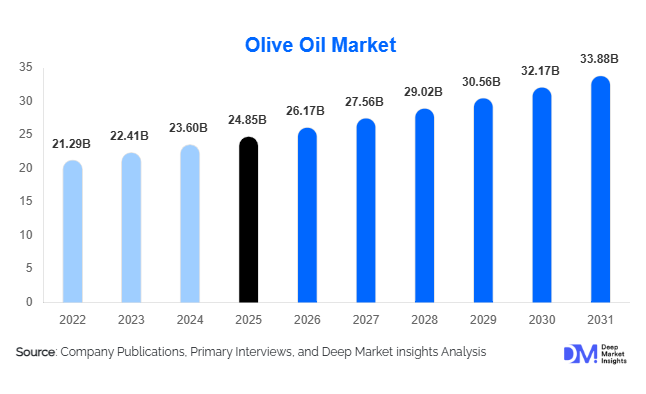
According to Deep Market Insights, the global olive oil market size was valued at USD 24.85 billion in 2025 and is projected to grow from USD 26.17 billion in 2026 to reach USD 33.88 billion by 2031, expanding at a CAGR of 5.3% during the forecast period (2026–2031). The olive oil market growth is primarily driven by increasing consumer preference for healthy edible oils, growing adoption of Mediterranean dietary patterns, rising demand for premium and organic food products, and expanding applications across the food & beverage, cosmetics, nutraceutical, and pharmaceutical industries. Growing awareness of the cardiovascular and antioxidant benefits associated with extra virgin olive oil is encouraging consumers to substitute conventional vegetable oils with olive oil. Furthermore, technological advancements in olive cultivation, cold-extraction processes, sustainable packaging, and digital traceability systems are strengthening product quality and supply chain transparency, supporting long-term market expansion.
Key Market Insights
- Extra Virgin Olive Oil (EVOO) accounts for nearly 48% of the global market, supported by strong consumer preference for minimally processed, premium-quality edible oils with superior nutritional benefits.
- Europe dominates the global olive oil market, contributing approximately 53% of total market revenue, with Spain, Italy, Greece, and Portugal remaining the world's leading production and export hubs.
- Asia-Pacific is the fastest-growing regional market, driven by rising disposable incomes, increasing health awareness, expanding organized retail, and growing demand from China, India, Japan, and South Korea.
- Household consumption represents the largest end-use segment, accounting for nearly 64% of global demand as consumers increasingly replace conventional cooking oils with healthier alternatives.
- Premiumization and sustainability are reshaping competitive dynamics, with manufacturers investing in organic certification, geographical indication labels, recyclable packaging, and blockchain-enabled traceability.
- Precision agriculture, AI-powered orchard monitoring, automated harvesting, and advanced cold-extraction technologies are improving production efficiency while helping producers mitigate climate-related supply risks.
Olive Oil Market Trends
Premium and Certified Olive Oils Continue to Gain Global Acceptance
Consumer demand is steadily shifting toward premium olive oil products, particularly Extra Virgin Olive Oil (EVOO), single-origin varieties, and oils carrying Protected Designation of Origin (PDO) or Protected Geographical Indication (PGI) certifications. Consumers increasingly associate certified olive oils with superior quality, authenticity, nutritional value, and traceability. This trend is encouraging producers to invest in premium branding, sustainable cultivation, and transparent sourcing practices. Organic olive oil is also witnessing above-average growth as consumers seek pesticide-free and environmentally sustainable food products. Retailers are expanding shelf space dedicated to premium olive oil brands, while foodservice operators are incorporating high-quality olive oils into gourmet dining experiences to enhance product differentiation.
Technology Transforming Olive Cultivation and Supply Chains
Technological innovation is becoming a major differentiator across the olive oil value chain. Producers are increasingly adopting precision agriculture, satellite-based crop monitoring, drone-assisted orchard management, automated harvesting systems, and AI-driven irrigation optimization to improve productivity while reducing water consumption. At the processing stage, advanced cold-extraction technologies are enabling higher oil yields while preserving nutritional compounds such as polyphenols and antioxidants. Blockchain-based traceability systems are also gaining popularity, allowing consumers to verify product origin, production methods, and authenticity through digital platforms. Sustainable packaging innovations, including lightweight glass bottles, recyclable PET containers, and bag-in-box solutions, are further strengthening environmental performance while extending product shelf life.
Olive Oil Market Drivers
Growing Consumer Preference for Healthy Dietary Fats
Increasing awareness regarding preventive healthcare and nutrition continues to drive olive oil consumption worldwide. Extra virgin olive oil is recognized for its high concentration of monounsaturated fatty acids, antioxidants, and polyphenols that contribute to improved cardiovascular health, reduced inflammation, and better metabolic wellness. As obesity, diabetes, and cardiovascular diseases become more prevalent globally, consumers are actively replacing refined vegetable oils with healthier alternatives. Healthcare professionals, nutritionists, and dietary guidelines increasingly recommend olive oil as part of balanced eating patterns, further accelerating household adoption across both developed and emerging economies.
Global Expansion of Mediterranean Dietary Habits
The Mediterranean diet has evolved into one of the world's most widely promoted healthy eating patterns, positioning olive oil as its primary source of dietary fat. Countries outside traditional olive oil consuming regions, including the United States, Canada, China, India, Australia, and Japan, are experiencing rising demand as consumers embrace Mediterranean-inspired cooking. The expansion of international cuisines, premium restaurants, and cooking education through digital platforms has increased familiarity with olive oil, encouraging both retail purchases and foodservice consumption. This long-term dietary transition continues to expand the addressable consumer base for premium olive oil manufacturers.
Olive Oil Market Restraints
Climate Variability and Raw Material Price Volatility
Olive oil production remains highly dependent on climatic conditions across Mediterranean growing regions. Prolonged droughts, extreme heatwaves, irregular rainfall, and changing weather patterns have increasingly affected olive yields in major producing countries such as Spain, Italy, and Greece. Reduced harvest volumes contribute to significant fluctuations in olive prices, increasing manufacturing costs and retail prices worldwide. Supply uncertainty also complicates long-term procurement strategies for processors, exporters, and food manufacturers that rely on stable olive oil supplies.
Product Adulteration and Counterfeit Premium Oils
The premium pricing associated with extra virgin olive oil has contributed to persistent challenges related to product adulteration and mislabeling. Blending lower-quality vegetable oils or refined olive oils and marketing them as premium products undermines consumer confidence and creates unfair competition for genuine producers. Although regulatory agencies have strengthened quality standards and authenticity testing procedures, inconsistent enforcement across global markets continues to present challenges. Manufacturers are therefore investing heavily in laboratory testing, digital traceability, and certification programs to reinforce consumer trust and protect brand reputation.
Olive Oil Market Opportunities
Rapid Demand Growth Across Emerging Asian Markets
Asia-Pacific presents one of the most attractive long-term growth opportunities for the olive oil market. Rising disposable incomes, urbanization, increasing health awareness, and expanding organized retail networks are driving consumption across China, India, Japan, South Korea, and Southeast Asia. While per capita consumption remains significantly lower than Mediterranean countries, awareness campaigns promoting healthy cooking oils and the growing popularity of international cuisines are expanding market penetration. E-commerce platforms and premium supermarkets are making imported olive oil more accessible to urban consumers, creating substantial opportunities for international producers to diversify revenue beyond traditional European and North American markets.
Expansion Beyond Food into Cosmetics and Nutraceuticals
Olive oil is increasingly being utilized as a functional ingredient across cosmetics, personal care, nutraceutical, and pharmaceutical applications. Rich in antioxidants, vitamin E, and natural moisturizing compounds, olive oil is widely incorporated into facial creams, soaps, shampoos, massage oils, anti-aging products, and therapeutic skincare formulations. Simultaneously, olive polyphenols are gaining popularity within dietary supplements targeting cardiovascular health, immune support, and healthy aging. As consumers continue to favor naturally derived ingredients over synthetic alternatives, manufacturers have significant opportunities to develop value-added olive oil formulations that generate higher profit margins while reducing dependence on traditional edible oil markets.
Report Scope
| Report Metric | Details |
|---|---|
| Market Size in 2025 | USD 24.85 Billion |
| Market Size in 2026 | USD 26.17 Billion |
| Market Size in 2031 | USD 33.88 Billion |
| CAGR | 5.3% (2026-2031) |
| Base Year for Estimation | 2025 |
| Historical Data | 2022-2024 |
| Forecast Period | 2026-2031 |
| Report Coverage | Revenue Forecast, Competitive Landscape, Supply Chain Disruption, Growth Factors, Environment & Regulatory Landscape and Trends |
| Geographies Covered | North America, Europe, APAC, Middle East and Africa, LATAM |
| Countries Covered | U.S., Canada, U.K., Germany, France, Spain, Italy, Russia, Nordic, Benelux, Rest of Europe, China, Korea, Japan, India, Australia, Singapore, Taiwan, South East Asia, Rest of Asia-Pacific, UAE, Turky, Saudi Arabia, South Africa, Egypt, Nigeria, Rest of MEA, Brazil, Mexico, Argentina, Chile, Colombia, Rest of LATAM |
Explore more data points, trends and opportunities Download Free Sample Report
Product Type Insights
Extra Virgin Olive Oil (EVOO) dominates the global olive oil market, accounting for approximately 48.2% of total market revenue in 2025. The segment continues to lead owing to its superior nutritional profile, minimal processing, and strong consumer perception of quality and authenticity. EVOO is rich in monounsaturated fatty acids, polyphenols, and natural antioxidants, making it the preferred choice among health-conscious consumers. Growing adoption of Mediterranean dietary habits, increasing demand for premium edible oils, and expanding use in gourmet cooking have further strengthened segment growth. Manufacturers are increasingly introducing single-origin, cold-pressed, organic, and PDO/PGI-certified EVOO products to capture premium price points and improve brand differentiation.
Virgin Olive Oil maintains steady demand across traditional olive oil-consuming countries owing to its favorable balance between quality and affordability. The segment is widely utilized in household cooking and commercial foodservice applications where consumers seek natural olive oil characteristics without the premium pricing associated with extra virgin variants. Refined Olive Oil continues to serve mainstream retail and institutional foodservice markets due to its mild flavor, higher smoke point, and competitive pricing. It is commonly blended with virgin olive oil to produce pure olive oil, making it suitable for everyday cooking and frying applications.
Pure Olive Oil, a blend of refined and virgin olive oils, remains popular among price-sensitive consumers seeking a balance between nutritional benefits and affordability. Meanwhile, Olive Pomace Oil occupies a niche position within industrial food processing and commercial frying applications, where cost efficiency and high-temperature stability are key purchasing considerations.
Nature Insights
Conventional olive oil accounted for nearly 81.4% of the global market in 2025, supported by its extensive cultivation area, higher production volumes, established distribution networks, and relatively lower retail prices. Large-scale producers across Spain, Italy, Greece, Portugal, and Türkiye continue to rely predominantly on conventional farming methods to satisfy growing international demand. The segment benefits from well-developed export infrastructure and widespread availability across supermarkets, foodservice distributors, and institutional buyers.
Although comparatively smaller, the organic olive oil segment is expected to register the fastest growth during the forecast period. Increasing consumer preference for pesticide-free food products, rising environmental awareness, and expanding organic food retail channels are driving demand across North America, Europe, and Asia-Pacific. Premium pricing opportunities and government support for sustainable agriculture are encouraging producers to convert conventional olive groves into certified organic plantations. Growing demand from premium restaurants, specialty retailers, and health-conscious households is expected to further accelerate market expansion.
Packaging Type Insights
Glass bottles represent the largest packaging segment, accounting for approximately 51.8% of the global olive oil market in 2025. Premium olive oil manufacturers overwhelmingly prefer dark-colored glass bottles because they protect oil from light-induced oxidation while reinforcing premium product positioning. Glass packaging also enhances consumer confidence by preserving flavor, aroma, and nutritional quality throughout the product lifecycle. Metal cans and tins remain widely used for bulk household purchases and export shipments due to their excellent protection against light exposure and extended shelf life. These formats are particularly common across Mediterranean countries and institutional foodservice markets.
PET bottles continue to gain popularity within the economy and mid-priced product categories because they offer lower transportation costs, reduced breakage risks, and greater convenience for retailers. Manufacturers are increasingly introducing recyclable PET solutions to improve environmental performance while reducing logistics costs. Flexible packaging solutions, including stand-up pouches and bag-in-box formats, are emerging as one of the fastest-growing packaging categories. These formats reduce packaging waste, improve storage efficiency, and minimize oxygen exposure after opening, making them increasingly attractive for premium foodservice establishments and environmentally conscious consumers. Bulk packaging in drums, intermediate bulk containers (IBCs), and tanker shipments continues to dominate B2B exports between producing countries and international bottlers.
Distribution Channel Insights
Hypermarkets and supermarkets accounted for nearly 46.9% of global olive oil sales in 2025, making them the largest distribution channel. Organized retail chains provide consumers with extensive product portfolios, promotional pricing, private-label offerings, and premium international brands under a single shopping destination. Their strong purchasing power and well-established supply chains enable manufacturers to achieve broad market penetration across developed and emerging economies. Specialty food stores continue to play an important role in premium olive oil sales by offering certified organic products, artisanal brands, and geographically protected olive oils that appeal to discerning consumers. These retailers often emphasize product education, tasting experiences, and origin-based differentiation.
Online retail and e-commerce represent the fastest-growing distribution channel. Digital platforms allow consumers to compare brands, access subscription services, read product reviews, and purchase premium imported olive oils directly from producers. The rapid growth of direct-to-consumer (D2C) business models is enabling manufacturers to improve profit margins while strengthening customer engagement through personalized marketing and loyalty programs. Foodservice distributors continue expanding their presence as restaurants, hotels, cafés, and institutional kitchens increasingly prioritize premium cooking ingredients. Direct producer-to-business sales also remain significant within export markets where large food manufacturers and private-label bottlers procure olive oil in bulk quantities.
End-use Insights
Household consumption remains the largest end-use segment, contributing approximately 63.8% of the global olive oil market in 2025. Increasing health consciousness, rising disposable incomes, and greater awareness of the nutritional advantages of olive oil have encouraged consumers to replace conventional edible oils with healthier alternatives. Home cooking trends, premium grocery retail expansion, and wider availability of imported olive oils continue to support steady household demand across North America, Europe, and Asia-Pacific. The foodservice industry represents one of the fastest-growing commercial end-use segments. Hotels, restaurants, cafés, quick-service restaurants (QSRs), and premium catering providers increasingly utilize olive oil to satisfy growing consumer demand for healthier and more authentic culinary experiences. International cuisines such as Mediterranean, Italian, and Middle Eastern foods continue to drive commercial consumption worldwide.
The food processing industry is steadily increasing its utilization of olive oil in sauces, dressings, ready-to-eat meals, bakery products, canned foods, and gourmet packaged products. Manufacturers are incorporating olive oil into premium formulations to enhance nutritional positioning and support clean-label product development. Beyond food applications, the cosmetics and personal care industry is emerging as a high-value growth segment, utilizing olive oil in skincare creams, soaps, shampoos, massage oils, lip care products, and anti-aging formulations. Simultaneously, the nutraceutical and pharmaceutical sectors are expanding the use of olive-derived polyphenols and bioactive compounds in dietary supplements, cardiovascular wellness products, and functional healthcare formulations. These non-food applications are expected to generate above-average growth and higher profitability over the forecast period, reducing the industry's dependence on traditional retail edible oil consumption.
Explore more data points, trends and opportunities Download Free Sample Report
Olive Oil Market Segmentations
By Product Type
- Extra Virgin Olive Oil
- Virgin Olive Oil
- Refined Olive Oil
- Pure Olive Oil
- Olive Pomace Oil
By Nature
- Conventional
- Organic
By Packaging Type
- Glass Bottles
- PET Bottles
- Metal Cans & Tins
- Flexible Packaging (Pouches & Bag-in-Box)
- Bulk Packaging
By Distribution Channel
- Hypermarkets & Supermarkets
- Convenience Stores
- Specialty Food Stores
- Online Retail / E-commerce
- Foodservice Distributors
- Direct Sales
By End Use
- Household/Retail Consumption
- Food Processing Industry
- Foodservice (Hotels, Restaurants & Cafés)
- Cosmetics & Personal Care
- Pharmaceuticals & Nutraceuticals
- Industrial Applications
Regional Insights
Europe
Europe dominates the global olive oil market, accounting for approximately 52.8% of total market revenue in 2025. The region benefits from centuries-old olive cultivation practices, highly developed processing infrastructure, favorable climatic conditions, and globally recognized quality certification systems. Europe also represents the world's largest production and export hub, supplying a significant proportion of international demand. Strong domestic consumption, premium product innovation, and continuous investments in sustainable agriculture further reinforce the region's market leadership.
Spain is the largest country-level market, contributing nearly 23.5% of global market value. The country leads global olive cultivation, production, and exports owing to extensive orchard acreage, mechanized harvesting systems, and highly efficient processing facilities. Spanish producers continue expanding premium extra virgin olive oil exports while investing in precision agriculture, water-efficient irrigation, and digital traceability systems.
Italy accounts for approximately 13.8% of the global market, supported by strong domestic consumption and internationally recognized premium brands. Italian olive oil enjoys a premium reputation due to Protected Designation of Origin (PDO) certifications, artisanal production methods, and strong export demand across North America and Asia-Pacific. Greece and Portugal continue to strengthen their market positions through expanding organic cultivation, premium product exports, and modernization of olive processing facilities. Germany and France remain among Europe's largest import-dependent consumer markets, driven by increasing health awareness and premium food consumption.
North America
North America represents approximately 17.6% of the global olive oil market in 2025, supported primarily by strong retail consumption and increasing preference for healthier cooking oils. Growing awareness regarding cardiovascular health, expansion of Mediterranean dietary habits, and rising premium grocery sales continue to stimulate regional demand.
The United States accounts for nearly 15.4% of global market revenue, making it the world's largest olive oil importing country. Consumption continues to rise as consumers increasingly replace conventional vegetable oils with olive oil for cooking, salad dressings, and functional food applications. California contributes a modest share of domestic production; however, imports from Spain, Italy, Greece, Portugal, and Türkiye continue to satisfy the majority of demand.
Canada is witnessing steady market expansion supported by increasing multicultural food consumption, premium retail development, and growing interest in healthy dietary patterns. Mexico also represents an emerging consumption market as urban households and commercial foodservice operators gradually increase olive oil utilization.
Asia-Pacific
Asia-Pacific accounted for approximately 16.3% of the global olive oil market in 2025 and is projected to register the fastest regional CAGR of approximately 7.1% through 2031. Rising disposable incomes, rapid urbanization, westernization of food habits, and expanding organized retail are driving substantial growth across the region. China remains the region's largest importer, supported by increasing premium food consumption and greater consumer awareness regarding healthy edible oils. International brands continue expanding their presence through e-commerce platforms, specialty retailers, and premium supermarkets.
India is expected to emerge as the fastest-growing country globally, registering an estimated CAGR of around 8.5% during the forecast period. Government campaigns promoting healthier edible oils, rising middle-class purchasing power, and growing popularity of Mediterranean cuisine are accelerating household adoption. Expanding foodservice chains and online grocery platforms are further strengthening demand. Japan continues to represent a mature premium market characterized by strong demand for high-quality extra virgin olive oil, while South Korea and Southeast Asian countries are witnessing rapid growth driven by premium food retail expansion, wellness trends, and increasing use of olive oil in home cooking.
Latin America
Latin America contributes approximately 6.2% of the global olive oil market. Although regional consumption remains relatively modest compared to Europe and North America, demand continues to increase steadily due to improving household incomes and greater awareness of healthy cooking oils.
Brazil remains the region's largest importer, with premium olive oil consumption expanding across major metropolitan areas. Argentina and Chile have developed competitive domestic olive oil industries supported by favorable climatic conditions and increasing export opportunities. Investments in modern olive plantations, advanced irrigation systems, and premium branding are enhancing regional competitiveness within international markets.
Middle East & Africa
The Middle East & Africa accounted for approximately 7.1% of the global olive oil market in 2025. The region combines mature olive-producing economies with rapidly growing import-dependent consumer markets.
Türkiye continues to strengthen its position as one of the world's leading olive oil producers and exporters through expanding olive cultivation, modernization of milling infrastructure, and government support for agricultural exports. Tunisia and Morocco also play important roles in supplying export markets, particularly within Europe and North America.
Among importing countries, Saudi Arabia and the United Arab Emirates continue registering robust demand due to premium food consumption, hospitality sector expansion, and growing expatriate populations familiar with Mediterranean cuisine. Rising tourism activity and increasing investment in premium retail channels are expected to support sustained regional market growth.
Key Players in the Olive Oil Market
- Deoleo S.A.
- Sovena Group
- Salov Group
- Borges Agricultural & Industrial Edible Oils
- Costa d'Oro S.p.A.
- Pompeian Inc.
- Monini S.p.A.
- Farchioni Olii S.p.A.
- Acesur Group
- Ybarra Alimentación
- Migasa Group
- Olitalia S.r.l.
- Colavita S.p.A.
- Gaea Products S.A.
- Minerva S.A.