Raw Quinoa Market Size
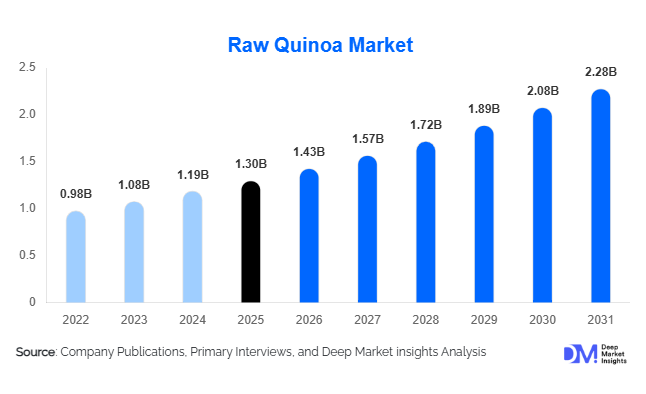
According to Deep Market Insights, the global raw quinoa market was valued at USD 1.30 billion in 2025 and is estimated to reach USD 1.43 billion in 2026. The market is projected to attain USD 2.28 billion by 2031, registering a CAGR of 9.8% during the forecast period (2026–2031). Market growth is supported by increasing global demand for nutrient-dense ancient grains, expanding adoption of plant-based diets, rising consumption of gluten-free foods, and growing incorporation of quinoa into functional food formulations. Improvements in international trade, expansion of quinoa cultivation beyond South America, and continuous product innovation by food manufacturers are further strengthening market development across both developed and emerging economies.
Key Market Insights
- Organic raw quinoa continues to gain market share as consumers increasingly prefer clean-label, sustainably cultivated grains with certified traceability.
- Food processing remains the largest application segment, accounting for a significant share of global demand through breakfast cereals, bakery products, snacks, pasta, infant nutrition, and ready-to-eat meals.
- North America represents the largest regional market, driven by widespread consumer awareness regarding healthy eating, gluten-free diets, and premium food consumption.
- Asia-Pacific is projected to be the fastest-growing regional market, supported by rising disposable incomes, rapid urbanization, and expanding modern retail infrastructure.
- Manufacturers are diversifying cultivation beyond Bolivia and Peru to improve supply chain resilience and reduce dependence on traditional production regions.
- Digital agriculture, precision farming, and advanced post-harvest processing technologies are improving crop yields, quality consistency, and export competitiveness worldwide.
Raw Quinoa Market Latest Trends
Rapid Expansion of Functional Food Applications
Raw quinoa is increasingly being incorporated into functional foods as manufacturers respond to consumer demand for nutrient-rich ingredients that deliver health benefits beyond basic nutrition. High-quality protein, dietary fiber, essential amino acids, antioxidants, vitamins, and minerals have positioned quinoa as one of the fastest-growing ancient grains within premium food categories. Manufacturers are expanding its use across breakfast cereals, protein bars, bakery products, gluten-free flour blends, snack foods, dairy alternatives, infant nutrition, and sports nutrition formulations. Food companies are also combining quinoa with legumes, seeds, oats, and pulses to develop multi-grain functional products that target weight management, digestive health, and cardiovascular wellness. This diversification is increasing demand for raw quinoa as an industrial food ingredient rather than solely as a retail grain.
Sustainable Cultivation and Organic Production Becoming Industry Standards
Sustainability has become a defining trend across the raw quinoa market. Consumers increasingly seek organically certified, non-GMO, fair-trade, and environmentally responsible food products, encouraging producers to invest in regenerative farming practices and transparent supply chains. Several producing countries are expanding certified organic acreage while adopting water-efficient irrigation, soil conservation techniques, and climate-resilient crop varieties. Blockchain-enabled traceability systems and digital farm monitoring are also improving transparency between producers, exporters, processors, and retailers. These initiatives not only strengthen consumer confidence but also enable suppliers to command premium pricing in developed markets where sustainability credentials strongly influence purchasing decisions.
Raw Quinoa Market Drivers
Growing Consumer Preference for Plant-Based Nutrition
Global dietary preferences continue shifting toward plant-based nutrition, creating sustained demand for protein-rich grains such as raw quinoa. Consumers increasingly seek alternatives to animal-derived proteins due to health, environmental, and ethical considerations. Quinoa's complete amino acid profile, gluten-free characteristics, and high nutritional value make it an attractive ingredient across vegetarian, vegan, flexitarian, and sports nutrition markets. Food manufacturers continue introducing quinoa-based products that address these evolving dietary preferences, thereby expanding market penetration across retail and foodservice channels.
Increasing Demand for Gluten-Free and Clean-Label Foods
The rising prevalence of gluten intolerance and consumer awareness regarding digestive health have significantly accelerated demand for naturally gluten-free grains. Raw quinoa has emerged as one of the preferred alternatives to wheat because it requires minimal processing while delivering superior nutritional characteristics. Simultaneously, clean-label purchasing trends encourage manufacturers to reduce artificial ingredients and utilize naturally nutritious raw materials. These factors continue driving incorporation of quinoa into bakery products, cereals, pasta, and ready-to-cook meal solutions across global food industries.
Expansion of Global Food Manufacturing Industry
Food processors increasingly utilize quinoa as a premium ingredient to differentiate products within competitive health food markets. Investments in functional foods, organic product lines, premium convenience foods, and fortified nutrition products continue supporting industrial demand. Expansion of private-label health foods by supermarkets and growing investment in food innovation across North America, Europe, and Asia-Pacific further stimulate large-scale procurement of raw quinoa from global suppliers.
Raw Quinoa Market Restraints
Climate Dependence and Agricultural Supply Volatility
Raw quinoa production remains susceptible to climatic fluctuations, including droughts, irregular rainfall, temperature variability, and soil degradation. Traditional producing countries continue facing weather-related production risks that can reduce harvest volumes and create supply shortages. Limited geographic concentration of premium quinoa cultivation also contributes to market uncertainty, affecting export availability and pricing stability for downstream food manufacturers.
Premium Pricing Compared to Conventional Grains
Although quinoa offers superior nutritional benefits, its retail and industrial pricing remains considerably higher than staple grains such as rice, wheat, barley, and oats. Higher cultivation costs, specialized processing requirements, international logistics expenses, and certification costs contribute to elevated prices. These factors may limit adoption among price-sensitive consumers and constrain penetration into lower-income markets where affordability remains a primary purchasing consideration.
Raw Quinoa Market Industry Key Opportunities
Expansion Across Emerging Consumer Markets
Emerging economies across Asia-Pacific, the Middle East, and parts of Latin America present significant opportunities for market expansion. Rising health awareness, increasing disposable income, rapid urbanization, and expansion of organized retail have substantially increased consumer exposure to superfoods and functional ingredients. Manufacturers introducing localized product formats, smaller retail packaging, and region-specific marketing strategies are expected to capture new consumer segments. Growth in e-commerce platforms further improves accessibility to premium grains in previously underserved markets.
Innovation in Functional Ingredients and Organic Product Development
Food manufacturers are increasingly developing value-added quinoa ingredients such as quinoa flour, protein concentrates, grain blends, infant nutrition formulations, and fortified cereals. Simultaneously, investments in organic certification, regenerative agriculture, fair-trade sourcing, and carbon-conscious farming practices allow producers to access premium international markets. Companies integrating sustainability with product innovation are expected to achieve stronger pricing power and long-term competitive differentiation within the global raw quinoa industry.
Report Scope
| Report Metric | Details |
|---|---|
| Market Size in 2025 | USD 1.30 Billion |
| Market Size in 2026 | USD 1.43 Billion |
| Market Size in 2031 | USD 2.28 Billion |
| CAGR | 9.8% (2026-2031) |
| Base Year for Estimation | 2025 |
| Historical Data | 2022-2024 |
| Forecast Period | 2026-2031 |
| Report Coverage | Revenue Forecast, Competitive Landscape, Supply Chain Disruption, Growth Factors, Environment & Regulatory Landscape and Trends |
| Geographies Covered | North America, Europe, APAC, Middle East and Africa, LATAM |
| Countries Covered | U.S., Canada, U.K., Germany, France, Spain, Italy, Russia, Nordic, Benelux, Rest of Europe, China, Korea, Japan, India, Australia, Singapore, Taiwan, South East Asia, Rest of Asia-Pacific, UAE, Turky, Saudi Arabia, South Africa, Egypt, Nigeria, Rest of MEA, Brazil, Mexico, Argentina, Chile, Colombia, Rest of LATAM |
Explore more data points, trends and opportunities Download Free Sample Report
Product Type Insights
White raw quinoa accounts for the largest share of the global raw quinoa market, representing approximately 61.8% of the 2025 market value. Its mild flavor, soft texture after cooking, and broad consumer acceptance make it the preferred variety among households, foodservice providers, and food manufacturers. White quinoa is extensively used in breakfast cereals, grain bowls, bakery products, and ready-to-cook meal kits due to its neutral taste and superior processing characteristics. Red raw quinoa holds a notable share owing to its firmer texture and visual appeal in salads and gourmet meals, while black quinoa is gaining traction in premium and specialty food categories because of its higher antioxidant content. Tri-color quinoa blends are witnessing increasing adoption in premium retail packaging, catering to consumers seeking both nutritional diversity and aesthetic presentation.
Nature Insights
Conventional raw quinoa remains the dominant category, accounting for nearly 68.5% of the global market in 2025, supported by large-scale commercial cultivation and competitive pricing. Food manufacturers sourcing quinoa for cereals, snacks, bakery products, and processed foods continue to favor conventional varieties due to consistent supply availability. However, organic raw quinoa represents the fastest-growing segment, registering double-digit annual growth driven by increasing consumer preference for pesticide-free, non-GMO, and sustainably cultivated products. Retailers across North America and Europe continue expanding shelf space for certified organic grains, enabling producers to command premium prices and improve profit margins.
Origin Insights
South American-origin quinoa, primarily sourced from Bolivia and Peru, continues to dominate the global market with approximately 72.4% market share in 2025. These countries benefit from favorable climatic conditions, centuries of cultivation expertise, established export infrastructure, and internationally recognized quinoa varieties. Nevertheless, commercial cultivation is steadily expanding across North America, Europe, India, China, and Australia as governments and agricultural institutions seek to diversify production and reduce dependence on imports. This geographical expansion is expected to improve supply chain resilience while supporting long-term market growth.
Processing Level Insights
Pre-washed and de-saponized raw quinoa represents the leading processing segment, accounting for nearly 58.6% of global demand. Consumers increasingly prefer quinoa that requires minimal preparation before cooking, while industrial food manufacturers benefit from standardized ingredient quality and reduced processing time. Unwashed quinoa continues to serve ingredient processors and bulk buyers that perform in-house cleaning and saponin removal before further processing. Advances in post-harvest technologies have improved product consistency, food safety, and export quality, encouraging broader commercial adoption.
Packaging Type Insights
Retail packs below 5 kg account for the highest market share at approximately 54.2% of global revenue, driven by increasing household consumption through supermarkets, health food stores, and online retail platforms. Smaller packaging formats improve convenience and product accessibility for first-time consumers. Bulk packaging exceeding 25 kg remains essential for food manufacturers, institutional buyers, and foodservice operators, while medium-sized packs continue gaining popularity among wholesalers and specialty retailers serving both commercial and retail customers.
Distribution Channel Insights
Business-to-Business (B2B) distribution dominates the raw quinoa market with an estimated 63.7% share of global revenue in 2025. Food manufacturers procure substantial quantities of raw quinoa for incorporation into cereals, bakery products, snacks, pasta, and nutritional foods. The Business-to-Consumer (B2C) segment continues to expand rapidly due to rising health awareness, increasing online grocery penetration, and growing availability of premium grains through supermarkets, specialty organic retailers, and direct-to-consumer e-commerce platforms. Digital retail channels have significantly enhanced product visibility and consumer accessibility worldwide.
Application Insights
Food processing remains the largest application segment, contributing approximately 47.9% of the global raw quinoa market in 2025. Manufacturers increasingly utilize quinoa in breakfast cereals, bakery products, pasta, snack foods, ready meals, flour blends, and infant nutrition due to its nutritional profile and clean-label positioning. Direct household consumption continues to represent a substantial share, while nutraceutical manufacturers are increasingly incorporating quinoa into dietary supplements and protein formulations. Emerging applications within cosmetics and premium pet nutrition are creating additional opportunities for market diversification.
End User Insights
Food and beverage manufacturers account for the largest end-user segment with nearly 44.8% of global market demand. The industry's focus on functional ingredients, premium nutrition, and product innovation continues driving procurement of raw quinoa. Household consumption remains robust as consumers prepare healthier home-cooked meals incorporating ancient grains. Nutraceutical manufacturers represent one of the fastest-growing end-user categories, supported by increasing demand for plant-based proteins and functional nutrition. Hotels, restaurants, and catering companies are also expanding quinoa-based menu offerings as consumers increasingly seek healthier dining alternatives.
Explore more data points, trends and opportunities Download Free Sample Report
Raw Quinoa Market Segmentations
By Product Type
- White Raw Quinoa
- Red Raw Quinoa
- Black Raw Quinoa
- Tri-color Raw Quinoa
By Nature
- Conventional Raw Quinoa
- Organic Raw Quinoa
By Origin
- South American Origin
- North American Origin
- European Origin
- Asia-Pacific Origin
- Others
By Processing Level
- Unwashed Raw Quinoa
- Pre-washed Raw Quinoa
- De-saponized Raw Quinoa
By Packaging Type
- Retail Packs
- Medium Packs
- Bulk Bags
Regional Insights
North America
North America accounted for approximately 34.6% of the global raw quinoa market in 2025, making it the largest regional market. The United States dominates regional consumption owing to widespread adoption of gluten-free diets, strong demand for plant-based nutrition, and well-established retail distribution networks. Canada also demonstrates strong demand, supported by growing health-conscious consumer populations and increasing domestic cultivation. Mexico continues to expand quinoa imports as premium health foods gain popularity among urban consumers. High disposable income, product innovation, and strong consumer awareness continue supporting regional market leadership.
Europe
Europe represented nearly 28.3% of global market revenue in 2025. Germany remains the region's largest consumer due to its mature organic food market and strong demand for functional ingredients. The United Kingdom, France, Italy, Spain, and the Netherlands continue witnessing increasing quinoa consumption across retail and foodservice sectors. European consumers place significant emphasis on sustainability, fair-trade sourcing, and organic certification, encouraging importers to strengthen traceable supply chains. Expansion of plant-based food manufacturing further supports regional demand.
Asia-Pacific
Asia-Pacific is projected to register the fastest CAGR through 2031. China and India are rapidly emerging as major consumption centers due to rising disposable incomes, expanding middle-class populations, and increasing awareness of healthy dietary practices. Japan and South Korea continue driving premium food demand, while Australia has developed both domestic cultivation and strong consumer acceptance. Expansion of modern retail chains, online grocery platforms, and functional food manufacturing is expected to accelerate regional market growth significantly during the forecast period.
Latin America
Latin America plays a dual role as both the world's largest production hub and an increasingly important consumption market. Bolivia and Peru remain the dominant exporters, supplying premium-quality quinoa to North America, Europe, and Asia-Pacific. Brazil, Argentina, and Chile continue expanding domestic consumption through health-conscious urban populations and growing retail availability. Government support for agricultural exports and sustainable farming practices continues strengthening the region's competitive position within the global quinoa supply chain.
Middle East & Africa
The Middle East & Africa currently accounts for a relatively smaller share of the global market but presents considerable long-term growth potential. The United Arab Emirates and Saudi Arabia are leading regional importers due to strong demand for premium health foods and expanding expatriate populations. South Africa remains the largest African consumer, supported by modern retail expansion and increasing awareness of plant-based nutrition. Rising investment in food security initiatives and diversification of imported grain portfolios are expected to support future market growth across the region.
Key Players in the Raw Quinoa Market
- Andean Valley Corporation
- Quinoa Foods Company
- NorQuin
- Northern Quinoa Production Corporation
- Adaptive Seeds
- Quinoabol
- Irupana Andean Organic Food S.A.
- COMRURAL XXI
- Alter Eco Foods
- Nature's Path Foods
- Ancient Harvest
- The British Quinoa Company
- Dutch Quinoa Group
- Quinoa Corporation
- Big Oz Industries