Office Soundproof Booth Market Size
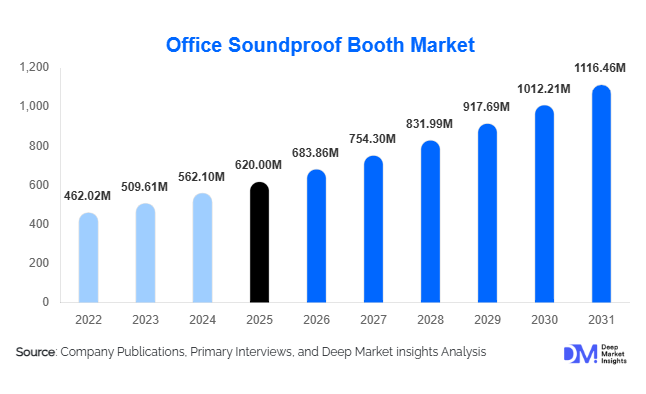
According to Deep Market Insights, the global office soundproof booth market size was valued at USD 620 million in 2025 and is projected to grow from USD 683.86 million in 2026 to reach USD 1,116.46 million by 2031, expanding at a CAGR of 10.3% during the forecast period (2026–2031). The office soundproof booth market growth is primarily driven by the widespread adoption of hybrid work models, increasing deployment of open-plan office environments, and growing demand for private spaces that support focused work, video conferencing, and confidential business discussions. As organizations seek flexible alternatives to permanent office construction, acoustic booths are becoming a strategic workplace investment that enhances employee productivity, privacy, and workplace wellness.
Key Market Insights
- Hybrid workplace transformation is accelerating demand for modular acoustic solutions, as organizations redesign office layouts around collaboration and focused work requirements.
- Single-person phone booths remain the dominant product category, accounting for approximately 32% of global market revenue due to their suitability for virtual meetings and private communications.
- North America leads the global market, supported by extensive adoption of open-office concepts, workplace modernization programs, and advanced workplace technology integration.
- Asia-Pacific is the fastest-growing regional market, driven by office infrastructure expansion, coworking growth, and rising investments in technology parks and business process outsourcing facilities.
- Smart and connected acoustic booths are gaining significant traction, incorporating occupancy sensors, automated ventilation systems, air-quality monitoring, and workplace analytics capabilities.
- Sustainability has become a major purchasing criterion, with enterprises increasingly preferring booths manufactured from recyclable materials and compliant with green building standards.
Office Soundproof Booth Market Trends
Smart Workplace Integration Driving Product Innovation
Office soundproof booth manufacturers are increasingly integrating intelligent workplace technologies into their product portfolios. Modern acoustic booths now feature occupancy sensors, IoT connectivity, automated booking systems, smart ventilation controls, adaptive lighting, and air quality monitoring capabilities. These innovations enable organizations to optimize workplace utilization while enhancing employee comfort and productivity. The integration of workplace analytics platforms allows facility managers to monitor booth usage patterns, optimize office layouts, and improve return on investment from workplace infrastructure. As enterprises continue to digitize workplace operations, technology-enabled booths are becoming a preferred solution for modern office environments.
Sustainable and Modular Workspace Solutions Gaining Momentum
Sustainability has emerged as a defining trend across the office soundproof booth market. Organizations are increasingly prioritizing environmentally responsible workplace solutions that align with corporate ESG objectives. Manufacturers are responding by incorporating recycled aluminum, low-emission materials, sustainable fabrics, and energy-efficient ventilation systems into booth designs. Modular construction techniques are also gaining popularity, allowing companies to relocate, reconfigure, and reuse booths as office requirements evolve. This flexibility reduces renovation costs and minimizes construction waste, making soundproof booths an attractive alternative to permanent office modifications.
Office Soundproof Booth Market Drivers
Growth of Hybrid Work and Video Conferencing
The widespread adoption of hybrid work models has fundamentally transformed office space utilization. Employees increasingly require quiet, private environments for virtual meetings, client interactions, and focused work sessions. As video conferencing platforms become embedded within daily business operations, organizations are investing in acoustic booths to address privacy concerns and reduce workplace distractions. This trend is particularly evident across technology, consulting, financial services, and professional services sectors where confidential communications are essential.
Expansion of Open-Plan Office Environments
Open-plan offices continue to dominate commercial workspace design due to their ability to encourage collaboration and optimize real estate utilization. However, these layouts often create significant noise-related productivity challenges. Soundproof booths offer a practical and cost-effective solution by providing enclosed spaces without requiring expensive office renovations. The growing recognition of acoustic comfort as a contributor to employee productivity is further accelerating market adoption globally.
Office Soundproof Booth Market Restraints
High Initial Capital Investment
Despite strong demand fundamentals, the relatively high upfront cost of premium office soundproof booths remains a challenge for market expansion. Enterprise-grade booths equipped with advanced acoustic materials, smart technologies, and enhanced ventilation systems can represent a substantial capital expenditure, particularly for small and medium-sized businesses. Budget constraints may delay purchasing decisions and limit adoption among price-sensitive organizations.
Lack of Standardized Acoustic Performance Evaluation
The market continues to face challenges associated with inconsistent acoustic performance measurement standards. While international certifications and testing frameworks are becoming more prevalent, differences in measurement methodologies create difficulties for buyers attempting to compare products across suppliers. This lack of standardization can slow procurement processes and increase customer uncertainty regarding actual sound reduction capabilities.
Office Soundproof Booth Market Opportunities
Expansion Across Emerging Commercial Real Estate Markets
Rapid commercial infrastructure development across India, Southeast Asia, the Middle East, and parts of Latin America presents substantial growth opportunities for office soundproof booth manufacturers. The expansion of technology parks, global capability centers, business process outsourcing facilities, and coworking spaces is creating sustained demand for privacy-focused workplace solutions. As multinational corporations continue to establish regional offices in emerging economies, demand for modular acoustic infrastructure is expected to accelerate significantly.
Premium Smart Booth Ecosystems
The emergence of intelligent workplace ecosystems presents a significant opportunity for market participants. Manufacturers are increasingly developing premium booths equipped with workplace management software integration, environmental controls, occupancy analytics, and predictive maintenance capabilities. These solutions not only command higher margins but also create opportunities for recurring software and service revenues. As enterprises prioritize data-driven workplace management, connected acoustic booths are expected to become a rapidly expanding market segment.
Report Scope
| Report Metric | Details |
|---|---|
| Market Size in 2025 | USD 620 Million |
| Market Size in 2026 | USD 683.86 Million |
| Market Size in 2031 | USD 1116.46 Million |
| CAGR | 10.3% (2026-2031) |
| Base Year for Estimation | 2025 |
| Historical Data | 2022-2024 |
| Forecast Period | 2026-2031 |
| Report Coverage | Revenue Forecast, Competitive Landscape, Supply Chain Disruption, Growth Factors, Environment & Regulatory Landscape and Trends |
| Geographies Covered | North America, Europe, APAC, Middle East and Africa, LATAM |
| Countries Covered | U.S., Canada, U.K., Germany, France, Spain, Italy, Russia, Nordic, Benelux, Rest of Europe, China, Korea, Japan, India, Australia, Singapore, Taiwan, South East Asia, Rest of Asia-Pacific, UAE, Turky, Saudi Arabia, South Africa, Egypt, Nigeria, Rest of MEA, Brazil, Mexico, Argentina, Chile, Colombia, Rest of LATAM |
Explore more data points, trends and opportunities Download Free Sample Report
Product Type Insights
Single-person phone booths dominate the office soundproof booth market, accounting for approximately 32% of total revenue in 2025. Their popularity is driven by growing demand for private spaces that support video conferencing, confidential conversations, and focused individual work. Small meeting pods designed for three to four occupants represent another major segment, widely adopted by organizations seeking flexible collaboration spaces without constructing permanent meeting rooms. Large meeting pods and executive privacy booths continue to gain traction among multinational corporations and premium office developments, while multi-purpose acoustic rooms are increasingly utilized for hybrid collaboration, brainstorming sessions, and training activities.
Installation Type Insights
Freestanding modular booths represent the largest installation segment, accounting for approximately 58% of global market revenue. Organizations favor modular solutions because they can be installed quickly, relocated as office layouts evolve, and deployed without major structural modifications. Portable acoustic booths are gaining popularity among coworking operators and flexible office providers due to their adaptability. Semi-permanent and fully customized installations remain concentrated within large corporate headquarters, financial institutions, and government facilities that require higher levels of acoustic isolation and design customization.
Technology Integration Insights
Conventional office soundproof booths continue to account for the majority of installed units globally; however, smart sensor-enabled products are experiencing the fastest growth. These solutions incorporate occupancy monitoring, ventilation management, energy optimization, and environmental controls that improve user experience while providing valuable workplace analytics. IoT-connected booths are increasingly integrated with workplace reservation systems and facility management platforms, enabling organizations to maximize utilization and improve operational efficiency. AI-enabled booth management systems are also emerging as a premium category within the market.
End-Use Industry Insights
Corporate offices remain the largest end-use segment, representing approximately 45% of total market demand. Large enterprises are investing heavily in acoustic solutions to support hybrid work environments and improve employee productivity. Coworking and flexible workspace operators represent the fastest-growing end-use category, benefiting from increasing demand for privacy solutions within shared office environments. The IT and ITES sector continues to be a major contributor due to extensive video conferencing requirements, while banking, financial services, healthcare administration, legal services, and educational institutions are increasingly adopting soundproof booths to support confidential communication and focused work activities.
Explore more data points, trends and opportunities Download Free Sample Report
Office Soundproof Booth Market Segmentations
By Product Type
- Single-Person Phone Booths
- Single-Person Focus Pods
- Two-Person Collaboration Booths
- Small Meeting Pods (3–4 Persons)
- Medium Meeting Pods (5–6 Persons)
- Large Meeting Pods (7+ Persons)
- Executive Privacy Pods
- Multi-Purpose Acoustic Rooms
By Installation Type
- Freestanding Modular Booths
- Portable / Mobile Booths
- Semi-Permanent Installed Booths
- Fully Customized Built-In Acoustic Booths
By Technology Integration
- Conventional Booths
- Smart Sensor-Enabled Booths
- IoT-Connected Booths
- AI-Based Occupancy & Environment Managed Booths
By Enterprise Size
- Small Enterprises (1–99 Employees)
- Medium Enterprises (100–999 Employees)
- Large Enterprises (1,000+ Employees)
By End Use
- Corporate Offices
- Coworking & Flexible Workspaces
- Information Technology & ITES
- Banking, Financial Services & Insurance (BFSI)
- Healthcare & Life Sciences Offices
- Government & Public Sector Offices
- Educational Institutions
- Legal & Consulting Firms
- Media & Creative Agencies
- Research & Innovation Centers
Regional Insights
North America
North America accounted for approximately 34% of the global office soundproof booth market in 2025, making it the largest regional market. The United States represents nearly 29% of global demand, driven by hybrid workplace adoption, technology sector expansion, and extensive office modernization initiatives. Canada continues to experience growing adoption across government institutions, educational organizations, and corporate offices. The region benefits from strong awareness of workplace wellness, high office renovation spending, and rapid adoption of smart workplace technologies.
Europe
Europe accounted for approximately 31% of global market revenue in 2025. Germany, the United Kingdom, France, the Netherlands, and Nordic countries remain major contributors due to their strong emphasis on workplace sustainability, employee well-being, and flexible office design. The region is home to several leading acoustic booth manufacturers and continues to drive innovation in acoustic performance, modularity, and environmentally sustainable workplace solutions.
Asia-Pacific
Asia-Pacific represented approximately 25% of global demand and is expected to record the highest growth rate through 2031. China, India, Japan, South Korea, and Australia are leading markets within the region. India is projected to be the fastest-growing country globally, supported by rapid expansion of global capability centers, coworking spaces, and technology parks. Rising office construction activity and increasing adoption of modern workplace concepts continue to strengthen regional demand.
Latin America
Latin America currently accounts for approximately 5% of global market revenue, with Brazil and Mexico serving as the primary demand centers. Corporate office expansion, growing coworking adoption, and increasing foreign direct investment are supporting market growth. Organizations across the region are increasingly investing in flexible workplace infrastructure to improve employee productivity and optimize office space utilization.
Middle East & Africa
The Middle East and Africa region accounts for approximately 5% of global market demand. The United Arab Emirates and Saudi Arabia are leading markets due to ongoing commercial real estate development, smart city initiatives, and investments in modern workplace infrastructure. South Africa remains a key market within the African region, supported by corporate office expansion and growing adoption of hybrid work practices.
Key Players in the Office Soundproof Booth Market
- Framery
- ROOM
- Mute
- Silen
- Mikomax Smart Office (Hush)
- Steelcase
- Orangebox
- SnapCab
- Zenbooth
- Persy Booths
- Narbutas
- MEAVO
- Allied Modular Building Systems
- myO
- Taiga Concept