Greeting Cards Market Size
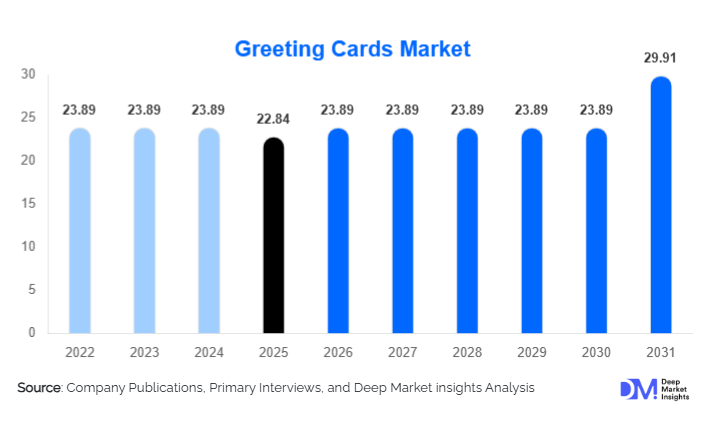
According to Deep Market Insights, the global greeting cards market size was valued at USD 22.84 billion in 2025 and is projected to grow from USD 23.89 billion in 2026 to reach USD 29.91 billion by 2031, expanding at a CAGR of 4.6% during the forecast period (2026–2031). The greeting cards market growth is primarily driven by rising consumer demand for personalized gifting solutions, increasing adoption of premium and customized greeting cards, and the continued expansion of e-commerce platforms that enable convenient product customization and global distribution. Despite the growing use of digital communication channels, consumers continue to value physical greeting cards for birthdays, anniversaries, festive celebrations, weddings, and corporate gifting, supporting steady market expansion across developed and emerging economies.
Key Market Insights
- Personalized greeting cards are witnessing strong adoption, supported by digital printing technologies, AI-assisted design tools, and growing consumer preference for customized gifting experiences.
- Premium and eco-friendly greeting cards are gaining popularity, with manufacturers increasingly utilizing recycled paper, biodegradable packaging, soy-based inks, and sustainable production processes.
- North America dominates the global market, driven by high seasonal spending, well-established retail distribution networks, and strong demand for premium greeting cards.
- Asia-Pacific is emerging as the fastest-growing regional market, supported by expanding middle-class income, increasing online shopping penetration, and growing celebration of personal and cultural occasions.
- Online retail continues to reshape the industry, enabling consumers to design, personalize, and order greeting cards through mobile applications and e-commerce platforms with faster delivery services.
- Technological innovations, including augmented reality (AR), QR-enabled interactive cards, AI-powered artwork generation, and print-on-demand manufacturing, are transforming consumer engagement and product differentiation.
Greeting Cards Market Trends
Growing Adoption of Personalized and Premium Greeting Cards
Personalization continues to transform the greeting cards industry as consumers increasingly seek products that reflect individual emotions and memorable experiences. Digital printing technology has significantly reduced production time while enabling customers to customize photographs, artwork, handwritten messages, and unique designs without substantial cost increases. Print-on-demand capabilities allow manufacturers to produce smaller batches efficiently, minimizing inventory risks while expanding product variety. Premium greeting cards featuring textured paper, foil stamping, embossing, laser-cut artwork, handcrafted finishes, and luxury packaging are witnessing increasing demand among consumers seeking differentiated gifting experiences. Businesses are also utilizing personalized greeting cards for customer engagement, employee recognition, and festive promotional campaigns, creating additional revenue opportunities for manufacturers and online retailers worldwide.
Sustainability and Digital Integration Reshaping Product Innovation
Environmental sustainability has become one of the most influential trends within the greeting cards market as manufacturers continue replacing conventional paper with recycled materials, responsibly sourced fiber, biodegradable packaging, and eco-friendly inks. Consumers increasingly prefer brands demonstrating environmental responsibility while maintaining premium product quality. At the same time, digital technologies are enhancing traditional greeting cards through QR codes, augmented reality experiences, interactive multimedia content, and NFC-enabled messaging that combine physical cards with digital engagement. Artificial intelligence is also simplifying card creation by generating personalized artwork and message recommendations based on customer preferences. These innovations are enabling manufacturers to appeal simultaneously to environmentally conscious consumers and younger digital-native demographics while preserving the emotional value associated with physical greeting cards.
Greeting Cards Market Drivers
Increasing Consumer Preference for Personalized Gifting Experiences
The growing popularity of personalized gifting continues to serve as one of the primary growth drivers for the global greeting cards market. Consumers increasingly value emotional connections created through customized greeting cards featuring personal photographs, individualized messages, creative illustrations, and premium finishes. Corporate organizations are similarly expanding the use of personalized greeting cards for customer relationship management, festive promotions, employee appreciation, and brand loyalty initiatives. Continuous improvements in digital printing, online customization platforms, and same-day production capabilities have made personalized greeting cards more accessible and affordable across multiple consumer segments. Rising disposable incomes, expanding celebration culture, and increasing expenditure on social occasions further strengthen demand for customized greeting card solutions across both developed and developing markets.
Expansion of E-commerce and Omnichannel Retail Networks
The rapid growth of online retail has significantly improved market accessibility by allowing consumers to purchase customized greeting cards anytime through mobile applications, dedicated brand websites, and leading e-commerce marketplaces. Advanced design software enables customers to preview products before ordering while integrated logistics networks ensure faster delivery for both individual and corporate buyers. Subscription-based gifting services, seasonal promotional campaigns, and direct-to-consumer business models have further increased market penetration. Social media platforms also contribute to product discovery through influencer marketing, targeted advertising, and personalized recommendations, encouraging repeat purchases and expanding the overall customer base for greeting card manufacturers globally.
Greeting Cards Market Restraints
Growing Popularity of Digital Communication Alternatives
The widespread adoption of smartphones, instant messaging applications, email platforms, and social media continues to reduce demand for conventional greeting cards in several mature markets. Consumers increasingly utilize digital messages, animated greetings, video calls, and electronic greeting cards because they offer immediate delivery, minimal cost, and convenient accessibility. Younger consumers, in particular, often prefer digital communication channels for everyday celebrations, reducing purchase frequency for traditional physical greeting cards. Although premium and personalized products continue to maintain strong demand, increasing digital substitution remains one of the major restraints limiting long-term expansion of conventional greeting card sales across several developed economies.
Rising Raw Material and Production Costs
Manufacturers continue facing cost pressures resulting from fluctuations in paper pulp prices, specialty printing materials, inks, adhesives, transportation expenses, and labor costs. Sustainable raw materials, while increasingly preferred by consumers, often involve higher procurement and certification expenses. Supply chain disruptions and inflationary pressures have further increased manufacturing costs, forcing several producers to adjust pricing strategies. Small and medium-sized manufacturers are particularly affected due to limited economies of scale and lower purchasing power, creating profitability challenges while intensifying competitive pressure across the greeting cards industry.
Greeting Cards Market Opportunities
Expansion of Sustainable and Eco-Friendly Greeting Card Products
Growing environmental awareness presents substantial opportunities for manufacturers investing in sustainable greeting card solutions. Consumers increasingly prefer products manufactured using recycled paper, responsibly sourced wood pulp, biodegradable packaging materials, vegetable-based inks, and carbon-neutral production processes. Companies adopting environmentally responsible manufacturing practices are strengthening brand loyalty while attracting environmentally conscious consumers across global markets. Government sustainability initiatives and retailer preferences for certified eco-friendly products are expected to further accelerate investment in green manufacturing technologies and sustainable product innovation throughout the forecast period.
AI-Enabled Customization and Print-on-Demand Manufacturing
Artificial intelligence and advanced digital printing technologies are creating significant growth opportunities across the greeting cards industry. AI-powered design platforms enable consumers to generate personalized artwork, customized messages, multilingual content, and occasion-specific recommendations within minutes. Print-on-demand manufacturing minimizes inventory costs while allowing businesses to efficiently produce low-volume customized orders with faster turnaround times. Integration of augmented reality, QR-enabled interactive experiences, and digital multimedia elements further enhances customer engagement, enabling manufacturers to differentiate their products while expanding premium product offerings across consumer and corporate gifting segments.
Report Scope
| Report Metric | Details |
|---|---|
| Market Size in 2025 | USD 22.84 |
| Market Size in 2026 | USD 23.89 |
| Market Size in 2031 | USD 29.91 |
| CAGR | % (2026-2031) |
| Base Year for Estimation | 2025 |
| Historical Data | 2022-2024 |
| Forecast Period | 2026-2031 |
| Report Coverage | Revenue Forecast, Competitive Landscape, Supply Chain Disruption, Growth Factors, Environment & Regulatory Landscape and Trends |
| Geographies Covered | North America, Europe, APAC, Middle East and Africa, LATAM |
| Countries Covered | U.S., Canada, U.K., Germany, France, Spain, Italy, Russia, Nordic, Benelux, Rest of Europe, China, Korea, Japan, India, Australia, Singapore, Taiwan, South East Asia, Rest of Asia-Pacific, UAE, Turky, Saudi Arabia, South Africa, Egypt, Nigeria, Rest of MEA, Brazil, Mexico, Argentina, Chile, Colombia, Rest of LATAM |
Explore more data points, trends and opportunities Download Free Sample Report
Product Type Insights
Traditional greeting cards continue to account for the largest share of the global market due to their widespread use during birthdays, anniversaries, weddings, religious festivals, seasonal celebrations, and corporate events. Consumers continue to value the emotional connection and tangible experience associated with physical cards, particularly in developed markets where greeting card culture remains deeply established. Manufacturers are introducing premium finishes including embossed textures, foil stamping, handcrafted designs, recycled paper materials, and luxury packaging to enhance product appeal. Personalized greeting cards represent one of the fastest-growing categories, supported by online customization platforms that allow consumers to incorporate photographs, handwritten messages, artwork, and unique themes. Digital greeting cards are also witnessing increasing adoption among younger consumers due to instant delivery, lower costs, interactive multimedia features, and seamless integration with social media and mobile applications. Continued innovation across all product categories is expected to strengthen long-term market expansion.
Distribution Channel Insights
Offline retail continues to dominate the greeting cards market through supermarkets, hypermarkets, gift shops, bookstores, stationery retailers, convenience stores, and specialty card outlets. Physical retail stores provide consumers with immediate product availability and the opportunity to evaluate design quality, materials, and finishes before purchase. Meanwhile, online retail is experiencing the fastest growth as consumers increasingly purchase greeting cards through dedicated brand websites, e-commerce marketplaces, and mobile applications. Online platforms provide extensive product customization, AI-assisted design recommendations, home delivery, and seasonal promotional offers that enhance customer convenience. Corporate sales also represent an important distribution channel, with organizations purchasing greeting cards for employee recognition, customer appreciation, festive campaigns, promotional events, and business relationship management. Omnichannel retail strategies integrating both online and offline sales are becoming increasingly important for manufacturers seeking broader market reach.
Explore more data points, trends and opportunities Download Free Sample Report
Greeting Cards Market Segmentations
By Product Type
- Traditional Greeting Cards
- Personalized Greeting Cards
- Digital Greeting Cards
By Distribution Channel
- Offline Retail
- Online Retail
- Corporate Sales
Regional Insights
North America
North America remains the largest regional market for greeting cards owing to strong consumer spending on seasonal celebrations, birthdays, anniversaries, weddings, and corporate gifting. The United States represents the largest contributor within the region due to its well-established greeting card culture, extensive retail infrastructure, and high adoption of premium personalized products. Consumers increasingly prefer customized greeting cards featuring premium paper, luxury finishes, and interactive digital elements. Online personalization services continue expanding rapidly alongside traditional retail channels, while environmentally sustainable greeting card collections are gaining popularity among environmentally conscious consumers. Continuous product innovation, high disposable income, and growing corporate gifting activities continue supporting regional market leadership.
Europe
Europe represents a mature greeting cards market characterized by strong demand across the United Kingdom, Germany, France, Italy, Spain, and the Nordic countries. Consumers increasingly prioritize sustainable greeting cards manufactured using recycled paper, biodegradable packaging, and environmentally certified production methods. Premium handcrafted cards and artistic designs remain highly popular across several European countries, while digital personalization services continue expanding through online retail channels. Government sustainability initiatives and consumer awareness regarding environmental responsibility are encouraging manufacturers to invest in eco-friendly production technologies. Seasonal festivals, Christmas celebrations, and cultural traditions continue driving consistent demand across both retail and corporate customer segments.
Asia-Pacific
Asia-Pacific is projected to register the fastest market growth throughout the forecast period, driven by rising disposable incomes, expanding urbanization, growing middle-class populations, and increasing celebration of personal and cultural occasions. China, India, Japan, South Korea, and Australia represent the leading regional markets with rapidly expanding e-commerce penetration supporting online greeting card purchases. Younger consumers increasingly prefer personalized greeting cards featuring photographs, customized artwork, and premium finishes, while businesses continue adopting greeting cards for festive marketing and customer engagement initiatives. Improvements in digital printing technologies and expanding online retail infrastructure are expected to further accelerate regional market growth.
Latin America
Latin America is witnessing gradual growth supported by increasing consumer spending on birthdays, religious festivals, weddings, and family celebrations. Brazil, Mexico, Argentina, and Chile remain the leading markets within the region, where greeting cards are increasingly purchased through both traditional retailers and online platforms. Growing urbanization, expanding organized retail, and improving internet penetration continue encouraging online product customization and e-commerce adoption. Manufacturers are introducing affordable personalized greeting cards and localized cultural designs to strengthen market presence across diverse consumer segments throughout Latin America.
Middle East & Africa
The Middle East & Africa greeting cards market continues to expand steadily as increasing disposable income, urban development, tourism growth, and corporate gifting activities stimulate consumer demand. The United Arab Emirates, Saudi Arabia, South Africa, and several Gulf Cooperation Council countries represent key regional markets where premium greeting cards are gaining popularity for weddings, religious celebrations, business events, and luxury gifting. Digital retail channels are expanding rapidly alongside traditional stationery stores and gift retailers, while international manufacturers continue strengthening regional distribution partnerships. Rising adoption of customized greeting cards and premium gifting products is expected to support long-term market development across the region.
Key Players in the Greeting Cards Market
- Hallmark Cards Inc.
- American Greetings Corporation
- Card Factory plc
- Moonpig Group plc
- Archies Limited
- LovePop Inc.
- Minted LLC
- Designer Greetings Inc.
- Carlton Cards Ltd.
- Avanti Press Inc.
- Papyrus (Schurman Retail Group)
- Graphique de France
- Paper Source Inc.
- Recycled Paper Greetings Inc.
- Funky Pigeon