Lip Stain Market Size
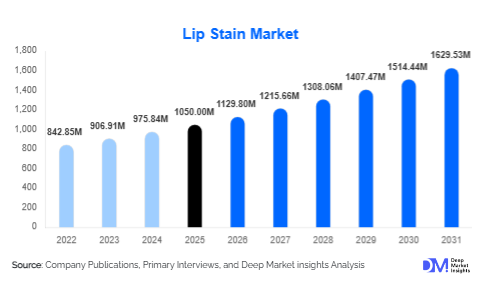
According to Deep Market Insights, the global lip stain market size was estimated at USD 1,050 million in 2025 and is projected to reach approximately USD 1,629.53 million by 2031, expanding at a modelled CAGR of 7.6% during the forecast period (2026–2031). The lip stain market growth is primarily driven by increasing consumer preference for long-lasting lip colour, rising demand for lightweight and natural-looking makeup, the influence of Korean beauty trends, and the expansion of online beauty retail. Product innovation in hydrating stains, glossy tints, water-based formulations, and transfer-resistant colour products further supports market growth.
Key Market Insights
- Water-based lip stains are a leading product category, supported by lightweight textures, buildable pigmentation, and demand for natural-looking lip colour.
- Everyday and casual makeup applications support recurring demand, as consumers seek convenient colour cosmetics that require fewer touch-ups.
- Asia-Pacific is an important regional market, driven by Korean beauty innovation and demand across China, Japan, South Korea, India, and Southeast Asia.
- Online retail is becoming an important distribution channel, allowing brands to reach consumers through e-commerce platforms, product reviews, and creator-led demonstrations.
- Hydrating and hybrid formulations are gaining attention, as consumers seek the staying power of lip stains without excessive dryness or uneven fading.
- Mass-market products provide an accessible entry point, while premium and luxury brands compete through specialised formulations, packaging, and differentiated finishes.
What are the latest trends in the lip stain market?
Hydrating and Hybrid Lip Stain Formulations Gaining Traction
Lip stain manufacturers are increasingly developing formulations that combine lasting pigmentation with hydration, lightweight textures, and comfortable wear. Traditional stains can sometimes create dryness, emphasise lip texture, or fade unevenly, encouraging brands to improve their formulations through moisturising oils, emollients, and suitable film-forming ingredients. Lip stain oils, serum-based tints, glossy stains, and cream-gel products are expanding the range of finishes available to consumers. These products appeal to buyers who want the lasting colour of a stain while maintaining a softer, more moisturised appearance.
Formulation development is also supporting more specialised products for different consumer preferences. Some customers prefer sheer colour for everyday makeup, while others seek stronger pigmentation for evening wear and special occasions. Manufacturers are responding with buildable shades, blurred finishes, glossy textures, and products that combine lip colour with additional cosmetic functions. These innovations can encourage repeat purchases and support premium pricing when consumers perceive a clear improvement in performance. However, manufacturers must balance hydration, durability, colour consistency, and formulation stability to deliver a reliable product experience.
Social Commerce and Digital Beauty Discovery
Social media, short-form videos, beauty tutorials, and influencer demonstrations are changing how consumers discover lip stains. Demonstrations of colour payoff, transfer resistance, application techniques, and fading patterns help customers compare products before purchasing. Online reviews and user-generated content also influence shade selection, particularly when consumers cannot test products physically. Brands are increasingly combining creator partnerships with direct-to-consumer websites, online beauty retailers, and marketplace listings to improve product visibility.
Digital tools such as virtual shade matching and augmented-reality try-on experiences can help customers assess colours before purchasing. Brands can also use online sales data to identify popular shades, monitor repeat purchases, and test new product concepts. Smaller businesses benefit from the ability to introduce limited shade collections online before expanding into physical retail. Nevertheless, inaccurate digital colour representation and differences in natural lip pigmentation can affect customer satisfaction, making clear product imagery and realistic application demonstrations important to long-term brand performance.
What are the key drivers in the lip stain market?
Rising Preference for Long-Lasting and Convenient Makeup
Demand for convenient colour cosmetics is supporting the adoption of lip stains among consumers who prefer lightweight makeup and fewer touch-ups throughout the day. Lip stains are designed to leave pigment on the lips and can provide a more natural-looking appearance than some traditional lip colour products. Their portability and suitability for work, study, travel, and social activities make them relevant to everyday beauty routines. Transfer-resistant formulations can provide additional value to customers who want colour that remains visible after routine activities, although actual wear time varies by product and individual use.
Manufacturers are responding by improving pigment performance, application precision, and the comfort of long-wear formulations. Products that fade evenly and maintain a comfortable feel can encourage repeat purchases. Consumers also benefit from buildable pigmentation, which allows a single product to create either a subtle tint or a more intense colour. This versatility supports demand across different makeup styles and contributes to the continued development of the category.
Influence of Korean Beauty and Product Innovation
Korean beauty trends have helped popularise water-based tints, gradient lips, blurred colour, and lightweight makeup. These styles have influenced consumer preferences beyond South Korea, encouraging brands to develop products with sheer pigmentation, precise application, and a natural finish. Japanese cosmetics innovation and product development across other Asian markets also contribute to the variety of lip tint formats available internationally.
Manufacturers are expanding shade ranges and introducing glossy, matte, satin, and hydrating finishes to serve different customer needs. Inclusive colour selections are important because lip colour can appear differently depending on natural lip pigmentation and skin undertones. Affordable product launches, smaller packaging sizes, and creator-led marketing can further encourage trial purchases. As consumers become more familiar with new formulations, innovation can help brands differentiate themselves in an otherwise competitive colour cosmetics market.
What are the restraints for the global market?
Dryness, Uneven Fading, and Performance Limitations
One of the major challenges facing lip stain manufacturers is maintaining lasting pigmentation without compromising comfort. Certain formulations may emphasise dry patches, produce uneven colour around the edges, or become difficult to remove. Product performance can also vary depending on application technique, lip condition, food consumption, and environmental conditions. When a product does not match advertised expectations, customer dissatisfaction can reduce repeat purchases and damage brand reputation.
Manufacturers must therefore invest in formulation research, product stability testing, packaging compatibility, and consumer performance assessments. Improvements in moisturising ingredients, pigment dispersion, and film-forming systems can help address these challenges, but they must be balanced against cost and safety requirements. Brands also need to communicate realistic wear-time expectations rather than relying on unsupported claims. Consistent performance across production batches is essential for maintaining consumer confidence.
Price Competition and Regulatory Compliance Costs
Lip stains compete with conventional lipsticks, lip glosses, tinted balms, and other colour cosmetics that offer similar benefits at different price points. Consumers may switch to less expensive alternatives when they do not perceive a meaningful difference in colour retention, comfort, or application. Frequent promotions and product launches can place additional pressure on selling prices, particularly in the mass-market segment.
Regulatory requirements add another challenge for companies selling across multiple countries. Manufacturers must assess ingredient safety, permitted colourants, labelling, packaging compatibility, and applicable product registration or notification requirements. In the United States, the Modernization of Cosmetics Regulation Act introduced requirements concerning areas such as facility registration, product listing, safety substantiation, and serious adverse-event reporting, subject to applicable exemptions. Compliance requires documentation, quality controls, and market-specific preparation. These costs can be especially challenging for smaller brands entering international markets.
What are the key opportunities in the lip stain industry?
Expansion of Hydrating, Multi-Functional, and Inclusive Products
The development of lip stains that combine colour, comfort, and additional cosmetic functions presents a major opportunity for established manufacturers and new entrants. Products such as hydrating stains, glossy tints, serum-based formulations, and lip-and-cheek stains can appeal to consumers seeking versatility and simplified beauty routines. Brands can differentiate themselves through improved wear performance, comfortable textures, inclusive shade ranges, and packaging designed for precise application. Products that address common concerns such as dryness and uneven fading may also support higher customer retention.
There is additional potential in developing formulations suited to different climates, skin tones, and consumer preferences. Lightweight water-based stains may appeal to customers seeking sheer colour, while oil-based and serum formulations can attract consumers who prioritise a moisturised appearance. Manufacturers should validate product claims through appropriate testing and ensure that multi-functional products meet the relevant requirements for their intended uses. Clear product positioning and realistic performance communication can help new products establish credibility.
Emerging-Market Expansion and Export-Led Growth
Asia-Pacific and other emerging beauty markets provide opportunities for brands seeking new customers and broader distribution. China, India, Indonesia, Thailand, and other regional markets offer potential through online beauty retail, mobile commerce, and demand for accessible colour cosmetics. Brands can develop locally relevant shade ranges, competitive pricing, and smaller pack sizes to encourage product trial. Partnerships with regional retailers, beauty creators, and e-commerce platforms can improve visibility and help brands understand local consumer preferences.
Export-led growth offers another opportunity for manufacturers that can maintain consistent quality, competitive production costs, and reliable supply. Successful products can move from domestic online sales into international beauty retailers, marketplaces, and specialist cosmetics stores. However, expansion requires attention to destination-market regulations, ingredient permissions, labelling, customs costs, and product documentation. Companies that combine differentiated formulations with strong regulatory preparation and distribution partnerships can improve their chances of building sustainable international sales.
Report Scope
| Report Metric | Details |
|---|---|
| Market Size in 2025 | USD 1050 Million |
| Market Size in 2026 | USD 1129.80 Million |
| Market Size in 2031 | USD 1629.53 Million |
| CAGR | 7.6% (2026-2031) |
| Base Year for Estimation | 2025 |
| Historical Data | 2022-2024 |
| Forecast Period | 2026-2031 |
| Report Coverage | Revenue Forecast, Competitive Landscape, Supply Chain Disruption, Growth Factors, Environment & Regulatory Landscape and Trends |
| Geographies Covered | North America, Europe, APAC, Middle East and Africa, LATAM |
| Countries Covered | U.S., Canada, U.K., Germany, France, Spain, Italy, Russia, Nordic, Benelux, Rest of Europe, China, Korea, Japan, India, Australia, Singapore, Taiwan, South East Asia, Rest of Asia-Pacific, UAE, Turky, Saudi Arabia, South Africa, Egypt, Nigeria, Rest of MEA, Brazil, Mexico, Argentina, Chile, Colombia, Rest of LATAM |
Explore more data points, trends and opportunities Download Free Sample Report
Product Type Insights
Water-based lip stains are estimated to be the leading formulation category, representing an indicative 38% of the global market in 2025, equivalent to approximately USD 399 million under the report's provisional market model. Their lightweight texture, buildable colour, and suitability for natural-looking makeup support consumer interest. Watery tints and liquid stains are particularly relevant to consumers seeking a subtle appearance without the heavier feel associated with some conventional lip colour products. The popularity of gradient-lip techniques and Asian beauty trends has also supported interest in lightweight tint formats.
Gel-based stains provide an alternative for consumers seeking stronger pigmentation and a different application texture. Oil-based stains and tinted lip oils appeal to customers who prefer a glossy appearance and a more moisturised feel. Cream and serum formulations seek to combine colour retention with comfort, while marker-style products provide precise application for customers who value portability and controlled colour placement. Peel-off stains offer a distinctive application format in which a coloured film is removed after setting, leaving pigment behind. These formats can attract consumers interested in experimenting with different application techniques.
Finish is a separate classification dimension from formulation. Natural and sheer finishes are assigned an illustrative 34% share of 2025 market revenue, or approximately USD 357 million. Matte, satin, and glossy finishes address different styling preferences and can be offered across multiple formulation types. Manufacturers that provide a balance of colour intensity, comfortable wear, and consistent fading are better positioned to differentiate their products.
Application Insights
Everyday and casual wear is estimated to be the largest application category, accounting for an indicative 48% of the 2025 global market, or approximately USD 504 million. Lip stains are suited to daily routines because they are portable, can be applied in varying levels of intensity, and often create a lightweight appearance. Consumers use them for work, study, travel, and casual social activities. The growing popularity of minimalist makeup also supports demand for sheer and natural-looking shades.
Social and special-occasion applications provide additional demand for high-pigment stains and products designed to maintain colour through extended events. Weddings, parties, evening functions, and festive celebrations can encourage purchases of more intense colours and premium formulations. Professional makeup artists also use stains for photography, video production, stage applications, and event makeup, where colour consistency and application precision can be important. Demand in these applications depends on the product's suitability for the intended look and duration of wear.
Multi-functional products represent an emerging application opportunity. Lip-and-cheek stains can appeal to consumers who want coordinated colour from a single product, while gradient and layered lip techniques encourage the use of different shades and finishes. However, market sizing should classify each product according to its primary intended use to prevent double counting between lip cosmetics and broader multi-purpose makeup categories.
Distribution Channel Insights
Online retail is an important distribution channel for lip stains, supported by e-commerce marketplaces, brand-owned websites, and specialist online beauty retailers. Online platforms allow consumers to compare prices, explore shade collections, read reviews, and view application demonstrations. Brands can also use digital campaigns and customer purchase data to introduce new colours, test product concepts, and improve marketing efficiency. Online retail is assigned an indicative 32% share of the 2025 market, equivalent to approximately USD 336 million in the provisional market model.
Specialty beauty retailers remain important because consumers can test shades, assess texture, and obtain product recommendations. Multibrand beauty stores and beauty chains offer visibility across mass-market and premium products, while single-brand boutiques support a more controlled brand experience. Pharmacies, drugstores, supermarkets, and other mass-market retailers provide convenience and can support high-volume sales of affordable products. Department stores and duty-free outlets are relevant to selected prestige and luxury brands.
Social commerce and creator-led marketing increasingly influence product discovery, although the channel in which a transaction is completed should determine its classification. A product discovered through a social media video but purchased from an e-commerce marketplace should be counted as an online marketplace sale. This distinction is important for measuring channel revenue accurately and avoiding duplication.
Consumer Group Insights
Consumers under 25 are assigned an indicative 36% share of the 2025 market, or approximately USD 378 million, within the provisional model. This group can be receptive to new beauty trends, affordable product launches, and social media demonstrations. Water-based tints, gradient-lip products, and distinctive finishes can appeal to younger buyers who enjoy experimenting with makeup. However, the actual share of spending by age group requires validated consumer-panel or retailer data.
Adults aged 25–39 represent another important consumer group, with demand linked to convenient daily makeup, workplace use, and versatile colour products. Consumers in this group may prioritise comfortable wear, reliable performance, and products suitable for both casual and professional settings. The 40–54 age group can support demand for hydrating formulations, flattering shades, and products that provide controlled pigmentation. Consumers aged 55 and above may value comfortable textures, precise applicators, and clear product instructions.
Age alone does not determine product preference. Purchasing decisions also depend on disposable income, beauty routines, local trends, brand familiarity, and individual preferences for colour and finish. Manufacturers should therefore combine age-based segmentation with behavioural and price-tier analysis when planning product portfolios.
Price Range Insights
Mass-market lip stains, defined in this report as products priced below USD 10, are assigned an indicative 42% share of global revenue in 2025, equivalent to approximately USD 441 million. Affordable pricing encourages trial purchases, supports broader distribution, and allows consumers to experiment with different shades. This segment is particularly relevant to brands that compete through accessible pricing, frequent product launches, and high-volume retail availability.
Mid-range products priced from USD 10 to USD 19.99 can attract customers seeking a balance between affordability, formulation quality, packaging, and brand recognition. Premium products priced from USD 20 to USD 34.99 may differentiate themselves through specialised textures, distinctive finishes, more elaborate packaging, and stronger brand positioning. Luxury products priced at USD 35 and above can command higher retail prices, although their market share depends on brand demand, distribution, and willingness to pay.
These price bands are analytical classifications rather than verified global average selling prices. Local taxes, retailer promotions, pack sizes, and currency movements affect actual selling prices. Manufacturers must also distinguish retail revenue from the net revenue received by the brand after retailer margins, discounts, and other channel costs.
Explore more data points, trends and opportunities Download Free Sample Report
Lip Stain Market Segmentations
By Product Type
- Water-Based Lip Stains
- Gel-Based Lip Stains
- Liquid and Ink Lip Stains
- Oil-Based Lip Stains
- Cream and Serum Lip Stains
- Solid and Precision-Application Stains
- Peel-Off Lip Stains
By Finish
- Matte Finish
- Natural and Sheer Finish
- Glossy Finish
- Satin Finish
By Price Range
- Mass-Market (Below USD 10)
- Mid-Range (USD 10–19.99)
- Premium (USD 20–34.99)
- Luxury (USD 35 and Above)
By Application
- Everyday and Casual Wear
- Social and Special-Occasion Wear
- Professional Makeup Application
- Multifunctional Cosmetic Use
By Distribution Channel
- Online Retail
- Specialty Beauty Retail
- Mass-Market Retail
- Pharmacies and Drugstores
- Direct Selling and Other Retail
Regional Insights
North America
North America is assigned an indicative 30% share of the global lip stain market in 2025, equivalent to approximately USD 315 million. The United States is the principal market within the region, supported by established cosmetics retailers, premium beauty brands, online shopping, and influencer-led product discovery. Consumers purchase across mass-market and prestige price tiers, creating opportunities for affordable stains as well as higher-value hybrid formulations. Canada contributes through specialty beauty retail and e-commerce, while Mexico offers further potential through modern retail expansion and digital distribution. Demand is influenced by wear performance, shade availability, packaging, and brand reputation.
Europe
Europe is estimated to account for an indicative 24% of the 2025 market, or approximately USD 252 million. The United Kingdom, Germany, France, Italy, and Spain are important markets because of their established beauty retail infrastructure and demand for international cosmetics brands. France contributes through premium beauty positioning, while Germany and the United Kingdom offer opportunities across mass-market and specialty retail. Consumers increasingly compare product performance, ingredient information, shade suitability, and value for money. Regulatory compliance and accurate cosmetic labelling are essential for brands operating across multiple European markets.
Asia-Pacific
Asia-Pacific is assigned an indicative 32% share of the 2025 market, equivalent to approximately USD 336 million, making it the largest region in this report's model. South Korea plays an important role in lip tint innovation and beauty trends, while China offers demand potential through domestic cosmetics brands, digital commerce, and a large consumer market. Japan contributes through established cosmetics purchasing habits and demand for precision application and refined finishes. India represents an opportunity for affordable colour cosmetics, inclusive shade ranges, and e-commerce-led distribution. Indonesia and Thailand provide additional potential through mobile commerce and regional beauty trends. The actual regional share and country growth rankings require comparable market-level sales data.
Latin America
Latin America is assigned an indicative 9% share of the 2025 market, equivalent to approximately USD 94.5 million. Brazil is the principal market of interest because of its established beauty industry and consumer engagement with colour cosmetics. Mexico and Argentina also offer opportunities through physical beauty retail and online sales. Demand for lip stains depends on local purchasing power, brand availability, import costs, and currency movements. Affordable products, locally relevant shades, and reliable product distribution can help manufacturers reach a broader customer base.
Middle East & Africa
The Middle East and Africa region is assigned an indicative 5% share of the 2025 market, equivalent to approximately USD 52.5 million. Saudi Arabia and the United Arab Emirates offer opportunities in premium beauty retail, e-commerce, and long-wear makeup. South Africa provides a significant regional retail base, while Egypt and other African markets contribute through mass-market cosmetics demand. Product selection is influenced by purchasing power, climate, import dependence, and retail infrastructure. International brands can expand through specialist retailers and regional online platforms, provided they maintain competitive pricing and meet local regulatory requirements.
Key Players in the Lip Stain Market
The following companies and brands are relevant participants in the broader lip colour and lip stain competitive landscape. Their inclusion does not imply that each has the same level of dedicated lip stain sales or that the list represents a verified ranking by market share.
- L'Oréal Group
- LVMH
- Estée Lauder Companies
- Shiseido Company
- Amorepacific Corporation
- e.l.f. Beauty
- Coty Inc.
- Revlon
- KOSÉ Corporation
- Chanel
- Puig
- Proya Cosmetics
- Peripera
- Rom&nd
- Milani Cosmetics