Home Fragrance Market Size
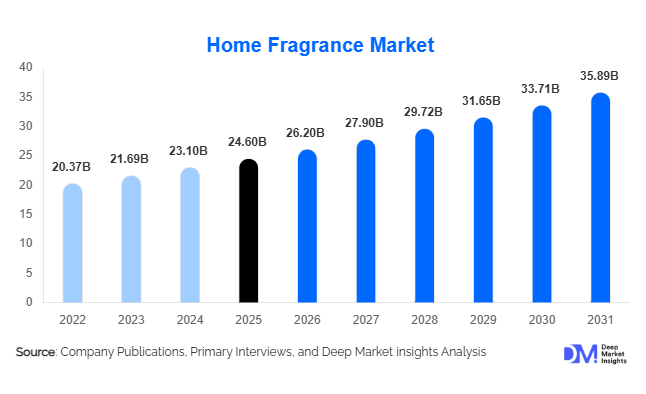
According to Deep Market Insights, the global home fragrance market size was valued at USD 24.6 billion in 2025 and is projected to grow from USD 26.20 billion in 2026 to reach USD 35.89 billion by 2031, expanding at a CAGR of 6.5% during the forecast period (2026–2031). The home fragrance market growth is primarily driven by rising consumer focus on wellness-oriented lifestyles, increasing expenditure on home décor and ambiance enhancement, and growing demand for premium scented products such as candles, diffusers, room sprays, and essential oil-based aromatherapy solutions.
Key Market Insights
- Home fragrance products are increasingly associated with emotional wellness and stress reduction, driving demand for aromatherapy-based candles, essential oils, and diffusers.
- Premium and luxury fragrance collections are witnessing strong growth globally, supported by gifting trends, designer collaborations, and aspirational home décor preferences.
- North America dominates the global home fragrance market, led by high consumer spending on lifestyle products and premium home ambiance solutions.
- Asia-Pacific is the fastest-growing regional market, supported by urbanization, rising disposable incomes, and rapid e-commerce penetration in China, India, and Southeast Asia.
- Sustainability and clean-label formulations are reshaping consumer preferences, encouraging brands to invest in soy wax candles, refillable diffusers, and eco-friendly packaging.
- Technological integration is expanding rapidly, with smart fragrance diffusers, app-controlled scent systems, and AI-based fragrance personalization enhancing customer engagement.
Home Fragrance Market Trends
Wellness-Oriented Fragrance Products Gaining Momentum
Consumers are increasingly purchasing home fragrance products not only for odor enhancement but also for emotional well-being, relaxation, and mindfulness. Aromatherapy candles, ultrasonic diffusers, and essential oil blends containing lavender, eucalyptus, sandalwood, chamomile, and citrus fragrances are gaining widespread popularity. The growing influence of wellness lifestyles, meditation practices, and stress-management routines is significantly expanding the market for therapeutic fragrance products. Brands are increasingly promoting fragrances as part of holistic self-care routines, with products specifically designed to improve sleep quality, reduce anxiety, and enhance mood. Wellness-focused packaging, ingredient transparency, and clean-label claims are also becoming major purchasing considerations for consumers globally.
Smart and Connected Fragrance Systems Expanding
The integration of smart home technologies into fragrance systems is emerging as a transformative trend within the market. Consumers are increasingly adopting app-controlled diffusers, programmable scent dispensers, and IoT-enabled fragrance systems that allow fragrance customization based on room usage, timing, and mood preferences. Luxury hospitality establishments, corporate offices, and premium residential properties are also deploying advanced ambient scent technologies to create differentiated sensory experiences. AI-powered fragrance recommendation platforms and subscription-based refill systems are improving customer retention while supporting recurring revenue models for manufacturers. Voice-assisted fragrance control and integration with connected home ecosystems are expected to further accelerate adoption of intelligent home fragrance solutions over the forecast period.
Home Fragrance Market Drivers
Growing Consumer Focus on Home Wellness and Ambiance
The increasing emphasis on wellness-oriented lifestyles is one of the primary drivers of the home fragrance market. Consumers are investing more heavily in products that improve emotional comfort, relaxation, and home aesthetics. Fragrance products are increasingly integrated into wellness routines involving meditation, yoga, mindfulness, and sleep improvement. The shift toward home-centric lifestyles after the pandemic significantly accelerated consumer spending on ambiance-enhancing products, including luxury candles, essential oil diffusers, and room sprays. Urban households, particularly among millennials and Gen Z consumers, are actively purchasing premium fragrance products to create personalized living environments that support mental well-being and lifestyle aspirations.
Premiumization and Luxury Home Décor Trends
The rapid expansion of premium home décor and lifestyle spending is fueling strong growth within the home fragrance market. Consumers increasingly perceive candles, diffusers, and luxury fragrance collections as decorative lifestyle accessories rather than purely functional products. Luxury fragrance brands and designer collaborations are strengthening market demand by offering limited-edition collections, artisanal craftsmanship, and aesthetically sophisticated packaging. Affluent consumers are showing high willingness to pay for premium fragrance experiences that align with luxury interior design trends. This premiumization trend is especially strong in North America, Europe, South Korea, Japan, and the Middle East.
Home Fragrance Market Restraints
Rising Raw Material and Packaging Costs
The home fragrance market faces ongoing challenges related to volatile raw material prices and supply chain disruptions. Key materials such as essential oils, fragrance compounds, waxes, glass containers, decorative packaging, and specialty chemicals have experienced significant cost inflation over recent years. Manufacturers are increasingly exposed to pressure from transportation expenses, energy costs, and fluctuations in agricultural yields affecting natural ingredient availability. Premium fragrance brands relying heavily on botanical extracts and artisanal production processes are particularly vulnerable to margin compression caused by rising procurement expenses.
Regulatory Concerns Related to Indoor Air Quality
Increasing regulatory scrutiny regarding volatile organic compounds (VOCs), allergens, and synthetic fragrance ingredients is emerging as a major restraint for the industry. Regulatory authorities in Europe and North America are implementing stricter compliance standards related to indoor air quality and chemical transparency. Consumers are also becoming more aware of potential respiratory sensitivities associated with low-quality fragrance products. Companies that fail to invest in safer formulations, transparent labeling, and sustainable ingredient sourcing may face reputational risks and reduced consumer trust. Compliance costs related to reformulation and packaging adaptation are expected to remain significant for manufacturers.
Home Fragrance Market Opportunities
Expansion of Sustainable and Clean-Label Fragrance Products
The growing global focus on sustainability presents substantial opportunities for manufacturers to develop eco-friendly and clean-label fragrance solutions. Consumers increasingly prefer soy wax candles, biodegradable packaging, refillable diffusers, cruelty-free formulations, and responsibly sourced botanical ingredients. Sustainability-focused brands are benefiting from stronger customer loyalty, particularly among younger demographics seeking environmentally responsible products. Companies investing in recyclable packaging systems, plastic-free containers, and renewable ingredient sourcing are expected to gain long-term competitive advantages. Regulatory pressure supporting low-emission and toxin-free products is also accelerating demand for sustainable fragrance innovation.
Commercial and Hospitality Scent Branding
The increasing adoption of scent branding across hotels, spas, luxury retail outlets, and corporate offices represents a major commercial growth opportunity for the market. Businesses are increasingly deploying signature ambient fragrances to strengthen brand identity, improve customer experiences, and enhance emotional engagement. Luxury hospitality chains are investing heavily in programmable scent systems integrated into HVAC infrastructure and premium interiors. Commercial scent marketing is creating recurring revenue opportunities for fragrance manufacturers through long-term supply contracts, refill subscriptions, and customized fragrance development services.
Report Scope
| Report Metric | Details |
|---|---|
| Market Size in 2025 | USD 24.6 Billion |
| Market Size in 2026 | USD 26.20 Billion |
| Market Size in 2031 | USD 35.89 Billion |
| CAGR | 6.5% (2026-2031) |
| Base Year for Estimation | 2025 |
| Historical Data | 2022-2024 |
| Forecast Period | 2026-2031 |
| Report Coverage | Revenue Forecast, Competitive Landscape, Supply Chain Disruption, Growth Factors, Environment & Regulatory Landscape and Trends |
| Geographies Covered | North America, Europe, APAC, Middle East and Africa, LATAM |
| Countries Covered | U.S., Canada, U.K., Germany, France, Spain, Italy, Russia, Nordic, Benelux, Rest of Europe, China, Korea, Japan, India, Australia, Singapore, Taiwan, South East Asia, Rest of Asia-Pacific, UAE, Turky, Saudi Arabia, South Africa, Egypt, Nigeria, Rest of MEA, Brazil, Mexico, Argentina, Chile, Colombia, Rest of LATAM |
Explore more data points, trends and opportunities Download Free Sample Report
Product Type Insights
Scented candles dominate the home fragrance market, accounting for the largest share of global revenues due to their decorative appeal, gifting popularity, and broad consumer acceptance across residential households. Premium candles featuring soy wax, artisanal fragrances, and designer packaging are particularly driving value growth within the segment. Diffusers, especially reed diffusers and ultrasonic aroma diffusers, are experiencing strong expansion because of their continuous fragrance release, convenience, and integration with wellness routines. Room sprays and aerosol fresheners continue to maintain strong demand in mass-market retail channels due to affordability and instant fragrance delivery. Essential oil-based aromatherapy products are emerging as one of the fastest-growing product categories as consumers increasingly associate fragrance with emotional wellness and therapeutic benefits.
Application Insights
Residential applications remain the dominant segment within the home fragrance market, driven by increasing consumer focus on home ambiance, emotional comfort, and personalized interior experiences. Living rooms and bedrooms account for the largest product consumption, particularly for candles, diffusers, and wellness-oriented fragrance systems. Commercial applications are also expanding steadily, especially within hospitality, wellness centers, luxury retail, and office environments. Hotels and spas increasingly deploy signature fragrance concepts to strengthen customer engagement and brand differentiation. Wellness and meditation spaces are emerging as fast-growing application areas, with increasing adoption of aromatherapy oils and calming scent blends designed to support mindfulness and relaxation practices.
Distribution Channel Insights
Online retail channels are rapidly transforming the home fragrance market by enabling direct-to-consumer engagement, subscription-based fragrance services, and personalized product recommendations. E-commerce marketplaces and brand-owned websites are witnessing substantial growth because consumers increasingly prefer broader product variety, convenience, and digital discovery experiences. Social media and influencer-led marketing campaigns are significantly shaping purchasing decisions, particularly among younger consumers. Offline retail channels including specialty home décor stores, department stores, supermarkets, and luxury boutiques continue to maintain strong relevance for experiential fragrance shopping and gifting purchases. Subscription commerce and refill-based sales models are also emerging as important distribution trends that improve recurring revenues and customer retention.
Consumer Demographic Insights
Millennials represent the largest consumer demographic in the home fragrance market due to strong interest in lifestyle-oriented home décor, wellness products, and personalized living environments. This consumer group actively purchases premium candles, diffusers, and aromatherapy products that align with interior aesthetics and self-care routines. Generation Z consumers are driving growth in sustainable and clean-label fragrance products, strongly influenced by social media trends, minimalist design preferences, and eco-conscious purchasing behavior. Generation X and baby boomers remain significant contributors to premium and luxury fragrance categories, particularly through gifting demand and high spending on wellness-enhancing home products. High-income households continue to dominate luxury fragrance purchases, favoring designer collaborations, limited-edition collections, and artisanal scent experiences.
Explore more data points, trends and opportunities Download Free Sample Report
Home Fragrance Market Segmentations
By Product Type
- Scented Candles
- Diffusers
- Room Sprays & Aerosols
- Essential Oils & Aromatherapy Products
- Incense Products
- Wax Melts & Tarts
- Plug-in Fragrance Devices
- Potpourri & Sachets
- Gel-based Air Fresheners
By Fragrance Family
- Floral
- Citrus/Fresh
- Woody
- Oriental/Spicy
- Fruity
- Herbal/Natural
- Oceanic/Aquatic
- Sweet/Gourmand
By Distribution Channel
- Online Retail
- Hypermarkets & Supermarkets
- Specialty Home Décor Stores
- Department Stores
- Convenience Stores
- Direct Selling
By End User
- Residential Consumers
- Hospitality Sector
- Corporate Offices
- Spa & Wellness Centers
- Retail Stores
Regional Insights
North America
North America remains the largest regional market for home fragrance products, accounting for approximately 36% of global revenues in 2025. The United States dominates regional demand due to strong consumer spending on premium home décor, wellness products, and luxury scented candles. American consumers increasingly prefer clean-label fragrances, seasonal collections, and subscription-based fragrance services. Canada is also witnessing rising demand for sustainable and botanical fragrance formulations. The region’s mature retail infrastructure, strong e-commerce penetration, and high disposable income continue to support market expansion.
Europe
Europe represents one of the most influential markets for premium home fragrance innovation, accounting for nearly 29% of global market share. France, Germany, the United Kingdom, and Italy are major contributors to regional demand. France benefits from its globally recognized fragrance heritage and luxury consumer culture, while Germany demonstrates strong demand for sustainable and eco-certified products. The UK market is heavily driven by gifting trends, home décor preferences, and premium lifestyle consumption. Scandinavian countries are increasingly embracing minimalist wellness-oriented fragrance concepts focused on natural ingredients and sustainable packaging.
Asia-Pacific
Asia-Pacific is the fastest-growing regional market, driven by rapid urbanization, rising disposable incomes, and expanding middle-class populations in China, India, Japan, and Southeast Asia. Chinese consumers are increasingly adopting premium fragrance products linked to modern lifestyle aspirations and luxury living trends. India is witnessing strong growth due to rising e-commerce penetration, increasing interest in home décor products, and gradual consumer transition from traditional incense toward modern fragrance formats such as candles and diffusers. South Korea and Japan remain important premium fragrance markets driven by beauty, wellness, and minimalist lifestyle trends.
Latin America
The home fragrance market in Latin America is expanding steadily, led primarily by Brazil and Mexico. Consumers in the region are increasingly purchasing affordable premium fragrance products as urbanization and modern retail penetration improve. Wellness-oriented fragrance products and decorative candles are witnessing increasing adoption among middle-income households. E-commerce growth is further supporting regional product accessibility and international brand penetration.
Middle East & Africa
The Middle East and Africa region demonstrates strong cultural affinity for fragrances, particularly luxury oud-based products, bakhoor, incense burners, and premium diffusers. Saudi Arabia and the UAE represent the largest regional markets due to high luxury spending and deeply rooted fragrance traditions. Luxury hospitality investments and premium residential developments are also driving commercial demand for ambient scent systems. South Africa remains an important emerging market for modern fragrance products within the African region, supported by growing urban consumer spending and retail modernization.
Key Players in the Home Fragrance Market
- Newell Brands (Yankee Candle)
- Bath & Body Works Inc.
- Reckitt Benckiser Group plc
- Procter & Gamble Co.
- S. C. Johnson & Son Inc.
- Diptyque Paris
- Jo Malone London
- Nest Fragrances
- Scentsy Inc.
- Voluspa
- Paddywax LLC
- Rituals Cosmetics
- Godrej Consumer Products Limited
- Air Wick
- Esteban Paris Parfums