Heavy Duty Truck Market Size
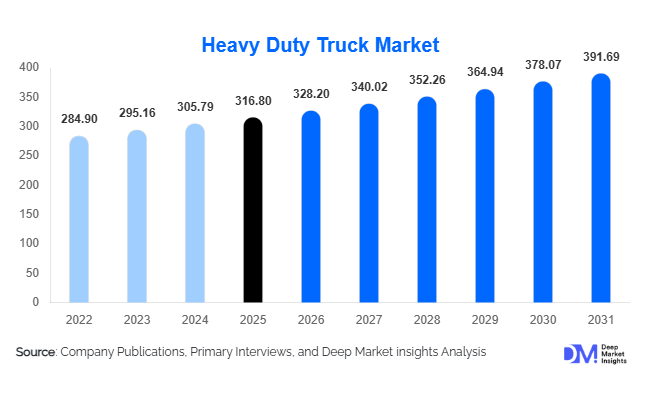
According to Deep Market Insights, the global Heavy Duty Truck market size was valued at USD 316.8 billion in 2025 and is projected to grow from USD 328.20 billion in 2026 to reach USD 391.69 billion by 2031, expanding at a CAGR of 3.6% during the forecast period (2026–2031). Market growth is primarily driven by increasing freight transportation demand, expanding global trade, rapid infrastructure development, fleet modernization initiatives, and the growing adoption of connected and low-emission commercial vehicles. Heavy duty trucks continue to form the backbone of industrial supply chains by supporting long-haul logistics, mining, construction, manufacturing, agriculture, and municipal operations across developed and emerging economies. Governments worldwide are investing heavily in transportation infrastructure, while fleet operators are replacing aging vehicles with technologically advanced trucks that offer improved fuel efficiency, enhanced safety systems, predictive maintenance capabilities, and lower total cost of ownership. Simultaneously, the industry is witnessing an accelerating transition toward battery-electric and hydrogen fuel-cell trucks, particularly in Europe, China, and North America, supported by stringent emission regulations and public incentives. These structural changes are expected to sustain long-term demand while reshaping product development, manufacturing investments, and competitive strategies across the global heavy duty truck industry.
Key Market Insights
- Class 8 trucks account for the largest share of the global market, representing nearly 62% of total industry revenue in 2025 owing to their dominance in long-haul freight transportation, industrial logistics, and cross-border cargo movement.
- Diesel-powered trucks continue to dominate the market, accounting for approximately 89% of global sales despite accelerating investments in battery-electric and hydrogen-powered heavy-duty commercial vehicles.
- Asia-Pacific leads the global Heavy Duty Truck market, contributing nearly 46% of worldwide revenue, supported by large-scale manufacturing activity, infrastructure investments, and expanding freight transportation across China, India, Japan, and Southeast Asia.
- India represents one of the fastest-growing national markets, driven by government infrastructure spending, logistics modernization, industrial expansion, dedicated freight corridors, and increasing organized fleet ownership.
- Fleet operators account for over two-thirds of global truck purchases, as commercial logistics companies increasingly prioritize standardized fleet management, digital telematics, predictive maintenance, and fuel-efficient vehicle replacement programs.
- Digital technologies including AI-powered fleet management, advanced telematics, predictive maintenance, over-the-air software updates, and ADAS are rapidly transforming fleet operations by improving safety, reducing downtime, and lowering operating costs.
Heavy Duty Truck Market Trends
Rapid Electrification of Heavy Commercial Vehicles
The heavy duty truck industry is undergoing one of its most significant technological transitions as manufacturers accelerate investments in battery-electric and hydrogen fuel-cell commercial vehicles. Governments across Europe, China, the United States, Japan, and South Korea continue introducing stringent emission regulations alongside purchase incentives, tax benefits, and charging infrastructure investments that encourage fleet electrification. Commercial fleet operators are increasingly adopting electric heavy-duty trucks for regional freight, municipal services, port operations, and urban distribution, where predictable routes and centralized charging infrastructure improve operational feasibility. Vehicle manufacturers are simultaneously investing in higher-capacity batteries, ultra-fast charging systems, battery swapping technologies, and hydrogen fuel-cell development to extend operating range while reducing charging downtime. Strategic partnerships between truck manufacturers, battery suppliers, charging infrastructure companies, and energy providers are accelerating commercialization of zero-emission heavy-duty transportation. As battery costs gradually decline and infrastructure expands, electrification is expected to become one of the most influential long-term growth trends shaping the Heavy Duty Truck market through the forecast period.
Connected Fleet Management Becoming an Industry Standard
Fleet digitalization has emerged as a defining trend across the Heavy Duty Truck market as logistics operators increasingly focus on maximizing vehicle utilization while minimizing operating costs. Advanced telematics systems now provide real-time vehicle diagnostics, fuel consumption monitoring, route optimization, predictive maintenance scheduling, remote diagnostics, driver behavior analytics, and over-the-air software updates through integrated cloud platforms. Artificial intelligence is enabling predictive maintenance models capable of identifying component failures before breakdowns occur, reducing vehicle downtime and improving fleet availability. Fleet operators are also integrating commercial vehicles with transportation management systems (TMS), warehouse management systems (WMS), and enterprise resource planning (ERP) platforms to optimize end-to-end logistics operations. Simultaneously, growing deployment of Advanced Driver Assistance Systems (ADAS), adaptive cruise control, collision mitigation systems, lane departure warning, electronic stability control, and driver fatigue monitoring technologies is improving operational safety while helping fleet owners comply with increasingly stringent regulatory requirements. Digital fleet ecosystems are therefore becoming an increasingly important differentiator among global truck manufacturers, with software-enabled services generating recurring revenue beyond traditional vehicle sales.
Heavy Duty Truck Market Drivers
Expansion of Global Freight Transportation and Logistics Networks
The sustained expansion of global freight transportation remains one of the strongest growth drivers for the Heavy Duty Truck market. Rising international trade, increasing industrial production, expanding e-commerce fulfillment networks, and the rapid development of third-party logistics (3PL) services continue to generate significant demand for high-capacity commercial vehicles. Heavy duty trucks play a critical role in transporting raw materials, industrial equipment, manufactured goods, agricultural products, construction materials, and consumer merchandise across regional and international supply chains. The continued expansion of distribution centers, multimodal logistics hubs, inland freight corridors, and cross-border transportation networks has further strengthened fleet replacement and new vehicle procurement activities. Large logistics operators are increasingly investing in technologically advanced trucks equipped with telematics, predictive maintenance systems, automated manual transmissions, and fuel-efficient powertrains to improve fleet productivity while lowering operating costs. Additionally, growing demand for time-sensitive freight transportation, cold-chain logistics, and just-in-time manufacturing continues to increase fleet utilization rates globally. As developing economies industrialize and mature economies modernize freight infrastructure, demand for heavy-duty trucks is expected to remain resilient throughout the forecast period.
Increasing Public Infrastructure Investment and Industrial Development
Governments across major economies continue to allocate substantial budgets toward transportation infrastructure, creating sustained demand for heavy duty commercial vehicles. Investments in highways, expressways, bridges, rail connectivity, ports, airports, industrial corridors, logistics parks, mining projects, renewable energy installations, and smart city developments require extensive movement of construction materials, machinery, aggregates, steel, cement, and heavy equipment. This has significantly increased demand for dump trucks, tractor units, concrete mixers, heavy-haul vehicles, and specialized construction trucks. Emerging economies including India, China, Indonesia, Vietnam, Saudi Arabia, Brazil, and several African nations are investing aggressively in infrastructure modernization to support long-term economic growth. Government initiatives such as dedicated freight corridors, industrial manufacturing clusters, and port expansion projects continue to stimulate procurement of heavy-duty vehicles across both public and private sectors. At the same time, expanding mining operations for copper, lithium, nickel, iron ore, and rare earth minerals—driven by global electrification and renewable energy investments—are generating additional demand for high-capacity off-highway trucks and specialized transportation equipment. These long-term infrastructure and industrial investments provide a stable foundation for continued market expansion.
Heavy Duty Truck Market Restraints
High Acquisition Cost of Advanced Commercial Vehicles
The substantial upfront cost associated with modern heavy duty trucks remains a significant restraint for market growth, particularly in developing economies. Advanced diesel vehicles equipped with sophisticated safety systems, connected telematics, automated transmissions, and emission-control technologies require considerably higher capital investment than previous-generation models. The price premium becomes even more pronounced for battery-electric and hydrogen fuel-cell trucks, where expensive battery packs, fuel-cell systems, and specialized components significantly increase purchase costs. Although these vehicles offer lower operating expenses over their lifetime through reduced fuel consumption and maintenance requirements, the higher initial investment often delays fleet replacement decisions among small fleet operators and owner-drivers. Limited financing availability, high borrowing costs, and uncertain residual values for alternative-fuel trucks further constrain adoption. In price-sensitive markets, many operators continue extending the service life of aging diesel fleets rather than investing in new technologies, slowing the pace of fleet modernization.
Supply Chain Volatility and Raw Material Price Fluctuations
The Heavy Duty Truck industry remains highly exposed to fluctuations in the prices and availability of critical raw materials and components. Steel, aluminum, copper, semiconductors, tires, rare earth materials, and battery minerals collectively account for a substantial portion of manufacturing costs, making production economics sensitive to commodity price movements. Global supply chain disruptions experienced in recent years highlighted vulnerabilities associated with semiconductor shortages, shipping bottlenecks, geopolitical tensions, and rising freight costs, leading to extended production lead times and increased manufacturing expenses. Battery-electric truck production is particularly affected by fluctuations in lithium, nickel, cobalt, and graphite prices, while emission-control technologies require additional high-value materials. Manufacturers are increasingly localizing supply chains, diversifying supplier networks, and entering long-term procurement agreements to improve resilience; however, persistent volatility continues to affect production planning, inventory management, pricing strategies, and overall profitability across the industry.
Heavy Duty Truck Market Opportunities
Accelerating Transition Toward Zero-Emission Heavy Duty Trucks
The global transition toward low-carbon transportation presents one of the most significant long-term growth opportunities for the Heavy Duty Truck market. Governments worldwide are implementing increasingly stringent emissions regulations, carbon reduction targets, and financial incentive programs that encourage the adoption of battery-electric and hydrogen fuel-cell commercial vehicles. Public investments in charging infrastructure, hydrogen refueling networks, renewable energy integration, and battery manufacturing ecosystems are creating favorable conditions for large-scale commercialization of zero-emission trucks. Fleet operators are simultaneously pursuing decarbonization strategies to achieve corporate sustainability objectives while reducing fuel expenses and regulatory compliance risks. Manufacturers capable of delivering reliable electric platforms, advanced battery technologies, hydrogen-powered solutions, and integrated energy management services are expected to capture substantial market share during the forecast period. Beyond vehicle manufacturing, opportunities are also expanding across charging infrastructure, battery recycling, fleet software, power electronics, and energy management solutions, creating an increasingly interconnected commercial vehicle ecosystem.
Expansion of Smart Fleet Solutions and Digital Mobility Services
The rapid digital transformation of commercial transportation is creating new revenue opportunities beyond traditional truck manufacturing. Fleet operators are increasingly investing in connected vehicle ecosystems that integrate telematics, artificial intelligence, predictive maintenance, route optimization, fuel analytics, remote diagnostics, driver performance monitoring, and over-the-air software updates into centralized fleet management platforms. These digital capabilities enable operators to maximize vehicle uptime, improve asset utilization, enhance driver safety, and reduce total operating costs throughout the vehicle lifecycle. Truck manufacturers are responding by expanding software-based service portfolios, subscription models, fleet analytics platforms, and digital aftermarket offerings that generate recurring revenue long after vehicle sales. In parallel, autonomous driving technologies, platooning systems, vehicle-to-everything (V2X) communication, and cloud-connected logistics platforms are expected to create additional opportunities as regulatory frameworks evolve. Companies capable of combining advanced vehicle engineering with intelligent software ecosystems will be well positioned to strengthen customer relationships, improve profitability, and differentiate themselves within the increasingly competitive Heavy Duty Truck market.
Report Scope
| Report Metric | Details |
|---|---|
| Market Size in 2025 | USD 316.8 |
| Market Size in 2026 | USD 328.20 |
| Market Size in 2031 | USD 391.69 |
| CAGR | 3.6% (2026-2031) |
| Base Year for Estimation | 2025 |
| Historical Data | 2022-2024 |
| Forecast Period | 2026-2031 |
| Report Coverage | Revenue Forecast, Competitive Landscape, Supply Chain Disruption, Growth Factors, Environment & Regulatory Landscape and Trends |
| Geographies Covered | North America, Europe, APAC, Middle East and Africa, LATAM |
| Countries Covered | U.S., Canada, U.K., Germany, France, Spain, Italy, Russia, Nordic, Benelux, Rest of Europe, China, Korea, Japan, India, Australia, Singapore, Taiwan, South East Asia, Rest of Asia-Pacific, UAE, Turky, Saudi Arabia, South Africa, Egypt, Nigeria, Rest of MEA, Brazil, Mexico, Argentina, Chile, Colombia, Rest of LATAM |
Explore more data points, trends and opportunities Download Free Sample Report
Truck Class Insights
Class 8 trucks represent the largest segment of the global Heavy Duty Truck market, accounting for approximately 61.8% of total market revenue in 2025. Their dominance is attributed to superior payload capacity, high towing capability, and extensive deployment across long-haul freight transportation, mining, construction, container movement, and industrial logistics. These trucks serve as the backbone of commercial freight networks in North America, Europe, China, Australia, and several emerging economies where road transport carries a significant share of domestic cargo. Fleet operators increasingly prefer Class 8 vehicles equipped with advanced diesel engines, automated manual transmissions, connected telematics, and fuel-efficient drivetrains that reduce operating costs while improving vehicle uptime. Meanwhile, Class 6 and Class 7 trucks continue to witness healthy demand in regional freight distribution, municipal operations, utility services, and medium-distance logistics. The growing adoption of battery-electric platforms within these lighter heavy-duty classes is expected to accelerate over the forecast period, particularly in urban and regional delivery applications where predictable routes support vehicle electrification.
Vehicle Type Insights
Articulated trucks dominate the global Heavy Duty Truck market with an estimated 56.2% share of industry revenue in 2025. Their modular configuration, consisting of tractor units coupled with interchangeable trailers, provides exceptional operational flexibility across long-distance freight transportation, containerized cargo movement, refrigerated logistics, and industrial supply chains. Logistics companies favor articulated vehicles because trailers can be rapidly exchanged based on cargo requirements, improving fleet utilization and reducing idle time. Rigid trucks maintain strong demand across construction, municipal services, utilities, waste management, and regional goods distribution due to their maneuverability and suitability for short-distance operations. Specialized heavy-duty vehicles—including dump trucks, cement mixers, tanker trucks, logging trucks, heavy-haul transporters, garbage collection vehicles, and refrigerated trucks—continue to experience growing demand from infrastructure projects, mining operations, oil and gas developments, agriculture, and public utility services. Increasing investments in specialized transportation equipment are expected to support long-term market expansion as industrial activity diversifies globally.
Propulsion Insights
Diesel-powered trucks remain the dominant propulsion segment, accounting for nearly 88.6% of the global Heavy Duty Truck market in 2025. Diesel engines continue to offer superior range, proven reliability, high torque output, extensive refueling infrastructure, and lower acquisition costs compared to alternative propulsion technologies. They remain indispensable for long-haul freight transportation, mining, heavy construction, and remote industrial operations where charging or hydrogen infrastructure remains limited. However, battery-electric heavy-duty trucks represent the fastest-growing propulsion segment as governments strengthen emission regulations and provide financial incentives for zero-emission commercial fleets. Adoption is particularly strong across China, Europe, and North America for regional haulage, municipal services, and port logistics. Hydrogen fuel-cell trucks are also gaining momentum for long-distance freight applications owing to their fast refueling capability and extended driving range. Natural gas-powered trucks continue serving selected markets where LNG and CNG infrastructure is well established, while hybrid technologies provide transitional solutions for operators seeking incremental fuel-efficiency improvements.
Axle Configuration Insights
The 6×4 axle configuration leads the global Heavy Duty Truck market with an estimated 46.5% market share in 2025. This configuration provides an optimal balance between payload capacity, traction, durability, and operating efficiency, making it the preferred choice for freight transportation, construction, mining, and heavy industrial applications. The 6×4 drivetrain performs effectively across highways as well as challenging off-road environments, enabling operators to transport heavy cargo under diverse operating conditions. The 4×2 configuration continues to dominate lighter freight applications where lower payload requirements and improved fuel economy are prioritized. Meanwhile, 8×4 and 10×4 configurations are increasingly deployed in specialized applications such as mining, quarrying, heavy construction, oversized cargo transportation, and infrastructure projects requiring exceptional load-bearing capability. Growing investments in industrial development and mining activities across Asia-Pacific, Latin America, Africa, and the Middle East are expected to sustain demand for higher-capacity axle configurations throughout the forecast period.
Horsepower Insights
Heavy-duty trucks equipped with 400–500 horsepower engines account for approximately 42.8% of global market revenue, making this the leading horsepower category in 2025. This power range offers an ideal combination of fuel efficiency, hauling capability, engine durability, and operational versatility, allowing fleet operators to optimize transportation costs without compromising payload performance. Trucks within this category are extensively utilized for interstate freight transportation, cross-border logistics, container movement, and industrial cargo hauling. Vehicles producing more than 500 horsepower continue gaining popularity in specialized heavy-haul transportation, mining operations, oil and gas projects, and oversized cargo movement where maximum pulling power is essential. Conversely, trucks below 400 horsepower remain widely deployed in regional logistics, municipal operations, agriculture, and short-haul distribution. Advances in turbocharging, engine management systems, lightweight materials, and combustion efficiency continue enabling manufacturers to deliver higher performance while meeting increasingly stringent global emissions standards.
Transmission Insights
Automated Manual Transmission (AMT) has emerged as the leading transmission segment in the global Heavy Duty Truck market, accounting for approximately 54.4% of total market revenue in 2025. Fleet operators are increasingly replacing conventional manual transmissions with AMT-equipped vehicles owing to their ability to improve fuel efficiency, reduce driver fatigue, enhance gear-shifting precision, and lower maintenance costs. Automated transmissions also integrate seamlessly with advanced driver assistance systems (ADAS), adaptive cruise control, predictive cruise control, and connected powertrain management systems, enabling better vehicle performance across varying road conditions. The growing shortage of experienced truck drivers in North America and Europe has further accelerated AMT adoption, as these systems simplify vehicle operation and reduce driver training requirements. Manual transmissions continue to maintain a significant presence across developing economies due to their lower acquisition costs, ease of repair, and familiarity among operators, while fully automatic transmissions are witnessing steady adoption in premium heavy-duty trucks used in municipal services, vocational applications, and urban logistics where frequent stop-and-go driving is common.
Cab Type Insights
Sleeper cabs dominate the Heavy Duty Truck market with an estimated 58.1% share of global revenue in 2025, supported by the continued expansion of long-haul freight transportation and cross-border logistics. Sleeper cabins provide integrated resting facilities that enable drivers to comply with regulated driving-hour requirements while improving comfort during extended journeys. Modern sleeper cabs increasingly incorporate ergonomic seating, climate control systems, digital instrument clusters, infotainment systems, advanced connectivity features, improved insulation, and enhanced safety technologies to maximize driver productivity and retention. Day cabs remain widely deployed in regional freight distribution, construction activities, municipal transportation, and port operations where overnight travel is unnecessary and lower vehicle weight improves operational efficiency. Crew cabs continue to serve specialized applications including utility maintenance, emergency response, defense logistics, telecommunications, and infrastructure services where additional personnel must be transported alongside equipment. Manufacturers continue investing in cabin aerodynamics, lightweight materials, and driver-centric interior designs to improve both fuel economy and driver satisfaction.
Application Insights
Long-haul freight transportation represents the largest application segment, accounting for nearly 41.6% of the global Heavy Duty Truck market in 2025. Continued expansion of international trade, e-commerce, industrial manufacturing, and regional distribution networks has significantly increased demand for high-capacity trucks capable of transporting goods across long distances efficiently. Logistics companies continue modernizing fleets with fuel-efficient, digitally connected vehicles that minimize downtime while improving route optimization and asset utilization. Construction remains the second-largest application area, driven by ongoing investments in highways, bridges, airports, industrial parks, ports, renewable energy projects, and urban infrastructure worldwide. Mining applications continue generating stable demand for specialized dump trucks and heavy-haul vehicles as global production of copper, lithium, iron ore, nickel, and rare earth minerals expands to support electrification and clean energy initiatives. Additional demand originates from oil and gas operations, agriculture, waste management, municipal services, utilities, defense logistics, and container transportation, each requiring purpose-built heavy-duty vehicles capable of operating under demanding environmental and operational conditions.
End-use Industry Insights
The logistics and transportation industry accounted for approximately 44.8% of the global Heavy Duty Truck market in 2025, making it the largest end-use segment. Increasing freight volumes generated by global trade, retail distribution, manufacturing output, and e-commerce fulfillment continue driving procurement of technologically advanced commercial fleets. Third-party logistics providers, express delivery companies, cold-chain operators, and dedicated freight carriers are investing heavily in connected trucks equipped with telematics, predictive maintenance software, and fuel-efficient drivetrains to improve operational efficiency and reduce total cost of ownership. The construction sector represents another major demand center, supported by sustained government spending on transportation infrastructure, industrial facilities, residential development, and smart city projects. Mining remains a critical end-user due to rising global demand for metals and minerals required for electric vehicles, renewable energy systems, and advanced manufacturing. Emerging demand is also being generated by renewable energy infrastructure, utilities, defense logistics, municipal transportation, and large-scale industrial manufacturing, where specialized heavy-duty trucks are increasingly deployed for transporting oversized equipment, construction materials, and high-value cargo.
Sales Channel Insights
Original Equipment Manufacturer (OEM) sales accounted for approximately 63.7% of the Heavy Duty Truck market in 2025, reflecting the growing preference among fleet operators for direct procurement from manufacturers. Large logistics companies, construction contractors, mining firms, and government agencies increasingly negotiate directly with OEMs to secure customized vehicle specifications, extended warranty programs, preventive maintenance contracts, fleet financing solutions, and integrated digital fleet management services. Direct procurement also enables buyers to standardize fleet configurations, simplify spare parts management, and optimize lifecycle operating costs across large vehicle fleets. Authorized dealer networks continue to play a vital role in serving small and medium-sized fleet operators by providing localized sales, financing, maintenance, and aftermarket support. Fleet leasing and long-term contract purchasing models are gaining popularity as operators seek greater financial flexibility while reducing capital expenditure. In addition, digital sales platforms and online fleet procurement solutions are gradually transforming commercial vehicle purchasing by enabling transparent product comparisons, configuration management, financing approvals, and aftermarket service scheduling through integrated digital ecosystems.
Explore more data points, trends and opportunities Download Free Sample Report
Heavy Duty Truck Market Segmentations
By Truck Class
- Class 6 Heavy Duty Trucks
- Class 7 Heavy Duty Trucks
- Class 8 Heavy Duty Trucks
By Vehicle Type
- Rigid Trucks
- Articulated Trucks (Tractor-Trailers)
- Specialized Heavy Duty Trucks
By Propulsion
- Diesel
- Natural Gas (CNG/LNG)
- Battery Electric
- Fuel Cell Electric (Hydrogen)
- Hybrid
By Application
- Long-Haul Freight
- Regional Freight
- Construction
- Mining
- Oil & Gas
- Municipal Services
- Agriculture
- Defense & Military Logistics
- Utilities
- Ports & Container Transportation
- Waste Management
- Industrial Material Transport
By End Use
- Logistics & Transportation
- Construction
- Mining
- Agriculture
- Manufacturing
- Oil & Gas
- Municipal Corporations
- Defense
- Utilities
- Ports & Shipping
Regional Insights
Asia-Pacific
Asia-Pacific dominated the global Heavy Duty Truck market with approximately 45.7% of total revenue in 2025, supported by rapid industrialization, expanding manufacturing activity, robust infrastructure development, and increasing domestic freight transportation. China represents the largest individual country market, contributing nearly 31.8% of global market revenue, owing to its extensive manufacturing base, well-developed highway infrastructure, strong mining sector, and government support for commercial vehicle electrification. The country is also leading global deployment of battery-electric heavy-duty trucks through large-scale investments in charging infrastructure and battery-swapping technologies. India is the fastest-growing major market in the region, registering an estimated CAGR of nearly 6.8% during the forecast period. Government initiatives including Bharatmala, Dedicated Freight Corridors, PM Gati Shakti, and continued industrial expansion are significantly increasing demand for freight transportation and heavy commercial vehicles. Japan and South Korea continue emphasizing fleet modernization, fuel-efficient technologies, autonomous driving capabilities, and hydrogen-powered commercial vehicles, while Southeast Asian countries including Indonesia, Vietnam, Thailand, and Malaysia are witnessing rising truck demand due to expanding manufacturing investments, logistics modernization, and cross-border trade.
North America
North America accounted for approximately 27.4% of the global Heavy Duty Truck market in 2025, making it the second-largest regional market. The United States contributes nearly 22.1% of worldwide market revenue and remains one of the world's largest freight transportation markets. Extensive interstate highway infrastructure, a mature logistics industry, expanding e-commerce, and continuous fleet replacement programs continue supporting robust demand for Class 8 trucks. Fleet operators across the United States are increasingly adopting connected vehicle technologies, automated manual transmissions, predictive maintenance platforms, and advanced safety systems to improve operational efficiency and reduce lifecycle costs. Canada maintains steady demand driven by mining, forestry, oil and gas, and cross-border freight transportation, while Mexico continues benefiting from expanding automotive manufacturing, industrial exports, and nearshoring investments that require increased commercial freight movement throughout North America. Growing investments in zero-emission commercial vehicles and autonomous trucking technologies are expected to support future regional market growth.
Europe
Europe represented approximately 19.3% of the global Heavy Duty Truck market in 2025, supported by stringent emission regulations, highly developed transportation infrastructure, and ongoing fleet modernization initiatives. Germany remains the largest market within Europe due to its strong automotive manufacturing sector, central geographic location, and extensive logistics network that serves cross-border freight transportation throughout the European Union. France, the United Kingdom, Italy, Spain, Poland, the Netherlands, and Sweden continue generating substantial demand for heavy-duty trucks across industrial manufacturing, retail logistics, construction, and municipal services. European manufacturers are leading the commercialization of battery-electric and hydrogen-powered trucks in response to ambitious carbon reduction targets and increasingly stringent CO₂ emission standards. Significant public investment in charging infrastructure, hydrogen refueling stations, and alternative fuel corridors is expected to accelerate adoption of zero-emission heavy-duty commercial vehicles throughout the forecast period.
Latin America
Latin America accounted for approximately 3.1% of the global Heavy Duty Truck market in 2025, with Brazil representing the region's largest market. Strong demand from agriculture, mining, food processing, construction, and domestic freight transportation continues driving commercial vehicle sales across the country. Brazil's extensive road freight network supports sustained replacement demand for long-haul tractors, dump trucks, and specialized agricultural transport vehicles. Mexico continues strengthening its position as a regional manufacturing and export hub through increasing automotive production and expanding trade with the United States. Argentina, Chile, Peru, and Colombia also contribute to regional demand through mining operations, infrastructure development, and agricultural exports. As industrial activity expands and transportation infrastructure improves, Latin America is expected to experience gradual growth in heavy-duty truck demand over the coming years.
Middle East & Africa
The Middle East & Africa accounted for approximately 4.5% of the global Heavy Duty Truck market in 2025, supported primarily by construction, mining, energy, and logistics investments. Saudi Arabia is emerging as one of the region's fastest-growing markets owing to large-scale infrastructure developments, industrial diversification initiatives, logistics corridor expansion, and giga-projects under Vision 2031. The United Arab Emirates continues strengthening its position as a regional logistics and re-export hub, generating steady demand for heavy-duty freight vehicles supporting port operations and international trade. South Africa remains Africa's largest commercial vehicle market due to its advanced mining industry, manufacturing sector, and established freight transportation network. Additional growth opportunities are emerging across Egypt, Nigeria, Kenya, Zambia, Namibia, and the Democratic Republic of Congo, where mining expansion, urban infrastructure development, and industrial investments are creating sustained demand for specialized heavy-duty commercial vehicles.
Key Players in the Heavy Duty Truck Market
- Daimler Truck Holding AG
- Volvo Group
- Traton Group
- PACCAR Inc.
- FAW Group
- Dongfeng Motor Corporation
- Sinotruk (CNHTC)
- Isuzu Motors Ltd.
- Hino Motors Ltd.
- Iveco Group
- Ashok Leyland Ltd.
- Tata Motors Ltd.
- Hyundai Motor Company
- Foton Motor Group
- XCMG Automobile Co., Ltd.