Duty Free Shopping Market Size
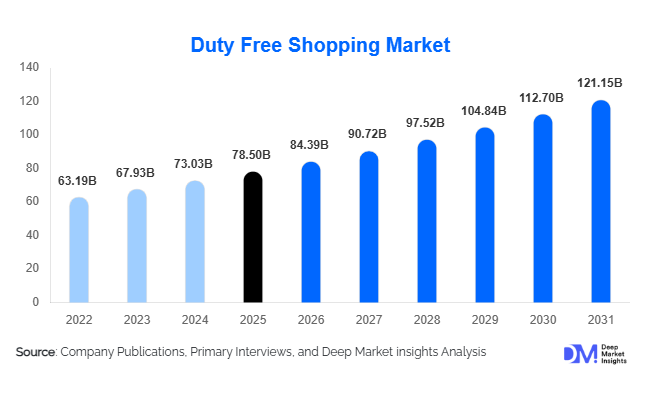
According to Deep Market Insights, the global Duty Free Shopping Market was valued at USD 78.5 billion in 2025 and is projected to grow from USD 84.39 billion in 2026 to reach USD 121.15 billion by 2031, expanding at a CAGR of 7.5% during the forecast period (2026–2031). The market growth is primarily driven by the resurgence of international tourism, expansion of airport infrastructure, increasing demand for luxury goods in travel retail, and rapid digitalization of airport shopping experiences.
Duty free retail has evolved from a limited tax-exempt shopping channel into a highly sophisticated global travel retail ecosystem. Modern duty free stores now function as experiential luxury hubs featuring premium fashion, cosmetics, electronics, and gourmet products. Strong growth in Asia-Pacific outbound tourism, rising middle-class income levels, and expansion of global aviation networks continue to strengthen the industry outlook. Airports and travel hubs are increasingly positioning duty free retail as a core non-aeronautical revenue stream, making it an integral part of global aviation economics.
Key Market Insights
- Airports dominate global duty free sales, accounting for the largest share of travel retail revenue due to high passenger dwell time and conversion rates.
- Perfumes & cosmetics remain the leading product category, driven by high margins, brand exclusivity, and frequent product launches tailored for travel retail.
- Asia-Pacific is the fastest-growing region, supported by rising outbound tourism from China, India, and Southeast Asia.
- Luxury and experiential retail formats are expanding rapidly, transforming duty free stores into premium lifestyle destinations.
- Digitalization and omnichannel retailing are reshaping consumer behavior, with pre-order, click-and-collect, and mobile shopping becoming mainstream.
- Middle East airports are emerging as global luxury retail hubs, led by Dubai and Doha.
Duty Free Shopping Market Trends
Digital Transformation of Travel Retail
Duty free operators are rapidly adopting digital technologies such as AI-based personalization, mobile pre-order platforms, and self-checkout systems. These innovations improve conversion rates and enhance passenger convenience by enabling seamless shopping before and during travel. Airports are integrating omnichannel ecosystems where travelers can browse, reserve, and collect products, significantly increasing basket size and engagement.
Luxury Brand Expansion in Travel Retail
Global luxury brands are increasingly prioritizing duty free channels as strategic retail spaces. Exclusive product launches, travel-retail-only SKUs, and immersive brand boutiques are becoming common across major airports. This trend is elevating the perception of duty free stores from transactional spaces to high-end experiential environments.
Duty Free Shopping Market Drivers
Rising Global Air Passenger Traffic
The steady increase in international air travel is the most significant growth driver for the duty free market. Expanding low-cost carriers, rising disposable incomes, and tourism recovery post-pandemic are fueling passenger growth. Each additional international traveler directly contributes to duty free spending potential, making passenger volume a critical growth metric.
Expansion of Airport Infrastructure
Governments across Asia-Pacific and the Middle East are heavily investing in new airports and terminal expansions. These developments increase retail space availability and allow operators to introduce larger, more diversified duty free offerings. New concession agreements also enable long-term revenue stability for global operators.
Premiumization of Consumer Spending
Travelers are increasingly opting for luxury and premium goods, particularly in cosmetics, fragrances, fashion, and electronics. Duty free shopping is becoming associated with exclusivity and value-driven luxury experiences, boosting average transaction values across global airports.
Duty Free Shopping Market Restraints
Regulatory and Tax Policy Variability
Changes in customs regulations, tax exemptions, and import duties can significantly impact pricing advantages in duty free retail. In some regions, narrowing price gaps between domestic and duty free goods reduces consumer motivation to purchase.
Dependence on Global Travel Volatility
The market is highly sensitive to disruptions in international travel caused by geopolitical tensions, pandemics, or economic downturns. A decline in passenger traffic directly reduces retail sales, making the industry vulnerable to external shocks.
Duty Free Shopping Market Opportunities
Omnichannel and Pre-Order Ecosystems
The integration of digital platforms with physical duty free stores presents a major opportunity. Pre-order systems and click-and-collect services allow travelers to shop in advance, improving conversion rates and operational efficiency. This digital ecosystem is expected to significantly enhance customer engagement.
Expansion in Emerging Aviation Markets
Rapid airport development in India, China, Vietnam, Saudi Arabia, and the UAE is creating substantial new retail opportunities. These regions are witnessing strong growth in outbound travel, making them key hotspots for future duty free expansion and long-term concession agreements.
Sustainability and ESG-Driven Retailing
Sustainability initiatives such as eco-friendly packaging, carbon-neutral operations, and ethical sourcing are becoming increasingly important. Operators aligning with ESG standards are gaining competitive advantages and stronger partnerships with global luxury brands.
Report Scope
| Report Metric | Details |
|---|---|
| Market Size in 2025 | USD 78.5 Billion |
| Market Size in 2026 | USD 84.39 Billion |
| Market Size in 2031 | USD 121.15 Billion |
| CAGR | 7.5% (2026-2031) |
| Base Year for Estimation | 2025 |
| Historical Data | 2022-2024 |
| Forecast Period | 2026-2031 |
| Report Coverage | Revenue Forecast, Competitive Landscape, Supply Chain Disruption, Growth Factors, Environment & Regulatory Landscape and Trends |
| Geographies Covered | North America, Europe, APAC, Middle East and Africa, LATAM |
| Countries Covered | U.S., Canada, U.K., Germany, France, Spain, Italy, Russia, Nordic, Benelux, Rest of Europe, China, Korea, Japan, India, Australia, Singapore, Taiwan, South East Asia, Rest of Asia-Pacific, UAE, Turky, Saudi Arabia, South Africa, Egypt, Nigeria, Rest of MEA, Brazil, Mexico, Argentina, Chile, Colombia, Rest of LATAM |
Explore more data points, trends and opportunities Download Free Sample Report
Product Type Insights
Perfumes & cosmetics dominate the global duty free shopping market due to strong brand partnerships, high global luxury demand, and consistently high gross margins across travel retail channels. This segment benefits from continuous product innovation, exclusive travel-retail editions, and frequent collaborations between luxury brands and airport operators, making it the most resilient and high-performing category globally. Alcoholic beverages and tobacco products continue to contribute significant volume-driven revenues, particularly in airports with high passenger throughput; however, their long-term growth is moderating due to tightening regulations, health awareness campaigns, and shifting consumer preferences.
Fashion & luxury goods represent the fastest-growing category, driven by increasing demand for aspirational shopping experiences among millennials and Gen Z travelers, especially in Asia-Pacific and the Middle East. Electronics and accessories are also gaining momentum due to rising digital lifestyles, connectivity needs during travel, and strong appeal among business and younger travelers. Confectionery and specialty food products maintain steady demand as impulse-driven purchases, particularly in transit zones where short dwell times encourage quick buying decisions. Overall, premiumization, exclusivity, and experiential retail positioning are key structural drivers shaping product-level growth across all segments.
Sales Channel Insights
Airports remain the dominant sales channel in the duty free shopping market, accounting for the majority of global revenue due to high international passenger traffic, extended dwell times, and premium retail environments. Major international hubs such as Dubai, Singapore, London Heathrow, and Seoul Incheon have transformed duty free spaces into experiential luxury destinations, significantly increasing conversion rates and average basket sizes. In-flight duty free sales continue to exist as a niche but stable channel, primarily driven by long-haul routes and premium airline services.
Seaports and cruise terminals are emerging as high-growth channels, supported by the rapid expansion of global cruise tourism, particularly in Europe and the Caribbean. Downtown duty free stores are gaining strong traction in Asia-Pacific, especially in China and South Korea, where city-based tax-free shopping ecosystems are expanding to capture demand beyond airport environments. Land border shops remain highly relevant in regions with strong cross-border mobility such as Europe and parts of Asia. The overall channel expansion trend is being driven by omnichannel integration, digital pre-order systems, and the growing convergence of travel and retail ecosystems.
Traveler Type Insights
International departing passengers account for the largest share of duty free spending globally, primarily due to longer dwell times, higher purchase intent, and fewer baggage constraints before departure. This segment is particularly strong in major international hubs where travelers actively engage in high-value luxury and impulse purchases. Transit passengers also represent a significant revenue contributor, especially in global aviation hubs such as Dubai, Singapore, and Doha, where long layovers encourage additional retail spending.
International arriving passengers form a smaller but steadily growing segment, supported by evolving policies in select regions that encourage arrival-based duty free incentives. Airline crew and diplomatic travelers constitute a niche yet consistent consumer base with predictable purchasing behavior and preference for premium, high-value goods. Overall, traveler segmentation growth is strongly influenced by global air connectivity expansion, rising tourism flows, and increasing integration of retail experiences within airport infrastructure.
Explore more data points, trends and opportunities Download Free Sample Report
Duty Free Shopping Market Segmentations
By Product Type
- Perfumes & Cosmetics
- Alcoholic Beverages
- Tobacco Products
- Fashion & Luxury Goods
- Electronics & Accessories
- Confectionery & Specialty Foods
- Others
By Sales Channel
- Airport Retail Stores
- In-Flight Sales
- Seaport & Cruise Terminal Stores
- Downtown Duty Free Stores
- Land Border Shops
By Traveler Type
- International Departing Passengers
- Transit / Connecting Passengers
- International Arriving Passengers
- Airline Crew & Diplomatic Travelers
Regional Insights
Asia-Pacific
Asia-Pacific leads the global duty free shopping market with approximately 40% market share in 2025, driven by strong outbound tourism, rapid urbanization, and rising disposable incomes across China, India, Japan, South Korea, and Singapore. The region benefits significantly from large-scale airport expansion projects, increasing international flight connectivity, and growing appetite for luxury consumption among middle-class and high-income travelers. China Duty Free Group and South Korea’s duty free ecosystem play a critical role in shaping competitive dynamics. rising middle-class wealth, expansion of international airports in India and Southeast Asia, strong luxury consumption trends, government-backed aviation infrastructure investments, and increasing penetration of global luxury brands in travel retail channels.
Europe
Europe accounts for around 30% of the global duty free market, supported by high intra-regional travel, strong tourism inflows, and established luxury shopping culture. Major airports such as London Heathrow, Paris Charles de Gaulle, Frankfurt, and Madrid serve as critical revenue hubs. The region benefits from a mature tourism ecosystem and consistent passenger flow driven by both leisure and business travel. strong intra-European mobility under Schengen travel, high penetration of luxury tourism, expansion of experiential retail formats, and increasing demand for sustainable and premium travel retail experiences among younger demographics.
Middle East & Africa
The Middle East is emerging as a global luxury retail powerhouse within the duty free market, led by world-class hubs such as Dubai International Airport and Hamad International Airport in Doha. Saudi Arabia’s Vision 2031 is accelerating massive airport infrastructure expansion, positioning the region as a key global transit and luxury shopping destination. Africa, particularly South Africa, Kenya, and Morocco, is experiencing steady growth driven by tourism development and improved aviation infrastructure. strategic geographic positioning as a global transit hub, high per-capita luxury spending in GCC countries, aggressive airport modernization programs, rising international tourism inflows, and strong government investment in aviation-led economic diversification.
North America
North America holds a moderate share of the global duty free market due to regulatory limitations on duty free pricing structures and lower penetration compared to other regions. However, major international airports such as JFK, LAX, Toronto Pearson, and Miami International continue to generate strong revenues driven by high passenger traffic and business travel demand.recovery in international inbound tourism, expansion of airport modernization projects, increasing premium travel demand among business travelers, and gradual adoption of enhanced retail experiences in major aviation hubs.
Latin America
Latin America represents a smaller but gradually expanding segment of the global duty free market, with Brazil and Mexico leading regional demand. Growth is primarily supported by tourism expansion, increasing international connectivity, and ongoing modernization of airport infrastructure across key cities. rising outbound tourism, expansion of airport redevelopment projects, increasing presence of international retail operators, and growing demand for affordable luxury and travel-related retail experiences.
Key Players in the Duty Free Shopping Market
- Avolta
- Lagardère Travel Retail
- DFS Group
- Gebr. Heinemann
- Dubai Duty Free
- China Duty Free Group
- Lotte Duty Free
- Shilla Duty Free
- King Power
- Aer Rianta International
- JR Duty Free
- 3Sixty Duty Free