Craft Knife Market Size
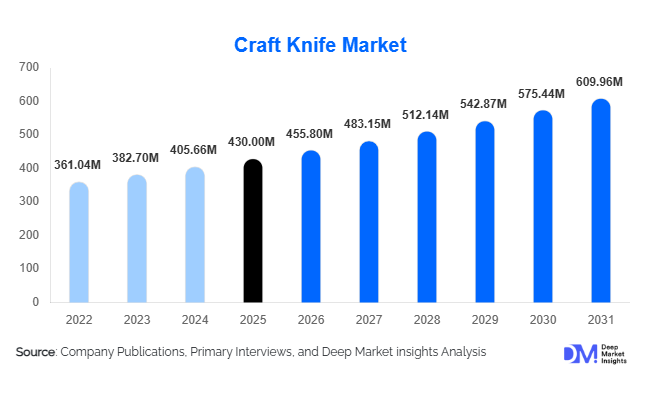
According to Deep Market Insights, the global craft knife market size was valued at USD 430 million in 2025 and is projected to grow from USD 455.80 million in 2026 to reach USD 609.96 million by 2031, expanding at a CAGR of 6.0% during the forecast period (2026–2031). The craft knife market growth is primarily driven by the rising popularity of DIY crafting activities, increasing participation in creative hobbies, and the expanding use of precision cutting tools in packaging, signage production, and design applications.
Craft knives are precision cutting tools widely used for intricate cutting tasks involving materials such as paper, cardboard, foam board, vinyl sheets, plastic films, and fabrics. These tools play a critical role in arts and crafts, model making, industrial packaging preparation, and educational design activities. As the global maker economy continues to expand, craft knives are becoming essential tools for hobbyists, small creative entrepreneurs, and professional designers.
The growing influence of online crafting communities, digital tutorials, and social media platforms has significantly boosted consumer engagement with DIY projects. In addition, e-commerce platforms have improved product accessibility, allowing manufacturers to reach niche hobby markets worldwide. Technological innovations in blade durability, ergonomic handle design, and safety mechanisms are further expanding the appeal of craft knives across both professional and recreational users.
Key Market Insights
- The global maker economy and DIY culture are significantly boosting craft knife demand, as hobbyists and small creative businesses increasingly rely on precision cutting tools.
- Precision craft knives dominate the product category, widely used in paper crafting, model building, and design applications requiring intricate cutting.
- North America holds the largest market share, driven by a strong DIY culture and a well-established arts and crafts retail ecosystem.
- Asia-Pacific is the fastest-growing regional market, supported by rising creative entrepreneurship and expanding art education programs.
- Online retail channels are rapidly gaining market share, enabling manufacturers to reach specialized hobbyist communities globally.
- Technological advancements in blade materials and ergonomic designs are enhancing safety, durability, and precision cutting performance.
What are the latest trends in the craft knife market?
Rising Popularity of DIY Crafting and Creative Communities
The global DIY movement is one of the most influential trends shaping the craft knife market. Increasing participation in creative hobbies such as scrapbooking, miniature modeling, paper engineering, and home décor crafting has significantly increased demand for precision cutting tools. Social media platforms such as YouTube, Pinterest, and Instagram have accelerated this trend by providing tutorials, project ideas, and interactive crafting communities.
As more consumers explore personalized handmade products and artistic hobbies, craft knives have become essential tools for achieving intricate cutting precision. In addition, the rise of small home-based craft businesses selling customized products through online marketplaces has further expanded demand. Entrepreneurs producing handmade greeting cards, decorative packaging, and customized art pieces rely heavily on high-quality craft knives to maintain product quality.
Innovation in Blade Materials and Ergonomic Tool Design
Manufacturers are increasingly investing in blade technology and ergonomic product design to improve performance and user safety. Modern craft knives now feature advanced blade materials such as titanium-coated steel, ceramic blades, and corrosion-resistant stainless steel alloys. These materials improve blade durability, reduce wear, and maintain cutting sharpness for longer periods.
Ergonomic improvements are also transforming product design. Anti-slip grips, lightweight aluminum handles, retractable blade systems, and safety locking mechanisms are becoming standard features in many premium craft knife models. These enhancements help reduce hand fatigue during prolonged usage while minimizing accidental injuries. As a result, professional designers, educational institutions, and hobbyists are increasingly adopting advanced craft knife models that offer improved precision and safety.
What are the key drivers in the craft knife market?
Expansion of the Global DIY and Maker Economy
The growing popularity of DIY projects and creative hobbies is a major driver of the craft knife market. Consumers worldwide are increasingly engaging in activities such as scrapbooking, paper art, miniature modeling, and personalized home décor creation. These activities require precise cutting tools capable of producing intricate patterns and shapes.
Online tutorials, digital crafting communities, and influencer-driven content have further accelerated this trend. As consumers gain access to creative project ideas and instructional resources, more individuals are experimenting with crafting hobbies. This surge in creative engagement has significantly expanded the global customer base for craft knives.
Growing Demand from Packaging and Signage Industries
Craft knives are widely used in commercial applications, including packaging preparation, labeling, and signage production. Small packaging businesses frequently rely on manual cutting tools to trim cardboard sheets, foam inserts, and vinyl labels. Craft knives provide a cost-effective solution for precision cutting tasks that do not require expensive automated cutting equipment.
The rapid expansion of e-commerce businesses has further increased demand for customized packaging and labeling solutions. As companies seek to differentiate their packaging designs, the need for precision cutting tools continues to grow.
What are the restraints for the global market?
Safety Concerns Associated with Sharp Cutting Tools
Craft knives are extremely sharp instruments, and improper handling can result in accidental injuries. Safety concerns are particularly relevant in educational environments or among beginner hobbyists who may lack experience using precision cutting tools. Some institutions restrict the use of sharp tools, which can limit adoption in certain segments of the market.
Manufacturers are addressing this challenge by introducing retractable blades, finger guards, and protective storage caps to improve safety standards.
Competition from Automated Cutting Technologies
Automated cutting machines such as digital craft plotters and laser cutters are gradually gaining popularity in professional design studios and craft workshops. These machines can produce highly precise cuts with minimal manual effort, reducing reliance on manual craft knives for certain applications.
Although automated equipment is significantly more expensive, increasing accessibility and declining equipment costs may reduce demand for manual cutting tools in some professional environments.
What are the key opportunities in the craft knife industry?
Growth of Creative Entrepreneurship and Small Craft Businesses
The rapid growth of online craft marketplaces has created significant opportunities for craft knife manufacturers. Entrepreneurs producing handmade products such as greeting cards, decorative packaging, vinyl decals, and custom art pieces rely heavily on precision cutting tools. These small businesses require reliable craft knives to maintain product quality and consistency.
Manufacturers can capitalize on this opportunity by developing specialized craft tool kits designed for small creative enterprises. Bundled tool sets, beginner kits, and modular blade systems are increasingly popular among independent craft creators.
Expansion of E-commerce Distribution Channels
The expansion of online retail platforms has dramatically improved global accessibility to craft tools. E-commerce marketplaces allow manufacturers to reach niche hobbyist communities that may not have access to specialty craft stores.
Direct-to-consumer brand websites are also becoming important sales channels. Companies are leveraging digital marketing strategies, online tutorials, and influencer partnerships to promote craft knife products and stimulate demand among creative hobbyists.
Report Scope
| Report Metric | Details |
|---|---|
| Market Size in 2025 | USD 430 Million |
| Market Size in 2026 | USD 455.80 Million |
| Market Size in 2031 | USD 609.96 Million |
| CAGR | 6.0% (2026-2031) |
| Base Year for Estimation | 2025 |
| Historical Data | 2022-2024 |
| Forecast Period | 2026-2031 |
| Report Coverage | Revenue Forecast, Competitive Landscape, Supply Chain Disruption, Growth Factors, Environment & Regulatory Landscape and Trends |
| Geographies Covered | North America, Europe, APAC, Middle East and Africa, LATAM |
| Countries Covered | U.S., Canada, U.K., Germany, France, Spain, Italy, Russia, Nordic, Benelux, Rest of Europe, China, Korea, Japan, India, Australia, Singapore, Taiwan, South East Asia, Rest of Asia-Pacific, UAE, Turky, Saudi Arabia, South Africa, Egypt, Nigeria, Rest of MEA, Brazil, Mexico, Argentina, Chile, Colombia, Rest of LATAM |
Explore more data points, trends and opportunities Download Free Sample Report
Product Type Insights
Precision craft knives dominate the global craft knife market, accounting for approximately 42% of total revenue in 2025. These knives are specifically engineered for intricate cutting tasks that require exceptional accuracy and control. Their slim, lightweight handles and interchangeable micro-precision blades allow users to cut delicate materials such as paper, vinyl, foam board, thin plastic sheets, and fabrics with minimal resistance. As a result, precision craft knives have become the preferred choice among professional designers, architects, hobbyists, and model makers who require consistent cutting performance for detailed work.
The leadership of this segment is largely driven by the rapid expansion of DIY crafting, miniature modeling, paper engineering, and graphic design applications. Increasing consumer interest in scrapbooking, handmade greeting cards, and personalized craft projects has significantly boosted demand for precision cutting tools. In addition, architectural model makers and product designers rely heavily on these knives for prototype development and detailed finishing work. The availability of interchangeable blades with varying shapes, such as angled, curved, and chisel blades, further enhances their versatility across different creative applications.
Application Insights
Arts and paper crafting represent the largest application segment in the craft knife market, accounting for nearly 38% of global demand. This segment’s dominance is primarily driven by the growing popularity of creative hobbies such as scrapbooking, paper cutting, card making, decorative journaling, and handmade gift packaging. These activities require precise cutting tools capable of producing intricate shapes, patterns, and edges without damaging delicate materials. As crafting communities continue to expand through online platforms and social media tutorials, demand for high-quality craft knives is expected to remain strong.
The rise of the global “maker culture” has also played a crucial role in expanding craft knife usage. Creative entrepreneurs producing handmade products, such as personalized stationery, custom décor items, and artistic paper installations, depend heavily on precision cutting tools to maintain product quality and design complexity. This trend has further strengthened the demand for craft knives among independent creators and small craft businesses. Model making and miniature crafting represent another important application area. Architects, industrial designers, and hobby model builders frequently use craft knives to cut foam boards, acrylic sheets, cardboard structures, and plastic modeling materials during prototype development. These tools enable designers to achieve precise angles and clean edges that are essential for accurate scale models.
Distribution Channel Insights
Offline retail channels continue to play an important role in the craft knife market, particularly through craft specialty stores, stationery retailers, hardware outlets, and office supply chains. These retail environments allow customers to physically examine tool ergonomics, handle materials, blade sharpness, and overall build quality before making a purchase decision. For many hobbyists and professionals, the tactile evaluation of the product remains a critical factor when selecting precision cutting tools. Specialty craft stores also provide expert guidance and product demonstrations that help consumers choose appropriate knife types for specific projects. Educational institutions and design studios often prefer sourcing tools through these established retail networks due to reliability and consistent product availability.
Online retail platforms are rapidly gaining market share and currently account for approximately 34% of global craft knife sales. E-commerce platforms provide consumers with access to a broader range of brands, blade types, and specialized craft tools that may not be available in local stores. Competitive pricing, product reviews, and detailed instructional content further enhance the online purchasing experience. The increasing influence of digital crafting communities has significantly boosted online sales. Many tutorials and project guides include direct links to recommended tools, encouraging hobbyists to purchase craft knives through e-commerce platforms. As a result, manufacturers are increasingly investing in direct-to-consumer websites, influencer marketing, and online craft education platforms to strengthen their digital sales channels.
End-User Insights
Hobbyists and DIY consumers represent the largest end-user segment in the craft knife market. The growing popularity of creative hobbies, home décor projects, and handmade crafts has dramatically expanded this consumer base. Consumers are increasingly seeking personalized products and artistic outlets, leading to higher participation in craft activities such as scrapbooking, paper art, miniature modeling, and custom packaging design. These projects often require precision cutting tools capable of producing detailed and aesthetically appealing results. The expansion of online marketplaces for handmade goods has also contributed to this segment’s growth. Small entrepreneurs selling customized crafts through digital platforms rely heavily on craft knives to produce intricate designs and maintain product quality. This shift toward creative entrepreneurship has significantly increased the demand for reliable, high-performance craft knives.
Professional designers and artists represent another important end-user group. Graphic designers, architects, industrial designers, and product developers frequently use craft knives for precision cutting tasks in model creation, concept development, and prototype fabrication. The ability to achieve clean edges and exact dimensions makes craft knives an indispensable tool within design studios. Educational institutions offering art, design, and architecture programs also contribute to market demand. Students regularly use craft knives for school projects, architectural models, and art assignments, making these tools a common component of educational supply kits.
Explore more data points, trends and opportunities Download Free Sample Report
Craft Knife Market Segmentations
By Product Type
- Precision Craft Knives
- Retractable Craft Knives
- Fixed Blade Craft Knives
- Heavy-Duty Craft Knives
By Application
- Arts & Paper Crafting
- Model Making & Miniature Craft
- DIY & Home Décor Projects
- Packaging & Office Cutting Tasks
- Industrial Precision Cutting
By Distribution Channel
- Online Retail
- Craft & Art Specialty Stores
- Stationery & Office Supply Stores
- Hardware & Tool Retailers
- Educational Supply Distributors
By End User
- Hobbyists & DIY Consumers
- Professional Designers & Artists
- Educational Institutions
- Industrial & Packaging Operators
Regional Insights
North America
North America accounts for approximately 34% of the global craft knife market, making it the largest regional market. The United States represents the dominant contributor within the region due to its well-established DIY culture and strong consumer spending on hobby and craft products. A large network of craft specialty retailers, online craft platforms, and creative workshops further supports market expansion.
Another major growth driver in North America is the increasing popularity of personalized handmade products and home-based craft businesses. Platforms supporting small creative entrepreneurs have encouraged many individuals to launch craft-focused microbusinesses, which rely heavily on precision cutting tools. Canada also contributes significantly to regional demand due to strong participation in arts education programs and community craft initiatives.
Europe
Europe holds roughly 28% of the global craft knife market. Germany, the United Kingdom, and France represent the largest markets within the region. European demand is strongly influenced by the region’s long-standing tradition of artistic craftsmanship, model building, and design education. Consumers in Europe tend to favor premium craft knives with ergonomic designs, high-quality steel blades, and durable materials. The presence of numerous design schools, architecture institutes, and creative industries across the region further supports demand. Additionally, the popularity of scale model building, particularly in Germany and the UK, continues to drive consistent sales of precision craft knives.
Asia-Pacific
Asia-Pacific is the fastest-growing region in the craft knife market, driven by rapid urbanization, expanding art education programs, and the rising popularity of creative hobbies. China and Japan serve as major manufacturing and consumption hubs, benefiting from strong tool manufacturing capabilities and active hobbyist communities. Japan has a particularly strong culture of precision craftsmanship and hobby modeling, which supports steady demand for high-quality craft knives. Meanwhile, China’s rapidly growing e-commerce ecosystem has enabled local manufacturers to distribute craft tools globally while simultaneously expanding domestic demand. India and Southeast Asian countries are emerging as promising growth markets due to increasing participation in art education programs, rising middle-class income levels, and growing creative entrepreneurship. The expansion of DIY culture and craft-based small businesses across these markets is expected to accelerate regional growth in the coming years.
Latin America
Latin America accounts for approximately 6% of the global craft knife market. Brazil and Mexico represent the largest markets within the region. Demand is largely driven by the increasing popularity of arts and crafts activities, school art programs, and DIY home décor projects. In addition, the expansion of local craft fairs, handmade product markets, and community art initiatives is contributing to greater adoption of craft tools across the region. As disposable incomes rise and creative hobbies gain popularity among younger demographics, the regional market is expected to experience gradual growth.
Middle East & Africa
The Middle East and Africa region currently accounts for around 4% of global craft knife demand. The United Arab Emirates and South Africa are the leading markets within this region. Demand is primarily driven by educational institutions, architectural design firms, and professional artists who require precision cutting tools for modeling and creative projects. The UAE’s growing design and architecture sectors, supported by rapid infrastructure development, have increased the demand for modeling tools used in prototype development and architectural presentations. In South Africa, the growth of art education programs and creative industries has contributed to rising adoption of craft knives. Although the region currently represents a smaller share of the global market, expanding creative industries, rising design education initiatives, and increasing availability of craft tools through online retail channels are expected to gradually support market growth in the coming years.
Key Players in the Craft Knife Market
- Fiskars Corporation
- OLFA Corporation
- Stanley Black & Decker
- X-Acto
- Maped
- Westcott
- Alvin & Company
- Excel Blades
- NT Cutter
- Carl Manufacturing
- Dahle
- Arteza
- Slice Inc.
- Tajima Tool Corporation
- Pro'sKit