Cloth Diapers Market Size
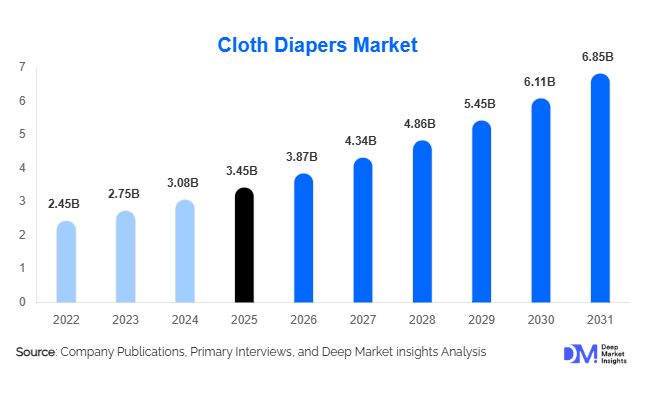
According to Deep Market Insights, the global cloth diapers market size was valued at USD 3.45 billion in 2025 and is projected to grow from USD 3.87 billion in 2026 to reach USD 6.85 billion by 2031, expanding at a CAGR of 12.1% during the forecast period (2026–2031). The cloth diapers market growth is primarily driven by increasing consumer awareness regarding sustainable baby care products, rising concerns over landfill waste generated by disposable diapers, growing adoption of organic and reusable infant hygiene solutions, and continuous innovations in absorbent fabrics and diaper designs. The market is benefiting from favorable demographic trends in emerging economies, increasing e-commerce penetration, and rising demand among environmentally conscious millennial and Gen Z parents seeking cost-effective long-term alternatives to disposable diapers.
Key Market Insights
- Reusable diaper systems are replacing traditional disposable alternatives among environmentally conscious consumers seeking lower lifecycle waste and reduced household expenditure.
- Organic cotton and bamboo-based cloth diapers are witnessing strong adoption due to superior skin compatibility, breathability, and sustainability credentials.
- North America accounts for approximately 34% of the global market, supported by strong environmental awareness and premium product adoption.
- Asia-Pacific is the fastest-growing regional market, driven by rising birth rates, expanding middle-class populations, and increasing digital retail penetration.
- Online retail channels contribute more than 45% of global sales, reflecting growing consumer preference for direct-to-consumer and marketplace purchasing.
- Product innovation remains a major competitive differentiator, with manufacturers introducing leak-proof systems, smart sizing solutions, antimicrobial fabrics, and hybrid reusable diaper models.
Cloth Diapers Market Trends
Growing Demand for Sustainable and Organic Baby Care Products
Sustainability has become one of the strongest purchasing drivers within the baby care industry. Consumers are increasingly evaluating products based on environmental impact, recyclability, and material sourcing. Cloth diapers manufactured from organic cotton, bamboo fibers, and hemp materials are experiencing strong demand due to their lower carbon footprint compared with disposable alternatives. Parents are increasingly attracted to products that reduce household waste while providing long-term cost savings. Manufacturers are responding by introducing certified organic product lines, sustainable packaging solutions, and eco-friendly production processes. The trend is particularly pronounced across North America and Europe, where environmentally responsible parenting practices are becoming mainstream consumer behavior.
Expansion of Direct-to-Consumer and Subscription-Based Sales Models
E-commerce platforms are transforming cloth diaper distribution globally. Direct-to-consumer business models allow manufacturers to educate consumers, build brand loyalty, and improve profit margins. Subscription-based diaper delivery services are gaining popularity by offering convenience, customized product bundles, and recurring replenishment options. Digital marketing, parenting influencers, and online product communities are accelerating product awareness and adoption. Brands are increasingly leveraging social commerce platforms, virtual consultations, and product trial programs to improve customer acquisition. These developments are significantly enhancing accessibility and supporting market expansion in both developed and emerging economies.
Cloth Diapers Market Drivers
Rising Environmental Concerns Regarding Disposable Diaper Waste
Disposable diapers contribute billions of units annually to global landfill waste streams, creating substantial environmental concerns. Increasing awareness regarding plastic pollution and waste management challenges is encouraging parents to switch toward reusable alternatives. Government sustainability initiatives and waste reduction programs across Europe and North America are further supporting consumer adoption. The environmental benefits associated with reusable diaper systems remain one of the strongest long-term growth drivers for the market.
Long-Term Cost Savings for Households
Although cloth diapers require higher upfront investment, they offer significant cost advantages over the entire diaper usage cycle. Families can reduce diapering expenses by 50–70% compared with disposable alternatives. Rising inflation and increasing household budget consciousness have further strengthened demand for reusable diaper products. The ability to reuse diapers across multiple children also enhances value perception among consumers.
Product Innovation and Enhanced User Convenience
Modern cloth diapers have evolved significantly from traditional reusable nappies. Manufacturers are introducing all-in-one designs, adjustable sizing systems, improved absorbent inserts, moisture-wicking materials, and leak-resistant technologies. These innovations are addressing historical consumer concerns related to convenience, hygiene, and maintenance. Product improvements have expanded adoption among first-time parents and mainstream consumer groups that previously preferred disposable products.
Cloth Diapers Market Restraints
Consumer Perception of Maintenance Complexity
Despite technological improvements, some consumers continue to perceive cloth diapers as time-intensive products requiring washing, drying, and storage. Busy urban households often favor disposable diapers due to convenience advantages. Limited consumer education regarding modern cloth diaper systems remains a challenge in several developing markets.
Water and Energy Consumption Concerns
While cloth diapers reduce solid waste generation, critics highlight water and energy usage associated with repeated washing and drying. Regions experiencing water scarcity may encounter slower adoption rates due to concerns regarding resource consumption. Manufacturers are increasingly addressing these concerns through low-maintenance fabrics and efficient cleaning recommendations.
Cloth Diapers Market Opportunities
Premium Organic and Hypoallergenic Product Expansion
The premium baby care segment presents substantial opportunities for market participants. Parents increasingly seek chemical-free, hypoallergenic, and certified organic products for infant care. Premium cloth diaper offerings incorporating organic cotton, bamboo fibers, and dermatologically tested materials command higher margins and support brand differentiation. This opportunity is particularly attractive in North America, Western Europe, Japan, South Korea, and Australia.
Rapid Growth Across Emerging Asian Markets
Asia-Pacific presents the strongest long-term growth opportunity due to rising birth rates, increasing disposable incomes, and expanding online retail infrastructure. Countries such as India, Indonesia, Vietnam, and the Philippines are witnessing increasing awareness regarding sustainable parenting products. Growing middle-class populations and improving healthcare awareness are expected to accelerate cloth diaper adoption across the region.
Integration of Smart Textile Technologies
Emerging smart fabric technologies create opportunities for premium product development. Moisture indicators, antimicrobial materials, temperature-monitoring fabrics, and advanced absorbency systems can significantly enhance user experience. Manufacturers investing in textile innovation and sustainable materials are expected to capture premium market segments and strengthen competitive positioning over the coming decade.
Report Scope
| Report Metric | Details |
|---|---|
| Market Size in 2025 | USD 3.45 Billion |
| Market Size in 2026 | USD 3.87 Billion |
| Market Size in 2031 | USD 6.85 Billion |
| CAGR | 12.1% (2026-2031) |
| Base Year for Estimation | 2025 |
| Historical Data | 2022-2024 |
| Forecast Period | 2026-2031 |
| Report Coverage | Revenue Forecast, Competitive Landscape, Supply Chain Disruption, Growth Factors, Environment & Regulatory Landscape and Trends |
| Geographies Covered | North America, Europe, APAC, Middle East and Africa, LATAM |
| Countries Covered | U.S., Canada, U.K., Germany, France, Spain, Italy, Russia, Nordic, Benelux, Rest of Europe, China, Korea, Japan, India, Australia, Singapore, Taiwan, South East Asia, Rest of Asia-Pacific, UAE, Turky, Saudi Arabia, South Africa, Egypt, Nigeria, Rest of MEA, Brazil, Mexico, Argentina, Chile, Colombia, Rest of LATAM |
Explore more data points, trends and opportunities Download Free Sample Report
Product Type Insights
All-in-One (AIO) cloth diapers accounted for approximately 29% of the global cloth diapers market in 2025, making them the largest product type segment worldwide. The segment's leadership is primarily driven by its ease of use and convenience, as AIO diapers closely replicate the functionality of disposable diapers while retaining the environmental and cost benefits of reusable products. First-time parents increasingly prefer AIO diapers because they require minimal assembly, washing complexity, or diapering expertise compared to prefold and fitted alternatives. The growing participation of working parents, particularly in North America and Europe, has further accelerated demand for convenient reusable diaper solutions. Manufacturers are also investing heavily in advanced absorbent cores, leak-proof barriers, and quick-drying fabrics, making AIO products more attractive to mainstream consumers.
Pocket diapers represented approximately 22% of global demand and remain highly popular due to their customizable absorbency levels and affordability. Consumers can adjust absorbent inserts according to infant age and usage requirements, providing greater flexibility than standard diaper systems. Hybrid cloth diapers are emerging as one of the fastest-growing product categories globally, supported by growing demand for flexible diapering solutions that combine reusable shells with disposable or reusable inserts. Hybrid systems are particularly attractive in urban households where convenience remains a key purchasing factor. Meanwhile, prefold and fitted diapers continue to maintain stable demand among experienced cloth diaper users due to their lower acquisition costs and durability. Swim diapers and training pants represent niche but steadily expanding categories, supported by increasing enrollment in infant swimming programs, early childhood development activities, and toilet-training initiatives across developed markets.
Material Type Insights
Cotton-based cloth diapers dominated the market with approximately 42% revenue share in 2025. Cotton remains the preferred material globally due to its natural softness, high breathability, skin compatibility, and widespread availability. The segment has particularly benefited from growing consumer concerns regarding diaper rash, skin allergies, and exposure to synthetic materials. Organic cotton variants are witnessing faster-than-market growth rates as parents increasingly seek chemical-free and sustainably sourced infant care products. Premium brands are leveraging organic certifications to strengthen product differentiation and command higher margins.
Bamboo-based cloth diapers accounted for nearly 24% of global demand and continue to gain market share because of their superior moisture absorption capabilities, antimicrobial properties, and sustainability credentials. Bamboo fibers can absorb significantly more liquid than conventional cotton, making them particularly attractive for overnight use. Hemp-based diapers are emerging as a premium absorbency solution, especially across North America and Western Europe, where environmentally conscious consumers are willing to pay premium prices for durable and sustainable products. Microfiber materials remain widely utilized due to their affordability, fast-drying characteristics, and manufacturing efficiency, particularly within mid-priced product categories.
Distribution Channel Insights
Online retail channels led the global cloth diapers market with approximately 46% market share in 2025. The segment's dominance is primarily driven by increasing digital commerce penetration, wider product availability, competitive pricing structures, and access to educational content that helps consumers understand reusable diaper systems. Cloth diaper purchases often require significant product research, making digital channels particularly effective because consumers can compare products, review customer feedback, access instructional materials, and evaluate long-term cost savings before purchasing.
Brand-owned websites are becoming increasingly important as manufacturers seek to improve customer retention, strengthen brand loyalty, and increase profit margins through direct-to-consumer sales models. Subscription-based diaper programs and bundled product offerings are further supporting online channel growth. Offline retail continues to play a significant role, particularly through baby specialty stores, pharmacies, and supermarkets where parents can physically evaluate product materials, sizing, and quality. Retailers are increasingly adopting omnichannel strategies that combine digital education with physical product experiences, creating a more seamless consumer purchasing journey.
End User Insights
Household consumers represented approximately 87% of global cloth diaper demand in 2025, making residential usage the dominant end-use segment. Household adoption continues to increase due to growing environmental awareness, long-term cost savings, and expanding availability of premium reusable diaper products. The shift toward sustainable parenting practices among millennial and Generation Z parents has become a major growth catalyst for this segment. Rising concerns regarding landfill waste and exposure to chemicals commonly found in disposable diapers are further strengthening household demand globally.
Daycare centers are emerging as a high-potential institutional segment, particularly across Europe and North America, where sustainability initiatives and waste reduction targets are encouraging the adoption of reusable diaper programs. Hospitals and maternity centers are increasingly incorporating reusable infant hygiene solutions into sustainability strategies aimed at reducing healthcare-related waste generation. NGO-supported maternal health and child welfare programs across Asia, Africa, and Latin America are also contributing to market expansion by promoting affordable and reusable infant care products among low-income households. These institutional channels are expected to become increasingly important as governments and organizations prioritize environmental sustainability objectives.
Explore more data points, trends and opportunities Download Free Sample Report
Cloth Diapers Market Segmentations
By Product Type
- Prefold Cloth Diapers
- Flat Cloth Diapers
- Fitted Cloth Diapers
- Contour Cloth Diapers
- Pocket Cloth Diapers
- All-in-One (AIO) Cloth Diapers
- All-in-Two (AI2) Cloth Diapers
- Hybrid Cloth Diapers
- Training Pants
- Swim Cloth Diapers
By Material Type
- Cotton
- Organic Cotton
- Bamboo Fiber
- Hemp Fiber
- Microfiber
- Fleece
- Polyester Blends
- Mixed Fabric Composites
By Distribution Channel
- Online Retail
- Brand-Owned Websites
- E-commerce Marketplaces
- Supermarkets & Hypermarkets
- Baby Specialty Stores
- Pharmacy & Drug Stores
- Department Stores
- Independent Retailers
By End User
- Household Consumers
- Daycare & Childcare Centers
- Hospitals & Maternity Centers
- NGOs & Welfare Programs
Regional Insights
North America
North America accounted for approximately 34% of the global cloth diapers market in 2025, making it the largest regional market worldwide. The United States alone contributed nearly 29% of global revenue, supported by strong consumer purchasing power, high environmental awareness, and widespread acceptance of premium baby care products. The region benefits from a highly developed e-commerce ecosystem, enabling consumers to access a broad range of reusable diaper products and educational resources. Growing concerns regarding plastic waste, increasing adoption of sustainable lifestyles, and rising consumer preference for organic baby products continue to drive market growth. Canada is experiencing strong adoption due to supportive sustainability policies, increasing participation in zero-waste movements, and growing demand for eco-certified infant care products. The presence of several leading cloth diaper brands and well-established direct-to-consumer sales channels further strengthens regional market leadership.
Europe
Europe represented approximately 29% of global market demand in 2025 and remains one of the most environmentally conscious consumer markets globally. Germany, the United Kingdom, France, the Netherlands, and Scandinavian countries are the primary demand centers. Regional growth is driven by stringent environmental regulations, circular economy initiatives, and government policies focused on reducing municipal waste generation. Germany remains the largest European market due to high consumer awareness, strong purchasing power, and established reusable product adoption. Scandinavian countries exhibit some of the highest per-capita usage rates globally, supported by strong sustainability cultures and government-backed environmental programs. Rising energy and household costs across Europe have also encouraged consumers to consider reusable products that provide long-term savings compared to disposable alternatives.
Asia-Pacific
Asia-Pacific accounted for approximately 24% of global revenue in 2025 and is projected to register the fastest regional growth rate of nearly 14% CAGR through 2031. China, India, Japan, South Korea, and Australia represent the largest regional markets. The region's growth is primarily supported by high birth rates, expanding middle-class populations, increasing disposable incomes, and rapidly growing e-commerce penetration. India is expected to emerge as the fastest-growing country market globally due to rising awareness regarding sustainable parenting, government cleanliness initiatives, and increasing affordability of reusable diaper products. China's market growth is being driven by increasing demand for premium organic baby care products and growing health-consciousness among urban parents. Japan and South Korea continue to support premium product demand through strong consumer focus on product quality, safety, and innovation.
Latin America
Latin America remains an emerging market for cloth diapers, led by Brazil, Mexico, Argentina, and Chile. Regional growth is being driven by increasing awareness of the economic benefits of reusable diapers, rising urbanization, and gradual improvements in household purchasing power. Brazil dominates regional demand due to its large infant population, expanding middle-income demographic, and growing environmental awareness among younger parents. Mexico is witnessing increased adoption through e-commerce channels and growing availability of international diaper brands. Rising inflation across several Latin American countries is also encouraging consumers to adopt reusable products that provide long-term cost savings compared with disposable alternatives.
Middle East & Africa
The Middle East and Africa region currently accounts for a relatively small share of global demand but presents significant long-term growth opportunities. South Africa, the UAE, Saudi Arabia, Kenya, and Nigeria represent the most promising markets. Regional growth is being supported by increasing awareness regarding sustainable consumer products, expanding retail infrastructure, and improving access to premium baby care solutions. In the Gulf Cooperation Council countries, high household incomes and increasing demand for premium infant care products are driving adoption. Across Africa, growth is supported by rising birth rates, expanding maternal healthcare programs, and NGO initiatives promoting affordable reusable diaper alternatives. Improvements in digital commerce infrastructure and international brand penetration are expected to further accelerate market development across the region during the forecast period.
Key Players in the Cloth Diapers Market
- BumGenius (Cotton Babies)
- Thirsties Baby
- GroVia
- Charlie Banana
- Smart Bottoms
- Kanga Care
- Blueberry Diapers
- Best Bottom Diapers
- Mother-ease
- Bambino Mio
- TotsBots
- Rumparooz
- Nora's Nursery
- Alva Baby
- Buttons Diapers