Eco-Friendly Toys Market Size
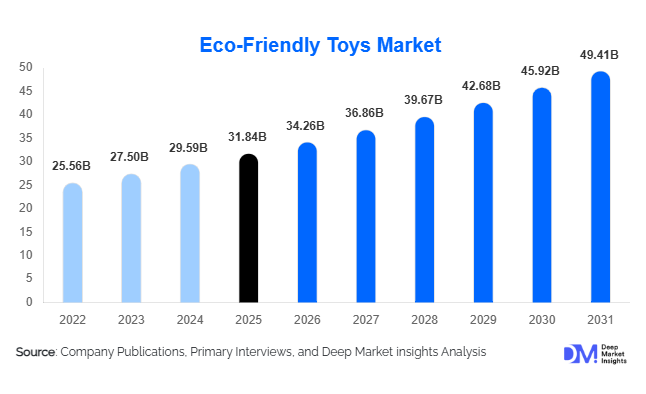
According to Deep Market Insights, the global eco-friendly toys market size was valued at USD 31.84 billion in 2025 and is projected to grow from USD 34.26 billion in 2026 to reach USD 61.47 billion by 2031, expanding at a CAGR of 7.6% during the forecast period (2026–2031). The Eco Friendly Toys market growth is primarily driven by increasing consumer awareness regarding environmental sustainability, rising demand for non-toxic children’s products, growing adoption of biodegradable materials, and expansion of eco-conscious retail channels. The market analysis covers product segmentation, application areas, regional performance, competitive landscape, and emerging trends shaping the sustainable toy industry.
Key Market Insights
- Eco-friendly toys are witnessing strong adoption as parents increasingly prioritize sustainable, chemical-free, and child-safe products, with more than 68% of manufacturers incorporating recycled or renewable materials into their portfolios.
- Wooden toys dominate the market, accounting for approximately 43.5% share in 2025, while organic fabric toys represent the fastest-growing category with an estimated CAGR of 8.9% through 2031.
- Educational toys remain the leading application segment, contributing nearly 46.7% market share due to rising demand for STEM-based learning products manufactured using sustainable materials.
- North America dominates the Eco Friendly Toys market, holding approximately 35.8% revenue share, supported by strong consumer spending, environmental awareness, and established sustainable product regulations.
- Asia-Pacific is emerging as the fastest-growing regional market, expanding at approximately 8.8% CAGR due to rising disposable income, growing middle-class populations, and increasing sustainability awareness.
- Technological advancements and sustainable manufacturing practices, including recycled polymers, biodegradable materials, and digital learning integration, are reshaping the competitive landscape of the Eco Friendly Toys industry.
Eco Friendly Toys Market Trends
Growing Adoption of Sustainable and Biodegradable Materials
The Eco Friendly Toys industry is experiencing a significant transition toward renewable and environmentally responsible materials, including FSC-certified wood, bamboo, organic cotton, recycled plastics, and plant-based polymers. Manufacturers are increasingly replacing conventional plastic toys with biodegradable alternatives to reduce environmental impact and improve product safety. In 2025, global production of sustainable toys exceeded 2.3 billion units, with eco-friendly products accounting for nearly 24% of premium toy manufacturing. More than 58% of new toy launches introduced sustainable materials, while consumer preference for environmentally certified toys increased by approximately 41%. Retailers are also expanding green product categories, supporting long-term Eco Friendly Toys market trend development.
Integration of Technology with Sustainable Educational Toys
Technology integration is becoming a key trend within the Eco Friendly Toys market as manufacturers combine sustainability with interactive learning experiences. Smart educational toys featuring digital connectivity, artificial intelligence-based learning support, and STEM-focused designs are gaining popularity among modern families. Production of sustainable educational toys surpassed 620 million units in 2025, while technology-enabled eco-friendly toys experienced approximately 27% year-over-year shipment growth. Around 49% of premium toy manufacturers invested in digital learning capabilities alongside recyclable packaging solutions. This combination of innovation and sustainability is strengthening Eco Friendly Toys market trend adoption among younger consumers.
Eco Friendly Toys Market Drivers
Increasing Consumer Awareness Toward Sustainable Products
Rising environmental consciousness among parents is one of the strongest factors accelerating Eco Friendly Toys market expansion. Consumers are increasingly concerned about plastic waste, harmful chemicals, and the environmental footprint of traditional toys. Surveys indicate that more than 71% of consumers prefer non-toxic and sustainable toys, while sales of certified eco-friendly products increased by approximately 18% during 2025. Governments across more than 40 countries are implementing sustainability initiatives encouraging manufacturers to adopt recyclable materials and environmentally responsible production methods. Growing demand for safe, durable, and ethical toys continues to strengthen Eco Friendly Toys market growth.
Rising Demand for Educational and Developmental Toys
The increasing focus on early childhood development is driving demand for sustainable educational toys. Parents and educational institutions are adopting toys that combine learning benefits with environmental responsibility. Educational toys accounted for approximately 46.7% of market revenue in 2025, with annual production exceeding 1.05 billion units. Schools, childcare centers, and home-learning environments are increasingly adopting eco-friendly STEM toys, puzzles, and creative learning products. The integration of sustainable materials with cognitive development features is expanding the consumer base and supporting Eco Friendly Toys market growth.
Eco Friendly Toys Market Restraints
Higher Production Costs Compared with Conventional Toys
Higher manufacturing expenses remain a major challenge for Eco Friendly Toys market adoption. Sustainable materials such as organic cotton, FSC-certified wood, and recycled polymers generally cost 20–45% more than conventional alternatives. Certification requirements can increase production expenses by approximately 10–15%, affecting pricing competitiveness. Nearly 22% of manufacturers experience supply limitations related to sustainable raw materials. These cost pressures increase product prices, limiting affordability among price-sensitive consumers in developing markets and restricting broader Eco Friendly Toys market penetration.
Limited Availability of Sustainable Raw Materials
The availability of certified sustainable materials continues to create supply chain challenges for manufacturers. Around 19% of producers report difficulties maintaining consistent access to recycled plastics, organic fabrics, and certified wood supplies. Fluctuating raw material availability, transportation expenses, and compliance requirements create operational challenges. Small and medium-sized manufacturers often face difficulties competing with larger companies due to limited purchasing power and restricted supplier networks. These factors continue to influence Eco Friendly Toys market expansion across developing regions.
Eco Friendly Toys Market Opportunities
Expansion Through E-Commerce and Digital Retail Channels
The rapid growth of online shopping platforms creates significant opportunities for Eco Friendly Toys manufacturers. E-commerce channels accounted for nearly 39% of global sales in 2025, enabling brands to reach environmentally conscious consumers worldwide. Digital platforms provide greater visibility for sustainable toy brands while allowing customers to compare certifications, materials, and product safety features. Online marketplaces are also supporting small manufacturers by reducing traditional retail barriers. Increasing internet penetration, mobile commerce adoption, and direct-to-consumer strategies are expected to create new growth opportunities for the Eco Friendly Toys market.
Growing Demand in Emerging Economies
Emerging economies represent significant growth opportunities due to rising disposable incomes and increasing environmental awareness. Countries such as India, China, Brazil, and Southeast Asian markets are witnessing growing demand for sustainable children's products. Eco-friendly toy consumption in emerging markets is expanding at more than 9% annually, supported by urbanization and improving retail infrastructure. Government sustainability programs and increasing parental awareness are encouraging adoption of environmentally responsible toys. These developments are expected to accelerate Eco Friendly Toys market opportunities during the forecast period.
Report Scope
| Report Metric | Details |
|---|---|
| Market Size in 2025 | USD 31.84 Billion |
| Market Size in 2026 | USD 34.26 Billion |
| Market Size in 2031 | USD 49.41 Billion |
| CAGR | 7.6% (2026-2031) |
| Base Year for Estimation | 2025 |
| Historical Data | 2022-2024 |
| Forecast Period | 2026-2031 |
| Report Coverage | Revenue Forecast, Competitive Landscape, Supply Chain Disruption, Growth Factors, Environment & Regulatory Landscape and Trends |
| Geographies Covered | North America, Europe, APAC, Middle East and Africa, LATAM |
| Countries Covered | U.S., Canada, U.K., Germany, France, Spain, Italy, Russia, Nordic, Benelux, Rest of Europe, China, Korea, Japan, India, Australia, Singapore, Taiwan, South East Asia, Rest of Asia-Pacific, UAE, Turky, Saudi Arabia, South Africa, Egypt, Nigeria, Rest of MEA, Brazil, Mexico, Argentina, Chile, Colombia, Rest of LATAM |
Explore more data points, trends and opportunities Download Free Sample Report
Product Type Insights
Wooden toys dominate the Eco Friendly Toys market, accounting for approximately 43.5% market share in 2025. These products benefit from strong consumer preference for natural materials, durability, and traditional designs. FSC-certified wooden blocks, puzzles, and educational toys represent major product categories, with annual production exceeding 870 million units. Recycled plastic toys represent the second-largest segment, contributing around 31% share, supported by increasing demand for circular economy products and reduced plastic waste solutions. Organic fabric toys account for nearly 25.5% share and are gaining popularity among infants and toddlers due to their softness, safety, and biodegradable characteristics. The increasing availability of bamboo-based products, plant-derived materials, and recyclable packaging continues reshaping product preferences within the Eco Friendly Toys market.
Application Insights
Educational toys represent the leading application segment, accounting for approximately 46.7% market share due to increasing demand for sustainable learning solutions. These products include STEM kits, puzzles, construction sets, and creative learning tools designed using environmentally friendly materials. Infant and toddler toys contribute nearly 33.2% share, driven by parental preference for chemical-free, BPA-free, and organic products suitable for young children. Outdoor toys represent around 20.1% share, supported by demand for durable sustainable play equipment manufactured using recycled plastics and bamboo composites. Increasing adoption across schools, households, and childcare facilities continues expanding application opportunities within the Eco Friendly Toys market.
Distribution Channel Insights
Online retail channels are becoming the fastest-growing distribution platform in the Eco Friendly Toys market, accounting for nearly 39% of global sales in 2025. E-commerce platforms provide consumers with access to a wider range of sustainable brands, detailed product information, environmental certifications, and customer reviews. Direct-to-consumer websites are also gaining popularity as manufacturers focus on stronger brand engagement and personalized shopping experiences. Offline retail channels, including specialty toy stores, supermarkets, educational supply stores, and eco-conscious boutiques, continue to contribute significantly by allowing customers to physically evaluate product quality and safety features. Specialty stores represent a major channel for premium wooden and organic fabric toys, while large retail chains are expanding sustainable product sections to meet increasing consumer demand. Social commerce and influencer-driven product discovery are further supporting Eco Friendly Toys market expansion, particularly among younger parents who actively seek environmentally responsible products online.
Age Group Insights
Children aged 3–8 years represent the largest consumer group in the Eco Friendly Toys market, supported by strong demand for educational toys, creative learning products, and sustainable construction sets. This segment accounts for nearly 52% of total product demand, with parents prioritizing toys that support cognitive development while reducing environmental impact. The infant and toddler segment, covering children below 3 years, contributes approximately 28% market share, driven by increasing demand for organic fabric toys, wooden sensory toys, and chemical-free products. Children aged 8–12 years represent a growing segment due to increasing adoption of STEM-based sustainable toys, science kits, and environmentally focused educational products. Growing awareness among parents regarding safe materials, durability, and sustainability continues influencing purchasing decisions across all age categories within the Eco Friendly Toys market.
Explore more data points, trends and opportunities Download Free Sample Report
Eco-Friendly Toys Market Segmentations
By Type
- Wooden Toys
- Recycled Plastic Toys
- Organic Fabric Toys
By Application
- Educational Toys
- Infant & Toddler Toys
- Outdoor Toys
By Distribution Channel
- Online Retail
- Specialty Toy Stores
- Supermarkets & Hypermarkets
- Educational Supply Stores
- Direct-to-Consumer (D2C) Channels
Regional Insights
North America
North America remains the dominant region in the global Eco Friendly Toys market, accounting for approximately 35.8% revenue share in 2025. The United States represents nearly 79% of regional demand, followed by Canada with approximately 16% contribution. Annual sustainable toy production in the region exceeded 620 million units, supported by strong consumer awareness, premium purchasing capability, and strict regulations regarding children's product safety. Increasing demand for organic materials, recycled plastics, and educational toys is strengthening market expansion across the region.
The U.S. market is witnessing strong adoption among environmentally conscious millennials and Gen Z parents who prioritize sustainable lifestyles. Online retail contributes more than 44% of regional sales, while specialty stores remain important distribution channels for premium eco-friendly brands. Educational institutions and childcare centers are increasingly incorporating sustainable toys into learning environments, supporting consistent demand growth. Government initiatives promoting recycling and reduced plastic usage are further encouraging manufacturers to develop innovative sustainable products, strengthening North America's leadership position in the Eco Friendly Toys market.
Europe
Europe represents the second-largest regional market, capturing approximately 29.4% share of global Eco Friendly Toys revenue in 2025. Countries including Germany, the United Kingdom, France, Italy, and the Netherlands account for the majority of regional consumption. European manufacturers produced more than 560 million sustainable toy units, supported by strong environmental regulations and consumer preference for ethically manufactured products. More than 64% of European consumers actively consider sustainability factors when purchasing children's products.
The region has become a global hub for FSC-certified wooden toys, organic textile products, and biodegradable toy innovation. Germany leads regional demand due to strong sustainability awareness and advanced manufacturing capabilities, while the U.K. market benefits from growing online sales of premium eco-friendly toys. European Union regulations focused on reducing plastic waste and improving product safety are encouraging manufacturers to adopt recyclable materials and environmentally responsible production methods. These factors continue driving Eco Friendly Toys market growth across Europe.
Asia-Pacific
Asia-Pacific is projected to be the fastest-growing regional market, expanding at approximately 8.8% CAGR during 2026–2031. The region accounted for nearly 25.8% market share in 2025, with China, India, Japan, South Korea, and Australia representing major contributors. Sustainable toy production exceeded 890 million units, making Asia-Pacific one of the largest manufacturing centers globally. Rising middle-class income, increasing urbanization, and growing environmental awareness are accelerating consumer adoption.
China contributes nearly 46% of regional manufacturing output, supported by large-scale production capabilities and expanding exports. India is emerging as a high-growth market due to increasing demand from urban families, educational institutions, and online marketplaces. Japan and South Korea show strong preference for technologically advanced sustainable educational toys, while Australia demonstrates high adoption of organic and nature-inspired products. Government sustainability programs and growing investments in green manufacturing infrastructure are expected to further strengthen the Eco Friendly Toys market across Asia-Pacific.
Latin America
Latin America accounted for approximately 5.2% of global Eco Friendly Toys market revenue in 2025, with Brazil and Mexico contributing nearly 68% of regional demand. Sustainable toy production exceeded 125 million units, supported by rising environmental awareness, improving retail infrastructure, and increasing demand among middle-income consumers. Brazil represents the largest regional market due to its expanding children's product sector and growing interest in natural materials.
Online retail adoption is increasing rapidly across Latin America, allowing sustainable toy manufacturers to reach customers beyond major urban areas. Educational toys and wooden products are gaining popularity among families seeking durable and environmentally responsible options. Local manufacturers are increasingly adopting recycled materials and sustainable packaging solutions to compete with international brands. Growing partnerships between retailers, schools, and eco-conscious organizations are expected to support long-term Eco Friendly Toys market development in the region.
Middle East & Africa
The Middle East & Africa region contributed approximately 3.8% market share in 2025, with the UAE, Saudi Arabia, and South Africa representing key demand centers. Regional sustainable toy production exceeded 85 million units, supported by increasing premium consumption, expanding e-commerce platforms, and rising awareness regarding environmentally friendly products. High-income consumers in Gulf countries are showing increasing interest in premium wooden toys, organic products, and educational sustainable brands.
South Africa remains the leading African market due to established retail networks and growing demand for educational toys. Middle Eastern countries are witnessing increased adoption through luxury retail channels and international brand expansion. Government sustainability initiatives, improved digital infrastructure, and rising parental awareness regarding child safety are creating new opportunities for manufacturers. Although market penetration remains lower compared with developed regions, increasing investments in sustainable products are expected to accelerate Eco Friendly Toys market growth throughout the forecast period.
Key Players in the Eco Friendly Toys Market
- PlanToys
- Hape International
- Melissa & Doug
- Green Toys Inc.
- Tender Leaf Toys
- Brio AB
- Grimm's Spiel und Holz Design
- Janod
- Le Toy Van
- Djeco
- Tegu
- BeginAgain Toys
- EverEarth
- Petit Collage
- Uncle Goose