Baby Care Products Market Size
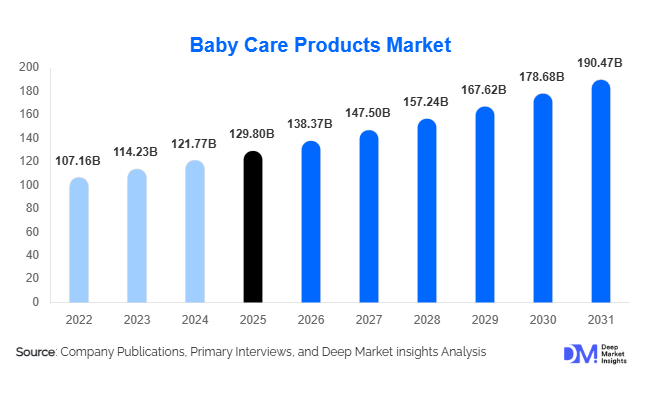
According to Deep Market Insights, the global baby care products market size was valued at USD 129.8 billion in 2025 and is projected to grow from USD 138.37 billion in 2026 to reach USD 190.47 billion by 2031, expanding at a CAGR of 6.6% during the forecast period (2026–2031). The baby care products market growth is primarily driven by increasing parental awareness regarding infant hygiene, rising demand for premium and organic formulations, growing adoption of dermatologist-tested products, and rapid expansion of online retail channels. Rising disposable income, urbanization, and increasing focus on infant wellness are further supporting global market expansion.
Key Market Insights
- Baby care products are increasingly shifting toward organic, chemical-free, and sustainable formulations, as parents prioritize safety, ingredient transparency, and environmentally responsible products.
- Skin care products dominate the baby care products market, accounting for approximately 46.5% of global revenue in 2025 due to strong demand for lotions, creams, moisturizers, and diaper rash treatments.
- Asia Pacific dominates the global market, contributing nearly 41.8% of revenue share in 2025, supported by rising birth rates, expanding middle-class populations, and increasing infant healthcare spending.
- Online retail is the fastest-growing distribution channel, expanding at a CAGR of nearly 8.1% due to subscription models, digital promotions, and wider availability of premium products.
- India is emerging as a high-growth country, projected to reach approximately USD 26.4 billion by 2031, driven by increasing urbanization and premium baby product adoption.
- Technological advancements, including AI-based quality monitoring, smart manufacturing, and personalized product recommendations, are transforming production and consumer engagement.
Baby Care Products Market Trends
Growing Demand for Organic and Sustainable Baby Products
Manufacturers are increasingly introducing organic skincare, plant-based toiletries, and eco-friendly hygiene products to meet rising consumer demand for safer infant care solutions. Global production of organic baby care products exceeded 1.4 billion units in 2025, representing approximately 31% of premium product sales. Companies are focusing on biodegradable packaging, natural ingredients, and chemical-free formulations as parents become more conscious about product safety. Adoption of sustainable packaging surpassed 27%, while plant-based formulations accounted for nearly 22% of new product launches. This shift toward environmentally responsible and sensitive-skin products is strengthening the long-term growth potential of the baby care products market.
Digital Transformation and Technology-Driven Product Innovation
Technology integration is reshaping manufacturing, distribution, and consumer purchasing behavior in the baby care industry. AI-powered quality monitoring systems, automated production lines, and data-driven product development have improved manufacturing efficiency by approximately 16%. Online platforms generated more than 34% of premium baby care product sales in 2025, supported by personalized recommendations, subscription-based purchasing, and digital marketing strategies. Mobile commerce adoption increased significantly, accounting for nearly 48% of online purchases. These technology-driven developments are improving accessibility and creating new opportunities across the baby care products market.
Baby Care Products Market Drivers
Increasing Parental Awareness and Infant Health Spending
Growing awareness regarding infant hygiene, skin sensitivity, and product safety is a major factor driving demand for premium baby care products. Premium product sales increased by approximately 19% in 2025, with urban households contributing nearly 62% of premium purchases. Parents are increasingly selecting dermatologist-tested, hypoallergenic, and organic formulations to ensure better infant protection. More than 900 million skincare units were sold through modern retail channels globally, highlighting increased consumer willingness to invest in high-quality infant care solutions. Rising healthcare awareness and changing parenting preferences continue to support the expansion of the baby care products market.
Expansion of Premium and Natural Product Categories
The shift toward natural, organic, and specialized baby products is accelerating market growth. Demand for sulfate-free shampoos, plant-based lotions, and biodegradable wipes has increased significantly as consumers seek safer alternatives. Premium baby care categories recorded growth exceeding 17%, supported by higher disposable income and increased spending on infant wellness. Manufacturers are investing in research and development to create innovative formulations with improved safety profiles, strengthening consumer trust and expanding the overall baby care products market.
Baby Care Products Market Restraints
High Product Pricing and Limited Affordability
Premium baby care products often carry higher prices compared with conventional alternatives, restricting adoption among price-sensitive consumers. Organic and dermatologist-tested formulations typically cost around 25–40% more due to expensive raw materials, certification processes, and advanced manufacturing requirements. In developing regions, affordability remains a major challenge as consumers continue balancing product quality with cost considerations. Fluctuating ingredient prices, increasing compliance expenses, and higher packaging costs further impact manufacturer margins and limit widespread adoption of premium baby care products.
Regulatory Compliance and Product Safety Requirements
Baby care manufacturers face strict regulatory requirements related to ingredient safety, labeling, and product testing. Compliance expenses increased manufacturing costs by approximately 11%, while product approval timelines extended by nearly 8 months in some markets. Companies must invest significantly in clinical testing, quality certifications, and safety evaluations before launching new products. These regulatory complexities create challenges for smaller manufacturers and increase operational barriers within the baby care products market.
Baby Care Products Market Opportunities
Expansion Through E-Commerce and Emerging Markets
The rapid growth of online shopping platforms presents significant opportunities for baby care brands. Online sales increased by approximately 22% year-over-year, with mobile commerce contributing nearly 48% of digital transactions. Emerging economies accounted for more than 58% of incremental demand, supported by rising middle-class populations and increasing internet penetration. Companies are leveraging direct-to-consumer platforms, subscription services, and digital marketing campaigns to expand consumer reach and improve customer retention.
Personalized Baby Care Solutions
Personalized infant care products represent an emerging opportunity within the market. Manufacturers are developing customized skincare solutions based on infant age, skin sensitivity, and specific healthcare requirements. AI-powered recommendations, digital consultations, and subscription-based product delivery models are improving customer engagement. Increasing demand for specialized products targeting sensitive skin, allergies, and newborn-specific needs is expected to create additional growth opportunities for the baby care products market.
Report Scope
| Report Metric | Details |
|---|---|
| Market Size in 2025 | USD 129.8 Billion |
| Market Size in 2026 | USD 138.37 Billion |
| Market Size in 2031 | USD 190.47 Billion |
| CAGR | 6.6% (2026-2031) |
| Base Year for Estimation | 2025 |
| Historical Data | 2022-2024 |
| Forecast Period | 2026-2031 |
| Report Coverage | Revenue Forecast, Competitive Landscape, Supply Chain Disruption, Growth Factors, Environment & Regulatory Landscape and Trends |
| Geographies Covered | North America, Europe, APAC, Middle East and Africa, LATAM |
| Countries Covered | U.S., Canada, U.K., Germany, France, Spain, Italy, Russia, Nordic, Benelux, Rest of Europe, China, Korea, Japan, India, Australia, Singapore, Taiwan, South East Asia, Rest of Asia-Pacific, UAE, Turky, Saudi Arabia, South Africa, Egypt, Nigeria, Rest of MEA, Brazil, Mexico, Argentina, Chile, Colombia, Rest of LATAM |
Explore more data points, trends and opportunities Download Free Sample Report
Product Type Insights
Skin care products dominate the baby care products market, accounting for approximately 46.5% of global revenue in 2025. This segment includes moisturizers, lotions, creams, oils, and diaper rash treatments designed to protect delicate infant skin. Production exceeded 1.8 billion units, supported by rising demand for hypoallergenic and dermatologist-tested formulations. Hair care products represent nearly 23% of market revenue, with production surpassing 900 million units. Mild shampoos, tear-free formulations, and scalp-care products remain popular among parents. Toiletries, including baby wipes, soaps, powders, and hygiene essentials, contribute approximately 30.5% of revenue, supported by frequent usage and growing preference for convenient hygiene solutions.
Application Insights
Infant skincare applications represent the largest segment due to increasing concerns regarding dryness, irritation, and sensitive skin conditions among newborns. Daily hygiene applications, including wipes, soaps, and cleansing products, maintain strong demand due to frequent household usage. Haircare applications are expanding as parents increasingly seek gentle and chemical-free shampoos suitable for infants. Specialty applications, including organic baby products, sensitive-skin solutions, and medically recommended formulations, are gaining traction among premium consumers. The increasing focus on preventive infant care and wellness continues to broaden application opportunities across the baby care products market.
Distribution Channel Insights
Offline retail remains the dominant distribution channel, accounting for approximately 57% of global sales. Supermarkets, hypermarkets, specialty baby stores, and pharmacies continue to attract consumers due to product availability and trusted purchasing experiences. Online retail represents nearly 29% of market revenue and is the fastest-growing channel due to convenience, competitive pricing, and wider access to premium brands. Pharmacies contribute approximately 14% of sales, particularly for dermatologist-recommended skincare products and medically approved infant hygiene solutions. The increasing adoption of digital commerce is expected to reshape distribution strategies throughout the forecast period.
Traveler Type Insights
Parents purchasing baby care products represent the primary consumer group, with purchasing decisions largely influenced by safety, product quality, brand reputation, and ingredient transparency. First-time parents contribute significantly to premium product demand as they tend to prefer dermatologist-tested skincare, organic formulations, and specialized hygiene products. Urban families represent a major consumer segment, accounting for nearly 62% of premium baby care purchases due to higher disposable income and greater awareness regarding infant wellness. Millennial and Gen Z parents are increasingly adopting digital shopping platforms, with online channels contributing more than 34% of premium product sales. Healthcare-conscious consumers are also driving demand for products designed for sensitive skin, allergies, and specific infant care requirements, expanding opportunities within the baby care products market.
Age Group Insights
Newborns and infants aged 0–12 months represent the largest consumer segment due to high demand for skincare, hygiene, and specialized products required during early development stages. This segment contributes significantly to sales of baby lotions, oils, wipes, and gentle cleansing products. Toddlers aged 1–3 years are another important category, supported by increasing demand for haircare products, bath essentials, and daily hygiene solutions. Children aged 3–5 years continue driving demand for mild personal care products as parents transition from infant-specific products to broader child wellness categories. Increasing awareness among parents regarding age-specific formulations and safety standards is encouraging manufacturers to develop targeted product portfolios across different infant age groups.
Explore more data points, trends and opportunities Download Free Sample Report
Baby Care Products Market Segmentations
By Product Type
- Skin Care Products
- Hair Care Products
- Toiletries
- Baby Wipes & Hygiene Products
By Application
- Infant Skincare
- Daily Hygiene & Cleansing
- Haircare
- Specialized Baby Care
By Distribution Channel
- Offline Retail
- Online Retail
- Pharmacies
- Specialty Baby Stores
Regional Insights
North America
North America accounted for approximately 28.4% of global baby care products market revenue in 2025, supported by strong consumer purchasing power, premium product adoption, and advanced retail infrastructure. The United States contributed more than 82% of regional sales, driven by high demand for organic skincare, natural ingredients, and dermatologist-approved formulations. Regional production exceeded 850 million units, with premium and sustainable products representing nearly 36% of demand. Consumers in North America increasingly prefer eco-friendly packaging, chemical-free products, and brands emphasizing transparency in ingredient sourcing. Online retail adoption is also expanding rapidly, supported by subscription-based models and direct-to-consumer platforms. The growing focus on infant wellness, safety certifications, and personalized baby care solutions continues to strengthen the regional baby care products market.
Europe
Europe represented nearly 24.6% of global revenue in 2025, supported by strict product safety regulations, high awareness regarding sustainable products, and strong demand for organic baby care solutions. Germany, the United Kingdom, France, Italy, and Spain collectively contributed more than 74% of regional sales. Regional production exceeded 780 million units, with organic-certified products accounting for approximately 34% of purchases. European consumers demonstrate strong preference for environmentally friendly packaging, natural formulations, and ethically produced infant products. Manufacturers are increasingly investing in recyclable materials, plant-based ingredients, and clean-label formulations to meet evolving consumer expectations. The region remains a key innovation hub for premium baby care products, with increasing adoption of sustainable manufacturing practices and digital retail channels.
Asia Pacific
Asia Pacific dominates the global baby care products market with approximately 41.8% revenue share in 2025, driven by large infant populations, rising disposable income, and rapid urbanization. China, India, Japan, South Korea, and Australia are the major contributors, with regional production exceeding 2.1 billion units. China remains a significant market due to strong demand for premium imported baby products, while India is experiencing rapid expansion due to increasing awareness of infant hygiene and growing e-commerce penetration. Premium baby skincare adoption is increasing across urban households, while local manufacturers are expanding affordable product portfolios to serve price-sensitive consumers. Digital platforms have become a major sales driver, particularly among younger parents seeking convenience, reviews, and competitive pricing. Rising healthcare expenditure and changing parenting preferences are expected to maintain Asia Pacific’s leadership position throughout the forecast period.
Latin America
Latin America contributed nearly 3.2% of global baby care products revenue in 2025, with Brazil and Mexico accounting for more than 68% of regional sales. Regional production exceeded 220 million units, supported by improving retail infrastructure and increasing consumer awareness regarding infant hygiene. Demand for affordable yet high-quality baby products is rising, particularly across urban areas where parents are adopting branded skincare, toiletries, and hygiene products. International brands continue expanding through partnerships with local retailers, while domestic manufacturers focus on competitive pricing and natural product development. Growing internet penetration is also supporting online sales growth, enabling wider access to premium baby care products in emerging markets across Latin America.
Middle East & Africa
The Middle East & Africa accounted for approximately 2.0% of global baby care products revenue in 2025 and is projected to record the fastest growth rate through 2031. Regional production exceeded 150 million units, supported by increasing healthcare investments, expanding retail networks, and rising demand for premium infant products. Countries such as Saudi Arabia, the UAE, and South Africa are witnessing higher adoption of imported and luxury baby care brands due to rising disposable income and consumer preference for quality-focused products. Africa’s growing young population creates significant long-term demand opportunities, while improvements in distribution infrastructure are enhancing product availability. Increasing awareness regarding infant hygiene and the expansion of online commerce are expected to accelerate regional growth.
Key Players in the Baby Care Products Market
- Johnson & Johnson
- Procter & Gamble
- Kimberly-Clark Corporation
- Nestlé S.A.
- Unilever PLC
- The Honest Company Inc.
- Beiersdorf AG
- Dabur India Ltd.
- Himalaya Wellness Company
- Chicco
- Pigeon Corporation
- Mustela
- Sebapharma GmbH & Co. KG
- Burt’s Bees Baby
- Mee Mee