Barbie Doll Market Size
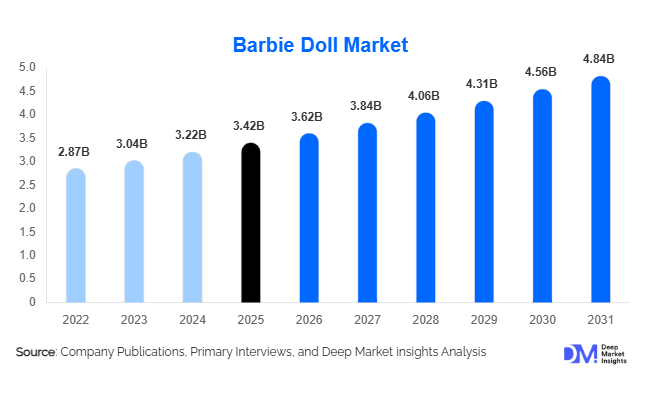
According to Deep Market Insights, the global Barbie doll market was valued at USD 3.42 billion in 2025 and is projected to grow from USD 3.62 billion in 2026 to reach USD 4.84 billion by 2031, expanding at a CAGR of 5.96% during the forecast period (2026–2031). The Barbie doll market growth is primarily driven by rising consumer demand for licensed fashion dolls, increasing popularity of collectible editions among adult consumers, expanding digital retail channels, and continuous product innovation emphasizing diversity, sustainability, and interactive play experiences. Growing disposable incomes across emerging economies, coupled with strong entertainment franchise collaborations and premium product launches, continue to strengthen long-term market expansion worldwide.
Key Market Insights
- Fashion dolls dominate the global market, accounting for more than 54% of total revenue due to continuous product innovation, licensed collections, and strong brand recognition.
- Offline retail remains the leading distribution channel, contributing over 61% of global sales through supermarkets, toy retailers, and department stores.
- North America dominates the global Barbie doll market, supported by high consumer spending, mature retail infrastructure, and a large collector community.
- Asia-Pacific is projected to witness the fastest growth, driven by expanding middle-class populations, increasing disposable incomes, and rapid growth of e-commerce platforms.
- Premium collectible Barbie dolls continue gaining popularity, particularly among adult collectors seeking limited-edition collaborations and anniversary releases.
- Sustainability initiatives and digital engagement, including recycled materials, interactive applications, AI-enabled shopping experiences, and online-exclusive launches, are reshaping consumer purchasing behavior.
Barbie Doll Market Trends
Growing Demand for Premium Collectible Dolls
Premium and limited-edition Barbie dolls continue gaining significant popularity among collectors worldwide. Manufacturers are increasingly collaborating with luxury fashion brands, entertainment franchises, celebrities, and designers to introduce exclusive collections that command premium pricing. Anniversary editions, movie-inspired dolls, cultural representation series, and artist collaborations are expanding the collector segment beyond traditional children's toys. Adult collectors are becoming an increasingly important consumer base, encouraging manufacturers to launch highly detailed products featuring superior craftsmanship, sustainable packaging, premium accessories, and certificate-authenticated collectibles. Online exclusive launches and limited production runs further increase product desirability while strengthening brand loyalty across developed and emerging markets.
Digital Retail and Sustainable Manufacturing Transforming the Industry
Digital transformation continues reshaping the Barbie doll industry as manufacturers invest heavily in direct-to-consumer websites, AI-powered product recommendations, virtual product showcases, and omnichannel retail strategies. E-commerce platforms are expanding global accessibility while enabling personalized shopping experiences. Simultaneously, sustainability has become a major product development priority, with manufacturers introducing recycled plastics, biodegradable packaging materials, environmentally responsible sourcing practices, and reduced carbon manufacturing initiatives. Consumers increasingly prefer brands demonstrating environmental responsibility, encouraging companies to integrate ESG strategies throughout production, packaging, logistics, and product lifecycle management while maintaining premium product quality and innovation.
Barbie Doll Market Drivers
Increasing Demand for Licensed Entertainment Merchandise
The growing popularity of entertainment franchises, blockbuster films, streaming content, and celebrity collaborations continues driving demand for licensed Barbie dolls worldwide. Successful movie releases significantly boost consumer engagement, creating substantial opportunities for themed product launches and limited-edition collections. Licensing agreements with fashion designers, entertainment companies, sports personalities, and cultural icons enable manufacturers to expand product portfolios while attracting both children and adult collectors. Strong social media marketing, influencer campaigns, and digital promotions further enhance product visibility, driving higher retail sales across physical and online distribution channels globally.
Growing Consumer Preference for Educational and Inclusive Toys
Parents increasingly seek toys that encourage creativity, imagination, diversity, and educational development. Barbie manufacturers continue introducing dolls representing multiple ethnicities, professions, body types, abilities, and cultural backgrounds, supporting inclusivity and positive social representation. Career-themed dolls focusing on science, medicine, engineering, aviation, business, sports, and arts promote aspirational learning among children while strengthening educational value. This shift toward inclusive and developmental play experiences continues expanding consumer acceptance across global markets.
Barbie Doll Market Restraints
Rising Manufacturing Costs and Price Sensitivity
Increasing prices of petroleum-based plastics, packaging materials, transportation services, labor, and energy continue placing pressure on manufacturing profitability. Higher production costs have resulted in increased retail prices, particularly affecting price-sensitive consumers in emerging economies. Currency fluctuations, global supply chain disruptions, and inflationary pressures further increase operational expenses for manufacturers and distributors. These factors limit affordability among middle-income households while intensifying pricing competition from regional toy manufacturers offering lower-cost alternatives.
Competition from Digital Entertainment Platforms
Children increasingly allocate leisure time toward smartphones, tablets, video games, streaming platforms, augmented reality experiences, and digital learning applications. This growing preference for digital entertainment reduces traditional toy engagement, particularly among older children. Toy manufacturers must continuously innovate by integrating digital features, interactive accessories, mobile applications, and connected play experiences to maintain relevance among technology-oriented younger generations while preserving the core physical play experience.
Barbie Doll Market Opportunities
Expansion Across Emerging Consumer Markets
Rapid urbanization, expanding middle-class populations, rising disposable incomes, and improving organized retail infrastructure across Asia-Pacific, Latin America, and the Middle East present substantial growth opportunities for Barbie doll manufacturers. Countries including India, Indonesia, Vietnam, Brazil, Mexico, and Saudi Arabia continue witnessing increasing demand for premium branded toys as household spending on children's products rises. Localized product designs, culturally relevant collections, and region-specific marketing campaigns enable manufacturers to strengthen brand penetration while expanding customer reach in high-growth economies.
Growth of Direct-to-Consumer and Personalized Product Offerings
Direct-to-consumer business models continue creating new revenue opportunities through customized dolls, personalized accessories, exclusive online collections, subscription programs, and limited-edition releases. Digital customization platforms allow consumers to personalize facial features, hairstyles, outfits, professions, and accessories, enhancing emotional engagement and brand loyalty. Artificial intelligence-powered recommendations, virtual shopping experiences, and social commerce integrations further strengthen online consumer engagement while improving conversion rates. These innovations are expected to remain key long-term growth opportunities for the global Barbie doll market.
Report Scope
| Report Metric | Details |
|---|---|
| Market Size in 2025 | USD 3.42 Billion |
| Market Size in 2026 | USD 3.62 Billion |
| Market Size in 2031 | USD 4.84 Billion |
| CAGR | 5.96% (2026-2031) |
| Base Year for Estimation | 2025 |
| Historical Data | 2022-2024 |
| Forecast Period | 2026-2031 |
| Report Coverage | Revenue Forecast, Competitive Landscape, Supply Chain Disruption, Growth Factors, Environment & Regulatory Landscape and Trends |
| Geographies Covered | North America, Europe, APAC, Middle East and Africa, LATAM |
| Countries Covered | U.S., Canada, U.K., Germany, France, Spain, Italy, Russia, Nordic, Benelux, Rest of Europe, China, Korea, Japan, India, Australia, Singapore, Taiwan, South East Asia, Rest of Asia-Pacific, UAE, Turky, Saudi Arabia, South Africa, Egypt, Nigeria, Rest of MEA, Brazil, Mexico, Argentina, Chile, Colombia, Rest of LATAM |
Explore more data points, trends and opportunities Download Free Sample Report
Product Type Insights
Fashion dolls represent the largest product segment in the global Barbie doll market, accounting for more than half of total revenue. Continuous product innovation, character diversity, seasonal collections, movie-inspired editions, and career-themed dolls continue driving consumer demand across both developed and emerging markets. Manufacturers regularly introduce new fashion accessories, customizable outfits, premium articulation, and multicultural collections to maintain brand relevance among younger consumers. Collectible Barbie dolls have emerged as one of the fastest-growing premium categories, attracting adult collectors through limited-edition launches, designer collaborations, anniversary editions, celebrity partnerships, and licensed entertainment collections. Playset dolls further strengthen market expansion by offering immersive play experiences through dollhouses, vehicles, pets, educational accessories, and interactive environments that encourage creativity and storytelling. Increasing adoption of sustainable materials, recycled plastics, and eco-friendly packaging across all product categories is further supporting long-term product innovation and consumer acceptance.
Distribution Channel Insights
Offline retail continues to dominate the Barbie doll market, supported by supermarkets, hypermarkets, department stores, toy specialty retailers, and branded stores that offer consumers immediate product availability and experiential shopping. Seasonal promotions, festive discounts, and attractive in-store merchandising continue driving significant sales volumes through traditional retail channels. Meanwhile, online retail is experiencing the fastest expansion owing to increasing internet penetration, smartphone usage, digital payment adoption, and improved logistics infrastructure. E-commerce platforms provide consumers with wider product selection, competitive pricing, customer reviews, exclusive online editions, and convenient home delivery services. Direct-to-consumer brand websites are also gaining popularity through personalized shopping experiences, product customization, loyalty programs, and limited-edition releases. Social commerce, influencer marketing, and live-stream shopping events are further enhancing online consumer engagement and accelerating digital sales worldwide.
Explore more data points, trends and opportunities Download Free Sample Report
Barbie Doll Market Segmentations
By Product Type
- Fashion Dolls
- Collectible Dolls
- Playset Dolls
By Distribution Channel
- Offline Retail
- Online Retail
- Specialty Stores
By Region
- North America
- Europe
- Asia-Pacific
- Latin America
- Middle East & Africa
Regional Insights
North America
North America remains the largest regional market for Barbie dolls, driven primarily by the United States and Canada. Strong household purchasing power, well-established retail infrastructure, high brand awareness, and a mature collector community continue supporting regional market leadership. Consumers increasingly purchase premium collector editions, licensed entertainment collaborations, and limited-release products through both physical and online retail channels. The region also benefits from extensive marketing campaigns, seasonal product launches, and high consumer spending on children's toys and collectibles. Sustainability initiatives and growing demand for inclusive product portfolios further strengthen long-term market expansion throughout North America.
Europe
Europe represents a significant share of the global Barbie doll market, supported by strong demand across Germany, the United Kingdom, France, Italy, and Spain. Consumers increasingly prefer educational, inclusive, and environmentally responsible toys, encouraging manufacturers to introduce sustainable materials and recyclable packaging. Premium collectible dolls, designer collaborations, and movie-inspired product launches continue attracting both children and adult collectors throughout the region. Well-developed retail networks, growing e-commerce penetration, and increasing consumer interest in licensed entertainment merchandise continue supporting steady market growth across Europe.
Asia-Pacific
Asia-Pacific is expected to register the fastest growth during the forecast period owing to rapid urbanization, rising disposable incomes, expanding middle-class populations, and increasing awareness of global toy brands. China serves as both a major manufacturing hub and an important consumer market, while India, Japan, South Korea, and Australia continue recording increasing demand for premium fashion dolls and collectible editions. Expanding organized retail infrastructure, strong e-commerce growth, and increasing digital marketing activities are enabling manufacturers to strengthen regional market penetration. Localized product launches and culturally diverse collections are also improving consumer acceptance across emerging Asian markets.
Latin America
Latin America continues demonstrating steady growth in Barbie doll sales, supported by improving economic conditions, expanding organized retail channels, and increasing disposable household incomes. Brazil and Mexico remain the largest regional markets, while Chile, Colombia, and Argentina continue witnessing growing consumer demand for licensed toys and branded collectibles. Manufacturers are strengthening regional distribution networks through retail partnerships, promotional campaigns, and online sales platforms to improve product accessibility. Family-oriented purchasing behavior and seasonal gift-giving traditions continue supporting long-term market expansion.
Middle East & Africa
The Middle East & Africa region is gradually emerging as a promising growth market due to increasing urbanization, expanding retail infrastructure, and rising premium consumer spending. The United Arab Emirates, Saudi Arabia, and South Africa represent the largest regional markets supported by international toy retailers, luxury shopping centers, and growing e-commerce adoption. Rising demand for branded educational toys, increasing participation of women in the workforce, and improving household incomes continue supporting higher toy expenditures. Manufacturers are increasingly introducing culturally relevant product collections and expanding regional distribution partnerships to strengthen long-term market presence.
Key Players in the Barbie Doll Market
- Mattel Inc.
- Hasbro Inc.
- MGA Entertainment Inc.
- Spin Master Corp.
- Jakks Pacific Inc.
- Bandai Namco Holdings Inc.
- Playmates Toys Ltd.
- Simba Dickie Group
- Tomy Company Ltd.
- Good Smile Company
- Funko Inc.
- VTech Holdings Ltd.
- Ravensburger AG
- Moose Toys
- ZURU Group