Calendar Market Size
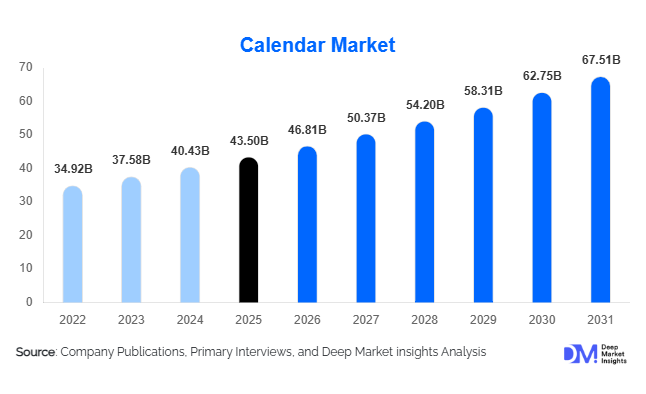
According to Deep Market Insights, the global calendar market size was valued at USD 43.5 billion in 2025 and is projected to grow from USD 46.81 billion in 2026 to reach USD 67.51 billion by 2031, expanding at a CAGR of 7.6% during the forecast period (2026–2031). The calendar market growth is driven by the continued relevance of printed calendars for promotional and personal use, increasing adoption of digital scheduling platforms integrated with productivity software, and growing demand for customized and themed calendars across both consumer and corporate segments.
Calendars remain essential tools for time management, scheduling, and organizational planning across households, educational institutions, and corporate environments. While traditional paper calendars maintain strong demand due to their visual accessibility and decorative value, digital calendars integrated with cloud-based productivity tools have expanded the overall market landscape. The integration of artificial intelligence scheduling features, collaborative calendar sharing, and cross-platform synchronization has accelerated adoption among enterprises and remote workforces.
Additionally, personalized calendars such as photo calendars, branded corporate calendars, and event-based custom calendars have gained popularity due to the rise of digital printing and e-commerce platforms offering print-on-demand services. Environmental considerations are also shaping the industry, with many manufacturers adopting recycled paper, eco-friendly inks, and sustainable printing processes. The coexistence of physical and digital formats has transformed the calendar industry into a hybrid ecosystem where traditional publishing companies and software developers both play critical roles in shaping future growth.
Key Market Insights
- Printed calendars continue to hold a strong consumer presence, particularly in households, educational institutions, and corporate promotional campaigns.
- Digital calendars integrated with productivity software are experiencing rapid growth as hybrid work environments demand collaborative scheduling tools.
- North America dominates the global calendar market, driven by enterprise adoption of digital scheduling platforms and high corporate promotional spending.
- Asia-Pacific is the fastest-growing regional market, supported by strong printing manufacturing capacity and expanding digital productivity adoption.
- Personalized and custom photo calendars are gaining popularity through online platforms offering user-friendly design and print-on-demand services.
- Sustainability trends are encouraging the adoption of recycled materials and eco-certified printing processes across the calendar manufacturing industry.
What are the latest trends in the calendar market?
Growth of AI-Powered Digital Calendar Platforms
Digital calendar platforms are increasingly evolving into intelligent productivity tools capable of automating scheduling and improving organizational efficiency. Artificial intelligence technologies are enabling features such as automatic meeting scheduling, predictive time management, and real-time collaboration across teams. Integration with project management systems, email platforms, and communication applications has made digital calendars central to enterprise productivity ecosystems. Companies are also introducing voice-enabled scheduling assistants and AI-driven meeting optimization tools that analyze participant availability and time zones. These capabilities are particularly valuable in hybrid work environments where distributed teams rely on shared digital tools to coordinate activities. As businesses continue investing in digital workplace infrastructure, AI-enabled calendar solutions are expected to become a cornerstone of modern productivity platforms.
Rising Demand for Personalized and Themed Calendars
Consumer demand for customized calendars has increased significantly with the expansion of digital printing technology and online design platforms. Personalized photo calendars featuring family photographs, travel memories, or pet images have become popular gift items, especially during festive seasons. Social media influencers, photographers, and artists are also leveraging print-on-demand services to sell themed calendars featuring exclusive artwork or photography. Businesses continue to use customized calendars for promotional campaigns, branding initiatives, and corporate gifting programs. These products provide year-long brand visibility and are often distributed to customers and partners as part of marketing strategies. The increasing availability of user-friendly online design tools is further accelerating the growth of this segment, allowing consumers to create unique calendar designs with minimal effort.
What are the key drivers in the calendar market?
Growing Adoption of Digital Productivity Tools
The rapid expansion of digital productivity platforms is a major driver of the calendar market. Organizations worldwide are adopting collaborative software solutions to manage schedules, projects, and team communication more efficiently. Digital calendars integrated within enterprise productivity suites allow employees to synchronize meetings, share availability, and manage workloads across multiple devices. As remote and hybrid work models become permanent fixtures in corporate environments, businesses are increasingly investing in integrated digital scheduling tools. This trend is particularly evident in sectors such as technology, finance, consulting, and education, where efficient time management and coordination are critical to operational success.
Strong Demand for Corporate Promotional Calendars
Printed calendars remain one of the most widely used promotional tools in corporate marketing. Companies distribute branded calendars to clients and partners as part of annual promotional campaigns, ensuring continuous brand exposure throughout the year. Industries such as automotive dealerships, financial services, insurance companies, and healthcare providers frequently utilize customized calendars as cost-effective marketing materials. Compared with many other promotional products, calendars offer long-term visibility and practical utility, making them an attractive option for businesses seeking high-return advertising solutions. The sustained demand from corporate marketing campaigns continues to support the growth of the printed calendar segment.
What are the restraints for the global market?
Increasing Reliance on Digital Scheduling Alternatives
The widespread use of smartphones and productivity applications has reduced the reliance on traditional printed calendars for many consumers. Digital calendars offer advantages such as automatic reminders, synchronization across devices, and integration with communication tools. As these features continue to improve, some individuals and organizations are shifting entirely to digital scheduling solutions, which could gradually limit demand for traditional printed calendars in certain markets.
Environmental Concerns Related to Paper Usage
Growing environmental awareness has prompted consumers and businesses to reconsider the use of paper-based products. Printed calendars contribute to paper consumption, raising concerns regarding sustainability and waste management. Many organizations are reducing printed materials as part of broader sustainability initiatives, encouraging employees to adopt digital alternatives. Although eco-friendly printing materials and recycled paper are helping address these concerns, environmental considerations remain a challenge for traditional calendar manufacturers.
What are the key opportunities in the calendar industry?
Expansion of Sustainable and Eco-Friendly Calendar Production
Environmental sustainability is becoming a significant purchasing factor across the stationery and print industries. Manufacturers that adopt recycled paper, biodegradable inks, and environmentally responsible printing processes can differentiate themselves in a competitive market. Corporate buyers, particularly multinational organizations, increasingly prioritize suppliers that meet sustainability standards and environmental certifications. The development of eco-friendly calendars not only reduces environmental impact but also enhances brand reputation for manufacturers and corporate customers alike.
Integration with Digital Workplace Platforms
The rapid evolution of cloud computing and enterprise productivity tools presents new opportunities for digital calendar providers. Integrating calendar platforms with project management software, collaboration tools, and enterprise communication systems can significantly enhance functionality. Companies offering advanced scheduling capabilities, AI-based meeting management, and cross-platforalmond-extractm synchronization are well positioned to capture growing enterprise demand. These integrations enable organizations to streamline workflows and improve productivity, making digital calendar solutions indispensable for modern workplaces.
Report Scope
| Report Metric | Details |
|---|---|
| Market Size in 2025 | USD 43.50 Billion |
| Market Size in 2026 | USD 46.81 Billion |
| Market Size in 2031 | USD 67.51 Billion |
| CAGR | 7.6% (2026-2031) |
| Base Year for Estimation | 2025 |
| Historical Data | 2022-2024 |
| Forecast Period | 2026-2031 |
| Report Coverage | Revenue Forecast, Competitive Landscape, Supply Chain Disruption, Growth Factors, Environment & Regulatory Landscape and Trends |
| Geographies Covered | North America, Europe, APAC, Middle East and Africa, LATAM |
| Countries Covered | U.S., Canada, U.K., Germany, France, Spain, Italy, Russia, Nordic, Benelux, Rest of Europe, China, Korea, Japan, India, Australia, Singapore, Taiwan, South East Asia, Rest of Asia-Pacific, UAE, Turky, Saudi Arabia, South Africa, Egypt, Nigeria, Rest of MEA, Brazil, Mexico, Argentina, Chile, Colombia, Rest of LATAM |
Explore more data points, trends and opportunities Download Free Sample Report
Product Type Insights
Wall calendars continue to represent the most widely used product category in the global calendar market, accounting for approximately 42% of total market demand. Their continued dominance is largely driven by their visibility, decorative appeal, and functional value as a daily reference tool within households, offices, and commercial establishments. The large format of wall calendars allows users to easily view dates, schedules, and important reminders from a distance, making them particularly suitable for shared environments such as kitchens, workplaces, retail counters, and reception areas. In addition to their functional purpose, wall calendars also serve as decorative elements featuring photography, artwork, landscapes, cultural themes, and brand messaging, which further strengthens consumer preference for this product type. The strong demand for promotional wall calendars distributed by businesses during year-end marketing campaigns also contributes significantly to the segment’s leadership position in the market.
Desk calendars represent another important product segment, particularly in professional and corporate environments where employees rely on quick-access scheduling tools placed directly on their workstations. These calendars provide an efficient way for professionals to track daily appointments, deadlines, and project milestones without constantly accessing digital devices. Planner-style calendars and academic planners also maintain strong demand among students, educators, and professionals who prefer structured time management systems that combine scheduling, note-taking, and goal tracking in a single format. These planners often include additional productivity features such as weekly planning layouts, habit tracking sections, and task prioritization pages, which enhances their value among productivity-focused users.
Digital calendars are currently the fastest-growing product category in the market as organizations and individuals increasingly adopt integrated productivity platforms. The growth of remote work, hybrid collaboration models, and cloud-based scheduling systems has accelerated the use of digital calendars integrated with email platforms, project management tools, and enterprise resource planning systems. Digital calendar solutions enable real-time collaboration, meeting coordination, automated reminders, and cross-device synchronization, making them essential tools within modern workplaces. At the same time, the growing popularity of customized photo calendars, themed artistic calendars, and personalized event calendars is expanding product diversity within the market. Advances in digital printing and print-on-demand technologies allow consumers to easily design personalized calendars using family photos, travel images, or branded graphics, further strengthening demand for customized calendar products.
Application Insights
Household and personal use represent the largest application segment within the global calendar market, supported by the continued popularity of family planning calendars, kitchen wall calendars, and decorative themed calendars used for personal organization. Many households rely on printed calendars to coordinate family activities, track important events such as birthdays and holidays, and maintain daily routines. Decorative wall calendars featuring nature photography, artwork, cultural themes, and inspirational content remain particularly popular among consumers seeking both functionality and aesthetic appeal in home spaces.
Corporate and commercial offices represent one of the fastest-growing application segments, largely driven by the rapid adoption of digital scheduling systems that support collaborative work environments. Businesses increasingly depend on shared calendar platforms that allow teams to schedule meetings, track project deadlines, and coordinate cross-department activities in real time. The expansion of hybrid work models and geographically distributed teams has further accelerated the adoption of digital calendar platforms integrated with communication and productivity software. Educational institutions also represent an important application segment, as academic calendars and student planners are widely used by schools, universities, and training organizations to structure academic schedules, examination timelines, and institutional events.
The advertising and promotional marketing segment contributes significantly to overall market demand, particularly through the distribution of branded calendars during corporate promotional campaigns. Many businesses distribute customized calendars to customers, partners, and employees as cost-effective marketing tools that maintain brand visibility throughout the year. Hospitality and tourism businesses also frequently utilize calendars as promotional merchandise to highlight travel destinations, resorts, and cultural attractions. In addition, religious organizations and community institutions distribute calendars aligned with local festivals, religious observances, and cultural traditions, particularly in regions where traditional printed calendars remain an important part of social and cultural life.
Distribution Channel Insights
Online retail channels are becoming increasingly dominant in the global calendar market due to the convenience of e-commerce platforms and the growing popularity of personalized calendar products. Consumers can easily browse a wide variety of designs, themes, and formats while also having the option to customize calendars using personal photographs, branding elements, or event-specific content. Online printing platforms allow users to design fully personalized calendars through digital interfaces and have them delivered directly to their homes, which has significantly expanded the reach of customized calendar products across global markets.
Offline retail channels continue to play an important role in calendar distribution, particularly during peak seasonal purchasing periods toward the end of the calendar year. Bookstores, stationery stores, gift shops, and department stores remain key retail outlets where consumers often purchase calendars as holiday gifts or personal planning tools. Physical retail environments allow customers to view designs, paper quality, and layout formats before purchasing, which remains an important factor for certain consumer segments that prefer traditional shopping experiences.
Corporate direct sales also represent a critical distribution channel within the calendar market. Printing companies frequently supply large volumes of customized promotional calendars to businesses that distribute them to customers and employees during marketing campaigns. The expansion of print-on-demand services has further transformed traditional distribution models by enabling independent designers, photographers, and small creative studios to produce and sell unique calendar designs without maintaining large inventory volumes. Through online marketplaces and digital storefronts, these creators can distribute personalized and artistic calendar products to global audiences, thereby increasing market diversity and innovation.
End-Use Industry Insights
The household segment accounts for the largest share of calendar demand globally, as many consumers continue to rely on printed calendars for both functional planning and interior decoration. Wall calendars, family planners, and personalized photo calendars remain widely used in residential environments where they provide an accessible visual reference for daily schedules, social events, and holiday planning. The growing popularity of customized home décor products has also contributed to increased demand for aesthetically designed calendars featuring artistic photography, motivational themes, and cultural content.
Corporate offices represent one of the fastest-growing end-use industries, primarily due to the increasing reliance on digital calendar platforms for workplace scheduling and collaboration. Organizations operating in hybrid work environments require efficient scheduling systems that allow employees to coordinate meetings, manage project timelines, and share availability across distributed teams. As a result, many enterprises are integrating digital calendar tools into broader productivity ecosystems that include communication platforms, project management software, and enterprise workflow systems.
Educational institutions represent a stable and consistent demand base for academic planners, institutional calendars, and event scheduling tools used by students, teachers, and administrative staff. Schools and universities rely on structured academic calendars to coordinate semester schedules, examination periods, academic holidays, and institutional activities. The advertising and promotional marketing sector also continues to drive demand for customized calendars used in brand promotion campaigns. Businesses frequently distribute branded calendars to maintain long-term brand visibility among customers, suppliers, and business partners. In addition, hospitality businesses and tourism operators often distribute branded calendars featuring travel destinations, cultural landmarks, and seasonal attractions, which contributes to recurring seasonal demand within the printing and promotional merchandise industries.
Explore more data points, trends and opportunities Download Free Sample Report
Calendar Market Segmentations
By Product Type
- Wall Calendars
- Desk Calendars
- Pocket & Mini Calendars
- Planner & Organizer Calendars
- Digital Calendars / Calendar Applications
- Custom / Personalized Calendars
By Application
- Household & Personal Use
- Corporate & Commercial Offices
- Educational Institutions
- Advertising & Promotional Marketing
- Hospitality & Tourism
- Religious Institutions
By Distribution Channel
- Online Retail & E-commerce
- Offline Retail
- Direct B2B Sales
Regional Insights
North America
North America holds the largest share of the global calendar market, accounting for approximately 34% of total market revenue in 2025. The region’s leadership position is primarily driven by strong consumer demand for both printed and digital calendar solutions across households, corporate offices, and educational institutions. The United States represents the dominant market within the region, supported by high adoption of digital productivity platforms and extensive corporate promotional spending. Businesses in the United States frequently distribute branded calendars as part of annual marketing campaigns, which contributes significantly to printed calendar demand.Another major growth driver in North America is the widespread integration of digital calendars within enterprise software ecosystems used by corporations, government agencies, and educational organizations. Many enterprises rely on shared digital calendars integrated with email platforms and collaboration tools to coordinate meetings, manage employee schedules, and support remote work environments. In addition, the region has a strong culture of personalized gifting and seasonal merchandise, which supports steady demand for customized photo calendars and artistic themed calendars. Canada also contributes significantly to regional demand, particularly through corporate gifting programs and promotional merchandise distributed by businesses during the holiday season. The presence of advanced printing infrastructure and well-developed e-commerce networks further strengthens the market growth potential across North America.
Europe
Europe accounts for approximately 22% of the global calendar market, with major demand concentrated in countries such as Germany, the United Kingdom, France, and Italy. The region benefits from a well-established printing and publishing industry that supports large-scale production of artistic, cultural, and commercial calendars distributed both domestically and internationally. European consumers demonstrate strong interest in visually appealing and artistically designed calendars featuring photography, artwork, landscapes, and cultural themes, which contributes to sustained demand for high-quality printed products.One of the key growth drivers in the European market is the increasing preference for environmentally sustainable printing practices. Consumers and businesses in the region are increasingly seeking eco-friendly calendars produced using recycled paper, biodegradable materials, and environmentally responsible inks. This shift toward sustainable products is encouraging printing companies to adopt green production technologies and responsible sourcing practices. Additionally, strong tourism activity across Europe supports demand for destination-themed calendars featuring iconic landmarks and cultural heritage sites. Corporate promotional campaigns and retail gift markets during the holiday season also play an important role in sustaining regional demand for printed calendars.
Asia-Pacific
Asia-Pacific represents approximately 29% of the global calendar market and is currently the fastest-growing regional market. Rapid population growth, expanding middle-class consumer spending, and increasing digital adoption across major economies are contributing to strong regional demand for both printed and digital calendar products. China plays a major role as a global manufacturing hub for printed calendars, producing large volumes of promotional calendars that are exported to international markets. The country’s large-scale printing infrastructure and competitive manufacturing costs enable high-volume production of customized calendars for corporate marketing campaigns worldwide.India represents another important market within the region, with strong domestic demand for religious, cultural, and festival-based calendars aligned with regional traditions and spiritual observances. These calendars often feature religious imagery, festival dates, and culturally significant events, making them widely used in households, temples, and businesses. Japan and South Korea are recognized for their high-quality stationery industries and innovative calendar designs, including artistic desk planners, minimalist wall calendars, and productivity-focused planners. The rapid growth of e-commerce platforms and digital productivity tools across Asia-Pacific is also driving the adoption of digital calendar applications, particularly among younger consumers and corporate professionals. The expansion of print-on-demand platforms and personalized product marketplaces further supports regional market growth.
Latin America
Latin America accounts for approximately 8% of the global calendar market, with Brazil and Mexico representing the largest regional markets. Printed calendars remain widely used in both household and business environments across the region, particularly due to their affordability and accessibility as everyday planning tools. Many businesses in Latin American countries utilize printed calendars as promotional merchandise distributed to customers, suppliers, and employees during year-end marketing campaigns.One of the key drivers supporting market growth in Latin America is the strong presence of small and medium-sized enterprises that rely on low-cost promotional products to maintain brand visibility throughout the year. Printed calendars provide an effective marketing medium because they remain visible in homes and offices for extended periods. In addition, cultural traditions and regional festivals also support demand for themed calendars featuring local celebrations, religious observances, and national holidays. The expansion of online retail platforms and digital printing services is gradually improving accessibility to customized calendar products across the region.
Middle East & Africa
The Middle East and Africa collectively account for approximately 7% of global calendar demand, with steady growth supported by expanding corporate promotional activities and rising demand for culturally themed calendars. The United Arab Emirates and Saudi Arabia represent key markets in the Middle East, where businesses frequently distribute branded calendars as part of corporate gifting programs and marketing campaigns. The strong presence of hospitality, tourism, and real estate industries in these countries also contributes to demand for customized promotional calendars distributed to clients and visitors.South Africa represents one of the most developed printing markets within the African region and serves as an important production hub supplying printed materials to neighboring countries. Cultural and religious calendars play a particularly significant role across several countries in the Middle East and Africa, where calendars aligned with Islamic, Christian, and regional cultural observances are widely used by households and community organizations. Increasing digital connectivity and smartphone adoption across the region are also gradually supporting the use of digital calendar applications, particularly among younger urban populations and corporate professionals.
Key Players in the Calendar Market
- Google LLC
- Microsoft Corporation
- Apple Inc.
- Calendly LLC
- Zoho Corporation
- BrownTrout Publishers Inc.
- House of Doolittle
- American Calendar Company
- BIC Graphic
- Shutterfly Inc.
- Navitor Inc.
- TimeTree Inc.
- Any.do
- Workday Inc.
- Vistaprint