Body Care Cosmetics Market Size
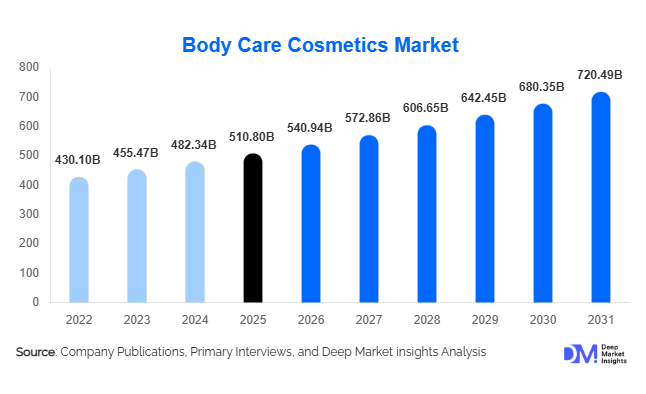
According to Deep Market Insights, the global body care cosmetics market size was valued at USD 510.8 billion in 2025 and is projected to grow from USD 540.94 billion in 2026 to reach USD 720.49 billion by 2031, expanding at a CAGR of 5.9% during the forecast period (2026–2031). The body care cosmetics market growth is primarily driven by rising consumer awareness regarding skin health, increasing adoption of premium personal care products, growing demand for active ingredient-based formulations, and the rapid expansion of e-commerce channels worldwide. Consumers are increasingly extending facial skincare routines to body care regimens, leading to strong demand for moisturizers, body serums, exfoliators, body oils, and specialized treatment products. Furthermore, innovation in clean-label formulations, dermatologically tested ingredients, sustainable packaging solutions, and personalized skincare is supporting long-term market expansion across developed and emerging economies.
Key Market Insights
- Body care products are increasingly being positioned as skin health solutions rather than basic hygiene products, accelerating demand for active ingredient-based formulations.
- Premium and dermatology-inspired body care products are outperforming traditional moisturizers, particularly in North America, Europe, Japan, and South Korea.
- Asia-Pacific dominates the global market, accounting for approximately 38% of total revenue in 2025, supported by strong demand from China, India, Japan, and South Korea.
- India represents one of the fastest-growing body care cosmetics markets globally, driven by rising disposable income, urbanization, and expanding digital retail channels.
- E-commerce has emerged as the fastest-growing distribution channel, enabling direct-to-consumer brands to gain market share and accelerate product innovation.
- Sustainability initiatives, refillable packaging, vegan formulations, and clean beauty products are increasingly influencing purchasing decisions across global consumer segments.
Body Care Cosmetics Market Trends
Skinification of Body Care Products
One of the most influential trends shaping the body care cosmetics market is the skinification of body care. Consumers are increasingly applying facial skincare principles to body care routines, resulting in rising demand for products containing ingredients such as retinol, ceramides, peptides, niacinamide, AHAs, BHAs, probiotics, and hyaluronic acid. Manufacturers are introducing body serums, anti-aging body creams, targeted treatment lotions, and microbiome-supporting products that address specific skin concerns rather than offering generic moisturization. This trend is particularly evident among younger consumers and premium beauty buyers who seek clinically proven efficacy and visible skin improvement. As a result, body care categories are experiencing premiumization and higher average selling prices across major markets.
Sustainable and Clean Beauty Formulations Gaining Momentum
Environmental awareness is significantly influencing consumer purchasing behavior. Brands are investing in sustainable sourcing, biodegradable ingredients, waterless formulations, refillable packaging systems, and recyclable materials to meet growing consumer expectations. Vegan, cruelty-free, organic, and clean-label body care products are expanding rapidly, particularly across Europe and North America. Manufacturers are also increasing transparency around ingredient sourcing and production processes to strengthen consumer trust. Sustainability certifications and carbon-neutral manufacturing initiatives are becoming important competitive differentiators, while retailers increasingly prioritize environmentally responsible brands within premium beauty portfolios.
Body Care Cosmetics Market Drivers
Growing Consumer Focus on Skin Health and Wellness
Consumers increasingly view body care as an integral component of overall wellness and preventive skincare. Rising awareness regarding skin barrier protection, hydration, anti-aging treatments, and dermatological health is fueling demand for specialized body care products. Educational content distributed through dermatologists, beauty influencers, social media platforms, and skincare professionals has enhanced consumer understanding of ingredient efficacy. This shift has supported increased spending on premium products that deliver measurable skin health benefits.
Expansion of Disposable Income in Emerging Economies
Rapid middle-class expansion across Asia-Pacific, Latin America, and parts of the Middle East and Africa is creating substantial opportunities for body care cosmetics manufacturers. Countries such as India, China, Indonesia, Vietnam, Brazil, Saudi Arabia, and the UAE are witnessing increased consumer expenditure on personal grooming and beauty products. Rising urbanization, greater beauty awareness, and wider product accessibility through modern retail channels are accelerating category adoption. International brands continue expanding regional manufacturing and distribution networks to capitalize on this growing consumer base.
Body Care Cosmetics Market Restraints
Raw Material Price Volatility
The body care cosmetics industry remains highly dependent on agricultural and specialty chemical inputs such as shea butter, cocoa butter, essential oils, botanical extracts, surfactants, and active ingredients. Price fluctuations resulting from climate conditions, supply chain disruptions, geopolitical uncertainties, and agricultural shortages can significantly impact manufacturing costs and profit margins. Smaller manufacturers are particularly vulnerable to input cost volatility, which can constrain pricing flexibility and profitability.
Complex Regulatory Compliance Requirements
Manufacturers must navigate varying regulatory frameworks governing cosmetic ingredients, labeling requirements, product testing, sustainability standards, and safety certifications across different countries. The European Union, United States, China, Japan, and other markets maintain distinct compliance requirements, increasing operational complexity and product development costs. Frequent updates to ingredient restrictions and sustainability regulations further challenge manufacturers seeking global market expansion.
Body Care Cosmetics Market Opportunities
Premium Active Ingredient-Based Body Care Products
The migration of advanced skincare ingredients from facial care into body care presents one of the largest growth opportunities within the industry. Consumers increasingly seek products offering anti-aging benefits, skin barrier repair, exfoliation, pigmentation correction, and collagen support. Premium body serums, retinol body treatments, peptide-enriched creams, and dermatologist-recommended formulations command significantly higher margins than traditional body moisturizers. Companies capable of demonstrating scientific efficacy through clinical studies and dermatologist endorsements are positioned to capture premium market growth.
Expansion Across Emerging Markets
Emerging economies continue to represent substantial untapped potential for body care cosmetics manufacturers. Rapid growth in internet penetration, digital payments, social commerce, and organized retail is improving accessibility across previously underserved regions. Localized product formulations designed for specific climatic conditions, skin types, and cultural preferences are creating opportunities for both multinational and domestic brands. As beauty consumption patterns evolve, emerging markets are expected to contribute a significant share of incremental global demand through 2031.
Report Scope
| Report Metric | Details |
|---|---|
| Market Size in 2025 | USD 510.8 Billion |
| Market Size in 2026 | USD 540.94 Billion |
| Market Size in 2031 | USD 720.49 Billion |
| CAGR | 5.9% (2026-2031) |
| Base Year for Estimation | 2025 |
| Historical Data | 2022-2024 |
| Forecast Period | 2026-2031 |
| Report Coverage | Revenue Forecast, Competitive Landscape, Supply Chain Disruption, Growth Factors, Environment & Regulatory Landscape and Trends |
| Geographies Covered | North America, Europe, APAC, Middle East and Africa, LATAM |
| Countries Covered | U.S., Canada, U.K., Germany, France, Spain, Italy, Russia, Nordic, Benelux, Rest of Europe, China, Korea, Japan, India, Australia, Singapore, Taiwan, South East Asia, Rest of Asia-Pacific, UAE, Turky, Saudi Arabia, South Africa, Egypt, Nigeria, Rest of MEA, Brazil, Mexico, Argentina, Chile, Colombia, Rest of LATAM |
Explore more data points, trends and opportunities Download Free Sample Report
Product Type Insights
Body washes and shower gels account for the largest product category, representing approximately 22% of global market revenue in 2025. Their leadership position is supported by high usage frequency, strong household penetration, and continuous product innovation across moisturizing, exfoliating, and sensitive skin formulations. Body lotions remain the second-largest segment due to widespread daily usage and growing demand for hydration-focused products. Specialized body treatments, including body serums, anti-aging creams, cellulite treatments, and retinol-based products, are emerging as the fastest-growing category as consumers increasingly seek targeted skincare solutions. Premium body oils and body butters are also witnessing strong demand, particularly in natural and organic beauty segments where consumers value botanical ingredients and sensory experiences.
Ingredient Type Insights
Conventional formulations continue to dominate the market, accounting for nearly 68% of total industry revenue due to affordability, broad consumer acceptance, and extensive retail availability. However, natural, organic, vegan, and clean-label formulations are experiencing significantly faster growth rates. Consumer concerns regarding ingredient transparency and environmental sustainability are encouraging manufacturers to reformulate products using plant-derived alternatives and naturally sourced actives. Ceramide-based, niacinamide-based, and probiotic formulations are gaining traction as dermatology-inspired body care products become increasingly mainstream.
Distribution Channel Insights
Supermarkets and hypermarkets remain the largest distribution channel, accounting for approximately 34% of global sales due to extensive product availability, promotional activities, and consumer convenience. Pharmacies and drug stores continue to perform strongly, particularly for dermatologist-recommended products and therapeutic formulations. E-commerce represents the fastest-growing distribution channel, supported by increasing internet penetration, direct-to-consumer business models, influencer marketing, and personalized product recommendations. Brand-owned online stores are also gaining prominence as manufacturers seek greater control over consumer engagement and data collection.
Consumer Group Insights
Women account for approximately 56% of global body care cosmetics demand, supported by broader product adoption, higher spending on premium formulations, and greater engagement with skincare routines. Male grooming products continue to gain momentum as awareness surrounding skincare and personal appearance increases globally. Unisex formulations are becoming increasingly popular among younger consumers who prioritize simplicity, inclusivity, and multifunctionality. Meanwhile, baby care and senior skincare categories are creating niche growth opportunities through specialized formulations designed for sensitive and age-related skin concerns.
Explore more data points, trends and opportunities Download Free Sample Report
Body Care Cosmetics Market Segmentations
By Product Type
- Body Lotions
- Body Creams
- Body Oils
- Body Butters
- Body Washes & Shower Gels
- Bar Soaps
- Body Scrubs & Exfoliators
- Deodorants & Antiperspirants
- Hand Care Products
- Foot Care Products
- Sun Care Body Products
- Specialized Body Treatments
By Ingredient Type
- Conventional/Synthetic Formulations
- Natural Formulations
- Organic Formulations
- Vegan Formulations
- Clean Label Formulations
- Dermatologically Active Formulations
By Consumer Group
- Women
- Men
- Unisex
- Children & Baby Care
- Senior Consumers
By Distribution Channel
- Supermarkets & Hypermarkets
- Pharmacies & Drug Stores
- Specialty Beauty Retailers
- Department Stores
- Direct Selling
- E-Commerce
- Brand-Owned Stores
- Convenience Stores
By End User
- Individual Consumers (Retail)
- Professional Beauty Salons
- Spas & Wellness Centers
- Hotels & Hospitality
- Dermatology Clinics
- Healthcare Institutions
Regional Insights
Asia-Pacific
Asia-Pacific dominates the body care cosmetics market, accounting for approximately 38% of global revenue in 2025. China represents the largest regional market, supported by premium beauty consumption, digital commerce penetration, and strong consumer spending. India is among the fastest-growing markets globally, benefiting from urbanization, rising disposable incomes, and expanding beauty awareness. Japan and South Korea remain innovation leaders, driving adoption of advanced skincare ingredients and premium body care products. Southeast Asian markets, including Indonesia, Vietnam, Thailand, and the Philippines, are contributing increasing demand through rapid middle-class expansion and retail modernization.
North America
North America accounts for approximately 24% of global market revenue, with the United States contributing nearly 20% of worldwide demand. Strong consumer spending, premium product adoption, and growing interest in active ingredient-based skincare continue to support market expansion. The region is characterized by high demand for dermatologist-backed products, sustainable formulations, and premium beauty brands. Canada demonstrates similar trends, particularly in clean beauty and environmentally conscious product categories.
Europe
Europe remains a mature but highly innovative market led by Germany, France, the United Kingdom, Italy, and Spain. Sustainability regulations, clean beauty initiatives, and consumer preference for natural ingredients continue shaping product development. France serves as a major manufacturing and export hub, while Germany remains one of the largest consumers of personal care products within the region. Demand for vegan, organic, and refillable body care products continues to accelerate across European markets.
Latin America
Brazil represents the largest body care cosmetics market in Latin America, supported by strong beauty culture, favorable demographics, and high personal care expenditure. Mexico and Argentina also contribute significantly to regional demand. Consumers increasingly favor moisturizing products, fragrances, and premium body care formulations, creating opportunities for both multinational and domestic manufacturers.
Middle East & Africa
The Middle East and Africa region is experiencing steady growth, led by Saudi Arabia, the UAE, South Africa, and Egypt. Premium beauty consumption, retail modernization, and growing awareness regarding skincare benefits are supporting market expansion. The Gulf Cooperation Council countries are witnessing increasing demand for luxury and imported body care products, while Africa presents long-term growth opportunities driven by population expansion and rising urbanization.