Adult Day Care Market Size
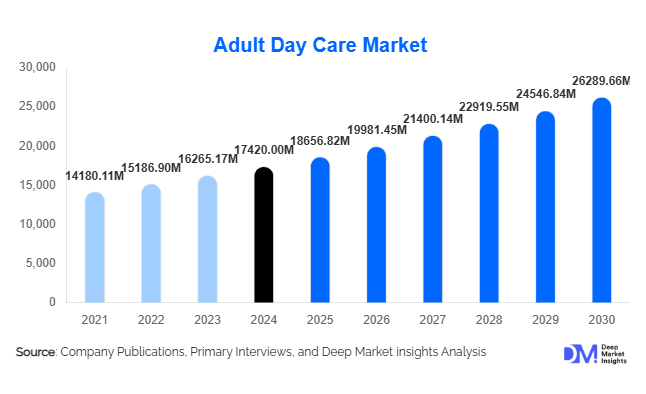
According to Deep Market Insights, the global adult day care market size was valued at USD 17,420.00 million in 2025 and is projected to grow from USD 18,656.82 million in 2026 to reach USD 26,289.66 million by 2031, expanding at a CAGR of 7.1% during the forecast period (2026–2031). The market growth is primarily driven by the rapidly ageing global population, increasing prevalence of chronic and cognitive conditions, and a global shift toward community-based and non-institutional long-term care models.
Key Market Insights
- Global ageing trends are the strongest demand driver, with over 1.4 billion people expected to be above age 60 by 2031, significantly expanding the addressable market for adult day services.
- Medical-model adult day care centres dominate the market, accounting for over 52% of global revenue in 2025 due to the integration of healthcare, therapy, and chronic condition management services.
- Public funding remains the leading source of revenue, representing nearly 55% of market value, driven by government subsidies, Medicare waivers, and community-care reimbursement schemes.
- North America leads the market with approximately 45% share in 2025, supported by mature infrastructure and established long-term care policies.
- Asia-Pacific is the fastest-growing region, expected to grow at over 7% CAGR owing to rapidly ageing populations in Japan, China, and India.
- Technology integration, including remote monitoring, electronic health records (EHRs), and engagement apps, is transforming operational efficiency and care delivery models.
Latest Market Trends
Integration of Digital Health and Hybrid Care Models
Adult day care providers are increasingly adopting digital health technologies to enhance service delivery, safety, and engagement. Remote health monitoring tools, wearable sensors, and AI-driven scheduling software are improving real-time patient oversight and reducing caregiver burden. Hybrid day care models that combine on-site programs with virtual participation options are emerging as a post-pandemic innovation, enabling continuity of care for less mobile adults. The integration of telehealth consultations and online activity programs is creating new revenue streams while broadening accessibility for clients in suburban and rural areas.
Specialized and Dementia-Focused Adult Day Programs
The rising prevalence of Alzheimer’s disease and other cognitive impairments is driving the development of specialized adult day programs tailored to these populations. Centres offering memory care, cognitive stimulation therapy, and caregiver education are seeing double-digit growth. These programs not only address unmet medical and social needs but also provide cost-effective alternatives to residential nursing care. Global initiatives promoting dementia-friendly communities are supporting the proliferation of these specialized facilities, enhancing both patient outcomes and market profitability.
Adult Day Care Market Drivers
Rapidly Ageing Global Population
The world’s population over 65 years old is expanding at an unprecedented rate. This demographic shift directly fuels demand for accessible and affordable daytime care options. Adult day care services meet the need for structured, safe, and socially engaging environments that help older adults maintain independence while relieving caregiver stress. Governments view these centres as essential to long-term care sustainability, further incentivizing market growth.
Shift Toward Community-Based and Cost-Efficient Care
Healthcare systems worldwide are transitioning from expensive institutional care to community-based solutions. Adult day care centres offer significant cost savings compared to full-time nursing homes while maintaining quality of care and improving quality of life. Policymakers and insurers increasingly reimburse such services, positioning adult day care as a key component of the continuum of care for elderly and disabled populations.
Increasing Dual-Income Households and Caregiver Burnout
With more dual-income families and fewer multigenerational households, family caregivers face growing pressure to balance work with care responsibilities. Adult day care programs provide essential respite care and professional support. This socio-economic shift, especially in urbanized regions, is driving consistent demand for reliable daytime care services, both publicly funded and private-pay.
Market Restraints
Workforce Shortages and High Operational Costs
Adult day care centres depend heavily on skilled healthcare professionals, therapists, and support staff. Global shortages of nursing and geriatric care personnel are limiting expansion and increasing operating expenses. Rising costs for transportation, facility maintenance, and food services further strain margins, particularly in small and mid-size centres.
Limited Reimbursement and Regulatory Complexity
In several regions, insurance and public reimbursement for adult day care remain fragmented or insufficient. Complex licensing, quality standards, and regulatory requirements also pose entry barriers for new providers. These challenges, coupled with variable coverage between states and countries, restrict access for lower-income populations and slow market penetration.
Adult Day Care Market Opportunities
Government and Policy Support Expansion
Many countries are introducing policy frameworks that emphasize ageing-in-place and community-based long-term care. Public-private partnerships, government subsidies, and grant programs are emerging as key enablers for scaling adult day care infrastructure. Providers who align services with these policy objectives can access stable funding streams, ensuring long-term growth and compliance advantages.
Technology-Enabled Care Delivery
Digital transformation presents significant opportunities for innovation. Integrating telemedicine, IoT-based health tracking, and AI-driven analytics can help centres improve care outcomes, optimize staffing, and enhance safety. Providers leveraging technology for remote engagement and caregiver coordination are better positioned to scale sustainably, attract younger clients, and participate in digital reimbursement models.
Expansion into Emerging Economies and Under-Served Segments
Rapid urbanization and ageing in emerging economies such as India, China, and Brazil create untapped potential for adult day care services. Providers entering these markets can capitalize on first-mover advantages by offering culturally adapted, affordable solutions. Beyond seniors, day care programs for adults with disabilities or chronic diseases represent additional growth segments, diversifying the revenue base.
Report Scope
| Report Metric | Details |
|---|---|
| Market Size in 2025 | USD 17420 Million |
| Market Size in 2026 | USD 18656.82 Million |
| Market Size in 2031 | USD 26289.66 Million |
| CAGR | 7.1% (2026-2031) |
| Base Year for Estimation | 2025 |
| Historical Data | 2022-2024 |
| Forecast Period | 2026-2031 |
| Report Coverage | Revenue Forecast, Competitive Landscape, Supply Chain Disruption, Growth Factors, Environment & Regulatory Landscape and Trends |
| Geographies Covered | North America, Europe, APAC, Middle East and Africa, LATAM |
| Countries Covered | U.S., Canada, U.K., Germany, France, Spain, Italy, Russia, Nordic, Benelux, Rest of Europe, China, Korea, Japan, India, Australia, Singapore, Taiwan, South East Asia, Rest of Asia-Pacific, UAE, Turky, Saudi Arabia, South Africa, Egypt, Nigeria, Rest of MEA, Brazil, Mexico, Argentina, Chile, Colombia, Rest of LATAM |
Explore more data points, trends and opportunities Download Free Sample Report
Product Type Insights
The medical/clinical adult day care model dominates the market, contributing approximately 52% of global revenue in 2025. These centres offer skilled nursing, physical and occupational therapy, and chronic disease management, which are increasingly covered by public funding. The social day care model, focused on recreation, meals, and social interaction, accounts for a substantial share in mature markets. Meanwhile, dementia-specific and specialized programs are the fastest-growing subsegment, supported by global initiatives targeting cognitive health and caregiver education.
End-Use Insights
Older adults without severe disabilities remain the largest client segment, contributing around 45% of the total market in 2025. However, adults with cognitive impairments, particularly dementia and Alzheimer’s patients, represent the fastest-growing end-user group, projected to expand at a CAGR above 7%. Day care programs for adults with chronic illnesses such as diabetes or mobility impairments are also gaining traction. Export-driven demand primarily involves franchising and international partnerships, with U.S. and Japanese operators establishing centres in developing regions to share expertise and standards.
Explore more data points, trends and opportunities Download Free Sample Report
Adult Day Care Market Segmentations
By Service Type
- Adult Social Day Care
- Adult Medical Day Care
- Specialized Alzheimer’s & Dementia Day Care
- Therapeutic and Rehabilitation Day Care
By Funding Source
- Publicly Funded Centers
- Privately Funded Centers
- Insurance-Based Programs
- Hybrid/Nonprofit Models
By Service Delivery Model
- Center-Based Adult Day Care
- Home-Based/Community-Linked Adult Day Care
- Integrated Healthcare Facility-Based Day Care
- Faith- or Community-Driven Day Care
By End-User Condition
- Physically Disabled Adults
- Mentally Disabled Adults
- Adults with Chronic Illnesses
- Elderly (Age 65+)
By Ownership Type
- Private Operators
- Nonprofit Organizations
- Government-Run Centers
- Hospital-Affiliated Programs
Regional Insights
North America
North America holds the largest share of the adult day care market, about 45% in 2025 (USD 7.9 billion). The U.S. leads due to comprehensive Medicaid waivers, strong long-term care infrastructure, and a high proportion of older adults. Canada follows with community-based programs integrated into provincial health systems. Growth is steady but mature, supported by public reimbursements and advanced dementia-care models.
Europe
Europe accounts for roughly 28% of the global market share (USD 4.9 billion in 2025). Aging demographics in Germany, Italy, France, and the U.K. sustain demand. EU member states are emphasizing community-based elder care through public grants and caregiver-support programs. Germany’s “Pflegeversicherung” (long-term care insurance) particularly drives consistent funding for adult day services.
Asia-Pacific
The Asia-Pacific region is the fastest-growing market, projected to expand at a 7–8% CAGR through 2031. Japan dominates, leveraging its established elder-care model, while China and India represent high-growth markets due to massive ageing populations and rapid social change. Government initiatives like China’s “Healthy Ageing 2031” and India’s “Senior Citizen Welfare Scheme” support infrastructure development and private investment in day-care facilities.
Latin America
Latin America represents 6% of the global share (USD 1.0 billion in 2025). Brazil and Mexico lead, supported by urbanization and growing awareness of structured elder care. Market development remains in early stages, but private providers and NGOs are filling service gaps with affordable, community-based solutions.
Middle East & Africa
This region accounts for approximately 5% of global market revenue (USD 0.9 billion in 2025). Countries like the UAE, Saudi Arabia, and South Africa are launching pilot community-care programs. While cultural preferences for family caregiving remain strong, government modernization plans (e.g., “Vision 2031”) are creating an emerging market for professional adult day services.
Key Players in the Adult Day Care Market
- Active Day / Senior Care, Inc.
- Adult Life Programs, Inc.
- Age UK
- Ascension Living
- Brookdale Senior Living
- Extendicare, Inc.
- Sunrise Senior Living
- BAYADA Home Health Care
- Deutsche Altenheim
- Badisa
- Grace Adult Day Health Care
- GerHogar
- Care Futures
- Epoch Elder Care
- CCACC Joyful Day Care Center
Recent Developments
- In May 2025, Active Day announced a USD 60 million investment plan to expand its medical-model adult day care centres across ten U.S. states, integrating telehealth capabilities and transportation upgrades.
- In April 2025, Brookdale Senior Living launched new hybrid day care programs in partnership with major health insurers, focusing on dementia-friendly and rehabilitation services.
- In February 2025, Age UK introduced a pilot digital-engagement platform connecting caregivers with adult day care participants for remote wellness tracking and virtual activity sessions.