Baby Bath Thermometer Market Size
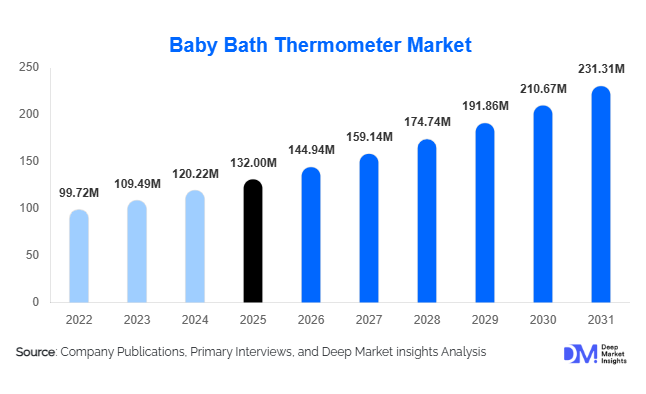
According to Deep Market Insights,the global baby bath thermometer market size was valued at USD 132 million in 2025 and is projected to grow from USD 144.94 million in 2026 to reach USD 231.31 million by 2031, expanding at a CAGR of 9.8% during the forecast period (2026–2031). The baby bath thermometer market growth is primarily driven by increasing parental awareness regarding infant safety, rising adoption of specialized baby care products, and the growing demand for digital and smart monitoring devices designed to ensure safe bathing conditions for infants.
Key Market Insights
- Floating bath thermometers are gaining popularity, as they combine temperature monitoring with engaging toy-like designs for infants.
- Digital and color-indicator thermometers are replacing traditional analog models, providing more accurate and user-friendly temperature readings.
- North America dominates the market, driven by high consumer awareness of infant safety products and strong purchasing power among young parents.
- Asia-Pacific is the fastest-growing region, supported by rising birth rates, increasing middle-class income levels, and expanding online retail channels.
- E-commerce platforms are transforming product accessibility, enabling parents to compare safety certifications, reviews, and prices before purchasing.
- Technological integration, including smart sensors, LED temperature alerts, and mobile-connected baby monitoring systems, is reshaping product innovation.
What are the latest trends in the baby bath thermometer market?
Smart and Digital Thermometers Gaining Adoption
One of the most notable trends in the baby bath thermometer market is the increasing adoption of digital and smart temperature monitoring devices. Modern thermometers are equipped with LCD displays, LED warning indicators, and smart sensors capable of detecting unsafe water temperatures. Some advanced products now offer Bluetooth connectivity, allowing parents to monitor bathwater temperature through mobile applications. This shift toward smart devices aligns with the broader growth of connected parenting technologies such as baby monitors, smart cribs, and wearable infant health trackers. Parents are increasingly prioritizing convenience and accuracy, which has accelerated the transition from analog thermometers to digital solutions.
Multifunctional Bath Toys with Temperature Monitoring
Manufacturers are increasingly designing baby bath thermometers that double as interactive bath toys. Floating thermometers shaped like animals, boats, or cartoon characters are becoming popular among parents because they make bath time more engaging while ensuring safety. These products often incorporate color-changing indicators that alert parents if the water temperature exceeds safe limits. This combination of entertainment and functionality has helped differentiate baby bath thermometers in a competitive infant care product market. As parents seek products that combine safety with developmental engagement for infants, multifunctional bath thermometers are expected to become a dominant design trend.
What are the key drivers in the baby bath thermometer market?
Growing Awareness of Infant Safety
The increasing awareness of infant safety and hygiene is one of the primary drivers supporting growth in the baby bath thermometer market. Pediatric healthcare professionals frequently emphasize the importance of maintaining safe bathwater temperatures to prevent burns and skin irritation in newborns. With access to parenting resources through online platforms, social media, and healthcare guidance, new parents are becoming more cautious and proactive in adopting safety-oriented baby care products. As a result, baby bath thermometers are increasingly viewed as essential items in newborn care kits.
Expansion of the Global Baby Care Products Industry
The rapid expansion of the global baby care products market is also accelerating demand for bath thermometers. Parents today are investing more in specialized baby products such as sterilizers, feeding accessories, monitors, and hygiene tools designed to improve infant well-being. Rising disposable income levels among young families and the growing influence of premium baby brands are encouraging consumers to purchase additional safety devices, including bath thermometers. The trend of curated baby registries and hospital-recommended product kits has further boosted product adoption.
What are the restraints for the global market?
Availability of Traditional Temperature Checking Methods
Despite increasing product awareness, many parents still rely on traditional methods such as checking bathwater temperature with their hands or elbows. These informal approaches are particularly common in developing economies where purchasing specialized baby products may not be considered necessary. This practice limits market penetration in price-sensitive regions and presents a challenge for manufacturers seeking to expand their customer base.
Low Replacement Cycle of Products
Baby bath thermometers are durable products that typically last several years without needing replacement. Since they are not consumable items, repeat purchases are relatively limited. Market growth therefore depends heavily on the continuous influx of new parents entering the consumer base each year. This long product lifecycle can slow overall market expansion compared to disposable baby care products.
What are the key opportunities in the baby bath thermometer industry?
Integration with Smart Parenting Ecosystems
The rise of connected baby care technologies presents a significant opportunity for manufacturers. Smart bath thermometers integrated with mobile applications can provide real-time alerts when bathwater temperatures exceed safe limits. Integration with broader smart parenting ecosystems—including baby monitors and health-tracking devices—could create new premium product categories. Companies investing in IoT-enabled baby care products are expected to benefit from higher consumer engagement and improved brand differentiation.
Growing Demand in Emerging Markets
Emerging economies in Asia-Pacific, Latin America, and the Middle East represent substantial growth opportunities for the baby bath thermometer market. Countries such as China, India, Brazil, and Indonesia are experiencing rising birth rates and growing middle-class populations. As disposable incomes increase and urban lifestyles evolve, parents in these regions are gradually adopting modern baby safety products. Expanding retail networks and online marketplaces are making these products more accessible, which is expected to drive significant demand growth.
Report Scope
| Report Metric | Details |
|---|---|
| Market Size in 2025 | USD 132 Million |
| Market Size in 2026 | USD 144.94 Million |
| Market Size in 2031 | USD 231.31 Million |
| CAGR | 9.8% (2026-2031) |
| Base Year for Estimation | 2025 |
| Historical Data | 2022-2024 |
| Forecast Period | 2026-2031 |
| Report Coverage | Revenue Forecast, Competitive Landscape, Supply Chain Disruption, Growth Factors, Environment & Regulatory Landscape and Trends |
| Geographies Covered | North America, Europe, APAC, Middle East and Africa, LATAM |
| Countries Covered | U.S., Canada, U.K., Germany, France, Spain, Italy, Russia, Nordic, Benelux, Rest of Europe, China, Korea, Japan, India, Australia, Singapore, Taiwan, South East Asia, Rest of Asia-Pacific, UAE, Turky, Saudi Arabia, South Africa, Egypt, Nigeria, Rest of MEA, Brazil, Mexico, Argentina, Chile, Colombia, Rest of LATAM |
Explore more data points, trends and opportunities Download Free Sample Report
Product Type Insights
Floating baby bath thermometers continue to dominate the global market, accounting for nearly 46% of total sales. Their popularity stems from their ease of use, high visibility during bath time, and playful designs that engage infants, making bath routines safer and more enjoyable. Handheld thermometers, while representing a smaller market share, remain a preferred choice for parents who favor manual and precise temperature measurements. Integrated thermometers embedded within baby bathtubs and bath accessories are gaining traction in premium segments, offering convenience and added safety. Additionally, smart multifunction thermometers that combine digital sensors, timers, and interactive toy elements are emerging rapidly, particularly in technologically advanced markets, catering to parents seeking innovative, all-in-one infant care solutions.
Application Insights
The household infant care segment constitutes the largest share in the baby bath thermometer market, accounting for over 80% of global demand. Parents use these devices to ensure bathwater temperature is consistently safe and comfortable for newborns and toddlers. Hospitals and maternity clinics also represent a notable application segment, with thermometers included in postnatal care kits or recommended by pediatricians to maintain infant safety. Daycare centers and infant care facilities are increasingly adopting these devices as part of standardized safety protocols. With the expansion of professional childcare services worldwide, demand for temperature-monitoring bath accessories in institutional settings is expected to grow steadily.
Distribution Channel Insights
Online retail channels dominate the baby bath thermometer market due to the growing popularity of e-commerce among young parents. Online platforms provide consumers with the ability to compare products, read reviews, and verify safety certifications before purchasing. Direct-to-consumer brand websites are also gaining traction, supported by manufacturers’ investments in digital marketing and targeted promotions. Despite the growth of online sales, offline retail channels—including baby specialty stores, pharmacies, and supermarkets—remain important for product discovery. First-time parents often prefer in-store guidance and hands-on evaluation before selecting baby safety products, ensuring sustained demand across physical retail networks.
Explore more data points, trends and opportunities Download Free Sample Report
Baby Bath Thermometer Market Segmentations
By Product Type
- Floating Baby Bath Thermometers
- Digital Baby Bath Thermometers
- Analog Baby Bath Thermometers
- Integrated Bath Thermometers
- Smart Connected Bath Thermometers
By Application
- Household Infant Bathing
- Hospitals and Maternity Clinics
- Daycare Centers and Childcare Facilities
- Baby Care Product Kits and Gift Sets
By Distribution Channel
- Online Retail (E-commerce Platforms & Brand Websites)
- Baby Specialty Stores
- Supermarkets and Hypermarkets
- Pharmacies and Drugstores
- Department Stores
Regional Insights
North America
North America is the largest regional market, representing approximately 32% of global demand in 2025. The United States is the leading country due to high consumer awareness of infant safety, strong disposable incomes, and widespread adoption of advanced baby care devices. Technological integration, such as smart and multifunctional bath thermometers, further drives market growth. Canada also contributes significantly, supported by well-established healthcare infrastructure, government health initiatives, and a strong cultural emphasis on newborn safety. Continuous innovation in baby care products and the presence of leading global manufacturers reinforce the region’s market dominance.
Europe
Europe accounts for nearly 27% of the global baby bath thermometer market. Key markets include Germany, the United Kingdom, France, and Italy. The region’s growth is primarily driven by stringent safety regulations, high consumer preference for certified and reliable baby care products, and awareness campaigns promoting infant health. Additionally, established baby product manufacturers in Europe support a steady supply of innovative and quality thermometers. Increasing urbanization and rising parental focus on infant hygiene further contribute to market expansion across the region.
Asia-Pacific
Asia-Pacific is the fastest-growing market for baby bath thermometers, fueled by rising birth rates, urbanization, and expanding middle-class populations in countries such as China, India, Japan, and South Korea. China leads the region due to its large infant population, strong manufacturing capabilities, and growing e-commerce penetration, which facilitates easy access to advanced baby care products. India is witnessing rapid growth as urban parents increasingly adopt specialized infant safety devices. Rising awareness of infant health, coupled with increasing disposable income and parental willingness to invest in premium and smart baby care solutions, is expected to sustain robust regional growth.
Latin America
Latin America accounts for roughly 9% of the global market, with Brazil and Mexico as the primary demand centers. Market expansion is driven by increasing awareness of infant safety, improving retail distribution networks, and growing online sales channels. Rising parental education, government health initiatives, and increasing urbanization are gradually boosting the adoption of baby bath thermometers across both household and institutional settings.
Middle East & Africa
The Middle East and Africa region is experiencing gradual growth in the baby bath thermometer market. Countries such as the United Arab Emirates and Saudi Arabia are seeing rising demand for premium imported baby care products. High-income households, increasing awareness of infant health, and expanding retail and e-commerce infrastructure support market growth. Additionally, rising urbanization, coupled with a growing focus on modern childcare practices, is contributing to the adoption of innovative baby safety devices across the region.
Key Players in the Baby Bath Thermometer Market
- Koninklijke Philips N.V.
- Artsana Group
- Pigeon Corporation
- Dorel Industries
- Tommee Tippee
- Angelcare
- Beaba
- Summer Infant
- Munchkin Inc.
- Mothercare plc
- Babyono
- Nuvita Baby
- Bébé Confort
- Skip Hop
- Dreambaby