Tortilla Market Size
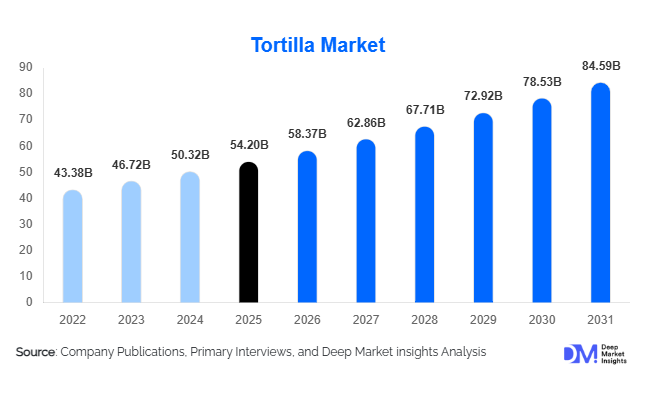
According to Deep Market Insights, the global tortilla market size was valued at USD 54.2 billion in 2025 and is projected to grow from USD 58.37 billion in 2026 to reach USD 84.59 billion by 2031, expanding at a CAGR of 7.7% during the forecast period (2026–2031). The tortilla market growth is primarily driven by increasing global consumption of convenient flatbread products, the rapid expansion of Mexican and Tex-Mex cuisine, rising demand for healthy wrap alternatives, and growing penetration of tortilla-based products across foodservice and retail channels worldwide.
Key Market Insights
- Flour tortillas dominate the global market, supported by widespread adoption in wraps, burritos, sandwiches, and quick-service restaurant applications.
- Health-focused tortilla variants are witnessing rapid growth, including gluten-free, keto-friendly, low-carb, multigrain, and high-protein products.
- North America remains the largest regional market, driven by strong household consumption and extensive foodservice penetration in the U.S. and Mexico.
- Asia-Pacific is emerging as the fastest-growing region, supported by urbanization, westernized eating habits, and expanding QSR networks in China and India.
- Online grocery platforms and modern retail chains are accelerating tortilla sales, particularly for premium packaged and frozen tortilla products.
- Technological advancements in automated baking and packaging systems are improving manufacturing efficiency, product consistency, and shelf-life management.
Tortilla Market Latest Trends
Functional and Health-Oriented Tortillas Gaining Momentum
Consumers are increasingly demanding healthier carbohydrate alternatives, driving significant growth in functional tortilla categories. Manufacturers are introducing low-carb, keto-friendly, high-protein, gluten-free, organic, and multigrain tortillas to meet evolving dietary preferences. The rising popularity of fitness-oriented lifestyles and plant-based diets is accelerating innovation in ingredients such as chickpea flour, flaxseed, quinoa, almond flour, and pea protein. Retailers are also expanding shelf space for clean-label tortillas with reduced preservatives and non-GMO certifications. Premium pricing for health-oriented tortillas is improving profit margins for manufacturers while helping brands differentiate themselves in a highly competitive market.
Expansion of Tex-Mex and Fusion Cuisine Worldwide
The globalization of Mexican and Tex-Mex cuisine continues to reshape the tortilla market landscape. Tortillas are increasingly being used in wraps, tacos, burritos, quesadillas, breakfast rolls, and fusion street foods across Europe, Asia-Pacific, and the Middle East. International quick-service restaurant chains are incorporating tortilla-based menu offerings to attract younger consumers seeking portable and customizable meals. In emerging markets such as India, China, and the UAE, foodservice operators are introducing localized tortilla applications that combine regional flavors with western-style convenience foods. Frozen ready meals and packaged snack kits using tortillas are also gaining popularity in retail channels, further supporting global consumption growth.
Tortilla Market Drivers
Rising Demand for Convenient and Portable Foods
Rapid urbanization, busy lifestyles, and increasing workforce participation are driving global demand for convenient meal formats. Tortillas offer flexibility, portability, and ease of preparation, making them ideal for wraps, sandwiches, burritos, tacos, and breakfast applications. Consumers increasingly prefer products that support quick meal assembly without compromising variety or taste. This trend is particularly strong among younger demographics and urban households seeking time-efficient food solutions. The growth of meal kits, grab-and-go foods, and frozen convenience meals is further strengthening tortilla demand globally.
Growth of Quick-Service Restaurants and Foodservice Chains
The rapid expansion of quick-service restaurants and fast-casual dining concepts is significantly contributing to tortilla market growth. Tortillas are widely used across foodservice operations because they allow menu customization while maintaining operational efficiency and ingredient versatility. Major QSR brands continue introducing tortilla-based wraps, tacos, burritos, and breakfast offerings to diversify menus and improve customer engagement. International restaurant expansion across Asia-Pacific, Europe, and the Middle East is increasing commercial tortilla demand. Food trucks and street-food-inspired restaurant concepts are also fueling growth in tortilla consumption worldwide.
Global Market Restraints
Volatility in Wheat and Corn Prices
Tortilla manufacturing is heavily dependent on wheat and corn, making the industry vulnerable to fluctuations in agricultural commodity prices. Weather-related disruptions, geopolitical instability, transportation costs, and supply-chain constraints can significantly impact raw material availability and pricing. These cost fluctuations place pressure on manufacturer margins, particularly in mass-market conventional tortilla categories where pricing competition remains intense. Smaller manufacturers with limited procurement scale are especially vulnerable to raw material price instability.
Limited Shelf Life and Distribution Challenges
Fresh tortillas have relatively short shelf lives, creating logistical and inventory management challenges for manufacturers and retailers. Maintaining freshness during transportation requires refrigerated storage and advanced packaging technologies, increasing operational costs. Export-oriented distribution also requires strong cold-chain infrastructure to prevent spoilage and maintain product quality. In emerging economies, underdeveloped logistics systems and inconsistent refrigeration capabilities may limit the penetration of premium fresh tortilla products. These challenges are encouraging manufacturers to invest in frozen tortilla formats and improved packaging solutions.
Tortilla Industry Key Opportunities
Expansion of Premium and Specialty Tortilla Categories
The growing consumer preference for healthier and value-added food products presents strong opportunities for premium tortilla manufacturers. Specialty tortillas featuring organic ingredients, functional nutrition, and clean-label positioning are achieving higher growth rates than conventional products. Consumers are increasingly willing to pay premium prices for tortillas with enhanced protein content, fiber enrichment, gluten-free formulations, and natural ingredients. Brands focusing on wellness-oriented positioning can expand market share while improving profitability. Retailers are also dedicating greater shelf space to premium tortilla products as demand for healthier convenience foods rises globally.
Growth of Export-Oriented and Frozen Tortilla Demand
International demand for tortillas is increasing significantly as Mexican cuisine gains mainstream acceptance worldwide. North American manufacturers are expanding frozen tortilla exports to Europe, Asia-Pacific, and the Middle East to support growing foodservice and retail demand. Frozen tortillas provide longer shelf life and easier transportation compared to fresh products, making them suitable for international trade. Emerging markets with limited domestic tortilla manufacturing capabilities are increasingly dependent on imports to satisfy rising consumer demand. Investments in cold-chain logistics and export-focused production facilities are expected to create long-term growth opportunities for global manufacturers.
Report Scope
| Report Metric | Details |
|---|---|
| Market Size in 2025 | USD 54.20 Billion |
| Market Size in 2026 | USD 58.37 Billion |
| Market Size in 2031 | USD 84.59 Billion |
| CAGR | 7.7% (2026-2031) |
| Base Year for Estimation | 2025 |
| Historical Data | 2022-2024 |
| Forecast Period | 2026-2031 |
| Report Coverage | Revenue Forecast, Competitive Landscape, Supply Chain Disruption, Growth Factors, Environment & Regulatory Landscape and Trends |
| Geographies Covered | North America, Europe, APAC, Middle East and Africa, LATAM |
| Countries Covered | U.S., Canada, U.K., Germany, France, Spain, Italy, Russia, Nordic, Benelux, Rest of Europe, China, Korea, Japan, India, Australia, Singapore, Taiwan, South East Asia, Rest of Asia-Pacific, UAE, Turky, Saudi Arabia, South Africa, Egypt, Nigeria, Rest of MEA, Brazil, Mexico, Argentina, Chile, Colombia, Rest of LATAM |
Explore more data points, trends and opportunities Download Free Sample Report
Product Type Insights
Flour tortillas account for the largest share of the global tortilla market, representing nearly 56% of total market revenue in 2025. Their dominance is supported by widespread application in wraps, burritos, quesadillas, and sandwich alternatives across retail and foodservice channels. Flour tortillas offer greater flexibility, larger sizing options, and compatibility with fusion cuisine formats, making them highly preferred by quick-service restaurant operators. Corn tortillas remain a major category, particularly in North America and Latin America, where they are consumed as traditional staple foods and increasingly positioned as gluten-free alternatives. Specialty tortillas, including high-protein, low-carb, spinach-based, and multigrain variants, are emerging as high-growth segments due to increasing consumer interest in functional nutrition and healthier meal solutions. Frozen and refrigerated tortillas are also gaining traction globally because they improve shelf stability and support export-oriented trade.
Application Insights
Wraps and burritos remain the leading application segment, accounting for approximately 34% of global tortilla consumption. The popularity of portable meal formats and customizable fillings continues driving strong demand across household and foodservice sectors. Tacos and quesadillas also represent substantial applications due to growing consumer familiarity with Mexican cuisine globally. Tortilla chips and snack products are witnessing rising consumption in retail snack categories, supported by increasing demand for savory packaged foods. Frozen ready meals utilizing tortillas are expanding rapidly in supermarkets and convenience retail chains. Breakfast applications, including breakfast wraps and egg burritos, are gaining momentum as consumers increasingly seek quick morning meal solutions. Tortillas are additionally being adopted as healthier alternatives to conventional sandwich bread in several developed markets.
Distribution Channel Insights
Supermarkets and hypermarkets dominate tortilla distribution globally, accounting for nearly 44% of total sales due to extensive product availability and strong consumer footfall. Modern retail chains provide consumers with broad choices across conventional, organic, frozen, and specialty tortilla categories. Convenience stores are important channels for smaller pack sizes and ready-to-eat tortilla products targeting urban consumers. Online grocery retail platforms are emerging as one of the fastest-growing channels due to increasing digital food purchases and home delivery services. Foodservice distributors play a critical role in supplying tortillas to restaurants, catering operators, and institutional kitchens. Wholesale clubs and cash-and-carry retailers are also expanding tortilla sales through bulk packaging formats targeted at commercial buyers and large households.
End-Use Insights
Household retail consumption represents the largest end-use segment in the tortilla market, accounting for nearly 46% of global demand. Consumers increasingly use tortillas for home-prepared wraps, tacos, sandwiches, and breakfast meals due to their convenience and versatility. Quick-service restaurants are the fastest-growing end-use segment, supported by global expansion of Tex-Mex and fast-casual dining concepts. Industrial food processors are also increasing tortilla procurement for frozen meals, packaged snack kits, and ready-to-eat convenience products. Institutional catering services, including schools, hospitals, and corporate cafeterias, are gradually integrating tortilla-based meal options due to operational efficiency and broad consumer appeal. Food trucks and street-food operators continue contributing to rising tortilla demand in urban markets worldwide.
Nature Insights
Conventional tortillas continue to dominate the market, accounting for nearly 78% of global revenue due to affordability, large-scale availability, and extensive foodservice usage. However, organic and clean-label tortilla categories are registering significantly faster growth rates, particularly in North America and Europe. Consumers increasingly prefer products with natural ingredients, reduced preservatives, and non-GMO certifications. Gluten-free tortillas made from corn, cassava, almond, and chickpea flour are witnessing rapid adoption among health-conscious and allergy-sensitive consumers. Manufacturers are actively reformulating products to align with clean-label trends while maintaining taste, texture, and shelf-life performance.
Explore more data points, trends and opportunities Download Free Sample Report
Tortilla Market Segmentations
By Product Type
- Flour Tortilla
- Corn Tortilla
- Whole Wheat Tortilla
- Multigrain Tortilla
- Gluten-Free Tortilla
- Low-Carb & Keto Tortilla
- High-Protein Tortilla
- Frozen Tortilla
- Refrigerated Fresh Tortilla
By Nature
- Conventional
- Organic
- Non-GMO
- Clean Label
By Application
- Wraps & Burritos
- Tacos
- Quesadillas
- Tortilla Chips & Snacks
- Frozen Ready Meals
- Breakfast Products
- Sandwich Alternatives
By End Use
- Household/Retail Consumption
- Quick-Service Restaurants
- Full-Service Restaurants
- Institutional Catering
- Industrial Food Processing
- Street Food & Food Trucks
By Distribution Channel
- Supermarkets & Hypermarkets
- Convenience Stores
- Specialty Food Stores
- Online Retail/E-Commerce
- Foodservice Distributors
- Club Stores & Wholesale Retailers
Regional Insights
North America
North America dominates the global tortilla market, accounting for nearly 52% of total market share in 2025. The United States remains the largest individual market due to the mainstream adoption of Mexican cuisine, strong household consumption, and the extensive presence of quick-service restaurant chains. Tortillas are increasingly replacing traditional bread in wraps and portable meal formats. Mexico continues to represent a major consumption hub because tortillas are staple food products consumed daily across households and foodservice establishments. Canada is witnessing rising demand for organic, gluten-free, and premium tortilla products driven by health-conscious consumers and multicultural food trends.
Europe
Europe accounts for approximately 21% of the global tortilla market and continues to witness steady growth driven by increasing demand for convenience foods and international cuisines. The United Kingdom represents the leading European market due to strong retail penetration of Tex-Mex food products and widespread popularity of wraps and burritos. Germany and France are experiencing rising tortilla consumption within frozen meals, snack products, and fast-casual dining applications. European consumers are increasingly attracted to organic and clean-label tortilla products, encouraging manufacturers to expand premium product portfolios.
Asia-Pacific
Asia-Pacific is the fastest-growing regional market and is projected to register a CAGR exceeding 9% during the forecast period. China and India are leading growth due to expanding urban populations, westernized eating habits, and rising disposable incomes. International quick-service restaurant chains are accelerating tortilla demand through menu localization and increasing store expansion. Japan and South Korea are witnessing increasing popularity of tortilla wraps and fusion street foods among younger consumers. Australia represents a mature market with strong retail and foodservice adoption of premium tortilla products. Rising supermarket penetration and online food retail are further supporting regional market expansion.
Latin America
Latin America remains a significant tortilla consumption region due to strong cultural familiarity and traditional dietary usage. Mexico dominates regional demand, while Brazil and Argentina are witnessing increasing adoption of tortilla-based foods through retail and foodservice expansion. Growth in packaged foods and frozen convenience products is creating additional opportunities for tortilla manufacturers in the region. Urban consumers are increasingly incorporating tortillas into modern meal formats beyond traditional applications.
Middle East & Africa
The Middle East & Africa tortilla market is expanding steadily due to increasing westernized food consumption, tourism growth, and rapid development of international restaurant chains. The UAE and Saudi Arabia represent the leading regional markets due to high disposable incomes and strong demand for convenience foods. Hospitality and catering sectors are contributing significantly to tortilla demand, particularly in wraps and snack applications. South Africa is also witnessing rising tortilla adoption through retail supermarkets and quick-service restaurants targeting younger urban consumers.
Key Players in the Tortilla Market
- Gruma S.A.B. de C.V.
- Mission Foods
- Ole Mexican Foods
- General Mills
- PepsiCo
- Bimbo Bakeries USA
- La Tortilla Factory
- Azteca Foods
- Catallia Mexican Foods
- Don Pancho Authentic Mexican Foods
- Easy Foods
- Aranda’s Tortilla Company
- Tortilla King
- Rositas Foods
- Tyson Foods