Frozen Egg Tart Skin Market Size
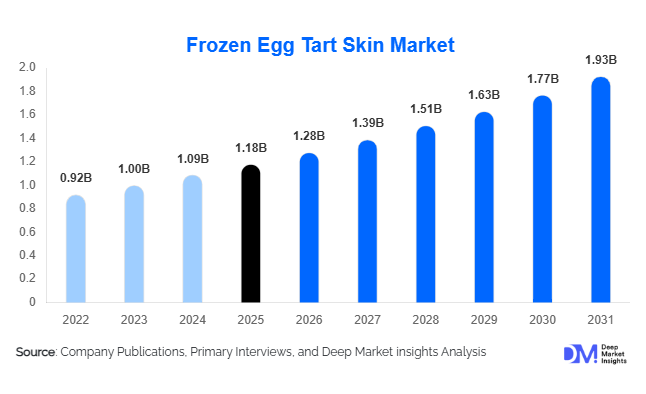
According to Deep Market Insights, the global Frozen Egg Tart Skin market size was valued at USD 1.18 billion in 2025 and is projected to grow from USD 1.28 billion in 2026 to reach USD 1.93 billion by 2031, expanding at a CAGR of 8.5% during the forecast period (2026–2031). The Frozen Egg Tart Skin market growth is primarily driven by rising demand for ready-to-bake bakery products, increasing adoption among foodservice operators, expansion of frozen food distribution networks, and growing consumer preference for convenient dessert preparation solutions. The market analysis covers segmentation by type and application, production trends, regional performance, competitive landscape, and emerging industry developments.
Key Market Insights
- Asia-Pacific dominates the Frozen Egg Tart Skin Market with approximately 46.2% market share in 2025, supported by China, Japan, South Korea, and Southeast Asian bakery consumption, while North America represents the fastest-growing region with a 9.4% CAGR.
- Puff Pastry Skin dominates the type segment, accounting for nearly 58.5% share of the Frozen Egg Tart Skin Market in 2025 due to superior layering, texture consistency, and commercial bakery preference.
- Foodservice applications lead market demand with approximately 61.8% share, driven by restaurants, cafes, hotels, and quick-service bakery chains requiring standardized frozen pastry solutions.
- China remains the largest production hub, contributing nearly 34% of global output with more than 32 million frozen egg tart skin units produced monthly.
- India represents an emerging growth market, expected to reach approximately USD 145 million by 2031 at a CAGR of 10.2%, supported by bakery modernization and frozen food adoption.
- Automation and premium product innovation, including specialty formulations, improved freezing technology, and sustainable packaging, are reshaping the Frozen Egg Tart Skin industry.
Frozen Egg Tart Skin Market Latest Trends
Automation and Premium Frozen Bakery Product Expansion
Frozen Egg Tart Skin manufacturers are increasingly adopting automated laminating systems, precision cutting technologies, and advanced freezing processes to improve product consistency and production efficiency. Global Frozen Egg Tart Skin production exceeded 920 million units in 2025 and is expected to surpass 1.45 billion units by 2031. Approximately 72% of large-scale manufacturers have integrated automated production lines, reducing production waste by nearly 15–20%. Premium pastry formulations with enhanced butter content, longer shelf life, and improved baking performance are gaining popularity among commercial bakeries, contributing nearly 34% of new product introductions. These advancements are strengthening the Frozen Egg Tart Skin Market by improving quality control and operational efficiency.
Foodservice Expansion and Ready-to-Bake Consumption Growth
Foodservice demand continues to influence Frozen Egg Tart Skin adoption as restaurants, cafes, and bakery chains increasingly depend on frozen pastry solutions. Foodservice operators consumed more than 560 million units in 2025, representing approximately 61.8% market share. Adoption among urban foodservice businesses reached nearly 76% in developed markets, while emerging economies recorded penetration levels between 45–55%. Sustainable packaging adoption reached around 38%, reflecting growing environmental awareness among manufacturers and buyers. The expansion of Asian dessert chains, cloud kitchens, and convenience bakeries continues supporting the Frozen Egg Tart Skin Market Trend globally.
Frozen Egg Tart Skin Market Drivers
Expansion of Commercial Bakery and Foodservice Networks
The rapid expansion of commercial bakeries, cafes, and foodservice chains is a major driver for the Frozen Egg Tart Skin Market. Foodservice applications accounted for approximately 61.8% market share in 2025, with consumption exceeding 560 million units. Frozen pastry solutions help operators reduce preparation time by nearly 45% while maintaining standardized product quality. More than 70% of international bakery chains using frozen pastry systems report improved operational efficiency. Rising urbanization, increased disposable income, and growing demand for Asian-style desserts are accelerating adoption across global markets.
Growing Demand for Convenient and Standardized Bakery Products
Consumer preference for convenient food preparation is increasing demand for frozen bakery ingredients. Household adoption of frozen egg tart skins reached approximately 21% globally in 2025, while retail frozen bakery sales contributed nearly 24.6% market share. Manufacturers are responding with products offering 6–12 months shelf stability, improved texture retention, and simplified baking processes. The demand for consistent quality among home consumers and professional bakers continues strengthening Frozen Egg Tart Skin Market expansion.
Frozen Egg Tart Skin Market Restraints
Cold Chain Infrastructure Limitations
Limited refrigerated logistics infrastructure remains a key restraint affecting Frozen Egg Tart Skin Market penetration in emerging economies. Approximately 28% of developing regions experience inadequate frozen storage capacity, leading to 8–12% annual supply losses. Small bakery operators face nearly 15–20% higher operating costs due to refrigeration requirements. These infrastructure challenges limit product availability in rural regions and slow market expansion despite increasing consumer demand for frozen bakery products.
Raw Material Cost Volatility
Fluctuating prices of butter, flour, and packaging materials create challenges for Frozen Egg Tart Skin manufacturers. Raw materials account for approximately 62% of total production expenses, while butter price fluctuations of nearly 12–18% annually influence manufacturing margins. Around 22% of producers report difficulty maintaining premium quality while controlling production costs. These factors create pricing pressure across the Frozen Egg Tart Skin industry.
Frozen Egg Tart Skin Industry Key Opportunities
Premium and Specialty Frozen Pastry Development
The rising demand for premium bakery experiences creates opportunities for specialty Frozen Egg Tart Skin products. Specialty frozen skins are projected to grow at a 10.1% CAGR between 2026 and 2031, increasing contribution from 11.8% share toward approximately 15% of total market demand. Products featuring gluten-controlled formulations, reduced sugar content, and premium butter ingredients are gaining traction among health-conscious consumers and luxury bakery operators.
Retail Expansion and E-Commerce Distribution
Retail and online distribution channels provide significant growth opportunities for Frozen Egg Tart Skin manufacturers. Retail applications represented approximately 24.6% share in 2025, with sales exceeding 226 million units. Expansion of supermarket frozen sections and digital grocery platforms is improving product accessibility. Online channels enable manufacturers to reach household consumers while supporting growth of home baking trends.
Report Scope
| Report Metric | Details |
|---|---|
| Market Size in 2025 | USD 1.18 Billion |
| Market Size in 2026 | USD 1.28 Billion |
| Market Size in 2031 | USD 1.93 Billion |
| CAGR | 8.5% (2026-2031) |
| Base Year for Estimation | 2025 |
| Historical Data | 2022-2024 |
| Forecast Period | 2026-2031 |
| Report Coverage | Revenue Forecast, Competitive Landscape, Supply Chain Disruption, Growth Factors, Environment & Regulatory Landscape and Trends |
| Geographies Covered | North America, Europe, APAC, Middle East and Africa, LATAM |
| Countries Covered | U.S., Canada, U.K., Germany, France, Spain, Italy, Russia, Nordic, Benelux, Rest of Europe, China, Korea, Japan, India, Australia, Singapore, Taiwan, South East Asia, Rest of Asia-Pacific, UAE, Turky, Saudi Arabia, South Africa, Egypt, Nigeria, Rest of MEA, Brazil, Mexico, Argentina, Chile, Colombia, Rest of LATAM |
Explore more data points, trends and opportunities Download Free Sample Report
Product Type Insights
Puff Pastry Skin emerged as the dominant product type in the Frozen Egg Tart Skin Market, accounting for approximately 58.5% of the global market share and production exceeding 538 million units in 2025. Its market leadership is primarily attributed to its superior laminated structure, typically consisting of multiple alternating layers of dough and fat with an average 20–40% fat content, which delivers the light, crispy, and flaky texture preferred by commercial bakeries, restaurants, cafés, and premium dessert manufacturers. The growing popularity of authentic Asian bakery products, particularly Portuguese and Hong Kong-style egg tarts, has significantly increased demand for puff pastry skins across both developed and emerging markets. Additionally, manufacturers increasingly prefer puff pastry skin because it ensures consistent baking performance, minimizes labor-intensive lamination processes, reduces production time, and improves operational efficiency while maintaining product quality. Continuous innovation in frozen dough technology, enhanced shelf life, and better freeze-thaw stability have further strengthened the adoption of puff pastry skins across industrial food production and foodservice operations worldwide.Specialty Frozen Skin represented approximately 11.8% of the global market, with production exceeding 108 million units in 2025. Although comparatively smaller, this segment continues to expand rapidly owing to rising consumer demand for premium, customized, and health-focused bakery solutions. Specialty products include gluten-free pastry skins, premium butter-based formulations, organic variants, vegan alternatives, low-fat options, and customized pastry sheets designed for specific commercial applications. Growing consumer awareness regarding dietary preferences, increasing demand for allergen-free bakery products, and continuous product innovation are encouraging manufacturers to diversify their specialty product portfolios. Premium cafés, artisan bakeries, luxury hotels, and specialty dessert manufacturers remain key end-users, while the expansion of premium frozen bakery offerings across retail channels continues to create favorable growth opportunities for this segment.
Application Insights
Foodservice remained the largest application segment in the Frozen Egg Tart Skin Market, accounting for approximately 61.8% of global market share while consuming more than 560 million units annually. The segment's leadership is primarily driven by the increasing adoption of frozen pastry solutions among restaurants, hotels, cafés, quick-service restaurants (QSRs), institutional kitchens, and commercial bakeries seeking greater operational efficiency. Frozen Egg Tart Skin significantly reduces labor requirements, preparation time, ingredient wastage, and production inconsistencies while ensuring standardized product quality across multiple outlets. The rapid expansion of international café chains, bakery franchises, tourism, hospitality infrastructure, and premium dessert menus has further accelerated demand within foodservice establishments. Moreover, rising labor shortages across commercial kitchens and the growing preference for ready-to-bake frozen bakery products continue encouraging foodservice operators to incorporate Frozen Egg Tart Skin into their daily operations, making this the leading application segment globally.Bakery chains accounted for approximately 13.6% of the market, utilizing frozen pastry solutions to standardize production across multiple store locations while improving overall operational efficiency. Large bakery chains increasingly rely on Frozen Egg Tart Skin to maintain product consistency, reduce skilled labor dependency, optimize inventory management, and minimize production costs. The growing expansion of multinational bakery franchises, cloud kitchens, and centralized production facilities has further strengthened demand within this segment. In addition, frozen pastry products enable bakery chains to respond quickly to changing consumer demand while maintaining high-quality standards across geographically dispersed operations, supporting continued growth throughout the forecast period.
Explore more data points, trends and opportunities Download Free Sample Report
Frozen Egg Tart Skin Market Segmentations
By Type
- Ready-to-Use
- Powder Mix
- Custom Formulation
By Application
- Commercial Bakeries
- Household
- Foodservice
By Distribution Channel
- Online Retail
- Supermarkets and Hypermarkets
- Specialty Baking Stores
- Direct Sales and B2B Distribution
Regional Insights
Asia-Pacific
Asia-Pacific dominated the Frozen Egg Tart Skin Market with approximately 46.2% of the global market share and production exceeding 430 million units in 2025. China alone contributed nearly 34% of global output, supported by its well-established bakery manufacturing ecosystem, large-scale frozen food processing industry, extensive cold chain infrastructure, and strong consumer demand for traditional egg tart products. China’s Frozen Egg Tart Skin market exceeded USD 390 million in 2025, supported by production exceeding 32 million units per month. Japan, South Korea, Taiwan, Hong Kong, and Southeast Asian countries continue generating substantial demand through expanding premium bakery markets, café culture, convenience stores, and organized foodservice sectors. Regional market growth is being driven by rapid urbanization, rising disposable incomes, increasing consumption of ready-to-bake bakery products, expansion of international bakery franchises, continuous investment in cold storage infrastructure, growing penetration of modern retail channels, and increasing consumer preference for convenient frozen foods. India remains one of the fastest-growing markets with an estimated 10.2% CAGR, fueled by rapid bakery industry expansion, increasing frozen food acceptance, rising middle-class consumption, and significant investments by domestic and international food manufacturers.
North America
North America accounted for approximately 18.4% of the global market share in 2025, with production reaching nearly 170 million units. The United States represented approximately 78% of regional demand, supported by the increasing popularity of Asian desserts, premium bakery products, and international café chains. The regional market is projected to expand at a robust 9.4% CAGR through 2031, making it one of the fastest-growing regional markets. Foodservice establishments account for nearly 70% of regional consumption, while retail adoption continues to increase through supermarkets, warehouse clubs, specialty food retailers, and e-commerce platforms. Regional growth is primarily driven by growing multicultural food preferences, rising consumer interest in authentic Asian bakery products, expanding frozen food consumption, advanced cold chain logistics, continuous innovation in frozen bakery products, increasing labor costs that encourage automation, and strong investments by commercial bakeries in ready-to-bake solutions that improve operational efficiency and product consistency.
Europe
Europe represented approximately 21.3% of the global market share, with production exceeding 196 million units. Germany, France, and the United Kingdom collectively contributed nearly 68% of regional demand, supported by their mature bakery industries and well-developed frozen food distribution networks. Shortcrust pastry products remain particularly popular across Europe, accounting for approximately 42% of regional consumption, owing to strong consumer preference for traditional European pastry products. Regional market growth continues to be driven by increasing premium bakery consumption, rising demand for convenience foods, expanding café and artisan bakery networks, growing adoption of sustainable packaging, continuous product innovation, increasing availability of clean-label frozen bakery products, and stringent food quality standards that encourage manufacturers to adopt high-quality frozen pastry solutions. The ongoing expansion of retail frozen bakery assortments and premium foodservice offerings further supports long-term market growth across the region.
Latin America
Latin America accounted for approximately 8.1% of the global market, with production reaching nearly 75 million units during 2025. Brazil and Mexico together represented more than 60% of regional demand, benefiting from expanding urban populations, increasing bakery consumption, and the modernization of commercial foodservice operations. Foodservice applications dominate regional consumption with nearly 64% share, supported by the rapid expansion of cafés, restaurants, hotels, and bakery chains. Regional growth is further driven by improving cold chain infrastructure, increasing investments in organized retail, rising disposable incomes, growing consumer demand for premium bakery products, expanding tourism activities, and greater availability of frozen bakery products through supermarkets and wholesale distribution channels. As commercial bakeries increasingly adopt automated production systems, demand for standardized frozen pastry products is expected to strengthen further.
Middle East & Africa
The Middle East & Africa contributed approximately 6.0% of the global market share, with production approaching 55 million units in 2025. Gulf Cooperation Council (GCC) countries represented more than 45% of regional demand, supported by strong growth in the hospitality sector, luxury hotels, international restaurant chains, and premium cafés. Frozen bakery adoption among hotels and restaurants exceeds 58%, reflecting the increasing preference for ready-to-bake products that deliver consistent quality while reducing kitchen preparation time. Regional market growth is being driven by expanding tourism infrastructure, increasing hotel construction, rising expatriate populations, growing popularity of international bakery products, investments in modern retail and foodservice sectors, improvements in refrigerated logistics, and increasing consumer demand for convenient premium bakery offerings. Emerging African economies are also witnessing gradual market expansion as urbanization, organized retail development, and frozen food distribution networks continue to improve, creating additional opportunities for Frozen Egg Tart Skin manufacturers throughout the forecast period.
Key Players in the Frozen Egg Tart Skin Market
- Rich Products Corporation
- General Mills Inc.
- Europastry S.A.
- Grupo Bimbo
- Lantmännen Unibake
- Dawn Food Products Inc.
- BakeMark
- Vandemoortele NV
- Fuji Baking Group
- Taichang Foods
- Guangzhou Restaurant Group
- Sanquan Food Co. Ltd.