Pear Preserves Market Size
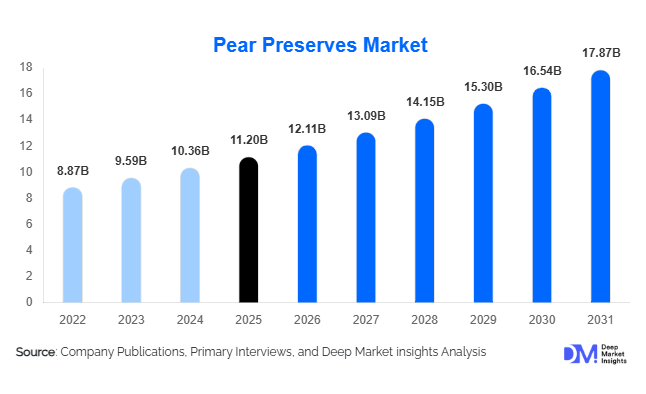
According to Deep Market Insights, the global pear preserves market size was valued at USD 11.2 billion in 2025 and is projected to grow from USD 12.11 billion in 2026 to reach USD 17.87 billion by 2031, expanding at a CAGR of 8.1% during the forecast period (2026–2031). The pear preserves market growth is supported by increasing consumer demand for premium fruit spreads, growing preference for clean-label and natural food products, expanding retail distribution networks, and rising utilization of fruit preserves across bakery, dairy, and confectionery applications.
Key Market Insights
- Conventional pear preserves remain the dominant product category, accounting for more than 62% of global production due to affordability, widespread retail availability, and established consumer preference.
- Organic and low-sugar pear preserves are witnessing the fastest adoption, supported by increasing health awareness, demand for clean-label foods, and premium grocery expansion.
- Europe dominates the global market, driven by extensive pear cultivation, strong processed fruit manufacturing capabilities, and high consumer preference for premium preserves.
- Asia-Pacific represents the fastest-growing regional market, supported by increasing disposable income, urbanization, modern retail penetration, and growing packaged food consumption.
- Food processing applications continue expanding, as bakeries, confectionery manufacturers, dairy producers, and snack companies increasingly incorporate pear preserves into value-added products.
- Automation, sustainable packaging, and clean-label processing technologies are improving production efficiency while supporting premium product positioning across global markets.
Pear Preserves Market Latest Trends
Premium and Clean-Label Fruit Preserves Continue Expanding
Manufacturers are increasingly introducing premium pear preserves prepared using natural ingredients, higher fruit content, organic certification, and reduced artificial additives. Consumer preference is shifting toward products containing recognizable ingredients, recyclable glass packaging, and sustainably sourced pears. Premium grocery retailers continue expanding shelf space for artisanal fruit preserves, while manufacturers differentiate products through regional fruit varieties, small-batch processing, and gourmet flavor combinations. Growing demand for healthier breakfast spreads and natural dessert ingredients continues strengthening premium positioning across developed and emerging markets.
Automation and Sustainable Manufacturing Improving Production Efficiency
Food processors are investing in automated fruit sorting, precision cooking systems, digital quality monitoring, and energy-efficient filling technologies to improve production consistency while reducing processing waste. Manufacturers are also adopting recyclable packaging materials, lightweight glass jars, renewable energy systems, and optimized supply chains to reduce environmental impact. Digital traceability solutions and improved inventory management systems are enhancing operational efficiency while helping producers satisfy evolving regulatory and consumer transparency requirements.
Pear Preserves Market Drivers
Growing Consumer Preference for Natural Fruit-Based Foods
Consumers are increasingly replacing highly processed breakfast spreads with fruit-based alternatives that offer natural ingredients and recognizable nutritional value. Rising health consciousness, expanding premium grocery retail, and increasing interest in minimally processed foods continue supporting demand for pear preserves. Growing utilization across breakfast meals, bakery fillings, desserts, yogurt toppings, and snack products is further contributing to sustained market expansion across both developed and emerging economies.
Expanding Demand from Bakery and Food Processing Industries
Commercial bakeries, confectionery manufacturers, dairy producers, and foodservice operators are increasingly incorporating pear preserves into pastries, cakes, cookies, yogurt products, frozen desserts, and ready-to-eat snacks. Product innovation focused on premium fillings, clean-label ingredients, and fruit-based formulations is encouraging manufacturers to increase procurement volumes while supporting consistent industrial demand worldwide.
Pear Preserves Market Restraints
Fluctuating Raw Material Availability and Production Costs
Pear production remains highly dependent on seasonal weather conditions, creating fluctuations in fruit availability and procurement costs. Climate variability, transportation expenses, packaging material inflation, and energy costs continue affecting manufacturing margins. These factors increase pricing volatility and create operational challenges for both regional and multinational preserve manufacturers.
Competition from Alternative Fruit Spreads
The market faces increasing competition from jams, marmalades, mixed-fruit preserves, nut spreads, honey, and reduced-sugar alternatives. Consumers seeking greater product variety often shift toward diversified fruit spreads, requiring manufacturers to continuously innovate through new formulations, premium ingredients, improved packaging, and differentiated product positioning to maintain competitiveness.
Pear Preserves Industry Key Opportunities
Expansion of Organic and Reduced-Sugar Product Lines
Growing consumer awareness regarding nutrition and wellness presents significant opportunities for manufacturers to introduce organic, low-sugar, naturally sweetened, and preservative-free pear preserves. Retailers are increasingly dedicating premium shelf space to healthier fruit spreads, enabling manufacturers to target health-conscious consumers through value-added product portfolios.
Growth Across Emerging Retail and Export Markets
Rapid expansion of organized retail, e-commerce grocery platforms, and international food exports is creating new opportunities for pear preserve manufacturers. Rising disposable income, urbanization, and premium food consumption across Asia-Pacific, Latin America, and the Middle East are encouraging companies to strengthen distribution networks and expand global market presence.
Report Scope
| Report Metric | Details |
|---|---|
| Market Size in 2025 | USD 11.20 Billion |
| Market Size in 2026 | USD 12.11 Billion |
| Market Size in 2031 | USD 17.87 Billion |
| CAGR | 8.1% (2026-2031) |
| Base Year for Estimation | 2025 |
| Historical Data | 2022-2024 |
| Forecast Period | 2026-2031 |
| Report Coverage | Revenue Forecast, Competitive Landscape, Supply Chain Disruption, Growth Factors, Environment & Regulatory Landscape and Trends |
| Geographies Covered | North America, Europe, APAC, Middle East and Africa, LATAM |
| Countries Covered | U.S., Canada, U.K., Germany, France, Spain, Italy, Russia, Nordic, Benelux, Rest of Europe, China, Korea, Japan, India, Australia, Singapore, Taiwan, South East Asia, Rest of Asia-Pacific, UAE, Turky, Saudi Arabia, South Africa, Egypt, Nigeria, Rest of MEA, Brazil, Mexico, Argentina, Chile, Colombia, Rest of LATAM |
Explore more data points, trends and opportunities Download Free Sample Report
Product Type Insights
The conventional pear preserves segment currently dominates the global market, accounting for the largest revenue share due to competitive pricing, extensive retail penetration, and strong consumer familiarity with traditional fruit spreads. The segment benefits from consistent household demand, widespread availability across supermarkets and grocery stores, and cost advantages that make conventional products accessible to a broad consumer base. Established manufacturing processes, longer market presence, and strong acceptance among price-sensitive consumers continue to support the leading position of conventional pear preserves.Low-sugar pear preserves are gaining significant traction as health-conscious consumers increasingly seek reduced-calorie alternatives without sacrificing taste, texture, and fruit authenticity. The growing prevalence of lifestyle-related health concerns and increasing demand for functional food products are encouraging brands to introduce low-sugar formulations using natural sweeteners and advanced preservation technologies. Continuous innovation in sugar reduction techniques, clean-label formulations, and healthier ingredient combinations is expected to support further diversification within the product category.
Application Insights
Household consumption represents the largest application segment of the pear preserves market, supported by regular usage in breakfast meals, bakery preparation, desserts, snacks, and everyday food applications. The leading growth driver for this segment is increasing consumer demand for convenient and versatile food products that enhance meal experiences while reducing preparation time. Rising household adoption of premium spreads, changing breakfast preferences, and increased experimentation with gourmet flavors are further contributing to segment expansion.Foodservice applications continue gaining importance through increasing adoption across hotels, cafés, restaurants, catering services, and institutional food providers. Demand for commercial-sized packaging formats is rising as foodservice operators incorporate fruit preserves into breakfast buffets, pastries, desserts, and specialty menu offerings. Growth in tourism, hospitality infrastructure, and premium dining experiences is supporting broader commercial utilization of pear preserves globally.
Distribution Channel Insights
Supermarkets and hypermarkets remain the leading distribution channel for pear preserves due to their extensive product availability, competitive pricing structures, organized shelf placement, and ability to serve a wide consumer base. The segment continues benefiting from strong consumer preference for one-stop shopping experiences, promotional activities, and access to multiple product variants including conventional, organic, and specialty preserves.Online retail platforms are emerging as a rapidly growing distribution channel due to increasing digital shopping adoption, direct-to-consumer business models, subscription-based food services, and improved home delivery infrastructure. The convenience of online purchasing, wider product selection, and growing penetration of e-commerce platforms are expected to accelerate digital sales of pear preserves, particularly among younger and urban consumers.Convenience stores and independent retailers continue supporting market expansion by improving product accessibility, especially across urban and suburban areas. These channels benefit from proximity-based purchasing behavior and increasing demand for convenient food products suitable for quick consumption occasions.
Packaging Insights
Glass jars represent the dominant packaging format in the pear preserves market due to their superior preservation capability, premium appearance, product visibility, recyclability, and strong consumer association with quality. The leading driver for glass packaging demand is the growing preference for premium and sustainable packaging solutions that enhance product perception while maintaining freshness and shelf stability.Plastic containers continue maintaining demand, particularly in value-focused retail segments, due to their lightweight nature, durability, lower transportation costs, and convenience advantages. Manufacturers targeting mass-market consumers increasingly utilize plastic packaging formats to improve affordability and operational efficiency.Sustainable packaging innovation is becoming increasingly important as manufacturers respond to environmental regulations and changing consumer expectations. Companies are investing in lightweight materials, recyclable packaging solutions, eco-friendly closures, and improved packaging designs to reduce environmental impact while maintaining product quality and convenience.
Explore more data points, trends and opportunities Download Free Sample Report
Pear Preserves Market Segmentations
By Type
- Conventional Pear Preserves
- Organic Pear Preserves
- Low-Sugar Pear Preserves
By Application
- Household Consumption
- Foodservice
- Food Processing
By Distribution Channel
- Supermarkets and Hypermarkets
- Specialty Grocery Stores
- Online Retail Platforms
- Convenience Stores and Independent Retailers
By Packaging Type
- Glass Jars
- Plastic Containers
- Flexible Packaging
Regional Insights
North America
North America represents a significant market for pear preserves, supported by strong consumer demand for premium fruit spreads, established food retail networks, and increasing preference for organic and natural food products. The United States accounts for the majority of regional consumption due to high adoption of breakfast spreads, developed packaged food industries, and strong presence of supermarkets and specialty food retailers. Growth in the region is primarily driven by rising demand for clean-label products, premiumization of grocery purchases, expanding organic food consumption, and increasing utilization of fruit preserves in bakery and processed food applications.Canada is also witnessing steady market expansion due to growing consumer interest in natural ingredients, sustainable food products, and premium grocery offerings. The region's mature food processing sector continues supporting demand through applications in bakery, dairy, confectionery, and ready-to-eat food manufacturing. Increasing availability of imported and specialty preserves through organized retail channels further contributes to regional growth.
Europe
Europe remains the largest regional market for pear preserves, supported by strong pear cultivation, advanced fruit processing capabilities, established preserve consumption patterns, and a long-standing tradition of fruit-based food products. Countries including Germany, France, Italy, Spain, and the United Kingdom represent major markets due to their developed food industries and high consumer acceptance of premium fruit spreads.Regional growth is primarily driven by increasing demand for organic, artisanal, and sustainably produced preserves, along with rising consumer preference for premium breakfast products and natural ingredients. Europe's strong agricultural ecosystem, advanced food manufacturing infrastructure, and growing emphasis on environmentally responsible production practices continue reinforcing its leadership position in the global market.
Asia-Pacific
Asia-Pacific is expected to register the fastest growth during the forecast period, supported by rising disposable incomes, rapid urbanization, expanding middle-class populations, and increasing adoption of packaged food products. China and India represent major growth opportunities due to their large consumer bases, improving retail infrastructure, and increasing awareness of international food products.Regional expansion is primarily driven by changing dietary habits, growing demand for convenient breakfast solutions, increasing penetration of supermarkets and online grocery platforms, and rising consumer interest in premium and health-oriented food products. Japan, South Korea, and Australia continue supporting regional demand through mature food retail systems, higher adoption of premium preserves, and increasing preference for natural and functional food options.
Latin America
Latin America is experiencing steady growth in the pear preserves market due to rising packaged food consumption, retail modernization, expanding middle-class populations, and increasing demand for premium fruit-based products. Brazil, Argentina, Chile, and Mexico represent key markets where improving distribution networks and changing consumer lifestyles are supporting broader adoption of processed fruit products.Regional growth is primarily driven by increasing urban consumption, expansion of modern grocery retailers, rising disposable income levels, and growing interest in convenient and higher-quality food offerings. Manufacturers are increasingly focusing on regional distribution expansion and product diversification to capture emerging consumer demand across Latin American markets.
Middle East & Africa
The Middle East & Africa market is gradually expanding due to increasing premium food imports, growing supermarket penetration, tourism development, and rising demand for gourmet and international food products. Gulf Cooperation Council countries represent important consumption markets due to higher purchasing power, strong hospitality sectors, and demand for premium packaged foods.Growth across the region is primarily driven by expanding foodservice operations, increasing adoption of modern retail channels, rising urban populations, and growing consumer exposure to global food trends. South Africa continues strengthening its position through domestic fruit processing capabilities and improved regional distribution networks, supporting wider availability of processed fruit products across African markets.
Key Players in the Pear Preserves Market
- Bonne Maman
- Hero Group
- Andros Group
- Smucker's
- Wilkin & Sons
- St. Dalfour
- B&G Foods
- Darbo AG
- Mackays
- Mrs. Bridges
- Rigoni di Asiago
- Sarabeth's Kitchen