Fish Balls Market Size
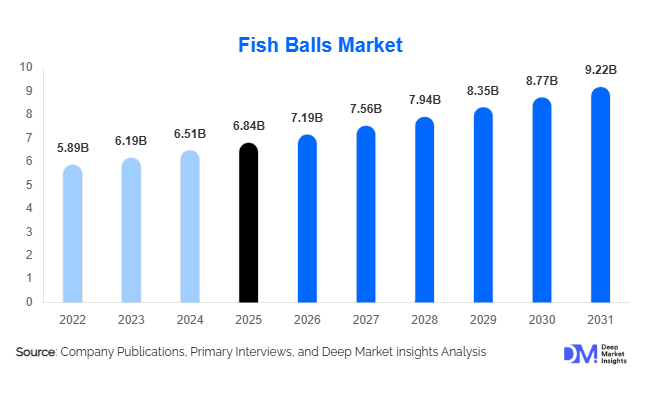
According to Deep Market Insights, the global fish balls market size was valued at USD 6.84 billion in 2025 and is projected to grow from USD 7.19 billion in 2026 to reach USD 9.22 billion by 2031, expanding at a CAGR of 5.1% during the forecast period (2026–2031). The fish balls market growth is primarily driven by increasing consumption of processed seafood products, rising demand for convenient ready-to-cook protein foods, rapid expansion of cold chain infrastructure, and growing adoption of frozen seafood across retail and foodservice industries worldwide.
Key Market Insights
- Frozen fish balls remain the leading product category, supported by their longer shelf life, superior export potential, and growing preference among supermarkets and organized retail chains.
- Foodservice applications account for the largest consumption share, driven by restaurants, hotpot chains, street food vendors, quick-service restaurants, and institutional catering services.
- Asia-Pacific dominates the global market, led by China, Thailand, Vietnam, Indonesia, Japan, and Malaysia owing to high seafood production and strong domestic consumption.
- Middle East & Africa is the fastest-growing regional market, supported by expanding frozen food distribution networks, urbanization, and increasing seafood imports.
- Premium and value-added seafood products are gaining popularity, with manufacturers introducing high-protein, clean-label, reduced-sodium, and preservative-free fish balls.
- Automation and advanced freezing technologies, including IQF processing, vacuum packaging, and digital traceability systems, are improving manufacturing efficiency and product quality across global seafood supply chains.
Fish Balls Market Latest Trends
Premium Frozen Seafood Products Continue to Expand
Manufacturers are increasingly focusing on premium frozen seafood products with higher fish meat content, improved texture, clean-label ingredients, and enhanced nutritional value. Individual Quick Freezing (IQF) technology has become the preferred production method due to its ability to preserve freshness, texture, and nutritional quality while extending shelf life. Retailers are expanding premium frozen seafood portfolios to meet growing consumer demand for convenient protein-rich meals. Private-label frozen seafood brands are also increasing investments in attractive packaging and sustainable sourcing certifications, strengthening consumer confidence and expanding market penetration.
Technology-Driven Seafood Processing and Packaging
Automation, smart manufacturing systems, AI-enabled quality inspection, and digital traceability are transforming seafood processing facilities worldwide. Advanced freezing technologies, modified atmosphere packaging, vacuum sealing, and intelligent cold-chain monitoring are improving operational efficiency while minimizing product loss. Manufacturers are increasingly adopting sustainable processing methods that reduce energy consumption and improve production consistency. Digital traceability platforms are also enhancing food safety compliance, allowing consumers and retailers to verify seafood origin, sustainability certifications, and processing information throughout the supply chain.
Fish Balls Market Drivers
Growing Demand for Convenient Seafood-Based Protein Foods
Rapid urbanization, changing dietary preferences, and increasing consumer demand for convenient, protein-rich food products continue to drive fish balls consumption globally. Working professionals and younger consumers increasingly prefer ready-to-cook and ready-to-eat seafood products that require minimal preparation while offering balanced nutrition. Expanding modern retail formats, online grocery platforms, and food delivery services have significantly improved product accessibility, encouraging greater household adoption. Rising awareness regarding seafood protein and omega-3 nutrition further supports long-term market expansion.
Expansion of Cold Chain Infrastructure Worldwide
Continuous investment in refrigerated transportation, frozen warehouses, and temperature-controlled logistics has significantly improved seafood distribution across both developed and emerging economies. Better cold chain infrastructure enables manufacturers to distribute premium frozen fish balls across longer distances while maintaining product quality and safety. This development supports export growth, reduces post-harvest losses, improves inventory management, and increases product availability throughout supermarkets, convenience stores, and foodservice establishments.
Fish Balls Market Restraints
Volatility in Raw Fish Supply and Pricing
Seasonal fishing restrictions, climate variability, changing marine ecosystems, and fluctuating fuel prices frequently impact raw fish availability and procurement costs. Manufacturers often experience variations in production expenses due to unstable seafood prices, creating challenges for maintaining competitive retail pricing. Supply disruptions can also affect export commitments and inventory planning, particularly for processors heavily dependent on specific fish species used in fish ball production.
Strict Food Safety and Regulatory Compliance
Seafood manufacturers must comply with stringent food safety regulations, export certifications, HACCP standards, and international quality requirements. Continuous investments in laboratory testing, product traceability, sanitation systems, and quality assurance programs increase operational costs. Smaller processors often face challenges in meeting evolving regulatory standards, limiting their ability to expand into premium export markets.
Fish Balls Industry Key Opportunities
Growth of Premium Functional Seafood Products
Manufacturers are introducing premium fish balls enriched with omega-3 fatty acids, higher protein content, collagen, natural seasonings, and reduced sodium formulations to address growing health-conscious consumer demand. Functional seafood products appeal to consumers seeking nutritious convenience foods while enabling manufacturers to achieve premium pricing and product differentiation. Clean-label formulations and sustainable seafood sourcing certifications are expected to create additional long-term opportunities.
Expansion Through E-commerce and Organized Retail
Rapid growth in online grocery platforms and modern retail chains is significantly improving global accessibility for frozen seafood products. Digital retail channels allow manufacturers to expand consumer reach, introduce direct-to-consumer business models, and launch premium product lines with greater marketing flexibility. Increasing investment in freezer infrastructure within supermarkets and convenience stores is expected to further accelerate global fish balls consumption.
Report Scope
| Report Metric | Details |
|---|---|
| Market Size in 2025 | USD 6.84 Billion |
| Market Size in 2026 | USD 7.19 Billion |
| Market Size in 2031 | USD 9.22 Billion |
| CAGR | 5.1% (2026-2031) |
| Base Year for Estimation | 2025 |
| Historical Data | 2022-2024 |
| Forecast Period | 2026-2031 |
| Report Coverage | Revenue Forecast, Competitive Landscape, Supply Chain Disruption, Growth Factors, Environment & Regulatory Landscape and Trends |
| Geographies Covered | North America, Europe, APAC, Middle East and Africa, LATAM |
| Countries Covered | U.S., Canada, U.K., Germany, France, Spain, Italy, Russia, Nordic, Benelux, Rest of Europe, China, Korea, Japan, India, Australia, Singapore, Taiwan, South East Asia, Rest of Asia-Pacific, UAE, Turky, Saudi Arabia, South Africa, Egypt, Nigeria, Rest of MEA, Brazil, Mexico, Argentina, Chile, Colombia, Rest of LATAM |
Explore more data points, trends and opportunities Download Free Sample Report
Type Insights
Frozen fish balls accounted for the largest share of the global fish balls market due to their extended shelf life, excellent product stability, ease of storage, and cost-efficient transportation across domestic and international supply chains. The ability to preserve product quality over long distances has made frozen fish balls the preferred choice for exporters, foodservice operators, and modern retail channels. Growing investments in cold-chain logistics, rapid expansion of frozen food sections in supermarkets, and increasing international trade of processed seafood products continue to strengthen the dominance of this segment. In addition, manufacturers are introducing premium frozen fish balls made with higher fish content, natural ingredients, clean-label formulations, and innovative flavor profiles to cater to evolving consumer preferences. The rising demand for convenient, ready-to-cook seafood products among busy urban households further accelerates adoption, while technological advancements in freezing and packaging help maintain texture, freshness, and nutritional quality.Ready-to-eat fish balls are witnessing the fastest growth as consumers increasingly seek convenient meal solutions that require minimal preparation. Rising urbanization, busy lifestyles, growing workforce participation, and increasing preference for on-the-go snacks have significantly boosted demand for microwave-ready and fully cooked seafood products. Food manufacturers are responding through innovative packaging technologies, single-serve portions, premium seasoning options, healthier formulations with reduced sodium, and region-specific flavors. The rapid growth of convenience stores, supermarkets, online grocery platforms, and quick-commerce delivery services is further enhancing product accessibility, making ready-to-eat fish balls an increasingly attractive option for modern consumers.
Application Insights
Foodservice dominated the global fish balls market and remains the leading application segment due to the widespread use of fish balls across restaurants, hotpot chains, quick-service restaurants, cafés, institutional catering, hotels, food courts, and street food vendors. The segment's leadership is primarily driven by the increasing popularity of Asian cuisine worldwide, expanding restaurant chains specializing in seafood-based dishes, and the consistent demand for affordable, protein-rich menu offerings. Fish balls are extensively incorporated into soups, noodles, curries, skewers, hotpot meals, seafood platters, and snack menus because of their versatility, standardized quality, ease of preparation, and cost-effectiveness. Continuous expansion of the hospitality industry, tourism sector, cloud kitchens, and food delivery platforms further strengthens demand from commercial foodservice establishments, ensuring sustained market leadership.Food processing represents another important application area, with manufacturers incorporating fish balls into frozen ready meals, instant noodles, seafood snacks, meal kits, canned products, and packaged convenience foods. The growing processed food industry, rising demand for value-added seafood products, and continuous product innovation are encouraging food processors to utilize fish balls as versatile ingredients across multiple product categories. Increasing investments in automated food manufacturing and expanding global demand for convenience foods are expected to further support this segment throughout the forecast period.
Explore more data points, trends and opportunities Download Free Sample Report
Fish Balls Market Segmentations
By Product Type
- Fresh Fish Balls
- Frozen Fish Balls
- Ready-to-Eat Fish Balls
- Fish Ball Mixes & Premixes
By Application
- Foodservice
- Retail
- Food Processing
- Institutional Catering
By Distribution Channel
- Supermarkets & Hypermarkets
- Convenience Stores
- Online Retail
- Specialty Seafood Stores
- Wholesale & Distributors
Regional Insights
Asia-Pacific
Asia-Pacific dominated the global fish balls market and is expected to maintain its leadership throughout the forecast period owing to abundant marine resources, well-established seafood processing industries, extensive aquaculture production, and deeply rooted seafood consumption traditions. China remains both the largest producer and consumer of fish balls, while Thailand, Vietnam, Indonesia, Malaysia, Japan, the Philippines, and South Korea contribute significantly to regional manufacturing capacity, exports, and product innovation. The region benefits from an integrated seafood value chain supported by modern processing facilities, competitive labor costs, and strong export capabilities. Rapid urbanization, increasing disposable income, rising demand for frozen convenience foods, and expanding modern retail networks continue to stimulate domestic consumption. Continuous investments in seafood processing automation, advanced freezing technologies, cold-chain logistics, and export-oriented infrastructure have further strengthened regional competitiveness. Government initiatives supporting fisheries development, sustainable aquaculture, seafood exports, and food processing modernization, combined with the rapid expansion of supermarkets, e-commerce grocery platforms, and foodservice chains, remain key drivers accelerating regional market growth.
North America
North America represents a mature and steadily expanding market driven by the growing popularity of Asian cuisine, increasing consumption of frozen seafood products, and strong demand from both foodservice and organized retail sectors. The United States and Canada continue witnessing rising consumer preference for high-protein, convenient, and premium-quality seafood products that align with healthier dietary habits. The rapid expansion of Asian restaurant chains, sushi outlets, hotpot restaurants, and multicultural foodservice establishments has significantly increased commercial demand for fish balls. Retail growth is supported by well-developed cold-chain infrastructure, advanced food distribution systems, and widespread availability through supermarkets, warehouse clubs, specialty seafood retailers, and online grocery platforms. Additional regional growth is being driven by rising immigrant populations, increasing household consumption of frozen convenience foods, growing adoption of clean-label seafood products, technological advancements in frozen food preservation, and continuous innovation in premium seafood offerings.
Europe
Europe continues to experience steady market growth supported by increasing seafood consumption, evolving multicultural food preferences, and rising imports of processed seafood products. Countries including the United Kingdom, Germany, France, Spain, Italy, and the Netherlands serve as major consumption centers due to their developed retail sectors and expanding international foodservice industry. Consumers are increasingly exploring authentic Asian cuisines, driving higher demand for fish balls across restaurants, specialty food retailers, and supermarkets. The region's stringent food safety regulations and emphasis on product quality have encouraged manufacturers to invest in premium ingredients, sustainable sourcing practices, and certified seafood products. Growth is further supported by rising health consciousness, increasing preference for protein-rich frozen meals, expansion of organized retail chains, growing popularity of convenience foods, and higher consumer willingness to purchase sustainably certified seafood products with transparent traceability.
Latin America
Latin America is witnessing gradual but consistent expansion in the fish balls market, supported by increasing urbanization, modernization of food retail infrastructure, and growing consumer awareness regarding the nutritional benefits of seafood. Brazil, Mexico, Chile, Peru, and Argentina are strengthening seafood processing capabilities while investing in improved freezing technologies and distribution networks. Rising disposable income, changing dietary patterns, and increasing adoption of convenient frozen food products are creating favorable market conditions. Expansion of supermarket chains, improving cold storage infrastructure, and the growing presence of international foodservice brands are enhancing product accessibility across urban centers. Additional regional growth is driven by expanding seafood exports, government initiatives supporting fisheries development, increasing investments in cold-chain logistics, and greater consumer interest in affordable, value-added seafood products suitable for home consumption.
Middle East & Africa
The Middle East & Africa is projected to register the fastest growth during the forecast period owing to rapid urbanization, expanding modern retail infrastructure, increasing seafood imports, and rising demand for convenient protein-rich food products. Saudi Arabia, the UAE, South Africa, Egypt, Qatar, and Kuwait are emerging as important consumption markets supported by growing hospitality industries, expanding tourism activities, and increasing penetration of international supermarket chains. Rising middle-class populations, higher disposable incomes, and changing dietary preferences toward nutritious convenience foods continue to stimulate demand for frozen seafood products. Significant investments in food security initiatives, cold storage facilities, refrigerated transportation, logistics infrastructure, and modern food processing capabilities are improving product availability throughout the region. Furthermore, expanding quick-service restaurants, increasing adoption of frozen ready-to-cook meals, supportive government investments in food supply resilience, and continued growth in organized retail are expected to sustain strong regional market expansion over the coming years.
Key Players in the Fish Balls Market
- Maruha Nichiro Corporation
- Nissui Corporation
- Thai Union Group
- Charoen Pokphand Foods (CP Foods)
- Pacific West Foods
- Hai Xin Foods
- Anjoy Foods Group
- Synear Food Holdings
- Gadre Marine Export
- Ocean Gala
- SeaPak Shrimp & Seafood
- Shishi Huabao Group