Nama Chocolate Market Size
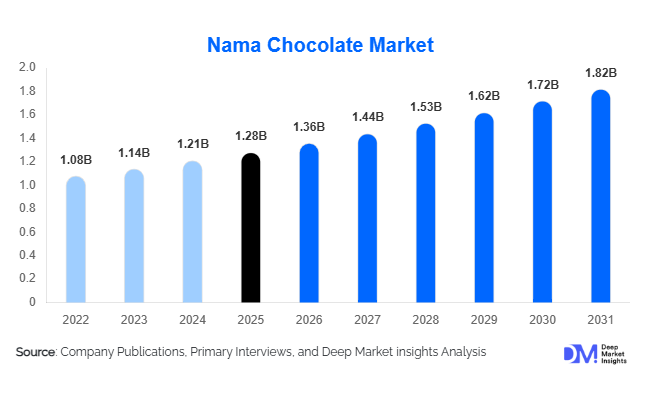
According to Deep Market Insights, the global nama chocolate market size was valued at USD 1.28 billion in 2025 and is projected to grow from USD 1.36 billion in 2026 to reach USD 1.82 billion by 2031, expanding at a CAGR of 6.0% during the forecast period (2026–2031). The nama chocolate market growth is primarily driven by rising consumer preference for premium confectionery products, increasing demand for artisanal chocolates, expanding gifting culture, and growing penetration of luxury chocolate brands through specialty retail stores and e-commerce platforms.
Key Market Insights
- Premium and handcrafted nama chocolates are witnessing strong global adoption, supported by increasing consumer spending on luxury confectionery and gourmet desserts.
- Milk nama chocolate remains the leading product category, owing to its broad consumer acceptance, smooth texture, and balanced flavor profile across all age groups.
- Asia-Pacific dominates the global market, led by Japan, China, and South Korea owing to high consumer awareness and established premium chocolate culture.
- North America is the fastest-growing regional market, driven by rising demand for premium gifting products and expanding online specialty chocolate sales.
- Seasonal gifting and festive consumption continue to accelerate premium chocolate purchases, particularly during Valentine's Day, Christmas, Lunar New Year, and other celebrations.
- Innovation in sustainable cocoa sourcing, premium packaging, and reduced-sugar formulations is reshaping product development across the global market.
Nama Chocolate Market Latest Trends
Premium Artisanal Chocolate Innovation Accelerating
Manufacturers are increasingly focusing on premium ingredients, single-origin cocoa, fresh dairy cream, and handcrafted manufacturing techniques to differentiate their products. Luxury confectionery companies continue introducing limited-edition seasonal collections, flavored nama chocolates, alcohol-infused variants, and fruit-based premium offerings to attract affluent consumers. Sustainable cocoa sourcing, clean-label ingredients, and preservative-free formulations are also becoming major purchasing criteria among premium chocolate buyers. Growing investments in elegant gift packaging and personalized assortments further strengthen premium positioning within the global market.
Digital Retail and Luxury Gifting Continue Expanding
E-commerce platforms have become an important sales channel for premium nama chocolates due to expanding cold-chain logistics and temperature-controlled delivery services. Direct-to-consumer websites, specialty confectionery retailers, and premium online marketplaces are improving product accessibility across international markets. Digital marketing campaigns, influencer collaborations, subscription-based gourmet chocolate boxes, and customized gifting solutions are further expanding customer engagement. Companies are also utilizing recyclable packaging, AI-based inventory management, and digital personalization to improve customer experience while reducing product wastage.
Nama Chocolate Market Drivers
Growing Premium Confectionery Consumption
Rising disposable income, changing consumer lifestyles, and increasing demand for luxury food products continue driving premium chocolate consumption worldwide. Consumers increasingly prefer handcrafted chocolates manufactured using premium cocoa, fresh cream, and natural ingredients over conventional mass-produced products. Expanding café culture, gourmet bakeries, luxury hotels, and specialty dessert chains are also contributing significantly to higher commercial demand. Growing preference for premium gifting further supports long-term industry expansion.
Increasing Demand for Premium Gifting Products
Festive celebrations, corporate gifting, weddings, anniversaries, and seasonal events continue generating strong demand for premium nama chocolates. Luxury packaging, personalized gift assortments, and limited-edition seasonal collections enable manufacturers to command higher selling prices while strengthening brand loyalty. Growing urbanization and increasing consumer willingness to spend on premium food gifts continue supporting market expansion globally.
Nama Chocolate Market Restraints
Limited Shelf Life and Cold Chain Requirements
Unlike conventional chocolates, nama chocolate contains high fresh cream content, resulting in a relatively shorter shelf life and mandatory refrigerated storage throughout production, transportation, and retail distribution. These requirements increase logistics costs while limiting product availability across distant international markets. Temperature-sensitive transportation also creates additional operational complexity for manufacturers and retailers.
Volatility in Cocoa and Dairy Ingredient Prices
Frequent fluctuations in cocoa bean prices, dairy costs, sugar prices, and transportation expenses directly influence manufacturing costs for premium chocolate producers. Since nama chocolate relies heavily on high-quality raw materials, sudden commodity price increases significantly affect profitability and product pricing. Premium positioning partly offsets these challenges but remains an important operational restraint for manufacturers.
Nama Chocolate Industry Key Opportunities
Expansion Across Emerging Premium Food Markets
Rapid urbanization, rising middle-class incomes, and growing consumer awareness of premium confectionery products present significant opportunities across Asia, Latin America, and the Middle East. Expansion of organized retail, luxury department stores, premium cafés, and international gourmet food chains is improving product accessibility. Local manufacturing partnerships and expanding cold-chain infrastructure are expected to further accelerate market penetration in emerging economies.
Health-Oriented Premium Chocolate Development
Manufacturers are increasingly introducing reduced-sugar, organic, vegan, plant-based, and high-cocoa nama chocolate variants to address evolving consumer preferences. Functional ingredients including nuts, berries, matcha, collagen, and probiotics are also being incorporated into premium product portfolios. These innovations are expected to attract health-conscious consumers while expanding premium market opportunities beyond traditional confectionery buyers.
Report Scope
| Report Metric | Details |
|---|---|
| Market Size in 2025 | USD 1.28 Billion |
| Market Size in 2026 | USD 1.36 Billion |
| Market Size in 2031 | USD 1.82 Billion |
| CAGR | 6% (2026-2031) |
| Base Year for Estimation | 2025 |
| Historical Data | 2022-2024 |
| Forecast Period | 2026-2031 |
| Report Coverage | Revenue Forecast, Competitive Landscape, Supply Chain Disruption, Growth Factors, Environment & Regulatory Landscape and Trends |
| Geographies Covered | North America, Europe, APAC, Middle East and Africa, LATAM |
| Countries Covered | U.S., Canada, U.K., Germany, France, Spain, Italy, Russia, Nordic, Benelux, Rest of Europe, China, Korea, Japan, India, Australia, Singapore, Taiwan, South East Asia, Rest of Asia-Pacific, UAE, Turky, Saudi Arabia, South Africa, Egypt, Nigeria, Rest of MEA, Brazil, Mexico, Argentina, Chile, Colombia, Rest of LATAM |
Explore more data points, trends and opportunities Download Free Sample Report
Product Type Insights
Milk nama chocolate continues to account for the largest share of the global nama chocolate market owing to its rich creamy texture, smooth melt-in-the-mouth consistency, balanced sweetness, and broad consumer appeal across all age groups. The segment maintains its market leadership as consumers increasingly prefer indulgent premium chocolate products that combine high-quality dairy ingredients with superior cocoa blends. Leading manufacturers continue to expand their milk nama chocolate portfolios by introducing limited-edition flavors, single-origin cocoa variants, premium inclusions such as roasted nuts and caramel, and luxurious gift assortments. The continued expansion of premium confectionery retail, rising disposable incomes, and growing consumer preference for gourmet chocolate products further strengthen the dominance of the milk nama chocolate segment. The leading driver supporting this segment is its universal consumer acceptance and its ability to cater to both everyday indulgence and premium gifting occasions, making it the preferred choice across both developed and emerging markets.White nama chocolate continues gaining popularity, particularly among younger consumers seeking visually appealing, innovative, and customized confectionery experiences. Manufacturers are continuously introducing flavored white nama chocolates featuring strawberry, matcha, citrus, vanilla, coffee, tropical fruits, caramel, and seasonal specialty ingredients to differentiate their product portfolios. Premium brands are also expanding multi-flavor luxury gift collections that combine milk, dark, and white nama chocolates within elegant packaging, thereby increasing product premiumization, enhancing gifting appeal, and supporting higher average transaction values across retail channels.
Application Insights
Retail continues to dominate the global nama chocolate market as the largest application segment due to the rapid expansion of premium chocolate availability through supermarkets, hypermarkets, specialty confectionery stores, gourmet retailers, luxury department stores, and online marketplaces. Consumers increasingly prefer purchasing premium nama chocolates for personal consumption, festive celebrations, and gifting occasions, supported by attractive packaging, seasonal promotions, and wider product accessibility. The leading growth driver for the retail segment is the continuous expansion of premium confectionery retail networks combined with rising consumer spending on luxury food products and convenient omnichannel shopping experiences. Manufacturers are strengthening retail presence through exclusive product launches, limited-edition collections, and direct-to-consumer initiatives that enhance customer engagement while improving brand visibility across both physical and digital retail environments.The gifting application continues recording robust growth supported by expanding seasonal celebrations, Valentine's Day, Christmas, Lunar New Year, weddings, anniversaries, birthdays, corporate gifting programs, and personalized luxury gift collections. Premium presentation, elegant packaging, customized assortments, and limited-edition seasonal offerings remain major purchasing factors that encourage consumers and businesses to select nama chocolate as a premium gifting option. Increasing corporate expenditure on employee appreciation programs and client relationship management further supports sustained growth within the gifting application segment.
Distribution Channel Insights
Specialty confectionery stores continue to lead the distribution landscape owing to their ability to provide exclusive premium product collections, expert customer assistance, personalized gifting services, luxury shopping experiences, and superior product quality assurance. The leading driver supporting this segment is the strong consumer preference for premium in-store experiences where freshness, craftsmanship, authenticity, and product exclusivity significantly influence purchasing decisions. Premium chocolate manufacturers frequently utilize specialty stores to launch new collections, seasonal offerings, and artisanal products while strengthening brand positioning within the luxury confectionery market.Online distribution channels are witnessing rapid expansion through direct-to-consumer websites, premium food marketplaces, luxury e-commerce platforms, and subscription-based gourmet chocolate services. Advancements in temperature-controlled logistics, insulated packaging technologies, same-day delivery services, and digital payment solutions have significantly improved consumer confidence in purchasing premium nama chocolates online. Social media marketing, influencer collaborations, personalized recommendations, and digital gifting platforms continue supporting strong online sales growth.Duty-free retail, airport boutiques, luxury department stores, and premium travel retail outlets further contribute to international premium nama chocolate sales by attracting tourists, business travelers, and affluent consumers seeking exclusive imported confectionery products. Limited-edition travel-exclusive assortments and luxury packaging continue strengthening premium brand visibility across global travel retail channels.
Consumer Insights
Affluent consumers remain the largest customer segment owing to their high purchasing power, strong preference for premium gourmet products, and increasing willingness to spend on luxury confectionery experiences. The leading driver supporting this segment is the continued rise in premiumization trends, where consumers increasingly associate high-quality chocolates with superior ingredients, artisanal craftsmanship, exclusivity, and sophisticated gifting experiences. Premium manufacturers continue introducing luxury assortments, handcrafted collections, and limited-edition releases specifically targeting high-income consumer groups seeking differentiated products.Young professionals continue emerging as an important customer category, driven by rising disposable incomes, evolving lifestyle preferences, and growing demand for premium self-indulgence products. Nama chocolates are increasingly purchased for workplace gifting, celebrations, personal rewards, and social occasions. Millennials and Generation Z consumers further contribute to market expansion through strong engagement with social media, premium branding, innovative flavor combinations, sustainability initiatives, and visually attractive packaging that enhances product desirability.Family purchases remain significant during festive seasons, cultural celebrations, and holiday occasions where premium chocolate gift boxes are widely exchanged among relatives and friends. Corporate buyers also continue expanding procurement of luxury nama chocolate gift collections for employee recognition programs, customer appreciation initiatives, business partnerships, and festive corporate gifting campaigns, thereby contributing to sustained institutional demand.
Explore more data points, trends and opportunities Download Free Sample Report
Nama Chocolate Market Segmentations
By Product Type
- Milk Nama Chocolate
- Dark Nama Chocolate
- White Nama Chocolate
- Flavored & Specialty Nama Chocolate
By Application
- Retail
- Foodservice
- Gifting
- Hospitality & Catering
By Distribution Channel
- Supermarkets & Hypermarkets
- Specialty Chocolate Stores
- Online Retail
- Convenience Stores
- Duty-Free & Department Stores
Regional Insights
Asia-Pacific
Asia-Pacific dominates the global nama chocolate market and continues to account for the largest revenue share, led by Japan, where nama chocolate originated and maintains exceptionally strong consumer acceptance. The region also benefits from rapidly growing premium confectionery demand across China, South Korea, India, Singapore, and other emerging Asian economies. Rising disposable incomes, expanding middle-class populations, accelerating urbanization, and increasing consumer willingness to purchase premium food products continue supporting regional market growth. The primary driver behind Asia-Pacific's leadership is the strong cultural preference for premium gifting and luxury confectionery, particularly during seasonal festivals, Valentine's Day, White Day, Lunar New Year, and other celebration periods. Additionally, continuous expansion of specialty chocolate boutiques, flagship luxury retail stores, premium supermarkets, and digital commerce platforms has significantly improved product accessibility. International chocolate manufacturers are strengthening regional investments through localized product development, exclusive seasonal collections, and premium retail partnerships, while growing tourism and expanding café culture further stimulate demand for artisanal nama chocolate products.
Europe
Europe represents one of the world's most mature and influential premium chocolate markets, supported by long-established chocolate manufacturing traditions across Switzerland, Belgium, Germany, France, Italy, and the United Kingdom. Consumers demonstrate strong demand for handcrafted, organic, ethically sourced, and premium-quality chocolate products that emphasize authenticity and craftsmanship. The major driver supporting regional growth is the increasing consumer preference for artisanal premium chocolates made using sustainably sourced cocoa, premium dairy ingredients, and clean-label formulations. European chocolatiers continue expanding their nama chocolate offerings through innovative flavor combinations, locally sourced ingredients, limited-edition seasonal collections, and luxury gift packaging. Increasing consumer awareness regarding sustainable cocoa production, fair-trade certification, environmentally responsible packaging, and premium gourmet experiences continues encouraging manufacturers to invest in product innovation while strengthening Europe's position within the global premium confectionery industry.
North America
North America is projected to witness the fastest market growth during the forecast period due to expanding consumer interest in gourmet confectionery, luxury gifting, premium food experiences, and imported artisanal chocolate products. The United States remains the largest regional market, supported by specialty chocolate retailers, premium supermarkets, luxury department stores, gourmet food chains, and widespread e-commerce penetration. The leading driver accelerating regional growth is the rapid premiumization of consumer food purchasing behavior, where consumers increasingly seek high-quality chocolates offering superior ingredients, unique flavors, and luxury packaging. Growing online retail penetration, subscription gifting services, corporate gifting programs, influencer-driven product awareness, and increasing demand for seasonal premium chocolate collections continue supporting market expansion. Rising consumer interest in international confectionery brands and experiential food products further strengthens long-term demand across the region.
Latin America
Latin America continues emerging as a promising premium confectionery market owing to rising urbanization, improving disposable income levels, expanding organized retail infrastructure, and growing consumer awareness of premium chocolate products. Brazil and Mexico remain the largest regional contributors, while Chile, Colombia, and Argentina continue witnessing increasing demand for gourmet confectionery. The key driver supporting regional growth is the abundant availability of high-quality cocoa production combined with increasing investments in domestic value-added chocolate manufacturing. Local manufacturers are increasingly moving beyond commodity cocoa exports by producing premium artisanal chocolates that cater to domestic and international consumers. Expansion of premium supermarkets, specialty confectionery retailers, luxury shopping centers, tourism activities, and international brand partnerships continues improving product accessibility while encouraging sustained market growth across the region.
Middle East & Africa
The Middle East & Africa market continues experiencing steady expansion driven by rising luxury food consumption, premium gifting traditions, increasing tourism, and continuous development of high-end retail infrastructure across the United Arab Emirates, Saudi Arabia, Qatar, South Africa, and other rapidly developing economies. The primary driver supporting regional growth is the strong cultural emphasis on luxury gifting during religious festivals, weddings, family celebrations, and corporate events, where premium chocolates represent highly valued gift items. Luxury shopping malls, premium hotels, gourmet cafés, international airport duty-free stores, and upscale department stores continue strengthening regional distribution networks for imported nama chocolate brands. Increasing investments in luxury retail, expanding international tourism, higher disposable incomes among affluent consumers, and the growing presence of global premium confectionery manufacturers are expected to further support long-term market growth throughout the forecast period.
Key Players in the Nama Chocolate Market
- ROYCE' Chocolate Co., Ltd.
- Lindt & Sprüngli
- Godiva Chocolatier
- Meiji Holdings Co., Ltd.
- Morinaga & Co., Ltd.
- Lotte Corporation
- Ferrero Group
- Läderach
- Venchi S.p.A.
- Neuhaus Chocolates
- Leonidas
- Valrhona