Grain Based Food Market Size
According to Deep Market Insights, the global grain based food market size was valued at USD 1,245.80 billion in 2025 and is projected to grow from USD 1,286.91 billion in 2026 to reach USD 1,513.74 billion by 2031, expanding at a CAGR of 3.3% during the forecast period (2026–2031). The grain based food market growth is primarily supported by increasing global consumption of staple cereals, rising demand for convenient packaged food products, growing adoption of fortified grain formulations, and continuous investments in modern grain processing technologies across both developed and emerging economies.
Key Market Insights
- Consumer preference is steadily shifting toward whole grain and fortified food products, driven by increasing awareness regarding nutrition, dietary fiber, and preventive healthcare.
- Food manufacturers are investing in automated milling, smart packaging, and clean-label product development, improving operational efficiency while expanding premium product portfolios.
- Asia-Pacific dominates the global market, supported by large-scale grain production, high staple food consumption, and rapidly expanding packaged food industries across China and India.
- Middle East & Africa represents the fastest-growing regional market, driven by investments in food security, grain processing infrastructure, and increasing urban food consumption.
- Household consumption remains the largest application segment, while food processing continues to register steady expansion due to growing industrial bakery, cereal, and snack manufacturing.
- Digital technologies including AI-assisted quality monitoring, automated milling systems, and traceability platforms are improving production efficiency and strengthening supply chain transparency.
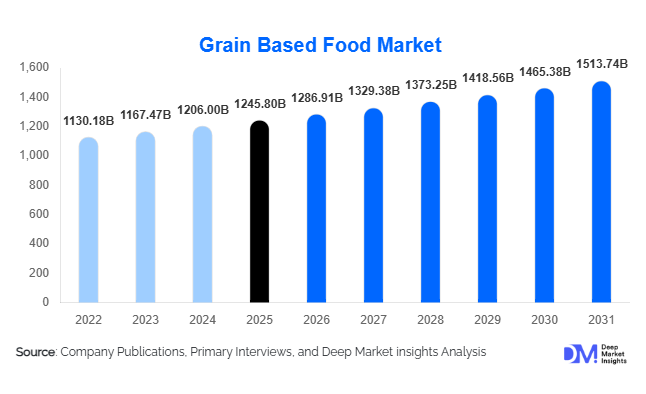
Grain Based Food Market Latest Trends
Growing Adoption of Functional and Fortified Grain Products
Manufacturers are increasingly expanding production of fortified flour, breakfast cereals, multigrain bakery products, and protein-enriched grain foods to address changing dietary preferences. Government nutrition initiatives and mandatory food fortification programs across several countries continue supporting commercial demand. Food producers are incorporating iron, folic acid, zinc, vitamin B12, and dietary fiber into grain products while reducing artificial additives to satisfy clean-label requirements. Growing consumer awareness regarding digestive health and immunity has accelerated the commercialization of functional grain foods across retail, institutional, and food service channels.
Automation and Digitalization Across Grain Processing
Advanced milling equipment, optical grain sorting, AI-enabled quality inspection, predictive maintenance systems, and automated packaging technologies are becoming standard investments across modern grain processing facilities. These innovations improve production consistency, reduce waste generation, optimize energy utilization, and strengthen traceability throughout the supply chain. Digital manufacturing platforms are also enabling processors to improve inventory planning and operational efficiency while meeting increasing regulatory requirements for food safety and product transparency.
Grain Based Food Market Drivers
Growing Demand for Convenient and Nutritious Grain-Based Foods
Rapid urbanization, rising disposable incomes, and increasingly busy lifestyles continue driving global consumption of ready-to-eat cereals, bakery products, pasta, noodles, and packaged grain snacks. Consumers are seeking foods that combine convenience with nutritional value, encouraging manufacturers to introduce healthier grain formulations enriched with vitamins, minerals, whole grains, and plant-based proteins. Expanding organized retail networks and e-commerce distribution channels further support product accessibility across both developed and emerging economies, strengthening long-term market expansion.
Increasing Government Support for Food Fortification Programs
Several governments continue promoting mandatory flour fortification and public nutrition programs to address micronutrient deficiencies. These initiatives encourage manufacturers to increase production of fortified grain products while investing in advanced processing technologies capable of maintaining nutritional consistency. Regulatory support, combined with public awareness campaigns and school nutrition programs, is accelerating demand for nutrient-enriched cereals and grain-based staple foods worldwide.
Grain Based Food Market Restraints
Volatility in Agricultural Commodity Prices
Price fluctuations affecting wheat, maize, rice, barley, and other cereal crops continue creating uncertainty across grain processing industries. Weather disruptions, geopolitical instability, transportation costs, and supply chain bottlenecks contribute to volatile raw material pricing, increasing manufacturing expenses and compressing operating margins. Small and medium-sized processors remain particularly vulnerable to unexpected commodity price movements, limiting investment flexibility and pricing competitiveness.
Climate Risks and Supply Chain Disruptions
Changing climatic conditions including droughts, floods, irregular rainfall, and extreme weather events continue affecting crop productivity across several major grain-producing regions. These production uncertainties impact grain availability, increase procurement costs, and complicate inventory planning for processors. Maintaining stable supply chains while ensuring consistent product quality remains a significant operational challenge for manufacturers operating across global markets.
Grain Based Food Industry Key Opportunities
Expansion of Premium Functional Grain Foods
Growing consumer interest in digestive wellness, heart health, sports nutrition, and preventive healthcare is creating strong opportunities for premium grain-based foods containing high fiber, ancient grains, probiotics, plant proteins, and micronutrient fortification. Manufacturers are increasingly launching premium breakfast cereals, multigrain bakery products, protein-rich snacks, and functional flour blends targeting health-conscious consumers across developed and emerging economies.
Growth of Digital Food Retail and Private Label Products
Rapid expansion of online grocery platforms and private label food brands is creating new commercial opportunities for grain product manufacturers. Digital retail channels enable broader product availability, personalized marketing, subscription-based grocery models, and improved consumer engagement. Retailers continue expanding private label grain portfolios that offer competitive pricing while maintaining nutritional quality, creating additional growth opportunities for contract manufacturers.
Report Scope
| Report Metric | Details |
|---|---|
| Market Size in 2025 | USD 1245.80 Billion |
| Market Size in 2026 | USD 1286.91 Billion |
| Market Size in 2031 | USD 1513.74 Billion |
| CAGR | 3.3% (2026-2031) |
| Base Year for Estimation | 2025 |
| Historical Data | 2022-2024 |
| Forecast Period | 2026-2031 |
| Report Coverage | Revenue Forecast, Competitive Landscape, Supply Chain Disruption, Growth Factors, Environment & Regulatory Landscape and Trends |
| Geographies Covered | North America, Europe, APAC, Middle East and Africa, LATAM |
| Countries Covered | U.S., Canada, U.K., Germany, France, Spain, Italy, Russia, Nordic, Benelux, Rest of Europe, China, Korea, Japan, India, Australia, Singapore, Taiwan, South East Asia, Rest of Asia-Pacific, UAE, Turky, Saudi Arabia, South Africa, Egypt, Nigeria, Rest of MEA, Brazil, Mexico, Argentina, Chile, Colombia, Rest of LATAM |
Explore more data points, trends and opportunities Download Free Sample Report
Type Insights
Refined grain products represent the leading segment in the global grain-based food market due to their extensive utilization across bakery products, noodles, pasta, breakfast cereals, snacks, and processed food applications. The segment benefits from strong consumer acceptance, longer shelf stability, uniform texture, and compatibility with large-scale food manufacturing processes. Growing demand from commercial bakeries, packaged food manufacturers, and convenience food producers continues supporting the dominance of refined grain products, particularly in developed and urbanizing markets where processed food consumption remains high.Whole grain products are experiencing consistent growth as consumers increasingly seek healthier food alternatives associated with higher dietary fiber content, improved digestive health, weight management benefits, and cardiovascular wellness. Rising awareness regarding preventive healthcare and clean-label nutrition is encouraging manufacturers to expand their portfolios with whole grain bread, cereals, snacks, and flour-based products. Fortified grain products are also witnessing accelerated adoption, supported by government nutrition programs, increasing awareness of micronutrient deficiencies, and consumer demand for functional foods. Manufacturers are increasingly introducing multigrain formulations, vitamin- and mineral-enriched cereals, and fortified bakery products to deliver enhanced nutritional value while maintaining convenience, taste, and product stability.
Application Insights
Household consumption remains the largest application segment in the global grain-based food market, driven by the essential role of grain products such as bread, rice, flour, cereals, pasta, and grain-based snacks in daily diets across both developed and emerging economies. Increasing population growth, rising household food expenditure, and continued demand for convenient staple foods are strengthening household consumption patterns worldwide.Food processing represents a rapidly expanding application segment, supported by the growing production of packaged bakery products, breakfast cereals, snack foods, ready-to-eat meals, and grain-based beverages. The increasing preference for convenience foods, longer shelf-life products, and standardized ingredients is encouraging food manufacturers to increase their reliance on processed grain ingredients. Food service applications are also growing steadily due to expanding restaurant networks, hotels, institutional catering, and quick-service restaurant chains that require consistent grain-based ingredients to maintain product quality, operational efficiency, and supply reliability.
Explore more data points, trends and opportunities Download Free Sample Report
Grain Based Food Market Segmentations
By Type
- Whole Grain Products
- Refined Grain Products
- Fortified Grain Products
By Application
- Household Consumption
- Food Service
- Food Processing
Regional Insights
North America
North America maintains a mature and technologically advanced grain-based food industry supported by established agricultural systems, sophisticated food processing infrastructure, and high consumption of packaged and convenience foods. The United States remains the dominant market contributor due to its large-scale grain production, strong milling industry, and extensive presence of bakery, cereal, and processed food manufacturers, while Canada continues to strengthen the region through significant grain cultivation and value-added processing capabilities.Regional growth is primarily driven by increasing consumer preference for whole grain, organic, fortified, and functional food products, along with rising demand for clean-label and minimally processed offerings. Growing awareness of nutrition and preventive healthcare is encouraging manufacturers to develop high-fiber cereals, fortified bakery products, and premium grain-based foods. Additionally, advancements in sustainable farming practices, automation in food processing, and innovations in alternative grain formulations are supporting continued market expansion across North America.
Europe
Europe represents a significant regional market supported by strong bakery traditions, high cereal consumption, advanced food processing capabilities, and stringent food quality and safety standards. Countries including Germany, France, Italy, Spain, and the United Kingdom remain key contributors due to their established bakery industries, advanced retail networks, and strong demand for grain-based packaged foods.Regional growth is driven by increasing demand for healthier grain products, including whole grain bakery items, fiber-enriched cereals, and clean-label formulations. Rising consumer focus on sustainable food production, environmentally responsible packaging, and plant-based nutrition is encouraging manufacturers to invest in innovative grain-based products. Government initiatives promoting healthier diets and increasing awareness of nutritional benefits are further supporting the adoption of fortified and functional grain products throughout the region.
Asia-Pacific
Asia-Pacific dominates the global grain-based food market due to its large population base, high dependence on staple grains, expanding packaged food sector, and significant agricultural production capacity. China and India represent the largest contributors to regional consumption, while Japan, Indonesia, Vietnam, and South Korea continue strengthening their processed food industries through technological advancements and increasing domestic demand.Regional growth is primarily supported by rapid urbanization, rising disposable incomes, changing dietary preferences, and expansion of modern retail channels. Increasing migration toward urban areas is driving demand for packaged cereals, bakery products, instant meals, and convenient grain-based foods. Growing investments in food processing infrastructure, e-commerce grocery platforms, and organized retail distribution are further accelerating market penetration. Additionally, rising health awareness among middle-class consumers is increasing demand for fortified grains, whole grain products, and premium nutritional food categories across major Asia-Pacific economies.
Latin America
Latin America is witnessing steady growth in the grain-based food market due to increasing urban populations, expanding food processing industries, and rising consumption of bakery and packaged food products. Brazil, Argentina, and Mexico remain key regional markets supported by strong agricultural production, established grain supply chains, and growing investments in food manufacturing capabilities.Regional expansion is driven by improving retail infrastructure, increasing adoption of convenience foods, and growing demand for processed grain products among urban consumers. Rising middle-class populations are contributing to higher consumption of packaged cereals, bakery products, snacks, and ready-to-eat grain-based meals. Furthermore, investments in modern milling facilities, agricultural productivity improvements, and food processing technologies are strengthening the overall grain value chain across Latin America.
Middle East & Africa
The Middle East & Africa region represents one of the fastest-growing markets for grain-based foods, supported by increasing investments in food security programs, grain storage infrastructure, milling capacity expansion, and packaged food manufacturing. Countries such as Saudi Arabia, South Africa, Egypt, Nigeria, and the UAE are strengthening domestic grain processing capabilities to reduce import dependency and improve food supply resilience.Regional growth is primarily driven by rapid population growth, increasing urbanization, rising demand for packaged and processed foods, and expansion of modern retail networks. Government-led food security initiatives, investments in agricultural technology, and development of advanced grain processing facilities are creating new opportunities for market participants. Growing consumer preference for convenient food products, improved distribution networks, and increasing adoption of fortified grain products are expected to further support long-term market development across the region.
Key Players in the Grain Based Food Market
- Nestlé S.A.
- General Mills, Inc.
- Kellanova
- PepsiCo, Inc.
- Mondelez International, Inc.
- Associated British Foods plc
- Cargill, Incorporated
- Archer Daniels Midland Company
- Bunge Global SA
- Conagra Brands, Inc.
- Post Holdings, Inc.
- Grupo Bimbo S.A.B. de C.V.
- ITC Limited
- Britannia Industries Limited
- The Hain Celestial Group, Inc.