High Fiber Biscuits Market Size
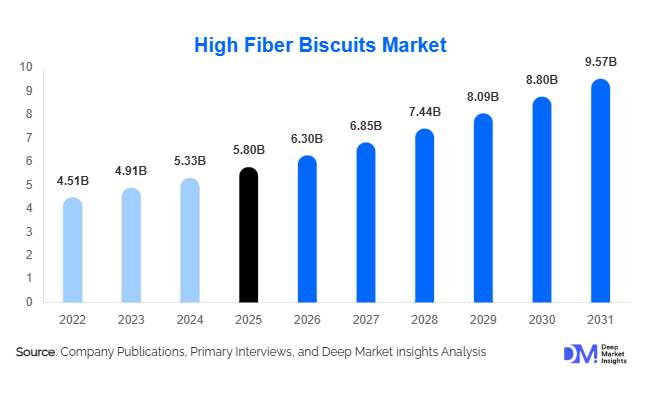
According to Deep Market Insights, the global high fiber biscuits market size was valued at USD 5.80 billion in 2025 and is projected to grow from USD 6.30 billion in 2026 to reach USD 9.57 billion by 2031, expanding at a CAGR of 8.7% during the forecast period (2026–2031). The high fiber biscuits market growth is primarily driven by increasing consumer awareness regarding digestive health, rising preference for functional nutrition products, growing adoption of clean-label snacks, and expanding demand for convenient health-focused food products.
Key Market Insights
- High fiber biscuits are increasingly becoming a mainstream functional snack category, supported by rising consumer focus on digestive wellness, weight management, and preventive nutrition.
- North America dominates the global high fiber biscuits market, accounting for nearly 34% market share in 2025, while Asia-Pacific represents the fastest-growing region with a CAGR of approximately 10.2%.
- Digestive biscuits dominate the product type segment, contributing nearly 42% market share, while protein fiber biscuits are witnessing faster adoption with an estimated CAGR exceeding 11%.
- Retail consumption remains the leading application segment, accounting for approximately 55% of global demand, supported by supermarket expansion and online grocery penetration.
- Asia-Pacific is emerging as a major growth hub, with India’s high fiber biscuits market projected to reach approximately USD 1.1 billion by 2031 at a CAGR of 12.3%.
- Ingredient innovation is reshaping product development, with approximately 46% of new launches incorporating oats, seeds, plant-based fibers, and whole grain formulations.
High Fiber Biscuits Market Latest Trends
Functional Nutrition and Clean Label Product Innovation
The high fiber biscuits market is witnessing a strong shift toward functional nutrition, clean-label ingredients, and naturally sourced fiber formulations. Manufacturers are increasingly incorporating oats, wheat bran, flax seeds, chia seeds, and plant-based fibers to improve nutritional value while maintaining consumer acceptance. Global production exceeded 7.5 billion biscuit packs in 2025, with approximately 46% of newly launched products featuring enhanced fiber content or functional ingredients. Around 62% of health-conscious consumers prefer transparent ingredient labeling, encouraging manufacturers to reduce artificial additives and develop minimally processed products. The demand from diabetic-friendly snacks, fitness consumers, and wellness-focused households is expanding at more than 14% annually, strengthening the high fiber biscuits market trend.
Digital Retail Expansion and Personalized Nutrition
Technology-driven distribution and personalized nutrition are transforming the high fiber biscuits market landscape. Online grocery platforms contributed nearly 18% of global high fiber biscuit sales in 2025, increasing from approximately 11% in 2022. Brands are adopting digital analytics, consumer tracking tools, and direct-to-consumer platforms to improve product targeting. Nearly 40% of premium biscuit manufacturers are utilizing consumer data analytics for product development and marketing optimization. Growing demand among millennials and Gen Z consumers for convenient and healthier snacks has increased functional biscuit consumption by approximately 22%, supporting continued high fiber biscuits market expansion.
High Fiber Biscuits Market Drivers
Growing Demand for Digestive Health and Functional Snacks
The rising focus on digestive wellness is one of the primary factors accelerating the high fiber biscuits market growth. Approximately 68% of consumers globally are actively seeking fiber-enriched food products due to increasing awareness about gut health and balanced nutrition. Global high fiber biscuit production surpassed 7 billion packs in 2025, with digestive biscuit variants representing nearly 42% of total production. Growing prevalence of lifestyle-related health concerns, increasing fitness participation, and demand for convenient nutrition solutions are encouraging manufacturers to expand functional snack portfolios. Urban markets recorded nearly 15% growth in premium health biscuit sales, reinforcing high fiber biscuits market development.
Increasing Adoption of Healthy and Convenient Food Products
Consumer preference for healthier alternatives to traditional snacks is significantly supporting the high fiber biscuits market. Approximately 55% of consumers prefer snacks offering additional nutritional benefits, including fiber, protein, and whole grains. Busy lifestyles and increasing demand for portable breakfast options have expanded biscuit consumption across working professionals and younger demographics. Manufacturers are introducing low-sugar, protein-enriched, and fortified biscuit products, with functional snack launches increasing by more than 10% annually. These evolving dietary preferences continue to create favorable conditions for high fiber biscuits market growth.
High Fiber Biscuits Market Restraints
High Production Costs and Premium Pricing
The high fiber biscuits market faces challenges due to increased manufacturing costs associated with premium ingredients and advanced processing technologies. Fiber-enriched biscuits generally require 18–25% higher production costs compared with conventional biscuits due to the use of oats, seeds, specialty grains, and functional additives. Approximately 35% of manufacturers report margin pressure caused by fluctuations in raw material prices. Higher retail pricing limits adoption among price-sensitive consumers, particularly in developing economies where premium biscuit categories represent only around 20% of total biscuit purchases.
Consumer Acceptance and Taste Challenges
Maintaining taste, texture, and consumer familiarity remains a major restraint for the high fiber biscuits market. Approximately 30% of consumers discontinue fiber-enriched biscuits due to differences in texture and flavor compared with traditional biscuits. High fiber formulations often require specialized baking processes, increasing production complexity by nearly 20%. Manufacturers must balance nutritional enhancement with sensory appeal while maintaining competitive pricing to achieve wider consumer adoption across different regions.
High Fiber Biscuits Industry Key Opportunities
Expansion of Plant-Based and Fortified Biscuit Categories
The growing demand for plant-based and fortified foods presents significant opportunities for the high fiber biscuits market. Approximately 52% of new product launches now include natural fiber sources such as oats, seeds, and legumes. Rising interest in vegan nutrition, protein enhancement, and functional snacks is encouraging manufacturers to develop innovative formulations. Emerging economies contribute more than 40% of future market volume growth, supported by increasing disposable income, urbanization, and changing dietary patterns.
Growth Through Personalized Health and Wellness Products
Personalized nutrition trends are creating new opportunities within the high fiber biscuits market. Consumers are increasingly seeking products designed for specific health goals such as digestive support, weight management, and fitness performance. Wellness-focused applications are expanding rapidly, with demand for fortified biscuits growing at approximately 12% CAGR. Manufacturers are introducing products with targeted benefits, including high protein, low sugar, gluten-free, and organic formulations, broadening consumer reach.
Report Scope
| Report Metric | Details |
|---|---|
| Market Size in 2025 | USD 5.80 Billion |
| Market Size in 2026 | USD 6.30 Billion |
| Market Size in 2031 | USD 9.57 Billion |
| CAGR | 8.7% (2026-2031) |
| Base Year for Estimation | 2025 |
| Historical Data | 2022-2024 |
| Forecast Period | 2026-2031 |
| Report Coverage | Revenue Forecast, Competitive Landscape, Supply Chain Disruption, Growth Factors, Environment & Regulatory Landscape and Trends |
| Geographies Covered | North America, Europe, APAC, Middle East and Africa, LATAM |
| Countries Covered | U.S., Canada, U.K., Germany, France, Spain, Italy, Russia, Nordic, Benelux, Rest of Europe, China, Korea, Japan, India, Australia, Singapore, Taiwan, South East Asia, Rest of Asia-Pacific, UAE, Turky, Saudi Arabia, South Africa, Egypt, Nigeria, Rest of MEA, Brazil, Mexico, Argentina, Chile, Colombia, Rest of LATAM |
Explore more data points, trends and opportunities Download Free Sample Report
Product Type Insights
Digestive biscuits dominate the high fiber biscuits market, accounting for nearly 42% market share in 2025 due to strong consumer familiarity and widespread availability. These biscuits typically contain 4–8 grams of dietary fiber per serving and use ingredients such as wheat bran, oats, and whole grains. Protein fiber biscuits represent approximately 28% market share and are expanding rapidly due to rising demand from fitness consumers. These products generally contain 6–12 grams of protein combined with fiber ingredients, with nearly 48% of new launches incorporating plant-based proteins. Whole grain biscuits contribute around 30% share, supported by consumer preference for minimally processed foods. Global production of whole grain high fiber biscuits exceeded 2.2 billion packs in 2025, driven by family nutrition and wellness applications.
Application Insights
Retail consumption represents the largest application segment in the high fiber biscuits market, accounting for approximately 55% share with production exceeding 4 billion packs in 2025. Supermarkets, convenience stores, and online grocery channels remain the primary distribution points due to consumer demand for convenient healthy snacks. Foodservice applications contribute nearly 20% market share, with hotels, cafes, and corporate cafeterias increasingly incorporating fiber-based snack options. Health and wellness applications account for approximately 25% share, supported by fitness centers, nutrition programs, and specialized diet channels. Usage penetration among wellness-focused consumers reached nearly 45%, reflecting growing acceptance of functional biscuit products.
Distribution Channel Insights
Supermarkets and hypermarkets remain the dominant distribution channels for high fiber biscuits due to strong consumer trust, product visibility, and extensive retail networks. Online grocery platforms are becoming increasingly important, contributing approximately 18% of global sales in 2025, supported by digital purchasing behavior and convenience. Direct-to-consumer platforms are gaining momentum as manufacturers strengthen online branding and personalized marketing strategies. Subscription-based health food platforms and specialty wellness retailers are also emerging as new channels, particularly among consumers seeking premium functional snacks.
Consumer Type Insights
Health-conscious consumers represent the largest customer group within the high fiber biscuits market, driven by increasing awareness of digestive health and preventive nutrition. Millennials and Gen Z consumers are adopting functional snacks rapidly, contributing to approximately 22% growth in premium health biscuit demand. Working professionals increasingly prefer high fiber biscuits as convenient breakfast replacements, while older consumers prioritize products supporting digestive wellness and balanced diets. Families represent a significant segment due to demand for healthier snack alternatives for children and adults.
Explore more data points, trends and opportunities Download Free Sample Report
High Fiber Biscuits Market Segmentations
By Type
- Digestive Biscuits
- Protein Fiber Biscuits
- Whole Grain Biscuits
By Application
- Retail Consumption
- Foodservice
- Health & Wellness
By Distribution Channel
- Supermarkets & Hypermarkets
- Online Grocery Platforms
- Convenience Stores
- Specialty Health Food Stores
- Direct-to-Consumer Channels
Regional Insights
North America
North America dominates the high fiber biscuits market with approximately 34% global market share in 2025, generating revenue of nearly USD 2 billion. The United States contributes approximately 75% of regional demand, followed by Canada with nearly 18%. Regional production exceeded 2.5 billion packs annually, supported by strong demand for digestive health products, clean-label foods, and premium snacks. Retail channels contribute nearly 58% of sales, while health and wellness applications account for approximately 27%. Consumer adoption remains high due to established awareness of functional nutrition.
Europe
Europe accounts for nearly 29% of global market share, with production exceeding 2 billion packs in 2025. Germany, the United Kingdom, and France represent more than 65% of regional consumption. Demand is driven by whole grain preferences, organic ingredient adoption, and strong consumer interest in nutritional labeling. Approximately 50% of European launches focus on natural or organic fiber sources. Retail consumption contributes nearly 57% of sales, while wellness applications represent around 30%.
Asia-Pacific
Asia-Pacific is the fastest-growing region in the high fiber biscuits market, expanding at approximately 10.2% CAGR. China, India, and Japan contribute nearly 70% of regional demand. Production exceeded 1.8 billion packs in 2025, supported by urbanization, rising health awareness, and increasing disposable income. India’s market is expected to reach approximately USD 1.1 billion by 2031, growing at 12.3% CAGR. Online retail penetration reached approximately 22%, accelerating product accessibility.
Latin America
Latin America contributes nearly 7% market share, with production approaching 500 million packs annually. Brazil and Mexico account for more than 60% of regional demand. Increasing middle-class spending and rising awareness of healthier snacks are supporting market development. Retail channels dominate with approximately 65% share, while wellness-oriented products are growing at nearly 8% annually.
Middle East & Africa
The Middle East & Africa region represents around 5% global share, with production exceeding 350 million packs in 2025. Gulf countries contribute significantly to premium biscuit demand, while South Africa remains a key regional market. Increasing urbanization, health awareness, and premium food adoption are supporting growth, with fiber biscuit demand expanding at approximately 9% annually.
Key Players in the High Fiber Biscuits Market
- Mondelez International
- Nestlé
- Kellogg Company
- PepsiCo
- Britannia Industries
- Parle Products
- ITC Limited
- General Mills
- Danone
- McVitie's