Breakfast Bread Market Size
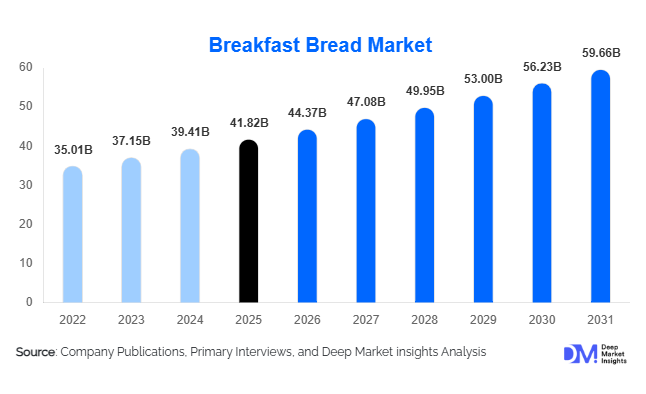
According to Deep Market Insights, the global breakfast bread market size was valued at USD 41.82 billion in 2025 and is projected to grow from USD 44.37 billion in 2026 to reach USD 59.66 billion by 2031, expanding at a CAGR of 6.1% during the forecast period (2026–2031). The breakfast bread market growth is primarily driven by increasing consumer preference for convenient breakfast solutions, rising demand for healthier bakery products, expanding organized retail distribution, and continuous product innovation in fortified, whole grain, and multigrain bread categories.
Key Market Insights
- Health-focused breakfast bread products are gaining strong consumer acceptance, with whole wheat, multigrain, and protein-enriched variants experiencing rapid adoption across developed and emerging markets.
- Europe dominates the global market, accounting for approximately 34.8% of total revenue owing to high per-capita bread consumption and advanced bakery infrastructure.
- Asia-Pacific represents the fastest-growing regional market, supported by urbanization, rising disposable income, and increasing demand for packaged breakfast foods.
- Household consumption remains the leading application, contributing more than 61% of global demand through widespread daily breakfast consumption.
- India is emerging as a high-growth market, driven by organized retail expansion, premium bakery launches, and increasing consumer awareness regarding healthier breakfast options.
- Automation, clean-label formulations, and smart packaging technologies are transforming manufacturing efficiency, extending shelf life, and enhancing product quality across the global bakery industry.
Breakfast Bread Market Latest Trends
Growing Demand for Functional and Clean-Label Bread
Consumers are increasingly shifting toward breakfast bread products containing whole grains, seeds, oats, natural ingredients, and high dietary fiber. Manufacturers are introducing fortified formulations with added protein, vitamins, minerals, and probiotics to meet rising nutritional expectations. Clean-label products free from artificial preservatives and synthetic additives continue gaining popularity, particularly among health-conscious consumers. Premium bakery brands are also expanding organic and gluten-conscious product portfolios to strengthen their competitive positioning while addressing evolving dietary preferences.
Automation and Smart Manufacturing Transforming Bakery Operations
Bakery manufacturers are investing heavily in automated production lines, AI-assisted quality inspection systems, robotic packaging, and smart inventory management to improve production efficiency and reduce operational costs. Digital monitoring systems enable better consistency in dough preparation, baking temperatures, and packaging quality while minimizing product waste. Sustainable packaging innovations, including recyclable materials and freshness-preserving technologies, are becoming standard across premium breakfast bread products, supporting long-term market expansion.
Breakfast Bread Market Drivers
Growing Preference for Convenient Ready-to-Eat Breakfast Products
Rapid urbanization, increasing workforce participation, and busy consumer lifestyles continue driving demand for convenient breakfast solutions worldwide. Packaged breakfast bread offers affordability, long shelf life, ease of preparation, and compatibility with numerous breakfast combinations. Expanding supermarket networks, convenience stores, and online grocery platforms have further improved accessibility, encouraging consistent household purchases across both developed and developing economies.
Increasing Consumer Focus on Healthy Eating Habits
Growing awareness regarding balanced nutrition has significantly increased demand for whole wheat, multigrain, fiber-rich, and protein-enhanced breakfast bread products. Consumers are actively replacing refined bakery products with healthier alternatives that support digestive health, weight management, and overall wellness. Food manufacturers continue investing in ingredient innovation and nutritional reformulation to satisfy evolving dietary preferences while expanding premium product offerings.
Breakfast Bread Market Restraints
Volatility in Raw Material Prices
Fluctuating wheat prices, rising energy expenses, increasing transportation costs, and supply chain disruptions continue creating cost pressures for bakery manufacturers. Frequent changes in agricultural commodity pricing affect production planning, profit margins, and retail pricing strategies, particularly for small and medium-sized bakeries operating with limited procurement flexibility.
Limited Shelf Life and Distribution Challenges
Breakfast bread products generally possess relatively short shelf lives, requiring efficient logistics, inventory management, and cold-chain infrastructure to maintain freshness. Product spoilage, inventory losses, and transportation inefficiencies remain significant operational challenges, particularly across emerging markets where modern retail infrastructure is still developing.
Breakfast Bread Industry Key Opportunities
Expansion of Premium and Functional Bread Categories
Growing consumer willingness to pay premium prices for healthier bakery products presents significant opportunities for manufacturers. Functional breakfast bread containing ancient grains, plant proteins, omega-3 fatty acids, probiotics, and clean-label ingredients continues attracting nutrition-conscious consumers seeking value-added bakery products beyond traditional white bread.
Growth of E-commerce and Direct-to-Consumer Bakery Sales
Online grocery platforms and direct-to-consumer bakery delivery services are creating new sales channels for packaged breakfast bread manufacturers. Subscription-based bakery deliveries, personalized nutrition offerings, and digital retail expansion enable producers to strengthen customer engagement while improving product availability across urban markets.
Report Scope
| Report Metric | Details |
|---|---|
| Market Size in 2025 | USD 41.82 Billion |
| Market Size in 2026 | USD 44.37 Billion |
| Market Size in 2031 | USD 59.66 Billion |
| CAGR | 6.1% (2026-2031) |
| Base Year for Estimation | 2025 |
| Historical Data | 2022-2024 |
| Forecast Period | 2026-2031 |
| Report Coverage | Revenue Forecast, Competitive Landscape, Supply Chain Disruption, Growth Factors, Environment & Regulatory Landscape and Trends |
| Geographies Covered | North America, Europe, APAC, Middle East and Africa, LATAM |
| Countries Covered | U.S., Canada, U.K., Germany, France, Spain, Italy, Russia, Nordic, Benelux, Rest of Europe, China, Korea, Japan, India, Australia, Singapore, Taiwan, South East Asia, Rest of Asia-Pacific, UAE, Turky, Saudi Arabia, South Africa, Egypt, Nigeria, Rest of MEA, Brazil, Mexico, Argentina, Chile, Colombia, Rest of LATAM |
Explore more data points, trends and opportunities Download Free Sample Report
Type Insights
The breakfast bread market is segmented into white bread, whole wheat bread, multigrain bread, and specialty bread categories, with each segment reflecting changing consumer preferences toward convenience, nutrition, and product innovation. White bread continues to hold the leading market position due to its affordability, widespread availability, longer shelf life, and strong consumer familiarity across developed and emerging markets. Its established presence in supermarkets, convenience stores, and household breakfast routines continues supporting consistent demand globally, particularly among price-sensitive consumers.Multigrain bread represents the fastest-growing product segment, driven by increasing consumer awareness of functional nutrition, premium bakery offerings, and demand for diverse grain-based products. The growing popularity of seed-enriched and high-protein formulations incorporating ingredients such as oats, rye, barley, flaxseed, quinoa, and millet is accelerating segment expansion. Consumers are increasingly seeking breakfast options that provide enhanced nutritional benefits, supporting innovation in premium and specialty bread categories. The continued introduction of organic, gluten-conscious, high-fiber, and clean-label formulations is further enabling manufacturers to capture emerging premium consumer segments.
Application Insights
Household consumption remains the largest application segment in the breakfast bread market, supported by the product’s role as a convenient and widely accepted daily breakfast staple. Changing lifestyles, increasing workforce participation, and demand for quick meal solutions continue strengthening household demand for packaged bread products. The availability of multiple product varieties, including whole grain, multigrain, fortified, and premium bread options, is further encouraging frequent household purchases.Retail channels remain essential for market growth as supermarkets, hypermarkets, neighborhood grocery stores, and convenience stores provide extensive consumer accessibility. The increasing penetration of modern retail formats, improved cold-chain and inventory management systems, and wider availability of branded bakery products continue strengthening retail sales. Online grocery platforms are also emerging as important distribution channels by improving convenience through home delivery services, digital subscriptions, and direct-to-consumer bakery purchasing models.
Explore more data points, trends and opportunities Download Free Sample Report
Breakfast Bread Market Segmentations
By Type
- White Bread
- Whole Wheat Bread
- Multigrain Bread
By Application
- Household Consumption
- Foodservice
- Retail & Convenience Stores
Regional Insights
North America
North America represents one of the largest breakfast bread markets globally, supported by high packaged food consumption, advanced bakery manufacturing capabilities, strong retail penetration, and established consumer demand for convenient breakfast solutions. The United States accounts for the majority of regional consumption, followed by Canada, due to widespread adoption of packaged bread products and strong supermarket distribution networks.Regional growth is primarily driven by increasing demand for healthier bakery alternatives, including whole grain, protein-enriched, organic, and clean-label bread products. Consumers are increasingly seeking functional breakfast foods that support wellness goals, encouraging manufacturers to introduce innovative formulations with added fiber, seeds, and nutritional enhancements. Additionally, advancements in automated bakery production technologies, premium product launches, and expanding private-label offerings across retail chains are supporting continued market expansion in the region.
Europe
Europe remains one of the most established breakfast bread markets due to strong cultural preferences for bread consumption, centuries-old bakery traditions, and a highly developed bakery manufacturing ecosystem. Countries including Germany, France, the United Kingdom, Italy, and Spain represent major contributors to regional demand through extensive production capacity and diverse consumer preferences.Regional growth is being supported by increasing consumer preference for organic, sourdough, artisanal, and whole grain bread products. Rising demand for minimally processed foods, sustainable ingredients, and premium bakery experiences is encouraging manufacturers to expand specialty bread portfolios. The leading regional growth driver is the shift toward healthier and premium bakery products, with consumers increasingly favoring products offering improved nutritional profiles, authentic preparation methods, and clean-label characteristics. Expansion of specialty bakeries and premium retail bakery sections is further strengthening market opportunities across Europe.
Asia-Pacific
Asia-Pacific is projected to experience the fastest growth in the global breakfast bread market, supported by rapid urbanization, rising disposable income, expanding middle-class populations, and increasing adoption of Western-style breakfast habits. Countries such as China, India, Japan, South Korea, and Australia are driving regional demand through growing bakery consumption, organized retail development, and expanding foodservice networks.The primary growth driver for the Asia-Pacific market is the rapid transformation of consumer eating habits toward convenient packaged breakfast solutions. Increasing urban lifestyles, greater participation of consumers in formal employment, and growing awareness of nutritional benefits are accelerating demand for packaged and healthier bread varieties. In addition, the expansion of international and domestic bakery chains, growth of e-commerce grocery platforms, and rising investments in modern bakery production facilities are creating significant opportunities for market players across emerging economies.
Latin America
Latin America is experiencing steady growth in the breakfast bread market due to increasing urban populations, expanding supermarket networks, and rising consumer acceptance of packaged bakery products. Brazil and Mexico remain the leading regional markets, supported by large consumer bases, improving retail infrastructure, and growing demand for convenient food options.Regional expansion is primarily driven by increasing penetration of modern retail channels and rising demand for affordable packaged breakfast products. Consumers are gradually shifting toward branded bread products due to improved product availability, hygiene standards, and longer shelf life compared with traditional bakery alternatives. Manufacturers are also introducing healthier bread options, including whole grain and fortified varieties, to address changing dietary preferences and strengthen consumer engagement.
Middle East & Africa
The Middle East and Africa breakfast bread market is expanding due to increasing urbanization, rising investments in commercial bakery infrastructure, population growth, and growing demand for convenient packaged food products. Gulf countries represent important premium bakery markets due to higher purchasing power, strong retail development, and growing demand for international bakery products.The leading growth driver across the region is the modernization of food retail and bakery production systems, which is improving product accessibility and supporting wider adoption of packaged bread products. Increasing urban lifestyles, expansion of supermarkets and convenience stores, and rising consumer preference for ready-to-eat breakfast options are strengthening market demand. In Africa, improving domestic bakery capabilities and investments in industrial-scale production are helping manufacturers meet growing urban consumption requirements, while Middle Eastern markets continue witnessing demand growth for premium, specialty, and health-focused bakery products.
Key Players in the Breakfast Bread Market
- Grupo Bimbo
- Flowers Foods
- Associated British Foods
- Yamazaki Baking Co., Ltd.
- Aryzta AG
- Campbell Soup Company
- Premier Foods plc
- George Weston Limited
- Hostess Brands
- Barilla Group
- Harry-Brot GmbH
- Lantmännen Unibake
- Britannia Industries Limited
- Modern Foods
- Warburtons Ltd.