Grape Preserves Market Size
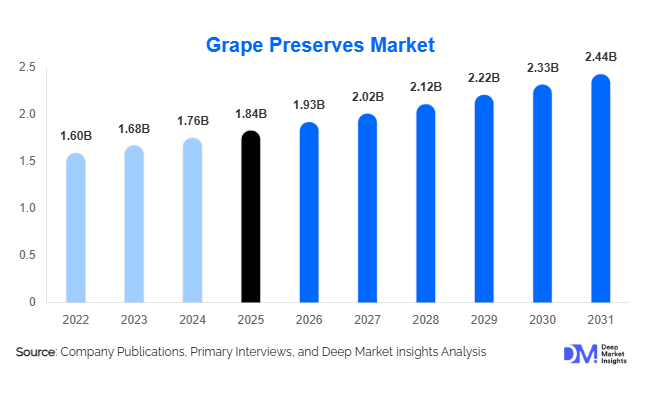
According to Deep Market Insights, the global grape preserves market size was valued at USD 1.84 billion in 2025 and is projected to grow from USD 1.93 billion in 2026 to reach USD 2.44 billion by 2031, expanding at a CAGR of 4.8% during the forecast period (2026–2031). The grape preserves market growth is primarily driven by increasing consumer preference for natural fruit spreads, rising demand for premium breakfast products, growing adoption of clean-label food ingredients, and expanding applications across bakery, confectionery, and dairy industries. Increasing investments in organic fruit processing, premium packaging, and low-sugar formulations continue to strengthen long-term industry expansion worldwide.
Key Market Insights
- Consumers are increasingly shifting toward clean-label and fruit-rich grape preserves, encouraging manufacturers to introduce products with higher fruit content, reduced artificial additives, and sustainable packaging.
- Premium and reduced-sugar grape preserves continue gaining popularity, supported by rising health awareness, demand for organic food products, and increasing retail shelf availability across developed economies.
- Europe dominates the global grape preserves market, driven by established fruit processing industries, high household consumption, and strong demand for premium breakfast spreads.
- Asia-Pacific remains the fastest-growing regional market, supported by expanding middle-class income, rapid supermarket penetration, and increasing consumption of bakery and processed food products.
- Household consumption represents the largest application segment, while foodservice and commercial bakery applications continue witnessing rapid expansion across emerging markets.
- Automation, vacuum filling technology, recyclable glass packaging, and digital retail channels are reshaping manufacturing efficiency and consumer purchasing behavior across the global grape preserves industry.
Grape Preserves Market Latest Trends
Premium, Organic, and Clean-Label Preserves Continue to Expand
Manufacturers are increasingly introducing premium grape preserves containing more than 60% fruit content, organic grapes, natural pectin, and reduced sugar formulations to satisfy changing consumer preferences. Demand for preservative-free fruit spreads continues to rise across supermarkets, specialty food retailers, and online grocery platforms. Organic grape preserves are experiencing rapid adoption due to growing awareness regarding healthy breakfast choices, while recyclable glass packaging and sustainable sourcing practices are becoming important product differentiators. Companies are also investing in premium packaging formats, artisan recipes, and regional grape varieties to strengthen brand positioning within the premium food category.
Digital Retail and Functional Product Innovation Drive Market Evolution
Online grocery platforms have significantly expanded the accessibility of grape preserves worldwide. E-commerce retailers now offer premium, imported, and specialty preserve products that were previously limited to niche stores. Manufacturers are incorporating functional ingredients such as antioxidants, natural sweeteners, vitamins, and fiber-rich formulations to appeal to health-conscious consumers. Smart manufacturing technologies, automated filling systems, improved pasteurization processes, and advanced quality control solutions are enhancing production efficiency while extending shelf life and maintaining superior product consistency.
Grape Preserves Market Drivers
Growing Consumer Preference for Natural Fruit-Based Breakfast Products
Rising global demand for natural breakfast spreads continues to support grape preserves consumption across households and commercial food manufacturers. Consumers increasingly prefer fruit-rich products over highly processed spreads due to growing health awareness and clean-label purchasing behavior. Expanding bakery production, rising demand for premium breakfast menus in hotels and cafés, and increasing consumption of gourmet bakery products further stimulate product demand. Manufacturers continue introducing innovative flavors, premium fruit blends, and healthier formulations to capture evolving consumer preferences across developed and emerging markets.
Expansion of Premium Bakery and Processed Food Industries
The continuous expansion of commercial bakeries, confectionery manufacturers, dairy processors, and ready-to-eat breakfast food producers has significantly increased industrial demand for grape preserves. Food manufacturers increasingly utilize premium fruit preserves as fillings, toppings, flavoring ingredients, and dessert inclusions due to their superior texture, flavor consistency, and extended shelf stability. Growth in premium bakery chains and café culture across Asia-Pacific and Latin America further supports long-term market expansion.
Grape Preserves Market Restraints
Volatility in Raw Material and Sugar Prices
Fluctuating grape harvests caused by changing climatic conditions, vineyard diseases, and seasonal production variability continue influencing manufacturing costs. Price fluctuations in sugar, fruit concentrates, packaging materials, and transportation further affect overall production economics. Small and medium-sized manufacturers often experience greater profitability challenges due to limited procurement capabilities and higher dependence on seasonal agricultural production.
Growing Competition from Alternative Fruit Spreads
The increasing availability of mixed-fruit jams, nut butters, chocolate spreads, honey-based products, and fruit compotes creates strong competitive pressure for grape preserves manufacturers. Consumers seeking diversified breakfast options frequently shift toward innovative spread categories offering unique nutritional positioning or flavor profiles. Continuous product innovation remains essential for maintaining long-term competitiveness.
Grape Preserves Industry Key Opportunities
Expansion of Organic and Reduced-Sugar Product Portfolios
Growing consumer interest in healthier food choices presents significant opportunities for manufacturers to expand organic, reduced-sugar, low-calorie, and naturally sweetened grape preserve offerings. Retailers increasingly dedicate premium shelf space to organic preserves, while health-conscious consumers actively seek products containing natural ingredients, sustainable sourcing, and transparent labeling. These trends continue creating attractive opportunities across developed and emerging economies.
Growth of Premium Export Markets and Sustainable Packaging
Premium fruit preserves are witnessing rising international demand as consumers increasingly seek imported gourmet food products. Manufacturers investing in recyclable packaging, sustainable sourcing, and environmentally responsible production practices are strengthening export competitiveness. Digital retail platforms, specialty food retailers, and gourmet grocery chains further support international market expansion by improving product accessibility across global markets.
Report Scope
| Report Metric | Details |
|---|---|
| Market Size in 2025 | USD 1.84 Billion |
| Market Size in 2026 | USD 1.93 Billion |
| Market Size in 2031 | USD 2.44 Billion |
| CAGR | 4.8% (2026-2031) |
| Base Year for Estimation | 2025 |
| Historical Data | 2022-2024 |
| Forecast Period | 2026-2031 |
| Report Coverage | Revenue Forecast, Competitive Landscape, Supply Chain Disruption, Growth Factors, Environment & Regulatory Landscape and Trends |
| Geographies Covered | North America, Europe, APAC, Middle East and Africa, LATAM |
| Countries Covered | U.S., Canada, U.K., Germany, France, Spain, Italy, Russia, Nordic, Benelux, Rest of Europe, China, Korea, Japan, India, Australia, Singapore, Taiwan, South East Asia, Rest of Asia-Pacific, UAE, Turky, Saudi Arabia, South Africa, Egypt, Nigeria, Rest of MEA, Brazil, Mexico, Argentina, Chile, Colombia, Rest of LATAM |
Explore more data points, trends and opportunities Download Free Sample Report
Product Type Insights
Conventional grape preserves accounted for the largest share of the global grape preserves market and continue to maintain their leadership owing to their affordability, widespread retail availability, familiar taste profile, and strong consumer acceptance across both developed and emerging economies. The dominance of this segment is primarily driven by its extensive presence across supermarkets, hypermarkets, convenience stores, and grocery chains, making conventional products the most accessible option for everyday household consumption. Their long shelf life, consistent product quality, cost-effectiveness, and compatibility with mass production further strengthen demand among both retail consumers and commercial food manufacturers. Conventional grape preserves are extensively used as breakfast spreads, bakery ingredients, dessert toppings, and foodservice accompaniments, ensuring stable year-round consumption.Reduced-sugar and no-added-sugar grape preserves have emerged as one of the fastest-growing product categories, supported by rising health consciousness, increasing diabetes prevalence, weight management trends, and growing consumer preference for healthier breakfast alternatives. Product innovations incorporating natural sweeteners, high-fruit-content formulations, and functional ingredients continue strengthening market penetration among health-conscious consumers. In addition, premium artisanal grape preserves, gourmet recipes, small-batch production, specialty grape varieties, and fruit-rich formulations containing higher percentages of whole fruit are creating new premiumization opportunities and enabling manufacturers to target affluent consumers seeking authentic taste, superior quality, and differentiated product experiences.
Application Insights
Household consumption remains the largest application segment within the global grape preserves market, primarily driven by increasing breakfast consumption, expanding home baking activities, and the versatility of grape preserves across multiple food applications. The leadership of this segment is supported by consumers' preference for convenient, ready-to-use fruit spreads that complement bread, toast, croissants, pancakes, waffles, muffins, yogurt, oatmeal, desserts, and various snack preparations. Rising demand for convenient breakfast solutions, coupled with growing interest in homemade bakery products and premium spreads, continues to reinforce household consumption worldwide.Foodservice establishments, including hotels, cafés, restaurants, quick-service restaurants, bakeries, catering companies, and premium breakfast chains, continue increasing their utilization of grape preserves across breakfast menus, gourmet sandwiches, desserts, pastries, cheesecakes, and specialty culinary preparations. The rapid expansion of café culture, premium bakery outlets, hospitality services, and tourism-related food establishments continues supporting strong commercial consumption globally while creating opportunities for premium and specialty preserve products.
Distribution Channel Insights
Supermarkets and hypermarkets continue to dominate the distribution landscape of the global grape preserves market, with their leadership primarily driven by extensive product assortment, broad geographic coverage, attractive promotional pricing, organized merchandising, and strong consumer footfall. These retail formats provide consumers with access to multiple domestic and international brands, private-label products, organic variants, reduced-sugar options, and premium artisanal preserves under one roof, making them the preferred purchasing destination for household consumers. Strategic promotional campaigns, seasonal discounts, product sampling, and loyalty programs further contribute to sustained sales growth through organized retail channels.Specialty gourmet stores maintain strong demand for imported, organic, premium, and artisanal grape preserves by catering to consumers seeking differentiated products, unique flavors, and premium quality. At the same time, direct-to-consumer brand websites are becoming increasingly popular among specialty food manufacturers by enabling greater customer engagement, customized offerings, exclusive product launches, subscription services, and higher brand loyalty.
End User Insights
Retail consumers represent the largest end-user segment in the global grape preserves market, with the segment's dominance primarily driven by rising household breakfast consumption, increasing demand for convenient fruit-based spreads, and growing preference for natural fruit products across daily diets. Consumers increasingly incorporate grape preserves into breakfast meals, snacks, desserts, baking recipes, and home cooking applications due to their convenience, flavor versatility, and long shelf life. Expanding disposable incomes, premium food preferences, and increasing awareness regarding fruit-based nutrition continue supporting sustained retail demand.Commercial bakeries remain major institutional consumers of grape preserves, utilizing them extensively in pastries, cakes, cookies, croissants, doughnuts, pies, muffins, tarts, and filled bakery products. Dairy manufacturers increasingly incorporate grape preserves into yogurt products, flavored dairy desserts, cheesecakes, ice creams, and premium dairy innovations to enhance flavor profiles and product differentiation. Hotels, restaurants, cafés, catering businesses, and hospitality operators continue expanding preserve usage within premium breakfast services, buffet offerings, desserts, gourmet sandwiches, and specialty menu items. Institutional foodservice providers across schools, universities, hospitals, corporate cafeterias, and healthcare facilities further contribute to stable commercial demand through large-scale procurement of fruit preserves for daily meal preparation.
Explore more data points, trends and opportunities Download Free Sample Report
Grape Preserves Market Segmentations
By Product Type
- Conventional Grape Preserves
- Organic Grape Preserves
- Reduced Sugar Grape Preserves
- Premium & Artisanal Grape Preserves
By Application
- Household Consumption
- Food Processing
- Foodservice
- Bakery & Confectionery
By Distribution Channel
- Supermarkets & Hypermarkets
- Convenience Stores
- Online Retail
- Specialty Food Stores
- Direct-to-Consumer
Regional Insights
North America
North America remains one of the most significant regional markets for grape preserves, supported by high consumer spending on premium food products, well-established retail infrastructure, and widespread acceptance of fruit-based breakfast spreads. The United States represents the largest contributor to regional demand owing to its mature processed food industry, extensive supermarket networks, and strong culture of breakfast consumption. Canada continues witnessing rising demand for imported premium preserves, organic fruit spreads, and clean-label products as health-conscious consumers increasingly prioritize natural ingredients. Regional market growth is further driven by expanding organic food consumption, increasing demand for reduced-sugar products, rapid adoption of online grocery platforms, continuous product innovation by leading food manufacturers, growing café culture, premium artisan bakery expansion, and rising consumer preference for convenient ready-to-eat breakfast solutions.
Europe
Europe dominates the global grape preserves market owing to its highly developed fruit processing industry, extensive grape cultivation, strong tradition of fruit preserve consumption, and mature premium food sector. Countries such as France, Germany, Italy, Spain, and the United Kingdom represent major consumption and production centers supported by long-standing breakfast traditions and widespread availability of premium fruit products. The region also benefits from advanced food processing technologies, well-established agricultural supply chains, and high consumer willingness to purchase premium and organic preserves. Regional growth continues to be driven by increasing demand for clean-label foods, rising consumption of organic products, expanding artisanal food manufacturing, strong export capabilities, growing sustainability initiatives, premium packaging innovations, and continuous investment in value-added fruit processing industries, further reinforcing Europe's leadership position in the global market.
Asia-Pacific
Asia-Pacific represents the fastest-growing regional market as rapid urbanization, rising disposable incomes, expanding middle-class populations, and changing dietary preferences continue stimulating demand for packaged fruit spreads. China, Japan, India, South Korea, and Australia are experiencing increasing consumption across both household and commercial bakery applications as western-style breakfast habits gain wider acceptance. The expansion of organized retail, premium supermarkets, convenience store chains, and digital grocery platforms has significantly improved product accessibility across the region. Regional growth is further supported by increasing investments in food processing industries, rapid expansion of café and bakery chains, rising health awareness, growing demand for premium imported food products, increasing adoption of convenience foods, expanding cold chain logistics, and continuous development of modern retail infrastructure throughout emerging Asian economies.
Latin America
Latin America continues experiencing steady market growth supported by abundant grape cultivation, favorable climatic conditions for fruit production, expanding food processing industries, and rising domestic consumption of fruit-based spreads. Brazil, Argentina, and Chile remain the major regional contributors owing to their established agricultural sectors, significant grape production capacity, and growing processed food manufacturing industries. Increasing urbanization, improving retail infrastructure, expanding supermarket penetration, rising disposable incomes, and growing consumer awareness regarding premium packaged food products continue supporting market development. Additionally, increasing exports of processed fruit products, government initiatives supporting agricultural value addition, and investments in food manufacturing capacity are creating favorable long-term growth opportunities across the region.
Middle East & Africa
The Middle East & Africa grape preserves market continues expanding steadily with increasing consumer demand for premium imported breakfast products, improving retail infrastructure, and rapid urbanization across major economies. South Africa remains the leading regional producer and consumer due to its well-developed agricultural sector and expanding food processing industry. Meanwhile, the United Arab Emirates and Saudi Arabia continue driving demand for premium imported preserves through expanding modern retail formats, hospitality industries, luxury hotels, and gourmet food establishments. Regional growth is further supported by increasing tourism, rising disposable incomes, growing preference for international food brands, expansion of organized supermarket chains, strengthening e-commerce grocery platforms, improving cold chain distribution networks, and increasing adoption of premium breakfast products among urban consumers.
Key Players in the Grape Preserves Market
- The J.M. Smucker Company
- Bonne Maman
- Hero Group
- Andros Group
- Baxters Food Group
- Wilkin & Sons Ltd.
- Crofter's Organic
- B&G Foods, Inc.
- St. Dalfour
- Darbo AG