Sugar Free Gummies Market Size
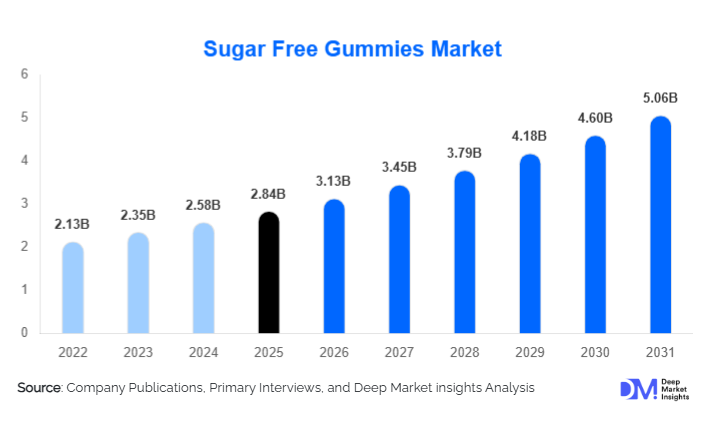
According to Deep Market Insights, the global sugar free gummies market size was valued at USD 2.84 billion in 2025 and is projected to grow from USD 3.13 billion in 2026 to reach USD 5.06 billion by 2031, expanding at a CAGR of 10.1% during the forecast period (2026–2031). The sugar free gummies market growth is primarily driven by increasing consumer preference for low-sugar confectionery, rising prevalence of diabetes and obesity, growing demand for functional gummy supplements, and continuous innovation in plant-based and naturally sweetened formulations. The expanding adoption of clean-label ingredients, premium nutritional confectionery, and online retail distribution continues to strengthen long-term market expansion.
Key Market Insights
- Pectin-based sugar free gummies dominate the market, accounting for approximately 45.7% of global revenue owing to strong demand for vegan and plant-based confectionery products.
- North America dominates the global market, representing nearly 36.4% of total revenue, supported by high consumer awareness and extensive retail penetration.
- Asia-Pacific is the fastest-growing regional market, driven by increasing disposable income, expanding health-conscious populations, and rapid growth of organized retail.
- Functional sugar free gummies containing vitamins, probiotics, collagen, and botanicals continue to gain popularity among consumers seeking convenient nutritional supplementation.
- Natural sweeteners including stevia, erythritol, allulose, and xylitol are increasingly replacing conventional artificial sweeteners across premium product launches.
- Automation, clean-label innovation, and e-commerce expansion are transforming manufacturing efficiency, product accessibility, and consumer purchasing behavior worldwide.
Sugar Free Gummies Market Latest Trends
Growing Adoption of Functional Nutrition Gummies
Manufacturers are increasingly incorporating functional ingredients such as vitamins, minerals, collagen peptides, probiotics, prebiotics, botanical extracts, and immune-support compounds into sugar free gummy formulations. Functional variants now represent a significant portion of new product launches as consumers seek convenient nutritional supplementation with reduced sugar intake. Premium formulations featuring clinically supported ingredients and naturally derived sweeteners are becoming increasingly popular across both developed and emerging markets. Healthcare awareness, preventive wellness, and personalized nutrition continue to accelerate demand for multifunctional sugar free gummies across all consumer age groups.
Plant-Based Ingredients and Clean-Label Innovation
The transition toward vegan and clean-label confectionery continues to reshape product development across the industry. Manufacturers are replacing gelatin with pectin while utilizing natural colorants, fruit concentrates, and plant-derived sweeteners to satisfy evolving consumer preferences. Clean-label positioning, transparent ingredient declarations, and environmentally sustainable packaging are becoming important purchasing factors. Digital commerce, direct-to-consumer channels, and personalized online nutrition platforms are further expanding market accessibility and strengthening global demand for premium sugar free gummy products.
Sugar Free Gummies Market Drivers
Increasing Consumer Preference for Healthier Confectionery
Growing health awareness and increasing concerns regarding excessive sugar consumption are encouraging consumers to replace conventional confectionery with sugar free alternatives. Rising diabetes prevalence, obesity management initiatives, and preventive healthcare trends continue to drive demand across both developed and emerging economies. Consumers increasingly prefer products containing natural sweeteners, functional ingredients, and clean-label formulations that provide nutritional benefits without compromising taste. Continuous innovation in texture, flavor, and ingredient technology is further supporting long-term industry expansion.
Rapid Expansion of Functional Food and Nutraceutical Industries
The growing nutraceutical sector is creating significant opportunities for sugar free gummies as manufacturers develop products targeting immunity, digestive health, bone health, cognitive wellness, beauty-from-within, and sports nutrition. Pharmaceutical companies, dietary supplement manufacturers, and confectionery producers are increasingly collaborating to launch multifunctional gummy products that combine convenience with improved consumer compliance. These innovations continue to broaden product applications while expanding the industry's addressable consumer base.
Sugar Free Gummies Market Restraints
High Cost of Premium Sweeteners and Specialized Ingredients
The production of sugar free gummies requires specialized sweeteners such as erythritol, stevia, allulose, and xylitol, which remain considerably more expensive than conventional sugar. Premium functional ingredients including collagen, probiotics, botanical extracts, and vitamins further increase manufacturing costs. These higher production expenses often translate into premium retail pricing, limiting product affordability in price-sensitive markets and slowing penetration across lower-income consumer segments.
Formulation Challenges and Taste Optimization
Developing sugar free gummies that closely replicate the taste, texture, and mouthfeel of traditional confectionery remains technically challenging. Some sugar substitutes continue to present aftertaste concerns, while maintaining shelf stability and product consistency requires advanced formulation expertise. Regulatory variations governing sweetener approvals and labeling requirements across international markets further increase product development complexity and commercialization timelines.
Sugar Free Gummies Industry Key Opportunities
Expansion of Personalized Nutrition Products
Personalized nutrition represents one of the fastest-growing opportunities within the global confectionery industry. Consumers increasingly seek customized gummy supplements designed for immunity, sleep support, digestive wellness, beauty nutrition, stress management, and sports recovery. Subscription-based nutrition services, digital health platforms, and AI-powered wellness recommendations are encouraging manufacturers to introduce highly specialized sugar free gummy formulations that address individual health goals.
Growing Demand Across Emerging Markets
Rapid urbanization, rising disposable income, expanding healthcare awareness, and improving retail infrastructure are creating attractive opportunities throughout Asia-Pacific, Latin America, and the Middle East. Consumers in these regions are becoming increasingly willing to pay premium prices for healthier confectionery alternatives. The expansion of supermarkets, pharmacies, specialty nutrition stores, and e-commerce platforms continues to improve product availability while supporting long-term global market growth.
Report Scope
| Report Metric | Details |
|---|---|
| Market Size in 2025 | USD 2.84 Billion |
| Market Size in 2026 | USD 3.13 Billion |
| Market Size in 2031 | USD 5.06 Billion |
| CAGR | 10.1% (2026-2031) |
| Base Year for Estimation | 2025 |
| Historical Data | 2022-2024 |
| Forecast Period | 2026-2031 |
| Report Coverage | Revenue Forecast, Competitive Landscape, Supply Chain Disruption, Growth Factors, Environment & Regulatory Landscape and Trends |
| Geographies Covered | North America, Europe, APAC, Middle East and Africa, LATAM |
| Countries Covered | U.S., Canada, U.K., Germany, France, Spain, Italy, Russia, Nordic, Benelux, Rest of Europe, China, Korea, Japan, India, Australia, Singapore, Taiwan, South East Asia, Rest of Asia-Pacific, UAE, Turky, Saudi Arabia, South Africa, Egypt, Nigeria, Rest of MEA, Brazil, Mexico, Argentina, Chile, Colombia, Rest of LATAM |
Explore more data points, trends and opportunities Download Free Sample Report
Type Insights
Pectin-based sugar free gummies represent the largest product category due to their compatibility with vegan lifestyles, clean-label positioning, and superior consumer acceptance. These formulations provide improved heat stability, natural texture, and broader appeal among health-conscious consumers seeking plant-based alternatives. Gelatin-based gummies continue maintaining significant market presence because of their excellent elasticity, chewiness, and flavor retention characteristics. Meanwhile, starch-based gummies are experiencing steady growth owing to their cost efficiency, production flexibility, and increasing utilization by manufacturers targeting value-oriented product segments.
Application Insights
Adult consumers account for the largest application segment, driven by increasing demand for healthier confectionery, diabetic-friendly snacks, and functional nutritional supplements supporting immunity, energy, weight management, and digestive wellness. Children's products continue expanding through reduced-sugar confectionery and vitamin-enriched gummy formulations preferred by parents seeking healthier alternatives. Senior consumers represent the fastest-growing application category as aging populations increasingly adopt sugar free gummies containing calcium, collagen, vitamin D, probiotics, and cognitive health ingredients to support healthy aging and improved nutritional compliance.
Distribution Channel Insights
Supermarkets and hypermarkets remain the leading distribution channels owing to their extensive product assortment, high consumer footfall, and promotional activities. Pharmacies continue strengthening their presence through functional nutritional gummies and dietary supplements, while specialty health stores attract consumers seeking premium wellness products. E-commerce has emerged as one of the fastest-growing sales channels, supported by subscription services, direct-to-consumer brands, personalized nutrition platforms, digital marketing, and expanding online grocery retail across global markets.
Consumer Group Insights
Health-conscious consumers represent the largest customer base for sugar free gummies as awareness regarding sugar reduction continues increasing globally. Individuals managing diabetes and obesity are driving significant demand for low-glycemic confectionery alternatives. Fitness enthusiasts increasingly prefer functional gummy supplements containing vitamins, electrolytes, collagen, and performance-support ingredients, while vegan consumers continue accelerating demand for plant-based pectin formulations manufactured using natural sweeteners and clean-label ingredients.
Ingredient Insights
Natural sweeteners including stevia, erythritol, monk fruit extract, allulose, and xylitol are becoming the preferred ingredient choices across premium sugar free gummy products. Manufacturers are increasingly incorporating fruit concentrates, botanical extracts, natural flavors, and clean-label colorants to improve product quality while addressing consumer demand for minimally processed ingredients. Functional additives such as probiotics, collagen peptides, vitamins, minerals, adaptogens, and herbal extracts continue expanding the nutritional value of modern sugar free gummy formulations.
Explore more data points, trends and opportunities Download Free Sample Report
Sugar Free Gummies Market Segmentations
By Type
- Pectin-Based
- Gelatin-Based
- Starch-Based
By Application
- Adults
- Children
- Seniors
By Distribution Channel
- Supermarkets & Hypermarkets
- Pharmacies & Drug Stores
- Specialty Health Stores
- Online Retail
- Convenience Stores
Regional Insights
North America
North America dominates the global sugar free gummies market owing to widespread consumer awareness regarding sugar reduction, strong purchasing power, and well-established retail infrastructure. The United States accounts for the majority of regional demand, supported by increasing diabetes prevalence, expanding functional nutrition markets, and continuous product innovation. Canada also contributes significantly through growing consumer preference for clean-label confectionery, plant-based ingredients, and premium nutritional supplements distributed across supermarkets, pharmacies, and online retail platforms.
Europe
Europe represents a mature market characterized by strict food regulations, widespread clean-label adoption, and strong consumer preference for healthier confectionery alternatives. Germany, the United Kingdom, France, Italy, and Spain remain leading regional markets due to increasing demand for vegan products, natural sweeteners, and reduced-sugar food products. Manufacturers continue investing in sustainable packaging, premium formulations, and innovative functional ingredients to satisfy evolving consumer expectations throughout the region.
Asia-Pacific
Asia-Pacific is expected to witness the fastest growth during the forecast period as rising disposable incomes, expanding middle-class populations, and improving healthcare awareness continue increasing demand for healthier confectionery products. China, India, Japan, South Korea, and Australia represent the largest regional markets. Rapid urbanization, expanding organized retail, growing online grocery penetration, and increasing acceptance of nutritional supplements are supporting strong long-term market expansion across the region.
Latin America
Latin America is experiencing gradual market expansion, supported by improving healthcare awareness, rising consumer spending, and increasing availability of premium confectionery products. Brazil and Mexico account for the majority of regional demand, while multinational manufacturers continue expanding distribution networks through supermarkets, pharmacies, and digital retail channels. Growing awareness regarding diabetes management and healthier lifestyles is expected to support sustained market development.
Middle East & Africa
The Middle East & Africa market is steadily expanding as healthcare awareness, modern retail infrastructure, and premium food consumption continue improving across the region. The United Arab Emirates, Saudi Arabia, and South Africa remain key growth markets due to rising disposable income, expanding organized retail, and increasing demand for imported premium confectionery. The growing prevalence of lifestyle-related diseases is further encouraging consumers to adopt healthier sugar-free alternatives.
Key Players in the Sugar Free Gummies Market
- Haribo GmbH & Co. KG
- Perfetti Van Melle
- Albanese Confectionery Group Inc.
- SmartSweets Inc.
- Project 7 Foods LLC
- The Hershey Company
- Nestlé S.A.
- Mondelez International Inc.
- Ferrara Candy Company
- YumEarth Inc.
- Katjes Fassin GmbH
- Candy People AB