Nutritional And Dietary Supplements Market Size
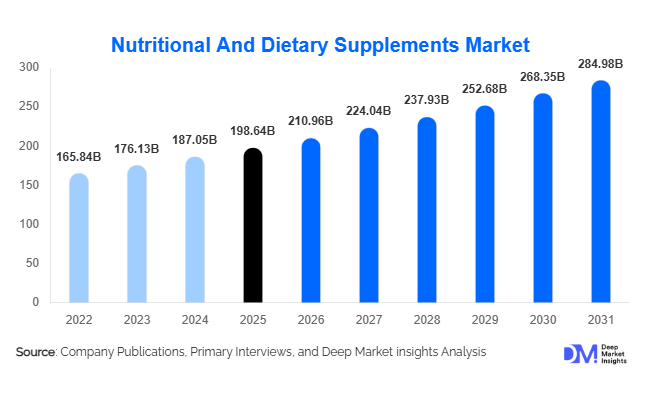
According to Deep Market Insights, the global nutritional and dietary supplements market size was valued at USD 198.64 billion in 2025 and is projected to grow from USD 210.96 billion in 2026 to reach USD 284.98 billion by 2031, expanding at a CAGR of 6.2% during the forecast period (2026–2031). The nutritional and dietary supplements market growth is primarily driven by rising preventive healthcare awareness, increasing consumer preference for functional nutrition, growing adoption of personalized wellness solutions, expanding aging populations, and continuous innovation in vitamins, minerals, probiotics, herbal formulations, and sports nutrition products. Increasing online retail penetration and higher healthcare expenditure across developed and emerging economies continue to strengthen global market expansion.
Key Market Insights
- Preventive healthcare and personalized nutrition are transforming the nutritional and dietary supplements industry, with consumers increasingly incorporating daily supplementation into long-term wellness routines.
- Vitamins remain the leading product category, supported by strong consumer demand for immunity enhancement, bone health, and overall nutritional support across all age groups.
- North America dominates the global market, driven by high consumer awareness, premium product adoption, advanced healthcare infrastructure, and widespread retail availability.
- Asia-Pacific represents the fastest-growing regional market, supported by rising disposable incomes, expanding middle-class populations, rapid urbanization, and increasing preventive healthcare awareness.
- Digital health platforms, AI-powered nutrition recommendations, and subscription-based supplement services are reshaping consumer purchasing behavior and personalized nutrition management.
- Clean-label, plant-based, probiotic, collagen, and botanical supplements continue gaining significant traction as consumers increasingly prioritize natural and scientifically supported wellness products.
Nutritional And Dietary Supplements Market Latest Trends
Personalized Nutrition Becoming Mainstream
Personalized nutrition continues to redefine the nutritional and dietary supplements industry as consumers increasingly seek customized formulations based on age, lifestyle, genetics, fitness goals, and health conditions. Artificial intelligence-powered nutrition assessments, digital wellness platforms, microbiome testing, and subscription-based vitamin packs are enabling manufacturers to deliver individualized supplement regimens. Companies are investing heavily in precision nutrition technologies, digital consultations, and consumer health analytics to improve product effectiveness and long-term customer engagement. This trend is particularly strong among millennials, athletes, and aging populations seeking preventive healthcare solutions that extend beyond conventional supplementation.
Rapid Expansion of Plant-Based and Functional Supplements
Manufacturers are significantly expanding portfolios of plant-based, vegan, probiotic, collagen, adaptogen, mushroom, and botanical supplements to meet evolving consumer preferences. Growing awareness regarding gut health, immunity, cognitive wellness, healthy aging, and stress management is accelerating demand for multifunctional nutritional products. Sustainable ingredient sourcing, clean-label formulations, recyclable packaging, and scientifically validated ingredients are becoming major competitive differentiators. Continuous innovation in gummies, chewables, powders, liquid supplements, and convenient daily nutrition formats is further broadening consumer accessibility and market penetration worldwide.
Nutritional And Dietary Supplements Market Drivers
Growing Consumer Focus on Preventive Healthcare
Preventive healthcare has become one of the strongest growth drivers for the nutritional and dietary supplements market. Increasing prevalence of lifestyle disorders, rising healthcare costs, expanding aging populations, and growing consumer awareness regarding nutrition are encouraging individuals to adopt dietary supplementation as part of their daily wellness routines. Healthcare professionals are increasingly recommending vitamins, minerals, omega-3 fatty acids, probiotics, and specialty nutrition products to address nutritional deficiencies and support immune function. Government health campaigns promoting nutritional awareness further reinforce long-term industry expansion.
Expanding Sports Nutrition and Active Lifestyle Adoption
Increasing participation in fitness activities, recreational sports, bodybuilding, endurance events, and healthy lifestyle programs has substantially increased demand for protein supplements, amino acids, creatine, electrolyte formulations, and performance nutrition products. Rising gym memberships, wearable fitness technologies, and digital coaching platforms continue encouraging consumers to integrate sports nutrition into daily health management. Premium formulations targeting muscle recovery, energy enhancement, hydration, and performance optimization continue creating sustained opportunities across developed and emerging markets.
Nutritional And Dietary Supplements Market Restraints
Stringent Regulatory Compliance and Product Standardization
The nutritional and dietary supplements industry operates under complex regulatory frameworks that vary significantly across countries. Manufacturers must comply with ingredient approvals, quality certifications, labeling standards, manufacturing practices, and product safety regulations before commercialization. These varying regulatory requirements increase operational complexity, delay product launches, and elevate compliance costs, particularly for companies expanding internationally. Regulatory scrutiny surrounding health claims and ingredient transparency also creates additional challenges for product marketing.
Counterfeit Products and Consumer Trust Issues
The availability of counterfeit supplements, misleading health claims, inconsistent ingredient quality, and unverified online products continues to impact consumer confidence. Price-sensitive consumers often purchase products from unauthorized online channels, increasing concerns regarding product authenticity and safety. Manufacturers continue investing in traceability technologies, third-party certifications, laboratory testing, and digital authentication systems to strengthen consumer trust and protect brand reputation within the competitive nutritional and dietary supplements industry.
Nutritional And Dietary Supplements Industry Key Opportunities
Expansion Across Emerging Healthcare Markets
Rapid urbanization, rising disposable incomes, improving healthcare infrastructure, and increasing nutrition awareness across Asia-Pacific, Latin America, the Middle East, and Africa present substantial opportunities for market participants. Expanding pharmacy networks, organized retail expansion, and digital commerce are improving supplement accessibility for first-time consumers. Local manufacturing investments and affordable product portfolios are expected to accelerate long-term market penetration throughout emerging economies.
Growth of Digital Wellness Ecosystems
Digital healthcare platforms are creating new growth opportunities through telehealth consultations, nutrition monitoring applications, wearable device integration, personalized supplement recommendations, and subscription-based wellness services. Companies are increasingly combining consumer health data with artificial intelligence to improve customer engagement, optimize formulations, and enhance long-term retention. The integration of e-commerce, digital diagnostics, and personalized nutrition ecosystems is expected to become a major competitive advantage during the forecast period.
Report Scope
| Report Metric | Details |
|---|---|
| Market Size in 2025 | USD 198.64 Billion |
| Market Size in 2026 | USD 210.96 Billion |
| Market Size in 2031 | USD 284.98 Billion |
| CAGR | 6.2% (2026-2031) |
| Base Year for Estimation | 2025 |
| Historical Data | 2022-2024 |
| Forecast Period | 2026-2031 |
| Report Coverage | Revenue Forecast, Competitive Landscape, Supply Chain Disruption, Growth Factors, Environment & Regulatory Landscape and Trends |
| Geographies Covered | North America, Europe, APAC, Middle East and Africa, LATAM |
| Countries Covered | U.S., Canada, U.K., Germany, France, Spain, Italy, Russia, Nordic, Benelux, Rest of Europe, China, Korea, Japan, India, Australia, Singapore, Taiwan, South East Asia, Rest of Asia-Pacific, UAE, Turky, Saudi Arabia, South Africa, Egypt, Nigeria, Rest of MEA, Brazil, Mexico, Argentina, Chile, Colombia, Rest of LATAM |
Explore more data points, trends and opportunities Download Free Sample Report
Product Type Insights
Vitamins account for the largest share of the global nutritional and dietary supplements market owing to their widespread use in preventive healthcare and daily wellness routines. The growing prevalence of vitamin deficiencies, increasing consumer awareness regarding immunity enhancement, and rising demand for products that support bone health, cardiovascular wellness, cognitive function, and energy metabolism continue to strengthen demand across developed and emerging economies. Multivitamins, vitamin C, vitamin D, vitamin B-complex, vitamin E, and vitamin K supplements remain among the most widely consumed products due to their broad health benefits and recommendations from healthcare professionals. The increasing adoption of personalized nutrition, routine health screenings, and physician-guided supplementation has further accelerated vitamin consumption across all age groups. Manufacturers continue introducing innovative formulations such as sugar-free gummies, sustained-release tablets, chewable supplements, effervescent tablets, liquid vitamins, and highly bioavailable softgel capsules to improve convenience and absorption. In addition, the growing popularity of vegan, organic, allergen-free, and clean-label vitamin products is expanding consumer appeal. Alongside vitamins, mineral supplements including calcium, magnesium, zinc, iron, potassium, and selenium continue witnessing steady demand as consumers seek solutions for bone health, muscle function, immunity, and nutritional deficiencies. Herbal supplements, probiotics, omega-3 fatty acids, collagen peptides, amino acids, adaptogens, and specialty botanical ingredients are experiencing rapid growth as consumers increasingly prefer natural, science-backed health products. Continuous research, product innovation, and premium ingredient development are enabling companies to expand their portfolios while addressing evolving consumer health priorities across immunity, digestive health, healthy aging, cognitive wellness, and metabolic support.
Application Insights
General health and wellness represents the largest application segment in the nutritional and dietary supplements market, primarily driven by the global shift toward preventive healthcare and increasing consumer focus on maintaining long-term physical and mental well-being. Rising awareness regarding immune health, cardiovascular wellness, digestive balance, bone strength, energy management, and healthy aging has significantly increased the routine consumption of dietary supplements among individuals across all age groups. Consumers are increasingly incorporating vitamins, minerals, probiotics, omega-3 supplements, antioxidants, and botanical extracts into their daily lifestyles to reduce the risk of nutritional deficiencies and support overall health. The growing burden of chronic diseases, sedentary lifestyles, changing dietary habits, and increasing healthcare costs further encourage preventive nutrition, making general wellness the dominant application segment. At the same time, sports nutrition continues to expand rapidly as professional athletes, fitness enthusiasts, and recreational exercisers seek products that enhance endurance, muscle growth, hydration, recovery, and athletic performance. Clinical nutrition remains an important segment supported by physician recommendations, hospital nutrition programs, elderly care, pregnancy nutrition, pediatric supplementation, post-surgical recovery, and disease management. Continuous advancements in nutritional science and precision nutrition are also creating opportunities across women's health, cognitive wellness, metabolic health, gut microbiome management, immune support, stress reduction, and healthy aging applications, enabling manufacturers to diversify their product offerings and target specialized consumer needs.
Distribution Channel Insights
Online retail has emerged as one of the fastest-growing distribution channels in the nutritional and dietary supplements market due to the rapid expansion of e-commerce platforms, increasing smartphone penetration, and changing consumer purchasing behavior. Consumers increasingly prefer digital platforms because they provide extensive product choices, competitive pricing, subscription-based purchasing options, home delivery convenience, customer reviews, product comparisons, and access to personalized nutrition recommendations. The growth of direct-to-consumer business models has enabled supplement manufacturers to strengthen customer relationships through personalized marketing, digital health platforms, wellness applications, and recurring subscription services. Artificial intelligence-driven product recommendations and nutrition assessments are further improving online customer engagement and purchase conversion rates. Meanwhile, pharmacies and drug stores continue to maintain a significant market share owing to high levels of consumer trust, professional pharmacist guidance, product authenticity, and the availability of clinically recommended supplements. Supermarkets, hypermarkets, specialty nutrition retailers, health food stores, wellness clinics, and fitness centers also remain important sales channels by offering convenient product accessibility and broad brand visibility. Companies are increasingly investing in omnichannel retail strategies that seamlessly integrate online and offline experiences through digital marketing campaigns, loyalty programs, mobile applications, click-and-collect services, and personalized customer engagement initiatives, ultimately enhancing customer satisfaction and long-term brand loyalty.
Consumer Group Insights
Adults constitute the largest consumer group in the global nutritional and dietary supplements market owing to growing awareness regarding preventive healthcare, rising workplace stress, increasingly sedentary lifestyles, and the desire to maintain long-term health and productivity. The increasing prevalence of lifestyle-related disorders such as obesity, diabetes, cardiovascular diseases, and nutritional deficiencies has encouraged adults to incorporate dietary supplements into their daily wellness routines. Growing disposable incomes, higher health consciousness, expanding employer wellness programs, and greater access to healthcare information have further strengthened supplement consumption among working professionals and middle-aged consumers. Adults also demonstrate higher purchasing power and broader adoption of premium formulations targeting immunity, digestive health, joint support, cognitive function, energy metabolism, and healthy aging. Older adults continue driving strong demand for specialized nutritional products designed to support bone density, cardiovascular health, muscle maintenance, vision, memory, and immune function as global populations continue aging. Sports professionals and fitness enthusiasts contribute significantly to performance nutrition sales through increasing demand for protein supplements, amino acids, hydration products, and recovery formulations. Pediatric supplements maintain consistent growth due to rising parental awareness regarding childhood nutrition, while women's health formulations supporting prenatal nutrition, fertility, menopause, hormonal balance, and bone health continue expanding as manufacturers introduce increasingly specialized products tailored to different life stages.
Explore more data points, trends and opportunities Download Free Sample Report
Nutritional And Dietary Supplements Market Segmentations
By Product Type
- Vitamins
- Minerals
- Herbal Supplements
- Probiotics
- Proteins & Amino Acids
- Omega-3 Fatty Acids
- Specialty Supplements
By Application
- General Health
- Sports Nutrition
- Clinical Nutrition
- Immune Health
- Women's Health
- Healthy Aging
By Distribution Channel
- Pharmacies & Drug Stores
- Supermarkets & Hypermarkets
- Specialty Nutrition Stores
- Online Retail
- Healthcare Institutions
Regional Insights
North America
North America continues to dominate the global nutritional and dietary supplements market due to its highly developed healthcare infrastructure, high consumer spending on preventive healthcare, advanced manufacturing capabilities, and widespread adoption of premium wellness products. The United States accounts for the majority of regional revenue, supported by strong consumer awareness regarding preventive nutrition, increasing healthcare expenditure, robust clinical research, and the presence of numerous leading dietary supplement manufacturers. Canada is also experiencing healthy market expansion owing to growing demand for natural health products, plant-based supplements, and personalized nutrition solutions. Regional growth is further driven by rising incidences of obesity, diabetes, cardiovascular disorders, and aging-related health conditions that encourage routine supplement consumption. In addition, the rapid expansion of e-commerce, digital health platforms, subscription-based wellness services, regulatory support for product innovation, and continuous investment in scientific research continue strengthening North America's long-term market leadership.
Europe
Europe represents a mature and highly regulated nutritional and dietary supplements market characterized by stringent quality standards, high consumer confidence, and increasing preference for scientifically validated health products. Germany, the United Kingdom, France, Italy, and Spain remain the largest contributors to regional revenue due to their well-established healthcare systems and high consumer awareness regarding preventive wellness. Regional growth is primarily driven by an aging population, increasing healthcare costs, growing adoption of preventive healthcare strategies, and rising demand for clean-label, organic, and plant-based nutritional products. Consumers are increasingly seeking botanical supplements, probiotics, omega-3 products, and personalized nutrition solutions supported by scientific evidence. Expanding investments in research and development, favorable innovation across functional ingredients, growing vegan populations, and rising consumer demand for sustainable packaging and ethically sourced ingredients continue creating significant growth opportunities throughout the European market.
Asia-Pacific
Asia-Pacific is projected to register the fastest growth throughout the forecast period owing to rapid urbanization, expanding middle-class populations, rising disposable incomes, and increasing awareness regarding preventive healthcare. China, Japan, India, South Korea, and Australia are major growth engines supported by strong demand for functional foods, dietary supplements, and traditional herbal nutrition products. The increasing prevalence of lifestyle-related diseases, changing dietary habits, aging populations in several countries, and greater focus on immunity following recent global health concerns continue accelerating supplement adoption. Regional growth is also supported by expanding digital commerce platforms, improving healthcare accessibility, government initiatives promoting nutrition and wellness, growing investments by multinational manufacturers, and the rising popularity of personalized nutrition. Strong manufacturing capabilities, expanding retail networks, and increasing consumer preference for premium, clean-label, and natural supplements position Asia-Pacific as the fastest-growing regional market.
Latin America
Latin America is witnessing steady expansion in the nutritional and dietary supplements market as healthcare accessibility improves and consumers become increasingly aware of the benefits of preventive nutrition. Brazil and Mexico account for the largest share of regional demand, supported by growing middle-class populations, increasing health consciousness, and expanding organized retail and pharmacy networks. Rising participation in fitness activities, growing demand for sports nutrition products, and increasing prevalence of obesity and metabolic disorders are encouraging consumers to adopt nutritional supplementation as part of healthier lifestyles. Regional growth is further supported by expanding e-commerce adoption, increasing availability of international supplement brands, favorable demographic trends, and greater investments by global dietary supplement manufacturers seeking to strengthen their presence across emerging Latin American economies.
Middle East & Africa
The Middle East & Africa nutritional and dietary supplements market is experiencing gradual but sustained growth supported by increasing healthcare investments, improving consumer awareness, and rising incidences of lifestyle-related diseases such as obesity, diabetes, and cardiovascular disorders. Saudi Arabia, the United Arab Emirates, and South Africa remain the leading regional markets owing to expanding healthcare infrastructure, growing disposable incomes, and increasing consumer focus on preventive wellness. Government initiatives promoting healthier lifestyles, nutrition education campaigns, and national healthcare diversification programs are encouraging greater supplement adoption across the region. The rapid expansion of organized retail, pharmacy chains, specialty health stores, and online commerce platforms has significantly improved product accessibility. Furthermore, increasing demand for immunity-supporting products, sports nutrition, children's supplements, and premium wellness formulations, coupled with growing investments from international manufacturers, continues to create favorable long-term growth opportunities across the Middle East and Africa.
Key Players in the Nutritional And Dietary Supplements Market
- Abbott Laboratories
- Amway Corporation
- Nestlé Health Science
- Herbalife Ltd.
- Glanbia plc
- NOW Foods
- Bayer AG
- Nature's Bounty
- Pfizer Inc.
- Haleon plc
- Archer Daniels Midland Company
- Blackmores Limited
- USANA Health Sciences
- Jamieson Wellness Inc.