Basil Leaves Market Size
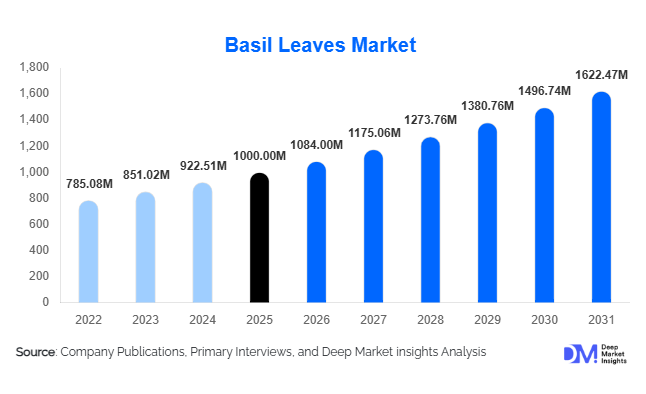
According to Deep Market Insights, the global basil leaves market size was valued at USD 1,000 million in 2025 and is projected to grow from USD 1,084 million in 2026 to reach USD 1,622.47 million by 2031, expanding at a CAGR of 8.4% during the forecast period (2026–2031). The basil leaves market growth is primarily driven by the increasing demand for natural herbs, expansion of global cuisines, and rising adoption of plant-based and clean-label ingredients across food, pharmaceutical, and cosmetic industries. Growing awareness of basil’s antioxidant, anti-inflammatory, and medicinal properties is further accelerating its integration into nutraceuticals and herbal formulations, strengthening its global demand outlook.
Key Market Insights
- Basil leaves consumption is increasingly driven by clean-label and natural ingredient trends, particularly in packaged food and ready-to-eat segments.
- Fresh basil dominates demand globally, supported by strong usage in foodservice and retail channels.
- Asia-Pacific leads global production, while North America and Europe represent high-value consumption markets.
- Organic basil is gaining traction rapidly, commanding premium pricing and driving higher margins for producers.
- Hydroponic and greenhouse farming are expanding, enabling year-round cultivation and improved yield efficiency.
- Cross-industry applications in pharmaceuticals and cosmetics are diversifying revenue streams beyond traditional culinary use.
What are the latest trends in the basil leaves market?
Shift Toward Organic and Sustainable Basil Cultivation
The global basil leaves market is experiencing a strong shift toward organic and sustainably grown produce. Consumers are increasingly prioritizing pesticide-free and traceable food sources, prompting producers to invest in certified organic farming practices. Organic basil commands a price premium of 20–40%, making it an attractive segment for both large-scale producers and niche growers. Retailers are also expanding organic product shelves, particularly in Europe and North America, further accelerating demand. Sustainability initiatives such as water-efficient irrigation, biodegradable packaging, and carbon-neutral farming are becoming standard across leading suppliers, aligning with broader environmental goals and regulatory expectations.
Adoption of Controlled-Environment Agriculture
Technological advancements in agriculture are reshaping basil cultivation. Hydroponic systems, vertical farming, and greenhouse production are enabling year-round supply with higher yields and lower water usage. These systems are particularly effective in urban and climate-sensitive regions, allowing producers to supply fresh basil to nearby markets with minimal logistics costs. Controlled-environment farming also improves product consistency and reduces dependency on seasonal variations, making it a preferred method for premium retail and foodservice segments. Increasing investments in agri-tech startups and urban farming infrastructure are further strengthening this trend globally.
What are the key drivers in the basil leaves market?
Rising Demand for Global Cuisines
The increasing popularity of international cuisines such as Italian and Thai is significantly driving basil consumption worldwide. Basil is a key ingredient in dishes like pesto, pasta sauces, and curries, making it indispensable in both household and foodservice applications. The rapid expansion of restaurants, quick-service chains, and cloud kitchens is further boosting bulk demand. As consumers continue to explore diverse culinary experiences, basil leaves are becoming a staple ingredient across multiple cuisines, supporting steady market growth.
Growth in Herbal Medicine and Nutraceuticals
Basil, particularly holy basil (tulsi), is widely recognized for its medicinal properties, including immunity enhancement and stress reduction. The rising popularity of herbal supplements and plant-based healthcare solutions has increased basil’s usage in nutraceuticals and pharmaceuticals. Post-pandemic health awareness has accelerated this trend, with consumers actively seeking natural remedies. This shift is creating new growth avenues for basil extracts, powders, and essential oils, expanding the market beyond traditional food applications.
What are the restraints for the global market?
Climatic Sensitivity and Supply Volatility
Basil cultivation is highly sensitive to environmental conditions such as temperature, humidity, and water availability. Adverse weather patterns, including droughts and excessive rainfall, can significantly impact yield and quality. This leads to supply fluctuations and price volatility, posing challenges for both producers and buyers. Climate change further exacerbates these risks, making consistent supply a critical concern in the global basil leaves market.
Short Shelf Life and Logistics Challenges
Fresh basil leaves have a limited shelf life, requiring efficient cold chain infrastructure for storage and transportation. Inadequate logistics systems, particularly in developing regions, lead to post-harvest losses and reduced product quality. This constraint limits market expansion, especially in export-driven trade, where maintaining freshness is essential. Investments in packaging innovation and cold storage solutions are necessary to overcome this challenge and ensure supply chain efficiency.
What are the key opportunities in the basil leaves industry?
Expansion of Value-Added Basil Products
The development of value-added products such as dried basil, powders, pastes, and essential oils presents a significant opportunity for market players. These products offer longer shelf life, ease of transportation, and higher profit margins compared to fresh basil. Food processing companies are increasingly incorporating basil into ready-to-eat meals, sauces, and seasonings, while the cosmetics and pharmaceutical industries are utilizing basil extracts in skincare and therapeutic formulations. This diversification is expected to enhance revenue streams and reduce dependency on raw leaf sales.
Export-Oriented Cultivation in Emerging Economies
Countries such as India, Vietnam, and Egypt are emerging as major exporters of basil leaves due to favorable climatic conditions and lower production costs. Government initiatives supporting agriculture, export incentives, and infrastructure development are encouraging farmers to expand basil cultivation. Growing demand from Europe and North America for both fresh and processed basil products is further strengthening export opportunities. Producers focusing on quality certification and compliance with international standards can gain a competitive edge in global markets.
Report Scope
| Report Metric | Details |
|---|---|
| Market Size in 2025 | USD 1000.00 Million |
| Market Size in 2026 | USD 1084.00 Million |
| Market Size in 2031 | USD 1622.47 Million |
| CAGR | 8.4% (2026-2031) |
| Base Year for Estimation | 2025 |
| Historical Data | 2022-2024 |
| Forecast Period | 2026-2031 |
| Report Coverage | Revenue Forecast, Competitive Landscape, Supply Chain Disruption, Growth Factors, Environment & Regulatory Landscape and Trends |
| Geographies Covered | North America, Europe, APAC, Middle East and Africa, LATAM |
| Countries Covered | U.S., Canada, U.K., Germany, France, Spain, Italy, Russia, Nordic, Benelux, Rest of Europe, China, Korea, Japan, India, Australia, Singapore, Taiwan, South East Asia, Rest of Asia-Pacific, UAE, Turky, Saudi Arabia, South Africa, Egypt, Nigeria, Rest of MEA, Brazil, Mexico, Argentina, Chile, Colombia, Rest of LATAM |
Explore more data points, trends and opportunities Download Free Sample Report
Product Type Insights
The global basil leaves market is characterized by a diverse portfolio of product types, with sweet basil maintaining its dominant position and accounting for approximately 42% of the total market share in 2025. This dominance is largely attributed to its extensive use in Mediterranean cuisine, particularly in staple preparations such as pesto, pasta sauces, and salads, as well as its widespread adoption across international culinary applications. The versatility of sweet basil, combined with its mild flavor profile and aromatic appeal, makes it a preferred choice for both household consumption and commercial food processing industries. Its consistent demand is further supported by its year-round cultivation in controlled environments, ensuring stable supply chains across regions.Specialty basil varieties, including lemon basil, purple basil, and cinnamon basil, are carving out niche markets, particularly in premium and gourmet segments. These variants are often used in high-end culinary applications, artisanal food products, and specialty beverages. Their unique flavor profiles and visual appeal enhance product differentiation, making them attractive to chefs, food innovators, and premium retail consumers. The growth of gourmet dining, coupled with increasing consumer awareness of exotic herbs, is supporting the expansion of these specialty varieties. Furthermore, the rise of urban farming and home gardening trends is enabling consumers to cultivate diverse basil types, thereby contributing to their growing popularity.The leading driver for the product type segment remains the dominance of sweet basil, supported by its extensive application across food processing and culinary industries. However, the increasing diversification of consumer preferences and the rising demand for functional and specialty herbs are collectively reshaping the competitive landscape, encouraging producers to expand their product offerings and invest in varietal innovation.
Application Insights
The application landscape of the basil leaves market is led by the food and beverages segment, which contributes nearly 55% of total demand in 2025. Basil’s integral role as a flavoring agent in sauces, dressings, soups, ready-to-eat meals, and seasoning blends underscores its importance in the global food industry. Its natural aroma and ability to enhance taste profiles make it a key ingredient in both traditional and modern food formulations. The increasing demand for convenience foods, coupled with the expansion of the processed food industry, is significantly driving basil consumption in this segment. Additionally, the growing preference for clean-label ingredients is encouraging manufacturers to incorporate natural herbs like basil instead of artificial flavor enhancers.The cosmetics and personal care industry is also contributing to the diversification of basil applications. Basil extracts are being incorporated into skincare formulations due to their antibacterial, anti-inflammatory, and antioxidant properties. These attributes make basil a valuable ingredient in products targeting acne, skin irritation, and aging. The shift toward natural and organic personal care products is further amplifying the demand for basil-derived ingredients. Manufacturers are increasingly highlighting herbal components in their formulations to appeal to environmentally conscious and health-aware consumers.The leading driver for the application segment is the strong dominance of the food and beverages industry, which continues to anchor market demand. However, the rapid expansion of nutraceutical and cosmetic applications is creating additional growth avenues, reflecting the multifunctional nature of basil and its ability to cater to evolving consumer needs across industries.
Distribution Channel Insights
The distribution landscape of the basil leaves market is dominated by retail channels, including supermarkets and hypermarkets, which collectively account for approximately 46% of the global market share. These channels provide consumers with easy access to fresh and packaged basil products, supported by well-established supply chains and efficient inventory management systems. The preference for retail channels is driven by the ability to physically assess product quality, particularly for fresh herbs, which are highly perishable. Additionally, organized retail formats offer a wide variety of basil types, catering to diverse consumer preferences.Direct sales to foodservice providers and food processors represent another important distribution channel. Bulk procurement by restaurants, hotels, and food manufacturing companies ensures a steady demand for basil, particularly in regions with a strong hospitality sector. These direct supply arrangements often involve long-term contracts, providing stability to producers and facilitating efficient supply chain operations. Furthermore, the integration of digital supply chain solutions is enhancing transparency, traceability, and operational efficiency, enabling stakeholders to optimize inventory and reduce wastage.The leading driver for the distribution channel segment is the dominance of retail channels, supported by consumer preference for accessibility and product variety. However, the rapid growth of online retail and the increasing adoption of direct procurement models are reshaping the distribution landscape, creating opportunities for innovation and efficiency improvements.
End-Use Industry Insights
The food processing industry remains the largest end-use segment in the basil leaves market, contributing around 38% of the total market demand. The widespread use of basil in processed foods, including sauces, ready meals, frozen products, and snack seasonings, underscores its importance in this sector. The growing demand for convenience foods, driven by busy lifestyles and urbanization, is significantly boosting basil consumption. Additionally, the trend toward clean-label and natural ingredients is encouraging food manufacturers to incorporate basil as a natural flavoring agent, further strengthening its position in the food processing industry.The pharmaceutical and nutraceutical industries are witnessing rapid growth, driven by the increasing demand for herbal products and dietary supplements. Basil’s medicinal properties are being leveraged in the development of various health products, including herbal teas, capsules, and extracts. The rising awareness of preventive healthcare and the growing preference for natural remedies are key factors driving demand in these industries. Furthermore, export-oriented demand from these sectors is contributing to overall market growth, as basil-based products gain popularity in international markets.The leading driver for the end-use industry segment is the dominance of the food processing industry, which continues to generate substantial demand. However, the rapid growth of the HoReCa sector and the expanding pharmaceutical and nutraceutical industries are creating additional growth opportunities, highlighting the diverse applications of basil across multiple industries.
Explore more data points, trends and opportunities Download Free Sample Report
Basil Leaves Market Segmentations
By Product Type
- Sweet Basil
- Thai Basil
- Holy Basil (Tulsi)
- Lemon Basil
- Purple Basil
- Others
By Form
- Fresh Basil Leaves
- Dried Basil Leaves
- Frozen Basil Leaves
- Basil Paste/Puree
- Basil Powder
By Nature
- Organic Basil
- Conventional Basil
By Application
- Food & Beverages
- Pharmaceuticals & Herbal Medicine
- Cosmetics & Personal Care
- Nutraceuticals & Supplements
By Distribution Channel
- Retail
- Online Retail/E-commerce
- Foodservice/HoReCa
- Direct Sales
Regional Insights
Asia-Pacific
Asia-Pacific dominates the global basil leaves market, accounting for approximately 38% of the market share in 2025. The region’s leadership is primarily driven by its strong production base, supported by favorable climatic conditions, abundant agricultural resources, and cost-effective labor. Countries such as India, China, and Vietnam play a pivotal role in the global supply chain, with India leading in the production of holy basil and Vietnam emerging as a key exporter of dried basil. The region also benefits from well-established agricultural practices and increasing adoption of modern farming techniques, which enhance productivity and quality.In addition to production advantages, Asia-Pacific is the fastest-growing market, with a CAGR of around 9.5%. This growth is driven by rising export demand, particularly from North America and Europe, where consumers are increasingly seeking natural and herbal products. Government support in the form of subsidies, training programs, and infrastructure development is further boosting agricultural output and export capabilities. The expansion of the food processing industry and the growing popularity of herbal medicine within the region are also contributing to increased basil consumption. Moreover, the rapid urbanization and rising disposable incomes in emerging economies are driving demand for convenience foods and premium ingredients, further supporting market growth.
Europe
Europe holds around 27% of the global market share, with countries such as Italy, Germany, and France being key contributors. Italy’s strong culinary dependence on basil, particularly in traditional dishes, ensures consistent demand across both retail and foodservice sectors. Germany leads in the consumption of organic basil, reflecting the region’s strong focus on sustainability and health-conscious consumption. The increasing demand for organic and locally sourced products is encouraging the adoption of sustainable farming practices, including greenhouse cultivation and vertical farming.Regional growth in Europe is driven by several factors, including stringent food safety regulations, which promote the use of high-quality and traceable ingredients. The clean-label movement is particularly influential, as consumers prefer products with natural and recognizable ingredients. Additionally, the growing popularity of plant-based diets is supporting the demand for herbs like basil, which enhance the flavor of vegetarian and vegan dishes. Technological advancements in controlled environment agriculture are also enabling year-round production, reducing dependency on imports and ensuring consistent supply.
North America
North America accounts for approximately 22% of the market share, with the United States being the largest contributor. The region’s demand is driven by the widespread use of basil in both retail and foodservice sectors, particularly in Italian and fusion cuisines. The expansion of hydroponic and indoor farming is a key growth driver, enabling local production of fresh basil with minimal environmental impact. These innovative farming methods ensure consistent quality and supply, addressing the challenges associated with traditional agriculture.Additional growth drivers include the strong presence of food processing companies, which utilize basil in a wide range of products, and the increasing consumer preference for fresh and organic herbs. The rise of health-conscious eating habits and the growing demand for natural ingredients are further supporting market growth. Moreover, the expansion of e-commerce platforms and meal kit services is enhancing product accessibility, enabling consumers to incorporate fresh basil into their daily diets more conveniently.
Middle East & Africa
The Middle East & Africa region contributes around 7% of the market share, with growing demand in countries such as the UAE and South Africa. The hospitality sector plays a crucial role in driving basil consumption, particularly in premium hotels and restaurants that cater to international cuisines. The increasing influx of tourists and expatriates is contributing to the diversification of culinary preferences, thereby boosting demand for herbs like basil.Regional growth is also supported by the expansion of modern retail infrastructure and the rising availability of imported fresh produce. Investments in greenhouse farming and controlled environment agriculture are enabling local production, reducing dependency on imports. Additionally, the growing awareness of health and wellness is encouraging the adoption of herbal ingredients, further supporting market expansion in this region.
Latin America
Latin America accounts for approximately 6% of the global market, led by Brazil and Mexico. The region is witnessing steady growth, driven by the increasing adoption of international cuisines and the expansion of the foodservice industry. The growing popularity of Italian and Mediterranean dishes is particularly influencing basil consumption, as these cuisines heavily rely on the herb for flavor enhancement.Key growth drivers in Latin America include improving agricultural practices, which are enhancing the quality and yield of basil production, and the rising penetration of organized retail channels, which are increasing product accessibility. Additionally, the expansion of the tourism sector is boosting demand from the hospitality industry. The growing awareness of herbal health benefits is also contributing to the adoption of basil in nutraceutical and wellness products, further supporting regional market growth.
Key Players in the Basil Leaves Market
- McCormick & Company
- Olam Group
- Sensient Technologies
- Döhler Group
- Kerry Group
- Givaudan
- Symrise AG
- Firmenich
- Takasago International Corporation
- Frontier Co-op
- Organic Herb Inc.
- Pacific Botanicals
- Van Drunen Farms
- British Pepper & Spice
- Greenyard NV