Functional Chewing Gum Market Size
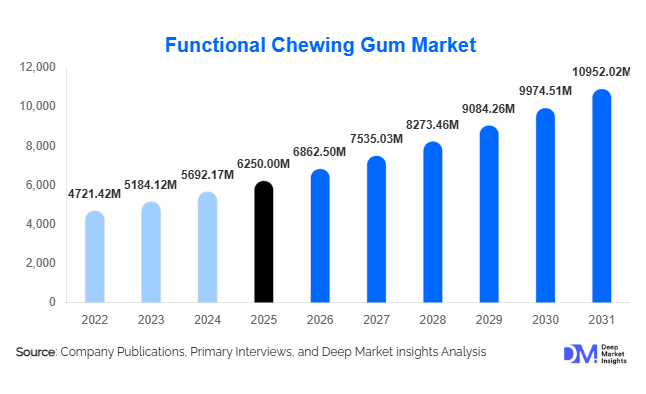
According to Deep Market Insights, the global functional chewing gum market size was valued at USD 6,250 million in 2025 and is projected to grow from USD 6,862.50 million in 2026 to reach USD 10,952.02 million by 2031, expanding at a CAGR of 9.8% during the forecast period (2026–2031). The functional chewing gum market growth is primarily driven by increasing consumer inclination toward convenient health-enhancing products, rising awareness regarding preventive healthcare, and the growing integration of nutraceutical ingredients into confectionery formats.
Key Market Insights
- Functional chewing gum is transitioning into a nutraceutical delivery format, enabling consumers to access health benefits such as oral care, energy, and stress relief in a convenient form.
- Sugar-free gum dominates the market, driven by increasing demand for low-calorie and dental-friendly alternatives.
- North America leads the market, supported by strong adoption of energy and oral health gum products.
- Asia-Pacific is the fastest-growing region, fueled by rising disposable incomes and expanding urban populations.
- Online retail channels are rapidly gaining traction, enabling direct-to-consumer expansion for niche functional brands.
- Technological innovations in ingredient delivery systems, such as microencapsulation, are enhancing product effectiveness and stability.
What are the latest trends in the functional chewing gum market?
Shift Toward Nutraceutical and Clean-Label Products
The market is increasingly witnessing a shift toward clean-label and nutraceutical-based chewing gums. Consumers are demanding transparency in ingredient sourcing, leading to higher adoption of plant-based, natural, and organic formulations. Functional gums infused with botanical extracts, vitamins, and minerals are gaining traction as consumers seek alternatives to traditional supplements. Manufacturers are focusing on eliminating artificial sweeteners and additives while incorporating ingredients such as xylitol, herbal extracts, and adaptogens. This trend is particularly prominent in developed markets, where consumers are willing to pay premium prices for health-focused, clean-label products.
Rising Popularity of Energy and Focus Gums
Energy and focus-enhancing chewing gums are emerging as one of the fastest-growing segments within the market. These products, often infused with caffeine, nootropics, and vitamins, cater to busy professionals, students, and athletes seeking instant cognitive and physical performance boosts. Compared to traditional energy drinks, functional gums offer faster absorption and greater convenience. The increasing adoption of these products in fitness and sports industries is further driving growth, with brands targeting niche consumer groups through specialized formulations and marketing strategies.
What are the key drivers in the functional chewing gum market?
Growing Health Awareness and Preventive Care
Rising global awareness regarding preventive healthcare is a major driver of the functional chewing gum market. Consumers are increasingly prioritizing products that offer health benefits beyond basic nutrition. Functional chewing gum provides an easy and enjoyable way to incorporate oral care, vitamins, and stress-relief solutions into daily routines. The increasing prevalence of dental issues and lifestyle-related health concerns is further boosting demand for such products.
Demand for Convenient and Portable Wellness Solutions
The fast-paced modern lifestyle has increased demand for convenient health solutions. Functional chewing gum serves as an ideal format due to its portability, ease of use, and ability to deliver active ingredients without the need for water or preparation. This convenience factor is particularly appealing to working professionals, travelers, and fitness enthusiasts, driving widespread adoption.
What are the restraints for the global market?
Regulatory Challenges and Approval Complexities
The functional chewing gum market faces significant regulatory challenges, particularly regarding health claims and the use of active ingredients. Different regions have varying approval processes, making it difficult for companies to standardize products globally. Compliance with food and pharmaceutical regulations increases time-to-market and operational costs.
Limited Active Ingredient Capacity
Chewing gum as a delivery format has inherent limitations in terms of the quantity of active ingredients it can contain. This restricts its effectiveness compared to traditional supplement formats such as capsules or powders. Manufacturers must balance taste, texture, and efficacy, which can limit product innovation.
What are the key opportunities in the functional chewing gum industry?
Expansion in Emerging Markets
Emerging economies such as India, China, and Brazil present significant growth opportunities due to rising disposable incomes and increasing health awareness. Urbanization and expanding retail infrastructure are enabling greater accessibility to functional products. Companies can capitalize on this opportunity by introducing affordable and localized product variants tailored to regional preferences.
Technological Advancements in Ingredient Delivery
Innovations in microencapsulation and controlled-release technologies are creating new opportunities for incorporating advanced nutraceutical ingredients into chewing gum. These technologies enhance stability, taste, and bioavailability of active compounds, enabling manufacturers to expand product offerings and improve efficacy.
Report Scope
| Report Metric | Details |
|---|---|
| Market Size in 2025 | USD 6250.00 Million |
| Market Size in 2026 | USD 6862.50 Million |
| Market Size in 2031 | USD 10952.02 Million |
| CAGR | 9.8% (2026-2031) |
| Base Year for Estimation | 2025 |
| Historical Data | 2022-2024 |
| Forecast Period | 2026-2031 |
| Report Coverage | Revenue Forecast, Competitive Landscape, Supply Chain Disruption, Growth Factors, Environment & Regulatory Landscape and Trends |
| Geographies Covered | North America, Europe, APAC, Middle East and Africa, LATAM |
| Countries Covered | U.S., Canada, U.K., Germany, France, Spain, Italy, Russia, Nordic, Benelux, Rest of Europe, China, Korea, Japan, India, Australia, Singapore, Taiwan, South East Asia, Rest of Asia-Pacific, UAE, Turky, Saudi Arabia, South Africa, Egypt, Nigeria, Rest of MEA, Brazil, Mexico, Argentina, Chile, Colombia, Rest of LATAM |
Explore more data points, trends and opportunities Download Free Sample Report
Product Type Insights
Oral health gum continues to dominate the functional chewing gum market, accounting for approximately 32% of the total market share in 2025. This leadership position is strongly supported by rising global awareness regarding preventive dental care and the increasing preference for convenient, on-the-go oral hygiene solutions. Consumers across both developed and emerging economies are increasingly shifting toward products that provide dual benefits of freshness and health enhancement. The inclusion of functional ingredients such as xylitol, calcium, and natural antibacterial extracts has significantly strengthened the value proposition of oral health gums. These ingredients are widely recognized for their ability to reduce cavity formation, neutralize oral bacteria, and support overall gum health, which has made them a mainstream alternative to traditional oral care routines in certain consumer segments.Energy and focus gums represent the fastest-growing product segment, driven by evolving consumer lifestyles characterized by longer working hours, increased screen time, and rising demand for cognitive performance enhancement. Professionals, students, and athletes are increasingly turning to functional gums as a quick and discreet method to improve alertness and reduce fatigue. The convenience of gum-based delivery systems, compared to beverages or capsules, provides a competitive advantage, particularly in fast-paced environments. The growth of remote work culture and hybrid work models has further accelerated demand for such products as individuals seek flexible productivity-enhancing solutions.Vitamin and supplement gums are also gaining significant traction, particularly among health-conscious consumers who prefer alternative delivery mechanisms over traditional pills and capsules. This segment benefits from growing awareness around preventive healthcare, immunity support, and nutritional supplementation. The integration of essential vitamins such as B-complex, vitamin C, and herbal extracts has enabled manufacturers to position these products as functional lifestyle enhancers. Increasing demand from younger demographics and urban populations has further strengthened this segment’s growth trajectory, making it an important contributor to overall market expansion.
Application Insights
Health and wellness applications represent the largest segment in the functional chewing gum market, driven by a global shift toward preventive healthcare and self-managed wellness routines. Consumers are increasingly prioritizing products that offer long-term health benefits rather than short-term satisfaction. Within this category, oral care remains the most established application, supported by strong consumer trust and consistent product usage patterns. Functional gums designed for oral hygiene are widely perceived as complementary to brushing and flossing routines, reinforcing their position in daily consumer habits.Energy and cognitive enhancement applications are witnessing rapid expansion as modern lifestyles demand improved mental performance and sustained focus. Functional gums in this category are often positioned as alternatives to caffeinated beverages and energy drinks, offering a more controlled and immediate release of active ingredients. The increasing prevalence of demanding work environments, academic pressure, and digital fatigue has further strengthened demand in this segment. Manufacturers are also investing in advanced formulations that combine natural stimulants, amino acids, and herbal extracts to enhance product effectiveness and consumer appeal.Smoking cessation remains a significant application area, supported by ongoing public health initiatives and increasing regulatory pressure to reduce tobacco consumption globally. Nicotine-based functional gums play a crucial role in behavioral substitution therapy, helping users gradually reduce dependence on smoking. Governments and health organizations in several regions actively promote such products as part of anti-smoking campaigns, ensuring consistent demand. The accessibility and discreet usage of gum-based cessation products make them a preferred choice among individuals attempting to quit smoking.Emerging applications such as stress relief and digestive health are expanding the scope of the market. Stress relief gums often incorporate calming herbal ingredients such as chamomile and ashwagandha, catering to the rising demand for mental wellness solutions. Digestive health gums, infused with enzymes and natural extracts, are also gaining popularity among consumers seeking convenient post-meal digestive support. These emerging categories highlight the increasing diversification of functional chewing gum beyond traditional use cases.
Distribution Channel Insights
Supermarkets and hypermarkets remain the dominant distribution channels, accounting for approximately 35% of functional chewing gum sales in 2025. These retail formats provide high product visibility, extensive shelf space, and strong consumer accessibility, which collectively contribute to impulse purchasing behavior. The ability to physically evaluate product packaging and compare multiple brands enhances consumer confidence, particularly in health-oriented product categories. Retail promotions and in-store marketing strategies further strengthen sales performance in this channel.Online retail is emerging as the fastest-growing distribution channel, driven by rapid digital transformation and shifting consumer purchasing behavior. The convenience of home delivery, wider product variety, and access to detailed product information have significantly boosted e-commerce adoption. Direct-to-consumer models adopted by functional gum manufacturers are also reshaping the competitive landscape, allowing brands to establish stronger consumer relationships and improve profit margins. Subscription-based purchasing models are further enhancing customer retention in this channel.Pharmacies and specialty health stores continue to play a crucial role, particularly for medically oriented functional gums such as nicotine replacement therapies and vitamin-enriched formulations. These channels benefit from strong consumer trust and professional recommendations, which are particularly important in health-related purchasing decisions. Pharmacists often act as advisors, influencing consumer choice and driving product credibility. This makes pharmacies a key distribution point for clinically positioned functional gum products.
End-Use Insights
The health and wellness industry remains the primary end-use segment for functional chewing gum, supported by increasing consumer focus on preventive healthcare and lifestyle optimization. Functional gums are increasingly being integrated into daily wellness routines as consumers seek convenient alternatives to traditional supplements and oral care products. The growing emphasis on holistic health management has significantly expanded the addressable market for functional chewing gum within this segment.The pharmaceutical sector also represents a significant end-use category, particularly in smoking cessation and therapeutic applications. Functional gums designed for nicotine delivery and other medicinal purposes are widely used as part of structured treatment programs. Pharmaceutical companies continue to invest in research and development to improve efficacy, dosage control, and user compliance, ensuring sustained growth in this segment.The fitness and lifestyle industry is emerging as a key growth driver, with increasing adoption of energy-enhancing gums among athletes, gym-goers, and active individuals. The demand for portable and quick-energy solutions aligns well with the functional gum format, making it a preferred choice in pre-workout and endurance scenarios. Additionally, the export-driven demand is rising steadily, with developed regions increasingly sourcing innovative functional gum products from emerging manufacturing hubs. This global trade flow further supports market expansion and product diversification.
Explore more data points, trends and opportunities Download Free Sample Report
Functional Chewing Gum Market Segmentations
By Functionality
- Oral Health Gum
- Energy & Focus Gum
- Vitamin & Supplement Gum
- Stress Relief & Relaxation Gum
- Weight Management Gum
- Digestive Health Gum
- Smoking Cessation Gum
By Ingredient Type
- Synthetic Active Ingredients
- Natural/Botanical Ingredients
- Sugar-Based Gum
- Sugar-Free Gum
By Distribution Channel
- Supermarkets & Hypermarkets
- Convenience Stores
- Pharmacies & Drug Stores
- Online Retail
- Specialty Health Stores
Regional Insights
North America
North America dominates the functional chewing gum market, accounting for approximately 34% of the global share in 2025. The region’s leadership is primarily driven by high consumer awareness regarding health and wellness products, strong purchasing power, and a well-established retail infrastructure. The United States remains the largest contributor, supported by strong demand for energy gums, oral health products, and smoking cessation solutions. A highly developed nutraceutical industry further strengthens market penetration, while continuous product innovation and marketing campaigns sustain consumer engagement.The key growth drivers in North America include increasing adoption of functional foods, rising focus on preventive healthcare, and growing demand for convenient wellness solutions. Additionally, the presence of major industry players and advanced research capabilities enables rapid product development and commercialization, ensuring sustained market leadership.
Europe
Europe holds approximately 28% of the global market share, supported by strong consumer awareness and a long-standing preference for health-oriented and sugar-free products. Countries such as Germany, the United Kingdom, and France are at the forefront of regional demand. The region benefits from stringent food safety regulations that promote high-quality functional food innovation and ensure consumer trust.Key growth drivers in Europe include increasing demand for natural and organic ingredients, rising focus on dental health, and strong regulatory support for functional food products. Additionally, aging populations in several European countries are driving demand for preventive healthcare solutions, further boosting the adoption of functional chewing gum across multiple applications.
Asia-Pacific
Asia-Pacific is the fastest-growing region, with a projected CAGR of approximately 11.5%. This growth is driven by rapid urbanization, rising disposable incomes, and increasing awareness of health and wellness products. Countries such as China, India, and Japan are major contributors, supported by expanding retail networks and growing middle-class populations.The key drivers in this region include lifestyle changes, increasing adoption of Western dietary habits, and rising demand for convenient health solutions. Additionally, expanding e-commerce penetration and aggressive marketing by global brands are accelerating market growth. The region’s large young population also plays a crucial role in driving demand for energy and cognitive enhancement gums.
Latin America
Latin America represents an emerging market with growing potential, led by countries such as Brazil and Mexico. Increasing health awareness, improving economic conditions, and expanding retail infrastructure are key factors supporting market growth. Consumers in this region are gradually adopting functional foods as part of their daily routines, particularly in oral care and energy enhancement segments.Key growth drivers include rising urbanization, increasing exposure to global wellness trends, and improving access to modern retail formats. Additionally, government initiatives promoting public health awareness are indirectly supporting demand for functional chewing gum products.
Middle East & Africa
The Middle East & Africa region is witnessing steady growth, with increasing demand from countries such as the United Arab Emirates and South Africa. Rising urbanization, expanding retail infrastructure, and growing awareness of health and wellness products are key factors driving market development. Consumers in urban centers are increasingly adopting functional products as part of modern lifestyle habits.Key growth drivers include increasing disposable income, expansion of organized retail, and growing influence of international brands. Additionally, rising focus on preventive healthcare and lifestyle diseases is encouraging consumers to adopt functional chewing gum as part of daily wellness routines. While the market is still developing, long-term growth potential remains strong due to demographic and economic transitions across the region.
Key Players in the Functional Chewing Gum Market
- Mars Wrigley
- Mondelez International
- Perfetti Van Melle
- Lotte Corporation
- Meiji Holdings
- Cloetta AB
- Peppersmith Ltd.
- GelStat Corporation
- NeuroGum Inc.
- Rev Gum
- Military Energy Gum
- Tree Hugger Gum
- Simply Gum Inc.
- Glee Gum
- Zeno Gum