Infant Formula Ingredients Market Size
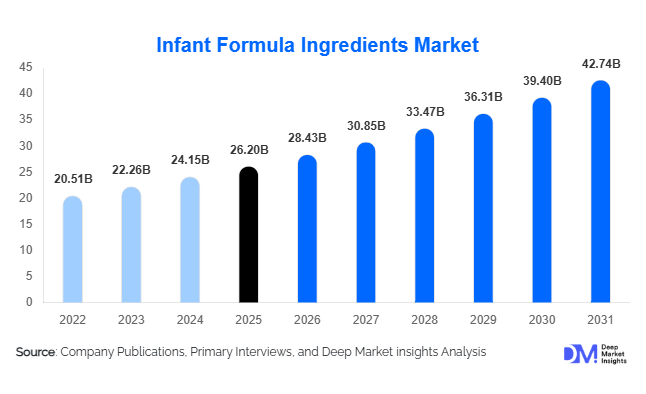
According to Deep Market Insights, the global infant formula ingredients market size was valued at USD 26.2 billion in 2025 and is projected to grow from USD 28.4 billion in 2026 to reach USD 42.7 billion by 2031, expanding at a CAGR of 8.5% during the forecast period (2026–2031). The infant formula ingredients market growth is primarily driven by increasing demand for premium infant nutrition products, rising awareness regarding early-life nutrition, growing female workforce participation, and advancements in bioactive and functional ingredient technologies.
Key Market Insights
- Human Milk Oligosaccharides (HMOs) and microbiome-focused ingredients are rapidly transforming infant nutrition formulations, particularly in premium and specialized products.
- Dairy-based ingredients continue to dominate global demand, with whey proteins, lactose, and milk fat fractions accounting for the largest revenue contribution.
- Asia-Pacific dominates the global infant formula ingredients market, led by China’s strong consumption of premium infant nutrition products.
- India and Southeast Asia represent the fastest-growing regional markets, supported by urbanization, rising disposable incomes, and expanding modern retail channels.
- Specialized and hypoallergenic infant formulas are witnessing accelerated growth, driven by rising pediatric allergies, digestive disorders, and premature birth rates.
- Technological advancements in precision fermentation, encapsulation, and protein hydrolysis are enabling the development of highly functional next-generation infant nutrition ingredients.
infant formula ingredients market latest trends
Premiumization and Human Milk Mimicking Nutrition
The infant formula ingredients industry is increasingly shifting toward premium formulations designed to closely replicate the nutritional functionality of human breast milk. Manufacturers are investing heavily in advanced bioactive compounds such as Human Milk Oligosaccharides (HMOs), lactoferrin, milk fat globule membrane (MFGM), and specialized whey proteins to improve infant immunity, gut health, and cognitive development. Parents are becoming more aware of scientifically validated infant nutrition benefits, encouraging demand for clinically supported formulations. Premium formulas containing DHA, probiotics, and advanced protein systems are rapidly gaining popularity in China, Europe, and North America. This trend is also increasing the average ingredient value per ton, benefiting specialty ingredient manufacturers with proprietary technologies and regulatory approvals.
Growth of Organic and Clean-Label Infant Nutrition
Organic and clean-label infant formula ingredients are emerging as a major industry trend. Consumers are increasingly demanding products free from artificial preservatives, genetically modified ingredients, pesticides, and synthetic additives. This is driving strong demand for organic dairy proteins, organic lactose, natural oils, and traceable micronutrient premixes. European markets continue to lead clean-label innovation, while demand is also expanding rapidly in Asia-Pacific due to increasing consumer awareness and premiumization trends. Manufacturers are strengthening sustainable sourcing programs, improving ingredient traceability systems, and investing in environmentally responsible dairy production practices. Clean-label positioning is also becoming an important competitive differentiator for infant formula brands globally.
infant formula ingredients market drivers
Increasing Demand for Premium Infant Nutrition
Growing parental awareness regarding infant immunity, digestive health, and cognitive development is driving substantial demand for premium infant nutrition products. Modern consumers are increasingly seeking formulas enriched with probiotics, DHA, HMOs, lactoferrin, and specialty proteins that closely resemble breast milk composition. Premium infant nutrition has become particularly important in urban regions across China, Japan, Europe, and North America, where consumers are willing to pay higher prices for advanced formulations. This trend has significantly expanded demand for high-value specialty ingredients and encouraged manufacturers to invest heavily in clinical nutrition research and ingredient innovation.
Rising Female Workforce Participation and Urbanization
Global increases in female workforce participation and rapid urbanization are contributing significantly to infant formula demand growth. Dual-income households and changing lifestyles have increased dependence on convenient infant feeding solutions, particularly in developing economies such as India, Indonesia, Brazil, and Vietnam. Expanding middle-class populations and rising disposable incomes are also improving access to premium infant nutrition products. Urban consumers increasingly prioritize scientifically formulated products with superior nutritional value, driving procurement demand for advanced dairy proteins, specialty carbohydrates, and omega fatty acid ingredients.
global market restraints
Stringent Regulatory Requirements
The infant formula ingredients market faces strict regulatory oversight due to the sensitive nature of infant nutrition products. Ingredient approvals require extensive safety testing, clinical validation, and compliance with highly regulated nutritional standards. Regulatory differences across Europe, China, the United States, and emerging markets increase commercialization complexity and extend product approval timelines. Manufacturers must also comply with rigorous quality assurance systems and traceability standards, increasing operational and R&D costs significantly.
Volatility in Dairy and Raw Material Prices
Fluctuating prices of dairy proteins, lactose, vegetable oils, and specialty nutrients remain a major challenge for manufacturers. Raw material costs are heavily influenced by climate conditions, milk production cycles, agricultural commodity markets, geopolitical trade disruptions, and transportation expenses. Price volatility directly impacts production planning, supplier contracts, and profit margins. Specialty ingredients such as lactoferrin and HMOs are particularly vulnerable to supply constraints due to limited global production capacity and complex manufacturing technologies.
infant formula ingredients industry key opportunities
Expansion of Specialized Medical Infant Nutrition
The growing prevalence of pediatric allergies, lactose intolerance, premature births, and digestive sensitivities is creating substantial opportunities for specialized infant formula ingredients. Demand for hydrolyzed proteins, amino-acid-based formulations, lactose-free carbohydrates, and clinical nutrition compounds is increasing globally. Hospitals, neonatal intensive care units (NICUs), and pediatric healthcare providers are increasingly recommending specialized nutritional formulations to support infant health management. Ingredient suppliers with clinically validated and regulatory-approved products are expected to benefit significantly from this growing segment.
Precision Fermentation and Biotechnology Innovation
Precision fermentation and biotechnology are emerging as transformative opportunities within the infant formula ingredients market. Advanced fermentation systems are enabling manufacturers to produce bioidentical HMOs, functional proteins, probiotics, and sustainable omega fatty acids at commercial scale. These technologies improve ingredient consistency, purity, and scalability while reducing dependence on traditional dairy supply chains. Biotechnology-driven innovation is also supporting the development of next-generation infant nutrition products with enhanced bioavailability and targeted health benefits. Companies investing in microbial fermentation and advanced encapsulation technologies are expected to achieve strong long-term competitive advantages.
Report Scope
| Report Metric | Details |
|---|---|
| Market Size in 2025 | USD 26.20 Billion |
| Market Size in 2026 | USD 28.43 Billion |
| Market Size in 2031 | USD 42.74 Billion |
| CAGR | 8.5% (2026-2031) |
| Base Year for Estimation | 2025 |
| Historical Data | 2022-2024 |
| Forecast Period | 2026-2031 |
| Report Coverage | Revenue Forecast, Competitive Landscape, Supply Chain Disruption, Growth Factors, Environment & Regulatory Landscape and Trends |
| Geographies Covered | North America, Europe, APAC, Middle East and Africa, LATAM |
| Countries Covered | U.S., Canada, U.K., Germany, France, Spain, Italy, Russia, Nordic, Benelux, Rest of Europe, China, Korea, Japan, India, Australia, Singapore, Taiwan, South East Asia, Rest of Asia-Pacific, UAE, Turky, Saudi Arabia, South Africa, Egypt, Nigeria, Rest of MEA, Brazil, Mexico, Argentina, Chile, Colombia, Rest of LATAM |
Explore more data points, trends and opportunities Download Free Sample Report
Ingredient Type Insights
Dairy-based ingredients continue to dominate the global infant formula ingredients market, accounting for nearly 38% of total revenue in 2025, primarily due to their nutritional similarity to human breast milk and their long-established role in infant nutrition formulations. Whey protein concentrates, lactose, milk protein isolates, and casein fractions remain highly preferred among manufacturers because they offer superior digestibility, balanced amino acid profiles, and enhanced nutrient absorption for infants during early developmental stages. The leading position of dairy ingredients is further supported by the growing global demand for premium and clinically validated infant nutrition products, particularly across Asia-Pacific and Europe where consumers strongly prefer scientifically formulated products with proven nutritional benefits.Prebiotics, probiotics, and human milk oligosaccharides (HMOs) represent some of the fastest-growing ingredient categories within the market. Increasing scientific evidence supporting the role of gut microbiome health in infant immunity and digestive development is encouraging formula manufacturers to incorporate microbiome-supporting ingredients into next-generation products. HMOs in particular are gaining significant commercial traction as companies invest heavily in biotechnology and precision fermentation technologies to replicate the immune-supportive functionality of human breast milk. Specialty ingredients such as lactoferrin, taurine, nucleotides, gangliosides, and milk fat globule membrane (MFGM) are also witnessing increasing adoption in premium infant nutrition formulations, driven by growing parental preference for high-performance products that support immunity, neurological development, and overall infant wellness.
Formula Type Insights
Standard infant formula ingredients continue to account for the largest share of the market due to their widespread global consumption and broad accessibility across both developed and emerging economies. The dominance of this segment is primarily driven by consistently high birth rates in developing countries, growing participation of working women, and rising dependence on supplemental infant nutrition products. Standard formulas remain the most commercially viable category for manufacturers because they serve the largest infant population and benefit from strong retail penetration globally.Hypoallergenic and lactose-free formula ingredients represent the fastest-growing segment within the market, supported by increasing incidences of pediatric food allergies, lactose intolerance, and digestive sensitivities among infants worldwide. Rising parental awareness regarding specialized nutrition solutions and increasing recommendations from pediatric healthcare professionals are significantly accelerating demand for hydrolyzed proteins, amino acid-based formulations, and lactose-free ingredient systems. Premature infant formula ingredients are also gaining importance within clinical nutrition and neonatal care settings due to rising global preterm birth rates and increasing demand for highly specialized nutritional support products designed for vulnerable infants.Organic infant formula ingredients are witnessing accelerated adoption globally as consumers increasingly prioritize clean-label, non-GMO, minimally processed, and sustainably sourced nutrition products. Growing regulatory scrutiny regarding synthetic additives and heightened consumer preference for transparency in infant nutrition are further supporting the expansion of organic ingredient demand.
Source Insights
Animal-derived ingredients dominate the infant formula ingredients market, accounting for approximately 64% of global demand in 2025. The segment maintains its leading position due to the extensive use of dairy proteins, lactose, milk fats, and bioactive dairy compounds in mainstream infant nutrition formulations. These ingredients continue to be preferred because of their superior nutritional profile, high bioavailability, and proven compatibility with infant digestive systems. The leading position of animal-derived ingredients is further supported by strong dairy production infrastructure across Europe, North America, and Oceania, enabling consistent large-scale supply for infant nutrition manufacturers.At the same time, microbial and fermentation-derived ingredients are emerging as rapidly growing categories due to advancements in biotechnology, precision fermentation, and sustainable ingredient manufacturing. Increasing investment in laboratory-produced HMOs, probiotics, and bioactive proteins is helping manufacturers reduce dependence on conventional dairy sources while improving ingredient consistency and scalability. Sustainability concerns and growing demand for environmentally efficient production methods are also accelerating adoption of fermentation-based nutritional ingredients.Plant-derived ingredients including soy protein isolates, rice proteins, oat derivatives, and pea proteins are gaining traction within specialized and allergy-sensitive infant nutrition applications. Rising demand for vegan-friendly, lactose-free, and hypoallergenic formulations is encouraging manufacturers to diversify ingredient sourcing strategies and expand plant-based infant nutrition offerings. In addition, increasing awareness regarding sustainability and alternative protein systems is expected to support long-term growth of plant-derived ingredients globally.
Form Insights
Powder ingredients dominate the global infant formula ingredients market with nearly 72% share due to their operational efficiency, long shelf life, lower transportation costs, and ease of storage across global supply chains. Powder-based formulations remain the preferred format for large-scale infant formula manufacturing because they offer superior stability, simplified handling, and improved compatibility with industrial blending and packaging processes. The leading position of powder ingredients is also supported by growing international trade in infant nutrition products, where shelf stability and transportation efficiency are critical factors for manufacturers and distributors.Liquid ingredients continue to maintain strong demand within high-purity and concentrated nutritional applications, particularly in specialized clinical formulations requiring precise nutrient delivery systems. Liquid ingredient systems are often preferred in premium formulations because they can improve ingredient dispersion and manufacturing consistency.Encapsulated ingredients are also witnessing growing adoption due to their ability to enhance nutrient protection, improve controlled release functionality, and maintain ingredient stability during processing and storage. Encapsulation technologies are becoming increasingly important for sensitive bioactive compounds including probiotics, omega fatty acids, vitamins, and specialty proteins that require protection from heat, oxygen, and moisture exposure throughout the manufacturing process.
End-Use Insights
Infant formula manufacturers remain the largest end-use segment, accounting for more than 68% of global ingredient demand in 2025. The segment’s dominance is primarily driven by continuous investments from major infant nutrition companies in premium ingredient systems, advanced nutritional formulations, and product differentiation strategies. Manufacturers are increasingly focusing on science-backed ingredients such as HMOs, probiotics, lactoferrin, DHA, and MFGM to strengthen product positioning within the highly competitive infant nutrition industry. Growing demand for premium and functional infant formulas across Asia-Pacific, Europe, and North America is further reinforcing the leadership of this segment.Pediatric clinical nutrition and hospital-based applications are witnessing rapid expansion due to increasing demand for specialized formulations designed for premature infants, low-birth-weight infants, and infants with medical or digestive conditions. Rising neonatal care investments and growing awareness regarding therapeutic infant nutrition are supporting demand growth within healthcare settings globally.Organic baby food manufacturers are also expanding procurement of certified organic proteins, oils, micronutrients, and specialty ingredients in response to rising global consumer preference for clean-label and naturally sourced infant nutrition products. Increasing retail availability of organic infant products and stronger regulatory emphasis on ingredient transparency are expected to further accelerate demand across this end-use segment.
Explore more data points, trends and opportunities Download Free Sample Report
Infant Formula Ingredients Market Segmentations
By Ingredient Type
- Dairy-Based Ingredients
- Plant-Based & Alternative Protein Ingredients
- Lipid & Fat Ingredients
- Carbohydrate Ingredients
- Prebiotics, Probiotics & Synbiotics
- Vitamins & Mineral Premixes
- Specialty Functional Ingredients
By Formula Type Application
- Standard Infant Formula Ingredients
- Follow-On Formula Ingredients
- Growing-Up Milk Formula Ingredients
- Premature Infant Formula Ingredients
- Hypoallergenic Formula Ingredients
- Lactose-Free Formula Ingredients
- Anti-Reflux Formula Ingredients
- Organic Infant Formula Ingredients
- Specialized Clinical Nutrition Formula Ingredients
By Source
- Animal-Derived Ingredients
- Plant-Derived Ingredients
- Microbial/Fermentation-Derived Ingredients
- Synthetic/Bioengineered Ingredients
By Form
- Powder Ingredients
- Liquid Ingredients
- Encapsulated Ingredients
By Functionality
- Nutritional Enrichment
- Digestive Health Enhancement
- Cognitive Development Support
- Immunity Enhancement
- Bone Health Support
- Weight Gain & Growth Support
- Allergy Management
- Shelf-Life Stabilization
Regional Insights
North America
North America represents a significant market for infant formula ingredients, driven by high consumer spending on premium infant nutrition products and strong demand for specialized formulations addressing allergies, digestive health, and immune support. The United States dominates regional demand due to extensive adoption of clinical nutrition products, rising incorporation of HMOs and probiotics in mainstream infant formulas, and increasing consumer preference for science-backed nutritional solutions. The region also benefits from advanced biotechnology capabilities and strong investments in infant nutrition research and development, which continue to accelerate innovation in specialty ingredients.Canada contributes significantly through its highly developed dairy processing industry and strong export capabilities for whey proteins, lactose, and specialized dairy ingredients. Growing awareness regarding early-life nutrition, rising participation of working mothers, and increasing demand for organic and clean-label infant formulas are further supporting market expansion across North America. Regulatory support for advanced infant nutrition standards and continuous product innovation from leading multinational brands continue to strengthen the region’s long-term growth outlook.
Europe
Europe remains a major production and innovation hub for infant formula ingredients, accounting for nearly 27% of global market share in 2025. Countries including the Netherlands, Ireland, Germany, France, and Denmark are globally recognized suppliers of dairy proteins, lactose, whey derivatives, and specialty nutritional ingredients. The region’s strong position is supported by highly advanced dairy infrastructure, stringent food safety regulations, and extensive expertise in infant nutrition research and manufacturing.Growing demand for organic infant nutrition products across Western Europe is significantly supporting ingredient innovation and premium product development. European manufacturers are also leading global investments in HMO commercialization, sustainable dairy processing technologies, and bioactive ingredient research. Rising consumer preference for traceable, non-GMO, and environmentally sustainable nutrition products is encouraging companies to adopt cleaner production processes and expand premium ingredient portfolios. Additionally, strong export demand from Asia-Pacific and the Middle East continues to reinforce Europe’s position as a key global supplier of infant formula ingredients.
Asia-Pacific
Asia-Pacific dominates the global infant formula ingredients market with approximately 43% share in 2025 and continues to represent the fastest-growing regional market globally. China remains the world’s largest consumer of infant formula ingredients due to exceptionally strong demand for premium imported-quality infant nutrition products. Chinese consumers increasingly prioritize advanced formulations enriched with probiotics, HMOs, DHA, specialty proteins, and immune-supportive ingredients, creating substantial growth opportunities for global ingredient suppliers.Japan and South Korea continue to demonstrate strong demand for highly functional premium nutrition products focused on immunity enhancement, cognitive development, and digestive health. In Southeast Asia, expanding retail infrastructure, growing e-commerce penetration, and increasing adoption of premium imported infant nutrition brands are further accelerating regional market expansion. Strong investments in domestic dairy processing and infant nutrition manufacturing capabilities across China and Southeast Asia are also contributing to long-term industry growth.
Latin America
Latin America is experiencing steady growth in infant formula ingredient consumption, led primarily by Brazil and Mexico. Rising awareness regarding pediatric nutrition, increasing urbanization, expanding middle-class populations, and improvements in modern retail distribution infrastructure are supporting market expansion across the region. Growing participation of women in the workforce and changing lifestyle patterns are also increasing demand for convenient infant nutrition solutions.Brazil’s well-established dairy processing industry is strengthening regional production capabilities for infant nutrition ingredients including whey proteins and lactose derivatives. Increasing penetration of international infant formula brands and growing demand for affordable and mid-premium nutrition products are supporting stable market growth across Latin America. Government initiatives focused on improving maternal and infant healthcare access, combined with rising investments in food processing infrastructure, are expected to further support regional market development over the forecast period.
Middle East & Africa
The Middle East & Africa infant formula ingredients market is witnessing moderate but consistent growth due to rising dependence on imported infant nutrition products, improving healthcare infrastructure, and increasing awareness regarding infant dietary requirements. Saudi Arabia, the UAE, and South Africa remain major regional demand centers due to higher consumer purchasing power, growing urban populations, and increasing availability of premium infant nutrition products.Regional growth is being further supported by expanding middle-class demographics, rising female workforce participation, and increasing healthcare expenditure across several countries. Governments in the Gulf region are also investing heavily in food security initiatives, nutritional self-sufficiency programs, and advanced food manufacturing infrastructure, which is expected to support long-term infant nutrition market expansion. In Africa, improving retail access, urban migration, and rising educational awareness regarding infant health and nutrition are gradually increasing adoption of fortified and specialized infant formula products.
Key Players in the Infant Formula Ingredients Market
- DSM-Firmenich
- Arla Foods Ingredients
- Fonterra Co-operative Group
- Glanbia plc
- FrieslandCampina Ingredients
- Kerry Group
- Ingredia SA
- BASF SE
- Chr. Hansen
- Nestlé Health Science
- Abbott Laboratories
- Royal Avebe
- Sachsenmilch Leppersdorf
- Carbery Group
- AptarGroup