Soft Pretzel Market Size
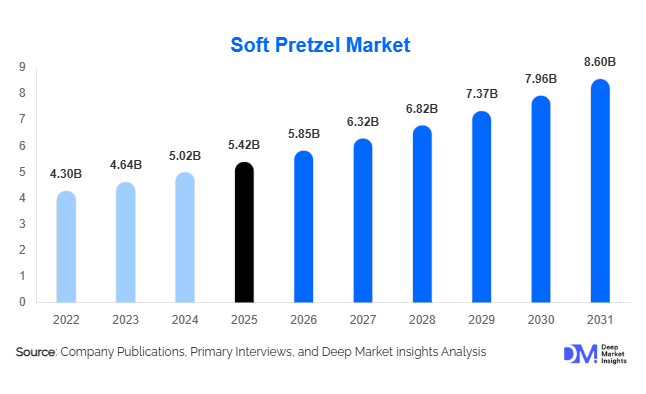
According to Deep Market Insights, the global soft pretzel market size was valued at USD 5.03 billion in 2025 and is projected to grow from USD 5.85 billion in 2026 to reach USD 8.60 billion by 2031, expanding at a CAGR of 8.0% during the forecast period (2026–2031). The soft pretzel market growth is primarily driven by rising consumer demand for convenient snack foods, increasing penetration of frozen bakery products, and the rapid expansion of quick-service restaurant chains and café culture globally.
Key Market Insights
- Soft pretzels are increasingly evolving into premium and gourmet snack offerings, with manufacturers introducing artisanal flavors, organic ingredients, and customized dipping combinations.
- Frozen and ready-to-bake pretzels are witnessing significant demand growth, particularly across foodservice chains, stadiums, convenience retail, and institutional catering.
- North America dominates the global soft pretzel market, supported by strong cultural consumption patterns, extensive stadium concessions, and established bakery brands.
- Asia-Pacific remains the fastest-growing regional market, driven by westernized snacking habits, rapid urbanization, and expanding café and convenience store infrastructure.
- Health-oriented product innovation is reshaping market competition, with growing demand for gluten-free, vegan, high-protein, and low-sodium soft pretzel variants.
- Automation and advanced freezing technologies, including rapid freezing systems and AI-enabled bakery operations, are improving shelf life, scalability, and operational efficiency.
soft pretzel market latest trends
Premium and Artisanal Pretzels Gaining Momentum
Consumers are increasingly shifting toward premium bakery snacks that deliver both indulgence and differentiated taste experiences. This trend has accelerated demand for artisanal soft pretzels featuring gourmet toppings, specialty cheeses, cinnamon sugar coatings, herb-infused doughs, and ethnic-inspired seasonings. Bakery cafés and specialty pretzel chains are capitalizing on this shift by launching limited-edition flavors and handcrafted product lines targeted toward millennials and urban consumers. Premiumization is also allowing manufacturers to improve profit margins while strengthening brand differentiation in a highly competitive snack market. In developed regions, artisanal pretzels are increasingly positioned as companion products for coffee, craft beverages, and entertainment-oriented dining experiences.
Growth of Frozen and Convenience-Oriented Pretzel Formats
Frozen and ready-to-bake pretzel products are witnessing substantial growth across retail and foodservice sectors. Quick-service restaurants, cinema chains, airports, and institutional kitchens are increasingly preferring frozen pretzels because of their operational convenience, reduced preparation time, and longer shelf life. Retail supermarkets are also expanding frozen bakery sections to cater to rising demand for convenient at-home snacks. Manufacturers are investing in advanced freezing technologies that maintain texture and freshness while supporting long-distance distribution. The growth of online grocery platforms and direct-to-consumer frozen snack delivery services is further accelerating demand for packaged soft pretzel products globally.
soft pretzel market drivers
Rising Global Snacking Culture
The increasing preference for portable and convenient snack products is a major driver supporting growth in the global soft pretzel market. Consumers across urban regions are shifting toward frequent snacking habits due to busy lifestyles and changing eating patterns. Soft pretzels fit well into this trend because they are easy to consume, affordable, and available in multiple flavor varieties. Demand is especially strong among younger consumers seeking savory snacks that combine indulgence with convenience. Expansion of convenience retail stores and grab-and-go food sections is also strengthening market penetration across developed and emerging economies.
Expansion of Quick-Service Restaurants and Café Chains
The rapid growth of quick-service restaurants (QSRs), coffee chains, and entertainment-based foodservice outlets has significantly increased commercial demand for soft pretzels. Pretzels are increasingly incorporated into snack menus, sandwich offerings, and combo meals due to their versatility and relatively low production cost. Stadiums, airports, cinema chains, and theme parks are also major contributors to foodservice demand. The expansion of international café franchises in Asia-Pacific and the Middle East is creating new growth opportunities for frozen and ready-to-bake pretzel manufacturers globally.
global market restraints
Raw Material Price Volatility
The soft pretzel market is highly sensitive to fluctuations in the prices of wheat flour, edible oils, butter, dairy ingredients, and energy costs. Volatility in agricultural commodity markets directly affects manufacturer profitability and operational planning. Smaller bakery operators are particularly vulnerable because of limited purchasing power and reduced ability to absorb rising costs. Inflationary pressures across transportation and packaging materials have further intensified operational expenses, creating pricing challenges for manufacturers competing in price-sensitive retail environments.
Health Concerns Related to Processed Bakery Snacks
Traditional soft pretzels are often perceived as high in sodium, refined carbohydrates, and calories, which may limit consumption among health-conscious consumers. Increasing awareness regarding obesity, cardiovascular health, and clean-label diets has encouraged some consumers to reduce intake of processed bakery products. Regulatory pressure regarding sodium reduction and ingredient labeling standards is also forcing manufacturers to invest in healthier formulations and product reformulation strategies. Companies unable to adapt to changing nutritional preferences may face slower long-term growth.
soft pretzel industry key opportunities
Health-Focused Pretzel Innovation
The growing consumer focus on healthier snacking presents major opportunities for manufacturers to diversify product portfolios. Gluten-free, vegan, low-sodium, multigrain, and high-protein soft pretzels are rapidly gaining popularity among health-conscious buyers. Functional ingredients such as oats, seeds, whole grains, and fortified flours are increasingly being incorporated into premium product launches. Clean-label positioning and ingredient transparency are also becoming critical purchase considerations. Companies capable of balancing indulgent taste with nutritional value are expected to gain substantial competitive advantages across retail and foodservice channels.
Expansion Across Emerging Markets
Emerging economies in Asia-Pacific, Latin America, and the Middle East offer strong long-term growth opportunities due to rising disposable incomes, urbanization, and westernization of food consumption habits. The rapid expansion of organized retail, café chains, convenience stores, and food delivery platforms is creating favorable conditions for bakery snack penetration. International bakery brands are increasingly expanding into countries such as China, India, Indonesia, Saudi Arabia, and the UAE through franchising and retail partnerships. Investments in frozen food logistics and cold-chain infrastructure are expected to further accelerate market growth across these regions.
Report Scope
| Report Metric | Details |
|---|---|
| Market Size in 2025 | USD 5.42 Billion |
| Market Size in 2026 | USD 5.85 Billion |
| Market Size in 2031 | USD 8.60 Billion |
| CAGR | 8% (2026-2031) |
| Base Year for Estimation | 2025 |
| Historical Data | 2022-2024 |
| Forecast Period | 2026-2031 |
| Report Coverage | Revenue Forecast, Competitive Landscape, Supply Chain Disruption, Growth Factors, Environment & Regulatory Landscape and Trends |
| Geographies Covered | North America, Europe, APAC, Middle East and Africa, LATAM |
| Countries Covered | U.S., Canada, U.K., Germany, France, Spain, Italy, Russia, Nordic, Benelux, Rest of Europe, China, Korea, Japan, India, Australia, Singapore, Taiwan, South East Asia, Rest of Asia-Pacific, UAE, Turky, Saudi Arabia, South Africa, Egypt, Nigeria, Rest of MEA, Brazil, Mexico, Argentina, Chile, Colombia, Rest of LATAM |
Explore more data points, trends and opportunities Download Free Sample Report
Product Type Insights
Traditional salted soft pretzels continue to dominate the global soft pretzel market, accounting for a substantial share of overall consumption due to strong consumer familiarity, widespread availability, and extensive foodservice integration. These products remain highly popular across stadiums, shopping malls, airports, cinema chains, amusement parks, and bakery outlets, particularly throughout North America and Europe where pretzel consumption is deeply embedded within snacking culture. The leading position of traditional salted soft pretzels is primarily supported by their affordability, broad demographic appeal, operational simplicity for foodservice operators, and consistent demand across both fresh and frozen product categories. In addition, quick-service restaurants and large entertainment venues continue to prioritize classic salted variants because of their high sales volume and strong repeat purchase behavior.At the same time, filled soft pretzels featuring cheese, chocolate, cream cheese, pizza-style fillings, and savory ingredients are rapidly gaining popularity among younger consumers seeking indulgent and experiential snack products. Manufacturers are increasingly investing in premium product innovation to capture rising demand for gourmet bakery snacks and flavor experimentation. Bite-sized pretzels, pretzel nuggets, and pretzel sticks are also witnessing increasing adoption because of their portability, convenience-oriented packaging, and suitability for on-the-go consumption. Premium flavored varieties such as garlic parmesan, cinnamon sugar, jalapeño cheddar, honey mustard, and spicy herb blends are supporting higher-margin growth opportunities for manufacturers globally. Frozen soft pretzels are becoming increasingly important within both retail and institutional foodservice applications due to their longer shelf life, reduced operational complexity, and ability to ensure consistent product quality across large-scale commercial environments.
Application Insights
Foodservice applications remain the dominant segment within the global soft pretzel market, supported by strong adoption across quick-service restaurants, cafés, stadiums, airports, cinema chains, amusement venues, and convenience dining establishments. The leadership of the foodservice segment is primarily driven by rising consumer preference for freshly baked snack products, increasing impulse snacking behavior, and expanding menu diversification strategies among commercial food operators. Soft pretzels are increasingly being utilized as standalone snacks, sandwich carriers, appetizer products, and premium side menu offerings, further strengthening their role within commercial dining environments.Retail household consumption is also expanding steadily as supermarkets and hypermarkets continue increasing frozen bakery product availability while online grocery platforms improve product accessibility and delivery convenience. Growing work-from-home trends and rising demand for convenient ready-to-bake snack products are further contributing to household adoption. Institutional catering applications, including schools, universities, hospitals, and corporate cafeterias, are emerging as important demand contributors because of the affordability, ease of storage, and large-scale preparation efficiency associated with frozen pretzel products. Specialty bakery cafés are increasingly incorporating gourmet pretzels into premium beverage-pairing menus, which is further broadening application diversity and supporting premiumization across urban markets.
Distribution Channel Insights
Supermarkets and hypermarkets dominate global soft pretzel sales due to their extensive product visibility, broad consumer reach, attractive promotional pricing strategies, and rapidly expanding frozen bakery sections. The leading position of this distribution segment is supported by rising consumer preference for one-stop shopping experiences and the increasing availability of branded frozen bakery products across organized retail channels. Retailers are also allocating greater shelf space to frozen snacks and ready-to-bake products as demand for convenience-oriented foods continues to rise globally.Convenience stores are becoming increasingly important distribution channels due to growing urbanization and rising demand for portable grab-and-go snacks among busy consumers. Bakery chains and specialty cafés continue to support premium pretzel sales through fresh artisanal offerings, customized toppings, and gourmet flavor innovation. Online retail and direct-to-consumer platforms are witnessing strong growth as consumers increasingly purchase frozen snacks through digital grocery channels and food delivery applications. Foodservice distributors supplying stadiums, educational institutions, airports, hospitality venues, and restaurant chains remain critical contributors to large-volume pretzel sales globally. In addition, social media marketing campaigns, influencer promotions, and strategic food delivery partnerships are becoming increasingly important customer acquisition tools for branded pretzel chains and bakery operators.
End-Use Insights
Quick-service restaurants represent the largest end-use segment in the global soft pretzel market, accounting for a substantial share of commercial consumption due to strong snack demand, menu diversification initiatives, and rising consumer preference for convenient handheld foods. The dominance of this segment is largely supported by the ability of soft pretzels to serve as versatile menu items that can be offered as snacks, meal accompaniments, or premium sandwich alternatives. Expanding international fast-food chains and franchise bakery operations are further accelerating pretzel adoption within commercial foodservice environments.Cafés and coffee chains are among the fastest-growing end-use categories as flavored and gourmet pretzels become increasingly popular alongside premium coffee beverages and specialty drinks. Household consumption also continues to rise because of growing consumer demand for frozen ready-to-bake snacks that offer convenience, affordability, and quick preparation. Stadiums, entertainment venues, amusement parks, and cinema chains remain major demand centers due to high-volume snack purchases during sporting events and live entertainment activities. Educational institutions and institutional catering facilities are increasingly adopting frozen pretzels because of their operational convenience, cost efficiency, and ability to support large-scale meal preparation requirements.
Packaging Type Insights
Single-serve packaging formats are witnessing strong global adoption due to rising on-the-go consumption trends, increasing demand for portion-controlled snacking, and growing preference for portable convenience foods. The rapid growth of this packaging category is being driven by busy urban lifestyles, expanding convenience retail networks, and increasing consumer preference for individually packaged snack products that support mobility and freshness retention.Resealable packaging formats are also gaining significant traction among household consumers seeking enhanced storage convenience and improved product freshness after opening. Bulk packaging formats continue to dominate foodservice distribution channels, particularly among stadium operators, institutional kitchens, catering companies, and restaurant chains that require high-volume procurement and operational efficiency. Frozen retail packs are expanding rapidly as supermarket frozen food sections continue growing and consumer demand for convenient at-home snack preparation increases globally. Sustainable packaging innovations, including recyclable materials, biodegradable films, compostable trays, and reduced-plastic packaging formats, are becoming increasingly important purchasing considerations among environmentally conscious consumers and are encouraging manufacturers to invest in eco-friendly packaging technologies.
Explore more data points, trends and opportunities Download Free Sample Report
Soft Pretzel Market Segmentations
By Product Type
- Traditional Soft Pretzels
- Filled Soft Pretzels
- Flavored Soft Pretzels
- Bite-Sized Pretzels
- Pretzel Sandwiches
- Frozen Soft Pretzels
- Gluten-Free Soft Pretzels
- Organic & Clean Label Pretzels
By Preparation Format
- Fresh Bakery Pretzels
- Frozen Baked Pretzels
- Frozen Dough Pretzels
- Par-Baked Pretzels
- Shelf-Stable Packaged Pretzels
By Distribution Channel
- Supermarkets & Hypermarkets
- Convenience Stores
- Bakery Chains
- Foodservice Outlets
- Online Retail
- Specialty Stores
- Club Stores & Wholesale Retailers
By End Use
- Household Consumption
- Quick Service Restaurants (QSRs)
- Cafés & Coffee Chains
- Stadiums & Entertainment Venues
- Institutional Catering
- Educational Institutions
- Airports & Travel Retail
By Packaging Type
- Single-Serve Packs
- Family Packs
- Bulk Foodservice Packs
- Frozen Retail Packs
- Resealable Packs
Regional Insights
North America
North America remains the largest regional market and accounted for nearly 41% of global market share in 2025. The United States dominates regional demand due to strong cultural consumption patterns, extensive penetration of pretzel chains, and widespread adoption across stadiums, airports, shopping malls, and entertainment venues. The region’s market leadership is primarily driven by high snack consumption frequency, strong frozen food infrastructure, and the widespread presence of quick-service restaurant chains and bakery cafés. Growing demand for convenience foods and increasing consumer preference for portable savory snacks continue to support sustained regional growth.Frozen pretzel consumption continues to expand steadily across both retail and foodservice sectors in the U.S. and Canada as consumers increasingly seek easy-to-prepare snack products. The strong café culture, rising premium snacking trends, and extensive availability of flavored and gourmet pretzel variants are further contributing to regional market expansion. Additionally, ongoing innovation in frozen bakery technologies, increasing sports and entertainment event attendance, and expanding food delivery services continue to reinforce North America’s dominant position within the global soft pretzel industry.
Europe
Europe represents a major market for soft pretzels, particularly across Germany, France, the United Kingdom, and other Western European countries. Germany remains one of the world’s largest consumers because of its long-standing bakery heritage and deeply rooted pretzel consumption culture. The regional market is strongly supported by the widespread presence of artisanal bakeries, premium café formats, and traditional baked snack consumption patterns. Increasing consumer demand for authentic bakery products and premium snack experiences continues to drive market growth throughout Europe.Premium artisanal pretzels and bakery café concepts are especially popular across Western Europe, where consumers increasingly favor gourmet flavors, handcrafted products, and clean-label bakery items. Growing health consciousness is encouraging manufacturers to introduce organic, low-sodium, and preservative-free pretzel alternatives. In addition, rising tourism activity, expanding café culture, and increasing demand for convenience-oriented frozen bakery products are further contributing to regional market expansion. Product innovation involving healthier ingredients and premium toppings continues to strengthen growth opportunities across the European soft pretzel market.
Asia-Pacific
Asia-Pacific is the fastest-growing regional market and is projected to expand at a CAGR exceeding 10% during the forecast period. China, India, Japan, and South Korea are emerging as major growth markets due to rapid urbanization, rising disposable incomes, expanding café chains, and increasing adoption of western-style snacking habits. The region’s strong growth trajectory is primarily supported by the rapid expansion of organized retail infrastructure, increasing exposure to international food trends, and rising demand for convenient ready-to-eat snack products among younger consumers.China is witnessing rising imports of frozen bakery products alongside rapid expansion of international bakery and café chains. India is benefiting from the strong growth of modern retail, food delivery platforms, and quick-service restaurant penetration across urban centers. Japan and South Korea continue to demonstrate strong demand for premium bakery snacks, innovative flavor combinations, and high-quality convenience foods. Increasing digital food ordering, rapid expansion of convenience store networks, and growing influence of western food culture are expected to continue driving substantial market growth across Asia-Pacific over the coming years.
Latin America
Latin America is experiencing gradual but steady market growth led primarily by Brazil and Mexico. Increasing penetration of international fast-food chains, modern retail infrastructure, and convenience store networks is supporting rising demand for bakery snacks across urban regions. The regional market is benefiting from changing consumer lifestyles, growing urban populations, and increasing exposure to western-style convenience foods among younger demographics.Demand for frozen and packaged soft pretzel products is increasing steadily as consumers seek affordable and convenient snack options suitable for busy lifestyles. Premium bakery café culture is also expanding across major metropolitan areas, encouraging higher demand for gourmet pretzel products and flavored bakery snacks. In addition, growing investments in foodservice infrastructure, increasing adoption of digital food delivery applications, and expanding middle-class consumer spending are expected to positively influence long-term market development across Latin America.
Middle East & Africa
The Middle East & Africa region presents strong long-term growth potential due to rising tourism activity, expanding café culture, and increasing investment in foodservice and hospitality infrastructure. Gulf countries including the UAE and Saudi Arabia are emerging as important premium bakery markets supported by affluent consumer populations, international retail expansion, and growing demand for western-style convenience foods. The region is also witnessing increasing adoption of premium snack products among younger urban consumers.South Africa remains one of the leading bakery consumption markets within Africa due to its comparatively developed urban retail infrastructure and growing demand for frozen convenience foods. Increasing airport retail activity, hospitality sector expansion, and rapid development of shopping malls and entertainment destinations are expected to positively influence regional pretzel demand. Additionally, rising investments in tourism-related infrastructure, international café chain expansion, and increasing popularity of quick-service dining concepts are expected to support continued market growth across the Middle East & Africa region.
Key Players in the Soft Pretzel Market
- Auntie Anne’s
- J&J Snack Foods Corp.
- SUPERPRETZEL
- Wetzel’s Pretzels
- Philadelphia Pretzel Factory
- Lantmännen Unibake
- Conagra Brands
- Tyson Foods
- Eastern Standard Provisions
- Ditsch Brezelbäckerei