Luxury Boxed Chocolates Market Size
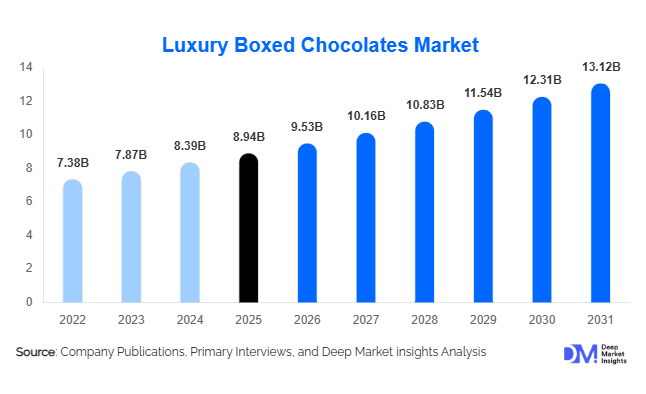
According to Deep Market Insights, the global luxury boxed chocolates market size was valued at USD 8.94 billion in 2025 and is projected to grow from USD 9.53 billion in 2026 to reach USD 13.12 billion by 2031, expanding at a CAGR of 6.6% during the forecast period (2026–2031). The luxury boxed chocolates market growth is primarily driven by increasing consumer preference for premium confectionery, rising demand for luxury gifting products during festive and corporate occasions, expanding retail availability, and growing adoption of artisanal chocolates made using premium cocoa, organic ingredients, and sustainable packaging.
Key Market Insights
- Premium gifting continues to be the largest revenue contributor, with seasonal celebrations and corporate gifting accounting for over one-third of annual luxury boxed chocolate sales worldwide.
- Assorted chocolate boxes dominate the market, supported by broad consumer preference for mixed-flavor collections, premium fillings, and customized gift packaging.
- Europe leads the global market, driven by established chocolate manufacturing, premium brands, and strong consumer spending on luxury confectionery.
- Asia-Pacific is the fastest-growing regional market, supported by rising disposable income, expanding premium retail channels, and increasing demand for luxury gifting in China, India, Japan, and South Korea.
- Sustainable cocoa sourcing and recyclable packaging are becoming major purchasing factors among environmentally conscious consumers.
- Digital commerce and personalized gifting solutions are transforming premium chocolate sales through direct-to-consumer platforms, subscription gifting, and customized luxury packaging.
Luxury Boxed Chocolates Market Latest Trends
Growing Preference for Sustainable Premium Chocolates
Luxury chocolate manufacturers are increasingly investing in ethically sourced cocoa, recyclable packaging materials, and environmentally responsible manufacturing practices. Consumers are demonstrating stronger preference for premium boxed chocolates carrying sustainability certifications, fair-trade cocoa sourcing, and organic ingredients. Luxury brands are also introducing biodegradable gift packaging and reusable premium boxes to strengthen brand positioning. Seasonal collections featuring handcrafted chocolates, locally sourced ingredients, and limited-edition premium assortments continue to gain popularity among affluent consumers while supporting higher average selling prices.
Rapid Expansion of Personalized and Digital Gifting
Online retail platforms are reshaping premium chocolate purchasing by offering customized assortments, personalized messages, luxury gift wrapping, and scheduled delivery services. Artificial intelligence-powered recommendation engines and digital personalization tools enable consumers to curate premium gift boxes based on recipient preferences. Subscription-based premium chocolate services, exclusive festive collections, and direct-to-consumer online channels are further strengthening customer engagement. The growing popularity of premium corporate gifting programs and luxury festive hampers continues to accelerate digital sales across developed and emerging markets.
Luxury Boxed Chocolates Market Drivers
Growing Premium Gifting Culture Worldwide
Luxury boxed chocolates have become one of the preferred premium gifting options for personal celebrations, weddings, festivals, corporate events, and luxury hospitality. Rising disposable income, increasing consumer willingness to purchase premium confectionery, and expanding premium retail networks continue to support market expansion. International brands are launching exclusive festive collections, premium packaging formats, and personalized gifting solutions that attract affluent consumers seeking differentiated luxury products.
Increasing Consumer Preference for Premium Confectionery
Consumers are increasingly shifting toward premium chocolates offering superior cocoa quality, artisan craftsmanship, innovative fillings, and healthier formulations including dark chocolate, organic ingredients, and reduced-sugar recipes. This premiumization trend has encouraged manufacturers to introduce high-value boxed assortments with enhanced product quality, elegant packaging, and exclusive seasonal offerings that command higher margins and strengthen brand loyalty.
Luxury Boxed Chocolates Market Restraints
Volatility in Cocoa and Raw Material Prices
Fluctuating cocoa bean prices, increasing packaging material costs, and supply chain disruptions continue to challenge premium chocolate manufacturers. Higher production expenses often translate into premium retail prices, limiting affordability in price-sensitive markets. In addition, volatile global logistics costs and climate-related impacts on cocoa cultivation continue to create uncertainties across the luxury chocolate value chain.
Limited Consumer Affordability in Emerging Markets
Although premium chocolate consumption is increasing globally, luxury boxed chocolates remain relatively expensive compared to conventional confectionery products. Premium pricing, import duties, and limited distribution in developing economies restrict broader market penetration. Manufacturers continue expanding localized production and affordable premium product ranges to improve accessibility across emerging markets.
Luxury Boxed Chocolates Industry Key Opportunities
Expansion into Emerging Premium Consumer Markets
Rapid urbanization, increasing middle-class income, and growing premium consumption across Asia-Pacific, Latin America, and the Middle East present significant opportunities for luxury chocolate manufacturers. International brands are expanding flagship stores, premium boutiques, and omnichannel retail strategies to capture rising demand from younger affluent consumers seeking luxury gifting experiences.
Innovation in Premium Personalization
Customized assortments, engraved chocolates, premium gift hampers, seasonal limited editions, and corporate-branded luxury gift boxes continue creating new revenue opportunities. Integration of digital customization tools, luxury packaging innovation, and direct-to-consumer subscription services is expected to further strengthen customer engagement while increasing average transaction values across premium chocolate retail channels.
Report Scope
| Report Metric | Details |
|---|---|
| Market Size in 2025 | USD 8.94 Billion |
| Market Size in 2026 | USD 9.53 Billion |
| Market Size in 2031 | USD 13.12 Billion |
| CAGR | 6.6% (2026-2031) |
| Base Year for Estimation | 2025 |
| Historical Data | 2022-2024 |
| Forecast Period | 2026-2031 |
| Report Coverage | Revenue Forecast, Competitive Landscape, Supply Chain Disruption, Growth Factors, Environment & Regulatory Landscape and Trends |
| Geographies Covered | North America, Europe, APAC, Middle East and Africa, LATAM |
| Countries Covered | U.S., Canada, U.K., Germany, France, Spain, Italy, Russia, Nordic, Benelux, Rest of Europe, China, Korea, Japan, India, Australia, Singapore, Taiwan, South East Asia, Rest of Asia-Pacific, UAE, Turky, Saudi Arabia, South Africa, Egypt, Nigeria, Rest of MEA, Brazil, Mexico, Argentina, Chile, Colombia, Rest of LATAM |
Explore more data points, trends and opportunities Download Free Sample Report
Product Type Insights
Assorted chocolate boxes represent the largest product category owing to their wide flavor variety, premium presentation, and suitability for gifting occasions. These collections typically combine pralines, truffles, caramel-filled chocolates, fruit centers, nut inclusions, and premium ganache varieties within elegant luxury packaging. Milk chocolate boxes maintain strong consumer appeal due to their broad acceptance across all age groups and festive occasions, while dark chocolate boxes continue gaining popularity among health-conscious consumers seeking higher cocoa content, antioxidant benefits, and premium taste profiles. Manufacturers continue expanding limited-edition seasonal assortments featuring regional flavors, handcrafted recipes, and exclusive collaborations to enhance premium brand differentiation.
Application Insights
Retail consumers account for the largest share of luxury boxed chocolate purchases, driven by self-consumption, family celebrations, and festive gifting. Corporate gifting represents one of the fastest-growing application segments as organizations increasingly utilize premium chocolate boxes for employee appreciation, client engagement, promotional campaigns, and executive gifting. The hospitality and events segment continues expanding through luxury hotels, weddings, conferences, airlines, and premium tourism experiences where high-end boxed chocolates enhance guest satisfaction and brand experience. Growing demand for personalized gift packaging and customized premium assortments further supports application diversification.
Distribution Channel Insights
Specialty chocolate boutiques and premium retail stores remain the leading distribution channels owing to personalized customer service and premium shopping experiences. Supermarkets and hypermarkets continue expanding premium confectionery offerings through dedicated luxury sections. Online retail has emerged as one of the fastest-growing channels supported by personalized gifting, subscription services, same-day delivery, and direct-to-consumer platforms. Brand-owned websites, luxury marketplaces, and premium e-commerce platforms are increasingly investing in digital marketing and customization capabilities to strengthen customer loyalty and repeat purchases.
Packaging Type Insights
Rigid premium gift boxes dominate luxury chocolate packaging due to their superior presentation, durability, and premium aesthetics. Magnetic closure boxes, decorative tins, handcrafted wooden gift boxes, and reusable luxury packaging continue gaining popularity among premium consumers seeking enhanced gifting experiences. Sustainable packaging solutions manufactured using recycled paperboard, biodegradable materials, and eco-friendly inks are increasingly adopted as manufacturers respond to growing environmental awareness and regulatory requirements while maintaining premium brand appeal.
Explore more data points, trends and opportunities Download Free Sample Report
Luxury Boxed Chocolates Market Segmentations
By Product Type
- Dark Chocolate Boxes
- Milk Chocolate Boxes
- Assorted Chocolate Boxes
- Seasonal & Limited-Edition Chocolate Boxes
By Application
- Retail Consumers
- Corporate Gifting
- Hospitality & Events
- Special Occasion Gifting
By Distribution Channel
- Specialty Chocolate Stores
- Supermarkets & Hypermarkets
- Online Retail
- Department Stores
- Duty-Free & Travel Retail
Regional Insights
Europe
Europe dominates the luxury boxed chocolates market, supported by globally recognized chocolate manufacturers, long-established confectionery traditions, and strong premium consumer spending. Switzerland, Belgium, Germany, France, Italy, and the United Kingdom remain major production and consumption hubs. Strong export capabilities, premium retail infrastructure, and consistent demand during Christmas, Easter, and Valentine's Day continue supporting regional leadership.
North America
North America represents one of the largest premium chocolate markets, driven by increasing consumer preference for artisanal chocolates, personalized gifting, and premium confectionery. The United States leads regional demand, supported by expanding online premium chocolate sales, premium supermarkets, specialty retailers, and corporate gifting programs. Canada also demonstrates steady growth through rising demand for ethically sourced premium chocolate products.
Asia-Pacific
Asia-Pacific is emerging as the fastest-growing regional market owing to increasing disposable income, rapid urbanization, premium retail expansion, and rising gifting culture. China, Japan, India, South Korea, and Australia are witnessing growing consumer interest in imported premium chocolate brands, luxury packaging, and seasonal gifting. Expanding digital commerce and premium supermarket penetration further accelerate regional growth.
Latin America
Latin America is gradually strengthening its position in the premium chocolate market through increasing domestic consumption and growing premium cocoa production. Brazil and Mexico lead regional demand, while Ecuador and Peru continue enhancing premium cocoa exports that support international luxury chocolate manufacturing. Rising tourism and expanding premium retail channels further contribute to market development.
Middle East & Africa
The Middle East is witnessing strong growth in luxury boxed chocolates due to high disposable income, premium gifting traditions, and expanding luxury retail infrastructure. The UAE, Saudi Arabia, and Qatar remain major consumption markets for imported premium chocolate brands. South Africa continues serving as an important regional production and distribution hub, while increasing premium confectionery demand supports wider market expansion across Africa.
Key Players in the Luxury Boxed Chocolates Market
- Ferrero Group
- Lindt & Sprüngli
- Godiva
- Neuhaus
- Leonidas
- Guylian
- Patchi
- Hotel Chocolat
- Mondelez International
- The Hershey Company
- Läderach
- Pierre Marcolini
- Venchi
- See's Candies
- Charbonnel et Walker