Smoked Mackerel Market Size
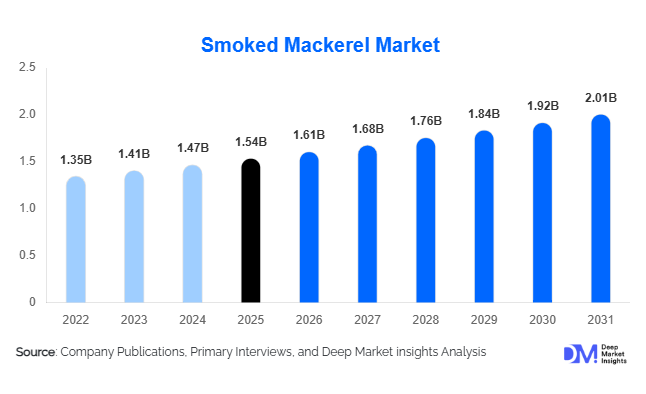
According to Deep Market Insights, the global smoked mackerel market was valued at USD 1.54 billion in 2025 and is projected to grow from USD 1.61 billion in 2026 to reach USD 2.01 billion by 2031, expanding at a CAGR of 4.5% during the forecast period (2026–2031). The smoked mackerel market is driven by rising consumer preference for protein-rich seafood, increasing demand for ready-to-eat and convenience food products, expanding cold-chain logistics, and growing retail penetration of premium smoked seafood across developed and emerging economies. Continuous investments in advanced smoking technologies, sustainable seafood sourcing, and value-added product innovation are further supporting long-term industry expansion.
Key Market Insights
- Hot smoked mackerel remains the leading product category, accounting for more than 51% of global consumption owing to its ready-to-eat convenience, superior flavor profile, and extended shelf life.
- Retail distribution dominates global demand, supported by increasing supermarket penetration, expanding online grocery platforms, and growing availability of premium packaged seafood products.
- Europe leads the global market, benefiting from well-established seafood processing industries, high seafood consumption, and strong export capabilities.
- Asia-Pacific is the fastest-growing regional market, driven by expanding seafood processing infrastructure, rising disposable incomes, and increasing consumption of premium seafood products.
- Vacuum packaging and modified atmosphere packaging technologies are improving product shelf life, food safety, and international export opportunities.
- Sustainability initiatives, including certified fisheries, responsible sourcing, and energy-efficient smoking technologies, are becoming key competitive differentiators across the industry.
Smoked Mackerel Market Latest Trends
Growing Popularity of Premium Ready-to-Eat Seafood Products
Consumer demand for premium ready-to-eat seafood continues to accelerate as busy lifestyles increase the preference for convenient, nutritious meal solutions. Smoked mackerel has gained widespread popularity due to its high protein content, omega-3 fatty acids, and distinctive flavor profile. Manufacturers are expanding premium product portfolios with flavored variants, herb-seasoned products, organic offerings, and skinless fillets that cater to health-conscious consumers. Retailers are also increasing shelf space for vacuum-packed smoked seafood products, while foodservice operators are incorporating smoked mackerel into gourmet salads, sandwiches, pasta dishes, and specialty seafood platters. These developments continue to strengthen demand across both mature and developing seafood markets.
Advanced Processing and Sustainable Packaging Technologies
Seafood processors are increasingly investing in automated smoking chambers, digital temperature control systems, and intelligent moisture management technologies to improve production efficiency and product consistency. Vacuum packaging and modified atmosphere packaging are becoming industry standards for extending shelf life while maintaining freshness and nutritional quality. At the same time, manufacturers are introducing recyclable packaging materials and energy-efficient smoking equipment to reduce environmental impact. Digital traceability platforms and certified sustainable fisheries are also gaining importance, allowing consumers to verify product origin and supporting premium pricing for responsibly sourced smoked mackerel products.
Smoked Mackerel Market Drivers
Increasing Consumer Demand for High-Protein Seafood
Growing awareness regarding healthy dietary habits has significantly increased demand for seafood products that offer high-quality protein, essential amino acids, and omega-3 fatty acids. Smoked mackerel provides an attractive combination of nutritional value, convenience, and longer shelf life, making it popular among working professionals, fitness-conscious consumers, and aging populations. Rising consumption of ready-to-eat seafood, expanding organized retail, and increasing preference for minimally processed protein sources continue to drive global market expansion. Furthermore, government initiatives encouraging seafood consumption and investments in sustainable fisheries are supporting long-term industry development.
Expansion of Organized Retail and Cold Chain Infrastructure
Continuous investments in refrigerated logistics, cold storage facilities, and organized retail networks have significantly improved product availability across supermarkets, specialty seafood stores, and online grocery channels. Better cold-chain infrastructure minimizes spoilage, enhances food safety, and enables international trade of premium smoked seafood products. Rapid growth in e-commerce grocery platforms and direct-to-consumer seafood delivery services is further expanding market accessibility while supporting premium product positioning across urban consumer markets.
Smoked Mackerel Market Restraints
Volatility in Raw Material Supply
Availability of raw mackerel remains highly dependent on seasonal fishing patterns, environmental conditions, fish stock management policies, and regulatory fishing quotas. Climate variability, changing ocean temperatures, and stricter sustainability regulations frequently affect catch volumes and create supply instability. Fluctuating raw material prices increase production costs and reduce profit margins for seafood processors, particularly those operating within export-oriented markets.
Stringent Food Safety and Export Regulations
Manufacturers must comply with rigorous international food safety standards governing seafood processing, traceability, packaging, labeling, and cold-chain transportation. Compliance with HACCP, EU seafood regulations, FDA requirements, and sustainability certifications increases operational costs, especially for small and medium-sized processors. Additional quality inspections and documentation requirements may delay exports and increase logistics complexity across international markets.
Smoked Mackerel Industry Key Opportunities
Growth of Premium Value-Added Seafood Products
Manufacturers are increasingly introducing flavored smoked mackerel, organic-certified products, gourmet seafood snacks, and premium ready meal solutions to capture higher-value consumer segments. Product innovation, premium packaging, and health-focused marketing strategies enable companies to differentiate their offerings while improving average selling prices. Expanding premium seafood consumption in Asia-Pacific, North America, and the Middle East provides substantial long-term growth opportunities.
Expansion of Online Seafood Retail
The rapid growth of digital grocery platforms and direct-to-consumer seafood delivery services creates new opportunities for smoked mackerel producers to reach wider customer bases. Advanced cold-chain logistics and temperature-controlled packaging enable safe home delivery while subscription seafood services encourage repeat purchases. Online platforms also allow manufacturers to introduce premium niche products and strengthen brand visibility through digital marketing initiatives.
Report Scope
| Report Metric | Details |
|---|---|
| Market Size in 2025 | USD 1.54 Billion |
| Market Size in 2026 | USD 1.61 Billion |
| Market Size in 2031 | USD 2.01 Billion |
| CAGR | 4.5% (2026-2031) |
| Base Year for Estimation | 2025 |
| Historical Data | 2022-2024 |
| Forecast Period | 2026-2031 |
| Report Coverage | Revenue Forecast, Competitive Landscape, Supply Chain Disruption, Growth Factors, Environment & Regulatory Landscape and Trends |
| Geographies Covered | North America, Europe, APAC, Middle East and Africa, LATAM |
| Countries Covered | U.S., Canada, U.K., Germany, France, Spain, Italy, Russia, Nordic, Benelux, Rest of Europe, China, Korea, Japan, India, Australia, Singapore, Taiwan, South East Asia, Rest of Asia-Pacific, UAE, Turky, Saudi Arabia, South Africa, Egypt, Nigeria, Rest of MEA, Brazil, Mexico, Argentina, Chile, Colombia, Rest of LATAM |
Explore more data points, trends and opportunities Download Free Sample Report
Type Insights
Hot smoked mackerel represents the largest product segment in the global smoked mackerel market owing to its fully cooked nature, superior convenience, extended shelf life, and broad consumer acceptance across both retail and foodservice channels. Its ready-to-eat format aligns well with the growing consumer preference for convenient, nutritious, and minimally prepared seafood products, making it a preferred choice among busy households and on-the-go consumers. The segment also benefits from increasing availability across supermarkets, hypermarkets, specialty seafood stores, and online retail platforms, while manufacturers continue introducing premium packaging and value-added product formats to strengthen consumer appeal. Rising awareness regarding the health benefits of oily fish, particularly its rich omega-3 fatty acid, protein, vitamin D, and essential mineral content, further supports sustained demand for hot smoked mackerel. Cold smoked mackerel maintains strong demand within premium delicatessen and gourmet seafood markets where consumers value its softer texture, refined smoky aroma, and traditional processing methods. This segment remains particularly popular in restaurants, specialty retailers, and premium hospitality establishments that emphasize authentic seafood experiences. Pepper smoked mackerel continues gaining popularity among consumers seeking differentiated taste profiles, premium seasoning blends, and gourmet seafood offerings, particularly among younger consumers willing to experiment with bold flavors. Manufacturers are also expanding flavored varieties featuring herbs, garlic, lemon, chili, honey glaze, maple, and regional spice combinations to diversify product portfolios, enhance product differentiation, address evolving consumer preferences, and capture premium market segments while improving overall product value.
Application Insights
Retail applications account for the largest share of global smoked mackerel consumption, supported by the widespread presence of supermarkets, hypermarkets, convenience stores, specialty seafood retailers, warehouse clubs, and rapidly expanding online grocery platforms. The leading position of the retail segment is primarily driven by growing consumer demand for convenient ready-to-eat seafood products, increasing preference for healthy protein-rich meal options, rising household consumption, and continuous expansion of modern retail distribution networks across both developed and emerging economies. Attractive packaging innovations, extended shelf-life technologies, refrigerated logistics improvements, and growing private-label offerings have further enhanced product accessibility and affordability, encouraging higher retail purchases. Foodservice remains a significant application area as restaurants, hotels, cafés, quick-service restaurants, catering operators, and premium seafood establishments increasingly incorporate smoked mackerel into salads, appetizers, sandwiches, seafood platters, breakfast menus, pasta dishes, gourmet pizzas, sushi preparations, and fusion cuisine to satisfy evolving consumer preferences for premium seafood experiences. Meanwhile, food processing manufacturers continue utilizing smoked mackerel in frozen meals, seafood spreads, pâtés, ready-to-eat snacks, canned seafood products, dips, sandwiches, wraps, and other value-added convenience foods. Increasing investments in processed seafood manufacturing, coupled with growing demand for functional, protein-rich packaged foods, continue contributing to stable industrial demand worldwide.
Explore more data points, trends and opportunities Download Free Sample Report
Smoked Mackerel Market Segmentations
By Type
- Hot Smoked Mackerel
- Cold Smoked Mackerel
- Pepper Smoked Mackerel
- Flavored & Seasoned Smoked Mackerel
By Application
- Retail
- Foodservice
- Food Processing
- Ready-to-Eat & Convenience Foods
By Distribution Channel
- Supermarkets & Hypermarkets
- Specialty Seafood Stores
- Online Retail Platforms
- Convenience Stores
- Direct-to-Consumer Seafood Delivery
Regional Insights
Europe
Europe remains the dominant regional market owing to its well-developed seafood processing industry, extensive fishing infrastructure, centuries-old smoking traditions, and strong consumer preference for smoked seafood products. Norway, the United Kingdom, Germany, Poland, Denmark, France, and the Netherlands represent major production and consumption centers supported by advanced cold-chain logistics and highly efficient seafood supply chains. The region benefits from abundant access to high-quality raw materials, technologically advanced fish processing facilities, established export networks, and stringent food quality standards that reinforce consumer confidence. High retail penetration, increasing demand for premium ready-to-eat seafood, widespread adoption of sustainable seafood certifications, and continuous product innovation continue supporting regional market leadership. Additionally, growing consumer awareness regarding the nutritional benefits of omega-3-rich seafood, rising demand for clean-label products, expanding premium delicatessen markets, and favorable government initiatives promoting sustainable fisheries further strengthen Europe's long-term market growth.
North America
North America represents a mature market characterized by growing demand for healthy convenience foods, premium seafood products, and value-added ready-to-eat meal solutions. The United States accounts for the majority of regional consumption, supported by expanding supermarket chains, specialty seafood retailers, warehouse clubs, and rapidly growing online grocery platforms. Consumer awareness regarding protein-rich diets, omega-3 nutrition, heart health, and functional foods continues driving smoked seafood consumption throughout the region. Increasing preference for clean-label packaged foods, rising popularity of gourmet seafood products, expanding foodservice offerings, and higher disposable incomes further support market expansion. In addition, improvements in refrigerated logistics, increasing imports of premium smoked seafood products, and growing demand among health-conscious consumers seeking minimally processed protein alternatives continue serving as key drivers for regional growth.
Asia-Pacific
Asia-Pacific is projected to register the fastest market expansion due to rapid urbanization, increasing disposable incomes, changing dietary patterns, growing seafood consumption, and significant investments in seafood processing infrastructure. China, Japan, South Korea, Thailand, Vietnam, Australia, and Indonesia continue expanding production capacity while strengthening export competitiveness through modernization of seafood processing facilities. Rising demand for premium packaged seafood products, organized retail development, expanding e-commerce grocery platforms, and increasing adoption of Western-style ready-to-eat food products further accelerate regional growth. Growing middle-class populations, increasing health awareness, government support for seafood processing industries, improving cold-chain infrastructure, and rising investments in value-added seafood manufacturing are further driving demand across both domestic and export markets, making Asia-Pacific one of the most attractive growth regions for smoked mackerel producers.
Latin America
Latin America is experiencing gradual market expansion supported by growing seafood exports, modernization of processing facilities, increasing domestic consumption of premium seafood products, and expanding cold-chain distribution networks. Chile, Brazil, and Peru remain important contributors through continuous investments in seafood processing technologies, refrigerated logistics, export-oriented production capabilities, and sustainable fisheries management. Rising urbanization, improving retail infrastructure, growing availability of imported and locally processed smoked seafood products, and increasing consumer interest in nutritious protein sources continue supporting regional demand. Furthermore, strengthening international trade relationships, expansion of seafood exports to Europe and North America, and increasing investments in food processing industries are creating favorable conditions for long-term market growth across the region.
Middle East & Africa
The Middle East & Africa market continues to expand through increasing imports of premium seafood products, improving retail infrastructure, rising consumer interest in healthy protein sources, and expanding hospitality and foodservice industries. Gulf Cooperation Council countries remain key import destinations due to high purchasing power, increasing expatriate populations, and growing demand for premium packaged seafood products. South Africa continues strengthening regional seafood processing capabilities, aquaculture development, and export potential through investments in modern processing facilities and cold-chain logistics. Growing supermarket penetration, increasing availability of international seafood brands, rising health consciousness, tourism-driven foodservice expansion, and government initiatives supporting food security and seafood production are collectively driving sustained market growth throughout the region.
Key Players in the Smoked Mackerel Market
- Lerøy Seafood Group ASA
- Mowi ASA
- Young's Seafood
- Thai Union Group PCL
- Espersen A/S
- John Ross Jr. Ltd.
- Seachill Ltd.
- Norvelita AS
- Ocean Beauty Seafoods
- Pacific Seafood
- Marine Harvest Scotland
- Royal Greenland A/S
- Frinsa del Noroeste S.A.
- Iceland Seafood International
- Princes Group