Unsweetened Applesauce Market Size
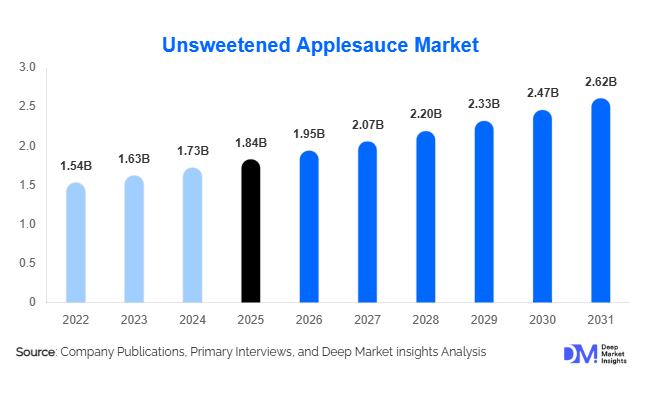
According to Deep Market Insights, the global unsweetened applesauce market size was valued at USD 1.84 billion in 2025 and is projected to grow from USD 1.95 billion in 2026 to reach USD 2.62 billion by 2031, expanding at a CAGR of 6.1% during the forecast period (2026–2031). The unsweetened applesauce market growth is primarily driven by increasing consumer preference for clean-label foods, rising demand for naturally sweetened fruit-based products, expanding applications in infant nutrition and bakery products, and growing adoption of sugar-free ingredients across the processed food industry. The market continues to benefit from rising health awareness, increasing utilization of applesauce as a fat replacer in baked goods, and strong retail demand for preservative-free fruit products.
Key Market Insights
- Growing consumer preference for clean-label and naturally sweetened food products is accelerating the adoption of unsweetened applesauce across household and industrial applications.
- Conventional unsweetened applesauce remains the largest product category, while organic variants are witnessing the fastest growth due to increasing demand for certified organic food products.
- North America dominates the global market, supported by strong apple production, advanced food processing infrastructure, and high consumer awareness regarding healthy eating.
- Asia-Pacific is emerging as the fastest-growing regional market, driven by expanding packaged food production, increasing disposable income, and growing demand for infant nutrition products.
- Food manufacturers are increasingly utilizing unsweetened applesauce as a natural fat and sugar substitute in bakery, dairy alternatives, snacks, and functional foods.
- Advancements in aseptic processing, sustainable packaging, and automated fruit processing technologies are improving product quality, shelf life, and manufacturing efficiency.
Unsweetened Applesauce Market Latest Trends
Clean-Label and Organic Product Expansion
Consumer demand for minimally processed foods continues to reshape the global unsweetened applesauce industry. Food manufacturers are increasingly introducing products made with organically cultivated apples, non-GMO ingredients, and preservative-free formulations to satisfy health-conscious consumers. Organic applesauce is becoming widely available across supermarkets, specialty retailers, and online grocery platforms, while recyclable packaging and sustainable sourcing practices are gaining greater industry acceptance. Retailers are also expanding private-label offerings to address increasing demand for affordable clean-label fruit products. Growing preference for transparent ingredient labeling and natural food formulations continues to strengthen market expansion across developed and emerging economies.
Growing Industrial Utilization Across Food Processing
Unsweetened applesauce is increasingly being incorporated into commercial food manufacturing as a multifunctional ingredient. Bakery manufacturers utilize applesauce as a natural moisture enhancer and fat replacement ingredient, while dairy alternative producers incorporate fruit puree into yogurt substitutes, smoothies, and plant-based desserts. Infant nutrition manufacturers continue expanding product portfolios using unsweetened fruit puree because of its natural sweetness and nutritional value. Advances in aseptic packaging, automated processing systems, and high-efficiency fruit puree production technologies are improving manufacturing productivity while extending product shelf life, further supporting long-term market development.
Unsweetened Applesauce Market Drivers
Growing Consumer Demand for Sugar-Free and Natural Foods
Increasing awareness regarding excessive sugar consumption is encouraging consumers to replace sweetened processed foods with naturally sweetened alternatives. Unsweetened applesauce has become a preferred ingredient for consumers seeking healthier diets because it contains naturally occurring fruit sugars without added sweeteners. Food manufacturers are expanding product portfolios that utilize applesauce in bakery, snacks, beverages, sauces, and baby food applications. Rising health consciousness, increasing demand for functional foods, and greater acceptance of clean-label ingredients continue to create favorable conditions for sustained market expansion.
Expanding Applications Across Processed Food Manufacturing
The growing processed food industry continues to increase demand for fruit-based ingredients that improve texture, moisture retention, and nutritional value. Unsweetened applesauce serves as an effective fat replacer in baked goods while maintaining product quality and reducing calorie content. Manufacturers are increasingly incorporating applesauce into muffins, cakes, breakfast products, dairy alternatives, confectionery, and ready-to-eat foods to improve product appeal among health-conscious consumers. Continuous innovation in food formulations further supports market growth.
Unsweetened Applesauce Market Restraints
Fluctuating Apple Production and Raw Material Pricing
The market remains highly dependent on consistent apple production, making manufacturers vulnerable to seasonal weather variations, pest infestations, and changing agricultural conditions. Variability in apple harvests can significantly affect raw material availability and increase procurement costs for processors. Rising transportation expenses, storage costs, and energy prices further influence production economics, making pricing stability challenging for manufacturers operating in highly competitive retail markets.
Limited Consumer Awareness in Emerging Markets
Although demand is increasing globally, consumer awareness regarding the nutritional benefits and culinary applications of unsweetened applesauce remains relatively limited across several developing countries. Traditional dietary habits, lower product availability, and limited retail penetration restrict market expansion in price-sensitive regions. Manufacturers continue investing in consumer education, product marketing, and expanded retail distribution to improve market penetration.
Unsweetened Applesauce Industry Key Opportunities
Expansion of Functional and Plant-Based Foods
The rapidly growing plant-based food industry presents significant opportunities for unsweetened applesauce manufacturers. Food companies increasingly utilize applesauce in vegan desserts, dairy alternatives, breakfast products, and healthy snacks because of its natural sweetness, fiber content, and moisture-retention capabilities. Growing demand for functional foods fortified with vitamins, minerals, and dietary fiber further supports innovation in premium applesauce formulations.
Product Innovation Through Premium and Value-Added Formulations
Manufacturers are introducing innovative products containing probiotic cultures, additional dietary fiber, vitamin fortification, and organic ingredients to address evolving consumer preferences. Convenient squeeze pouches, single-serving cups, and environmentally sustainable packaging formats are improving product accessibility across households, schools, and institutional foodservice channels. Premiumization continues creating attractive growth opportunities for global manufacturers.
Report Scope
| Report Metric | Details |
|---|---|
| Market Size in 2025 | USD 1.84 Billion |
| Market Size in 2026 | USD 1.95 Billion |
| Market Size in 2031 | USD 2.62 Billion |
| CAGR | 6.1% (2026-2031) |
| Base Year for Estimation | 2025 |
| Historical Data | 2022-2024 |
| Forecast Period | 2026-2031 |
| Report Coverage | Revenue Forecast, Competitive Landscape, Supply Chain Disruption, Growth Factors, Environment & Regulatory Landscape and Trends |
| Geographies Covered | North America, Europe, APAC, Middle East and Africa, LATAM |
| Countries Covered | U.S., Canada, U.K., Germany, France, Spain, Italy, Russia, Nordic, Benelux, Rest of Europe, China, Korea, Japan, India, Australia, Singapore, Taiwan, South East Asia, Rest of Asia-Pacific, UAE, Turky, Saudi Arabia, South Africa, Egypt, Nigeria, Rest of MEA, Brazil, Mexico, Argentina, Chile, Colombia, Rest of LATAM |
Explore more data points, trends and opportunities Download Free Sample Report
Type Insights
Conventional unsweetened applesauce represents the largest product segment because of its broad retail availability, competitive pricing, and well-established manufacturing infrastructure. These products remain highly preferred by households and commercial food processors owing to consistent quality and large-scale production capacity. Organic unsweetened applesauce is the fastest-growing category as consumers increasingly seek pesticide-free, certified organic, and minimally processed foods. Fortified variants containing added vitamins, minerals, and dietary fiber are gaining popularity among parents, elderly consumers, and health-conscious individuals seeking enhanced nutritional benefits. Continuous innovation in organic cultivation, premium packaging, and nutritional enhancement is expanding product diversification across global markets.
Application Insights
Household consumption continues to account for the largest application segment as consumers increasingly utilize unsweetened applesauce as a healthy snack, breakfast ingredient, baking substitute, and infant food. Food processing represents the fastest-growing application owing to expanding utilization in bakery products, confectionery, dairy alternatives, sauces, beverages, and ready-to-eat meals. Foodservice establishments, including restaurants, schools, hospitals, and institutional kitchens, are also increasing adoption because of growing demand for nutritious menu options and portion-controlled fruit products. Rising industrial utilization continues supporting long-term application diversification.
Explore more data points, trends and opportunities Download Free Sample Report
Unsweetened Applesauce Market Segmentations
By Type
- Organic
- Conventional
- Fortified
By Application
- Household Consumption
- Food Processing
- Foodservice
Regional Insights
North America
North America remains the leading regional market due to abundant apple production, highly developed food processing infrastructure, and widespread consumer preference for clean-label packaged foods. The United States accounts for the largest regional consumption, supported by strong demand across retail, bakery, dairy alternatives, and infant nutrition industries. Continuous innovation by leading manufacturers and increasing organic food consumption further reinforce regional market leadership.
Europe
Europe represents a significant share of the global market, driven by increasing consumer preference for sustainable food products and stringent food quality standards. Germany, France, Italy, Poland, and the United Kingdom remain major consuming countries, supported by well-developed fruit processing industries and expanding demand for organic packaged foods. Increasing adoption of recyclable packaging and premium fruit products continues supporting market expansion.
Asia-Pacific
Asia-Pacific is projected to witness the fastest market expansion owing to rapid urbanization, rising disposable income, growing health awareness, and increasing consumption of processed foods. China, India, Japan, Australia, and South Korea continue driving regional demand through expanding supermarket networks, infant nutrition markets, and healthy snack consumption. Growing investment in food manufacturing and packaged food production further strengthens long-term regional growth prospects.
Latin America
Latin America is gradually emerging as a promising regional market, supported by rising middle-class incomes, improving retail infrastructure, and increasing awareness regarding healthier food alternatives. Brazil, Mexico, Argentina, and Chile remain major contributors to regional demand as processed food manufacturers expand production capacities and diversify fruit-based product portfolios.
Middle East & Africa
The Middle East & Africa market continues to expand steadily with increasing demand for imported healthy packaged foods, growing supermarket penetration, and rising consumer awareness regarding sugar reduction. South Africa, Saudi Arabia, the United Arab Emirates, and Egypt remain key regional markets supported by expanding retail distribution and increasing consumption of infant nutrition and functional food products.
Key Players in the Unsweetened Applesauce Market
- TreeTop Inc.
- Materne North America Corp.
- Mott's LLP
- Musselman's
- Knouse Foods Cooperative Inc.
- Eden Foods Inc.
- Santa Cruz Organic
- Nature's Finest Foods
- White House Foods
- Peterson Farms Inc.
- Charles & Alice
- Andros Group