Slippers Market Size
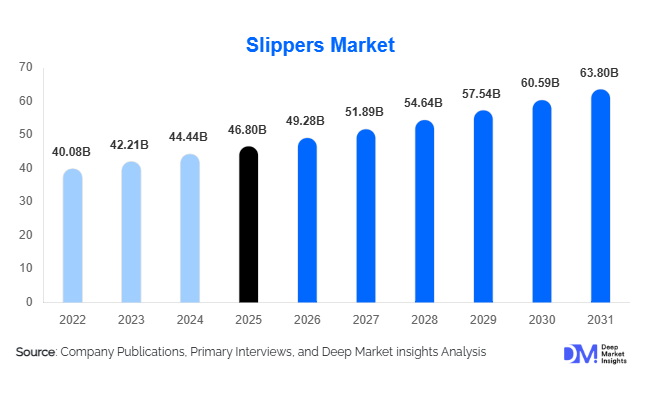
According to Deep Market Insights, the global slippers market size was valued at USD 46.8 billion in 2025 and is projected to grow from USD 49.28 billion in 2026 to reach USD 63.80 billion by 2031, expanding at a CAGR of 5.3% during the forecast period (2026–2031). The slippers market growth is primarily driven by rising consumer preference for comfort-oriented footwear, increasing adoption of casual and athleisure lifestyles, rapid expansion of e-commerce footwear sales, and growing demand for orthopedic and wellness-based footwear products.
The market has evolved significantly from low-cost utility footwear into a diversified lifestyle and fashion category. Consumers are increasingly prioritizing lightweight, ergonomic, and premium slippers that combine aesthetics with comfort and durability. The expansion of hybrid work environments and home-centric lifestyles has accelerated demand for indoor slippers, memory foam products, and wellness-oriented footwear globally.
Growing disposable income across emerging economies, including India, Indonesia, Brazil, and Vietnam, continues to support mass-market demand, while developed economies such as the U.S., Germany, Japan, and South Korea are witnessing strong growth in premium and orthopedic slippers. Sustainability has also become a major industry focus, with manufacturers investing in biodegradable materials, recycled EVA, eco-friendly rubber compounds, and vegan footwear collections.
The hospitality and travel sectors are contributing additional demand through increased procurement of disposable slippers, spa footwear, and premium guest amenities. Technological innovations such as antimicrobial fabrics, smart cushioning systems, thermal regulation materials, and AI-driven footwear customization are further reshaping product development strategies across the industry.
Key Market Insights
- Comfort and wellness-focused footwear demand is rapidly increasing, driven by hybrid work culture, aging populations, and rising consumer health awareness.
- Asia-Pacific dominates global slipper manufacturing and consumption, supported by strong domestic demand, low-cost production, and integrated supply chains.
- Orthopedic and ergonomic slippers are emerging as high-growth categories, particularly in North America, Europe, Japan, and South Korea.
- E-commerce and direct-to-consumer sales channels are transforming footwear distribution, enabling faster product launches and personalized consumer engagement.
- Sustainable slippers made from recycled and biodegradable materials are gaining strong traction, especially among environmentally conscious consumers in Europe and North America.
- Luxury and fashion-oriented slippers are expanding globally, supported by celebrity collaborations, athleisure trends, and premium homewear demand.
Slippers Market Trends
Rising Demand for Wellness and Orthopedic Slippers
The global slippers industry is increasingly shifting toward wellness-oriented footwear products that prioritize comfort, posture correction, and foot health. Consumers are actively seeking slippers with memory foam cushioning, arch support, anti-slip soles, and ergonomic footbeds that reduce fatigue and improve mobility. The aging global population and rising prevalence of diabetes, obesity, and joint disorders are significantly boosting demand for orthopedic slippers in developed markets. Healthcare providers, physiotherapy clinics, and elderly care facilities are also increasing adoption of therapeutic slipper products designed for rehabilitation and preventive care. Manufacturers are responding with podiatrist-certified designs, antimicrobial linings, and pressure-relief technologies that enhance comfort while supporting long-term foot health.
Sustainable and Eco-Friendly Footwear Expansion
Sustainability has become a major trend shaping the slippers market globally. Consumers are increasingly demanding products manufactured using recycled rubber, biodegradable foam, vegan leather, bamboo fibers, and organic textiles. Footwear companies are investing heavily in low-emission production processes, recyclable packaging, and circular economy initiatives to strengthen environmental positioning. Premium brands are launching eco-conscious slipper collections aimed at younger consumers who prioritize sustainability alongside fashion and comfort. Governments and retailers in Europe and North America are also introducing stricter environmental regulations related to plastics and synthetic materials, accelerating industry-wide transition toward greener manufacturing practices.
Slippers Market Drivers
Expansion of Casual and Athleisure Lifestyles
The growing influence of casual fashion and athleisure culture is significantly driving slippers market growth. Slippers are increasingly worn as outdoor lifestyle products rather than purely indoor footwear. Consumers, particularly millennials and Gen Z demographics, are embracing slides, flip-flops, and designer slippers as part of everyday fashion. Global sportswear and footwear brands are expanding their casual slipper portfolios through celebrity collaborations, limited-edition releases, and premium comfort collections. Social media and influencer marketing continue amplifying consumer interest in fashionable and branded slippers, especially across urban markets in North America, Europe, and Asia-Pacific.
Rapid Growth of E-Commerce Footwear Sales
The expansion of online retail infrastructure is transforming the global slippers industry. E-commerce platforms provide consumers with greater product variety, transparent pricing, personalized recommendations, and convenient home delivery. Direct-to-consumer business models are enabling footwear brands to improve profit margins while strengthening customer engagement through targeted advertising and data-driven product launches. Online footwear demand is growing rapidly in emerging economies such as India, Indonesia, Brazil, and Mexico due to rising smartphone penetration and digital payment adoption. Social commerce and influencer-driven purchasing behavior are also accelerating impulse slipper purchases globally.
Slippers Market Restraints
Intense Competition from Unorganized Manufacturers
The slippers market remains highly fragmented, particularly in developing economies where numerous local manufacturers compete aggressively on price. Low barriers to entry and availability of inexpensive raw materials encourage the presence of unorganized players offering low-cost products. This creates significant pricing pressure for established brands and reduces margin potential within economy and mid-range segments. Counterfeit footwear products also pose a challenge for premium manufacturers attempting to maintain brand positioning and customer loyalty.
Volatility in Raw Material Prices
Fluctuations in the prices of rubber, EVA, PVC, foam, leather, and textile materials continue to impact production costs across the footwear industry. Rising petrochemical prices, shipping costs, and supply chain disruptions create uncertainty for manufacturers dependent on synthetic materials. Geopolitical instability and trade disruptions further increase procurement challenges, affecting production planning and profitability. Manufacturers are increasingly investing in supplier diversification and sustainable materials to reduce exposure to raw material volatility.
Slippers Market Opportunities
Growth of Orthopedic and Therapeutic Footwear
The increasing global focus on preventive healthcare and wellness presents significant opportunities for orthopedic and therapeutic slipper manufacturers. Consumers are actively seeking products that improve posture, relieve foot pain, and support mobility. Medical-grade slippers with arch support, pressure-relief cushioning, anti-slip features, and diabetic-friendly materials are gaining strong adoption among elderly populations and healthcare institutions. Demand is particularly strong in developed economies such as the United States, Germany, Japan, and South Korea. Companies investing in podiatrist-certified footwear technologies and ergonomic product innovation are expected to benefit from higher margins and long-term growth potential.
Sustainable and Premium Product Innovation
The rising consumer preference for eco-friendly and premium footwear products is creating substantial opportunities for market participants. Sustainable slippers manufactured using recycled rubber, biodegradable foam, and vegan materials are gaining traction among environmentally conscious consumers. At the same time, luxury homewear trends are encouraging demand for designer slippers featuring premium materials, fashion collaborations, and customized designs. Brands focusing on sustainability, personalization, and premium comfort are increasingly differentiating themselves in a highly competitive marketplace.
Report Scope
| Report Metric | Details |
|---|---|
| Market Size in 2025 | USD 46.8 Billion |
| Market Size in 2026 | USD 49.28 Billion |
| Market Size in 2031 | USD 63.80 Billion |
| CAGR | 5.3% (2026-2031) |
| Base Year for Estimation | 2025 |
| Historical Data | 2022-2024 |
| Forecast Period | 2026-2031 |
| Report Coverage | Revenue Forecast, Competitive Landscape, Supply Chain Disruption, Growth Factors, Environment & Regulatory Landscape and Trends |
| Geographies Covered | North America, Europe, APAC, Middle East and Africa, LATAM |
| Countries Covered | U.S., Canada, U.K., Germany, France, Spain, Italy, Russia, Nordic, Benelux, Rest of Europe, China, Korea, Japan, India, Australia, Singapore, Taiwan, South East Asia, Rest of Asia-Pacific, UAE, Turky, Saudi Arabia, South Africa, Egypt, Nigeria, Rest of MEA, Brazil, Mexico, Argentina, Chile, Colombia, Rest of LATAM |
Explore more data points, trends and opportunities Download Free Sample Report
Product Type Insights
House slippers dominate the global slippers market, accounting for a significant share of revenue due to rising demand for indoor comfort footwear. Memory foam slippers, anti-skid products, and insulated indoor footwear are increasingly popular across North America, Europe, and urban Asia-Pacific markets. Open-toe slippers including slides and flip-flops, continue witnessing strong demand due to casual fashion trends and outdoor lifestyle adoption. Orthopedic slippers represent one of the fastest-growing product categories, supported by aging populations and increasing healthcare awareness. Disposable and hospitality slippers are also expanding steadily with growth in global tourism, luxury hotels, and wellness resorts. Manufacturers are increasingly introducing lightweight, waterproof, and thermal-regulated slipper products to cater to diverse climate and lifestyle preferences.
Material Type Insights
EVA-based slippers account for a major share of the global market due to their lightweight construction, durability, flexibility, and water-resistant properties. EVA materials are widely used in slides, beach slippers, and casual footwear because they offer cost efficiency while maintaining comfort. Rubber slippers continue maintaining strong demand in mass-market segments due to affordability and durability. Foam and memory foam materials are increasingly used in premium indoor slippers to improve comfort and pressure distribution. Sustainable materials including recycled rubber, organic cotton, and biodegradable compounds are emerging rapidly as manufacturers respond to rising environmental concerns and regulatory pressures.
Distribution Channel Insights
Offline retail remains the dominant distribution channel for slippers globally, as consumers prefer physically evaluating comfort, sizing, and material quality before purchasing footwear products. Footwear specialty stores, department stores, supermarkets, and brand-owned retail outlets continue driving large sales volumes across both developed and emerging economies. However, online channels are growing significantly faster due to convenience, broader product access, personalized recommendations, and competitive pricing. E-commerce marketplaces and direct-to-consumer websites are enabling brands to launch products faster while improving customer engagement. Social commerce and influencer-driven footwear marketing are increasingly shaping purchasing decisions among younger consumers.
End User Insights
Women consumers account for the largest share of the global slippers market due to broader product variety, higher fashion engagement, and more frequent footwear replacement behavior. Fashion-oriented slides, luxury slippers, and premium comfort footwear are particularly popular among female consumers. Men’s slippers continue witnessing strong demand in athleisure and casual footwear categories, especially branded slides and outdoor utility slippers. Children’s slippers represent a growing category due to increasing focus on comfort, safety, and anti-slip footwear designs. Elderly consumers are driving rising demand for orthopedic and therapeutic slippers featuring ergonomic support and medical-grade comfort technologies.
Application Insights
Residential applications represent the largest segment within the slippers market, supported by growing consumer spending on home comfort and lifestyle products. Consumers increasingly purchase multiple slipper categories for indoor use, travel, wellness, and casual outdoor activities. Hospitality applications are expanding rapidly due to increasing demand from hotels, resorts, spas, and airlines for disposable and premium guest slippers. Healthcare applications are also witnessing strong growth as hospitals, rehabilitation centers, and elderly care facilities adopt orthopedic and anti-slip slippers to improve patient comfort and safety. Wellness and preventive healthcare sectors are creating additional opportunities for therapeutic slipper products designed for posture correction and mobility support.
Explore more data points, trends and opportunities Download Free Sample Report
Slippers Market Segmentations
By Product Type
- Open-Toe Slippers
- Closed-Toe Slippers
- House Slippers
- Orthopedic & Wellness Slippers
- Disposable & Hospitality Slippers
- Travel & Utility Slippers
By Material Type
- Rubber
- EVA (Ethylene Vinyl Acetate)
- PVC
- Leather
- Textile/Fabric
- Foam & Memory Foam
- Recycled & Sustainable Materials
By Distribution Channel
- Offline Retail
- Online Retail
- Footwear Specialty Stores
- Department Stores
- Hypermarkets & Supermarkets
- Brand-Owned Stores
- E-Commerce Platforms
By End User
- Men
- Women
- Children
- Elderly Consumers
- Unisex Buyers
By Application
- Residential Use
- Hospitality Use
- Healthcare Use
- Travel & Aviation Use
- Recreational & Beach Use
- Wellness & Orthopedic Use
Regional Insights
North America
North America accounts for a major share of the global slippers market, led by strong demand in the United States and Canada. Consumers increasingly prioritize premium comfort footwear, orthopedic slippers, and branded athleisure products. The United States remains one of the largest importers of slippers globally due to high consumer spending and strong retail infrastructure. Rising interest in wellness-focused and sustainable footwear products is driving premium segment growth across the region. Winter-oriented insulated slippers are also witnessing strong demand in Canada due to colder climatic conditions.
Europe
Europe represents a mature but steadily growing slippers market, supported by high consumer preference for sustainable and ergonomic footwear products. Germany, the United Kingdom, France, Italy, and Spain are key regional markets. Demand for orthopedic slippers and eco-friendly footwear is particularly strong across Western Europe due to aging populations and rising healthcare awareness. European consumers increasingly prioritize biodegradable materials, ethical sourcing, and premium craftsmanship, encouraging manufacturers to invest in sustainable product innovation.
Asia-Pacific
Asia-Pacific dominates the global slippers market with the largest share of both manufacturing and consumption. China remains the world’s leading producer and exporter of slippers due to its extensive footwear manufacturing infrastructure and integrated supply chains. India is emerging as one of the fastest-growing markets globally, supported by rising disposable income, rapid urbanization, and expanding e-commerce penetration. Vietnam and Indonesia are strengthening their positions as important export-oriented footwear manufacturing hubs due to competitive labor costs and increasing foreign investment.
Latin America
Latin America remains a significant market for casual and beach slippers, particularly in Brazil and Mexico. Brazil is among the world’s largest consumers of flip-flops due to warm climatic conditions and strong domestic footwear brands. Urbanization, growing middle-class populations, and increasing fashion awareness continue supporting regional demand growth. Local manufacturers remain highly competitive within economy and mid-range product segments.
Middle East & Africa
The Middle East and Africa region is witnessing stable growth supported by tourism expansion, rising retail investments, and increasing disposable incomes. Gulf countries, including the UAE and Saudi Arabia, are experiencing rising demand for luxury and hospitality slippers due to growth in premium tourism infrastructure and luxury hotels. In Africa, South Africa remains an important footwear market supported by urban consumer demand and retail sector expansion. Rising tourism and hospitality development across the region continues creating opportunities for disposable and premium slipper suppliers.
Key Players in the Slippers Market
- Nike Inc.
- Adidas AG
- Crocs Inc.
- Puma SE
- Skechers USA Inc.
- Birkenstock Holding plc
- Deckers Outdoor Corporation
- Relaxo Footwears Ltd.
- Bata Corporation
- ECCO Sko A/S