Apparel Accessories Market Size
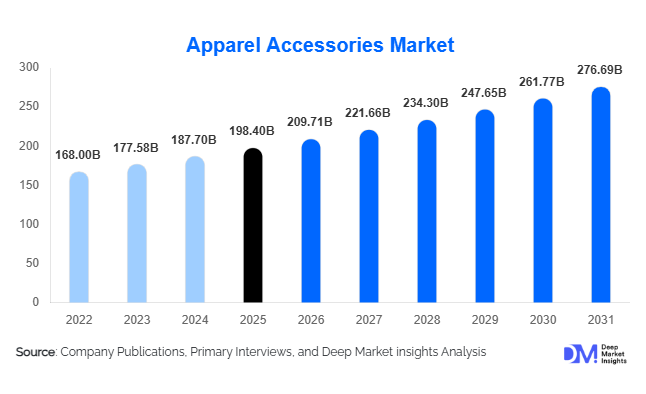
According to Deep Market Insights, the global apparel accessories market was valued at USD 198.40 billion in 2025 and is projected to increase from USD 208.65 billion in 2026 to USD 323.84 billion by 2031, registering a CAGR of 5.7% during the forecast period (2026–2031). Market expansion is supported by rising consumer expenditure on fashion products, increasing penetration of organized retail, rapid growth of e-commerce platforms, and continuous product innovation. Premiumization, sustainability initiatives, and digital commerce are further transforming purchasing behavior across developed and emerging economies.
Key Market Insights
- Sustainable apparel accessories are witnessing strong adoption, with recycled and bio-based materials becoming increasingly common across premium and mass-market product portfolios.
- Digital retail continues to reshape consumer purchasing behavior, supported by AI-powered product recommendations, virtual shopping experiences, and omnichannel retail strategies.
- North America accounted for the largest market share, benefiting from high consumer spending, strong brand presence, and mature retail infrastructure.
- Asia-Pacific is expected to record the fastest growth, driven by expanding middle-class populations, increasing disposable income, and rapid urbanization.
- Bags remain the leading product category, supported by demand across fashion, travel, and lifestyle applications.
- Premium and luxury accessories continue to outperform, supported by increasing brand consciousness and higher spending among affluent consumers.
Apparel Accessories Market Trends
Sustainable Materials Becoming an Industry Standard
Manufacturers are increasingly investing in environmentally responsible materials including recycled polyester, vegan leather, organic cotton, and biodegradable packaging. Fashion brands are integrating circular economy principles into product development by introducing recyclable collections and reducing manufacturing waste. Consumers are placing greater importance on sustainability certifications, encouraging manufacturers to improve supply chain transparency while minimizing environmental impact. Sustainable product launches continue to increase across both luxury and mainstream accessory brands.
Technology-Driven Retail Experience
Digital transformation is reshaping the apparel accessories industry through AI-powered personalization, RFID inventory tracking, virtual product visualization, and advanced analytics. Online retailers are utilizing machine learning algorithms to improve product recommendations while enhancing customer engagement through mobile applications and omnichannel shopping experiences. Social commerce, influencer marketing, and livestream shopping are also expanding consumer reach, particularly among younger demographics seeking convenient purchasing experiences.
Apparel Accessories Market Drivers
Growing Consumer Preference for Fashion and Premium Lifestyle Products
Increasing disposable income, changing fashion trends, and rising consumer awareness regarding branded products continue to support industry expansion. Urban consumers are purchasing multiple fashion accessories to complement apparel collections, while premium brands continue expanding their global presence. Growth in travel, corporate employment, and lifestyle spending is further increasing demand for handbags, belts, hats, wallets, and other fashion accessories across multiple consumer segments.
Expansion of Organized Retail and E-commerce Networks
The rapid expansion of department stores, branded retail outlets, specialty stores, and online marketplaces has significantly improved product accessibility worldwide. Retailers are adopting omnichannel business models that combine physical stores with digital platforms, allowing consumers to experience seamless shopping while benefiting from wider product selection, competitive pricing, and personalized recommendations.
Apparel Accessories Market Restraints
Volatility in Raw Material Prices
Fluctuations in the prices of leather, synthetic fibers, metals, cotton, and packaging materials continue to create cost pressures for manufacturers. Rising transportation expenses, currency fluctuations, and supply chain disruptions further impact production costs and profit margins. These challenges often result in higher retail prices that may affect purchasing decisions among price-sensitive consumers.
Growing Availability of Counterfeit Products
The widespread availability of counterfeit fashion accessories through unauthorized distribution channels continues to challenge established brands. Counterfeit products negatively impact brand reputation while reducing revenue opportunities for genuine manufacturers. Companies are increasingly investing in authentication technologies, intellectual property protection, and digital product verification to address this challenge.
Apparel Accessories Market Opportunities
Rapid Expansion of Online Fashion Retail
The increasing popularity of online shopping continues to create significant growth opportunities for apparel accessory manufacturers. Improved internet connectivity, widespread smartphone adoption, and secure digital payment systems are encouraging consumers to purchase fashion products online. Personalized recommendations, subscription models, and direct-to-consumer strategies are expected to further strengthen future market growth.
Rising Demand for Sustainable Fashion
Consumers are becoming increasingly conscious of environmental sustainability, creating opportunities for manufacturers offering eco-friendly products. Companies are expanding portfolios featuring recycled materials, biodegradable packaging, and ethically sourced raw materials. Sustainability certifications and transparent sourcing practices are becoming important competitive differentiators across the global marketplace.
Report Scope
| Report Metric | Details |
|---|---|
| Market Size in 2025 | USD 198.4 Billion |
| Market Size in 2026 | USD 209.71 Billion |
| Market Size in 2031 | USD 276.69 Billion |
| CAGR | 5.7% (2026-2031) |
| Base Year for Estimation | 2025 |
| Historical Data | 2022-2024 |
| Forecast Period | 2026-2031 |
| Report Coverage | Revenue Forecast, Competitive Landscape, Supply Chain Disruption, Growth Factors, Environment & Regulatory Landscape and Trends |
| Geographies Covered | North America, Europe, APAC, Middle East and Africa, LATAM |
| Countries Covered | U.S., Canada, U.K., Germany, France, Spain, Italy, Russia, Nordic, Benelux, Rest of Europe, China, Korea, Japan, India, Australia, Singapore, Taiwan, South East Asia, Rest of Asia-Pacific, UAE, Turky, Saudi Arabia, South Africa, Egypt, Nigeria, Rest of MEA, Brazil, Mexico, Argentina, Chile, Colombia, Rest of LATAM |
Explore more data points, trends and opportunities Download Free Sample Report
Product Type Insights
Bags continue to dominate the apparel accessories market, accounting for the largest revenue contribution due to their widespread adoption across fashion, travel, business, education, and lifestyle applications. Consumer preference for multifunctional and premium products, coupled with rising demand for sustainable materials and luxury handbags, remains the primary driver for this segment. Product innovations such as lightweight construction, RFID-enabled compartments, water-resistant fabrics, anti-theft designs, and smart travel features are further enhancing consumer appeal. Growing urbanization, increasing disposable income, expanding international travel, and the influence of fashion-conscious millennials and Gen Z consumers continue to strengthen demand for handbags, backpacks, tote bags, luggage accessories, and crossbody bags worldwide.
Belts represent a significant product segment supported by consistent demand from formalwear, casual apparel, luxury fashion, and corporate dressing. Premium leather belts, designer collections, reversible belts, and sustainable alternatives manufactured using recycled materials continue gaining popularity among consumers seeking both functionality and style. Increasing office employment, rising fashion awareness, and growing premium apparel sales are encouraging manufacturers to introduce innovative materials, customizable designs, and branded collections that enhance customer engagement across developed and emerging markets. Hats are experiencing healthy growth owing to increasing participation in outdoor recreation, sports, tourism, and athleisure activities. Fashion trends influenced by celebrities, social media platforms, and sports merchandising continue expanding consumer demand for baseball caps, bucket hats, winter caps, sun hats, and lifestyle headwear. The growing emphasis on UV protection, seasonal fashion collections, and performance-oriented materials is supporting continuous product innovation within this category.
Other apparel accessories including scarves, wallets, gloves, ties, socks, and small leather goods continue contributing significantly to overall industry revenue. Premium gifting trends, increasing demand for personalized accessories, expanding luxury retail, and the popularity of coordinated fashion collections are encouraging manufacturers to diversify product portfolios. Sustainability initiatives, digital customization technologies, and premium craftsmanship are expected to further strengthen long-term demand across these accessory categories.
Distribution Channel Insights
Offline retail continues to account for the largest share of the global apparel accessories market as consumers prefer physically evaluating product quality, material finish, comfort, and brand authenticity before making purchasing decisions. Department stores, supermarkets, branded outlets, fashion boutiques, shopping malls, and specialty retailers remain the preferred purchasing destinations for premium and luxury accessories. The leading driver for this segment is the growing investment in experiential retail, personalized customer service, exclusive product launches, and omnichannel strategies that seamlessly integrate physical stores with digital platforms, enhancing customer satisfaction and repeat purchases.
Online retail is projected to register the fastest growth throughout the forecast period owing to increasing internet penetration, smartphone adoption, digital payment infrastructure, and expanding e-commerce ecosystems. Artificial intelligence-powered product recommendations, virtual try-on technologies, influencer marketing, social commerce, flexible return policies, and same-day delivery services continue improving the online shopping experience. Direct-to-consumer business models and marketplace platforms are enabling brands to reach wider consumer bases while improving operational efficiency and customer engagement.
Specialty stores continue to maintain a loyal customer base by focusing on luxury fashion accessories, premium craftsmanship, exclusive designer collections, and personalized shopping experiences. These stores differentiate themselves through expert product consultation, customization services, limited-edition launches, and strong brand storytelling. Increasing demand for high-end accessories and experiential luxury retail continues supporting the expansion of specialty retail channels globally.
Explore more data points, trends and opportunities Download Free Sample Report
Apparel Accessories Market Segmentations
By Product Type
- Bags
- Belts
- Hats
- Scarves
- Wallets
- Gloves
- Other Apparel Accessories
By Distribution Channel
- Offline Retail
- Online Retail
- Specialty Stores
Regional Insights
North America
North America continues to dominate the apparel accessories market due to high consumer purchasing power, well-established fashion brands, advanced retail infrastructure, and widespread adoption of premium lifestyle products. The United States represents the largest regional contributor, supported by strong luxury spending, high fashion awareness, and continuous product innovation, while Canada and Mexico are witnessing increasing demand through expanding organized retail and digital commerce. The primary growth driver for the region is the rapid expansion of omnichannel retail strategies, premium fashion consumption, and increasing consumer preference for sustainable and branded accessories. Additionally, technological advancements in retail analytics, AI-driven personalization, and direct-to-consumer business models continue strengthening regional market performance.
Europe
Europe remains one of the leading markets owing to its rich fashion heritage, globally recognized luxury brands, and well-developed manufacturing ecosystem. Germany, France, Italy, Spain, and the United Kingdom account for the majority of regional demand, supported by premium leather goods, designer accessories, and luxury craftsmanship. The major growth driver is the increasing adoption of sustainable fashion, circular economy initiatives, and environmentally responsible manufacturing practices encouraged by stringent European regulations and growing consumer awareness. Rising investments in recycled materials, ethical sourcing, and digital fashion retail continue positioning Europe as a global leader in premium apparel accessories.
Asia-Pacific
Asia-Pacific is expected to witness the fastest growth throughout the forecast period, driven by rapid urbanization, expanding middle-class populations, rising disposable income, and growing fashion consciousness across China, India, Japan, South Korea, and Southeast Asia. The region has also emerged as a global manufacturing hub for apparel accessories, benefiting from cost-efficient production capabilities and integrated supply chains. The primary growth driver is the exceptional expansion of e-commerce platforms, increasing smartphone penetration, digital payment adoption, and rising demand for affordable as well as premium fashion products. International brands continue expanding regional operations while domestic manufacturers strengthen product innovation and localized fashion offerings.
Latin America
Latin America is experiencing stable growth led by Brazil, Mexico, Argentina, Chile, and Colombia as organized retail networks continue expanding across major urban centers. Rising disposable income, increasing brand awareness, and growing penetration of international fashion retailers are supporting market development throughout the region. The key growth driver is the rapid digitalization of retail, supported by expanding e-commerce platforms, improved logistics infrastructure, and increasing adoption of mobile commerce. Younger consumers are also driving demand for fashionable yet affordable accessories influenced by social media, celebrity endorsements, and international fashion trends.
Middle East & Africa
The Middle East & Africa apparel accessories market continues expanding steadily owing to rising luxury retail investments, increasing tourism activities, and higher consumer expenditure across Gulf Cooperation Council countries. The United Arab Emirates and Saudi Arabia remain the primary luxury retail hubs, while South Africa serves as an important regional manufacturing and distribution center. The leading growth driver for the region is the continuous expansion of premium shopping destinations, international luxury brand investments, and growing tourism-supported retail spending. Government-led economic diversification initiatives, increasing shopping mall developments, and rising demand for premium lifestyle products are expected to further accelerate regional market growth during the forecast period.
Key Players in the Apparel Accessories Market
- LVMH
- Kering SA
- Capri Holdings
- Tapestry Inc.
- Prada S.p.A.
- Hermès International
- Burberry Group plc
- PVH Corp.
- Ralph Lauren Corporation
- Fossil Group Inc.
- Coach
- Gucci
- Adidas AG
- Nike Inc.
- Michael Kors