Cotton Bag Market Size
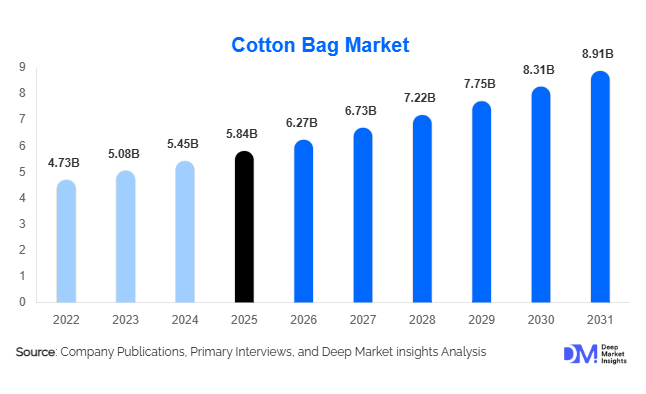
According to Deep Market Insights, the global cotton bag market was valued at USD 5.84 billion in 2025 and is projected to grow from USD 6.27 billion in 2026 to reach USD 8.91 billion by 2031, expanding at a CAGR of 7.3% during the forecast period (2026–2031). The cotton bag market growth is primarily driven by increasing restrictions on single-use plastic bags, growing consumer preference for sustainable and reusable shopping products, rising corporate adoption of eco-friendly promotional packaging, and continuous investments in biodegradable textile manufacturing. Expanding retail infrastructure, favorable government regulations promoting environmentally responsible packaging, and rising awareness regarding carbon footprint reduction are further supporting the long-term expansion of the cotton bag industry worldwide.
Key Market Insights
- Asia-Pacific dominates the global cotton bag market, supported by strong cotton production, low-cost manufacturing, and extensive exports from China, India, Bangladesh, and Vietnam.
- Europe is projected to witness the fastest growth, driven by strict plastic reduction policies, sustainability regulations, and increasing consumer demand for reusable shopping bags.
- Retail and grocery applications account for the largest market share, as supermarkets, hypermarkets, and organized retail chains increasingly replace plastic bags with reusable cotton alternatives.
- Organic and recycled cotton bags are witnessing rapid adoption, supported by rising environmental awareness, ESG commitments, and growing demand for certified sustainable packaging products.
- Fashion and lifestyle brands are increasingly incorporating reusable cotton bags into premium product packaging and merchandising strategies to enhance brand sustainability initiatives.
- Technological advancements in digital textile printing and automated manufacturing are improving product customization, reducing production waste, and increasing manufacturing efficiency across global facilities.
Cotton Bag Market Trends
Growing Preference for Sustainable and Reusable Packaging
Consumers across developed and emerging economies are rapidly shifting toward reusable shopping solutions as governments continue implementing restrictions on single-use plastics. Cotton bags have become one of the most preferred alternatives due to their durability, biodegradability, and long service life. Retailers, supermarkets, fashion brands, restaurants, and corporate organizations are increasingly replacing disposable packaging with reusable cotton bags to strengthen sustainability initiatives and improve brand perception. Manufacturers are expanding production capacities while introducing certified organic cotton, recycled cotton fibers, and environmentally friendly dyeing processes that significantly reduce water consumption and carbon emissions. Growing collaborations between textile manufacturers, retailers, and environmental organizations are further accelerating product adoption, positioning cotton bags as an essential component of sustainable packaging strategies worldwide.
Increasing Customization and Premium Product Innovation
Product customization has emerged as one of the most influential trends shaping the cotton bag industry. Digital textile printing, automated embroidery, water-based inks, and advanced fabric finishing technologies enable manufacturers to produce highly customized reusable bags for promotional campaigns, luxury retail packaging, corporate branding, educational institutions, and event merchandising. Premium cotton bags featuring reinforced stitching, thicker GSM fabrics, laminated interiors, zipper closures, and designer aesthetics are gaining widespread acceptance among fashion and lifestyle brands. Manufacturers are also integrating recycled cotton blends, natural dyes, QR-code enabled branding, and personalized artwork to differentiate their product portfolios. The growing influence of e-commerce platforms and direct-to-consumer brands continues to expand demand for customized cotton bags across global markets.
Cotton Bag Market Drivers
Government Regulations Promoting Sustainable Packaging
Governments worldwide are implementing strict regulations aimed at reducing plastic waste and encouraging the adoption of reusable alternatives. Plastic bag bans, environmental taxes, extended producer responsibility (EPR) regulations, and sustainability mandates have significantly increased the demand for reusable cotton bags across retail, grocery, hospitality, education, and corporate sectors. Several multinational retailers have voluntarily committed to eliminating single-use plastic packaging from their operations while introducing reusable shopping bags manufactured using certified organic and recycled cotton materials. Public awareness campaigns promoting environmentally responsible consumer behavior, combined with growing investments in sustainable textile manufacturing, continue to strengthen long-term industry growth. The increasing participation of global brands in circular economy initiatives is expected to further accelerate cotton bag adoption throughout the forecast period.
Growing Consumer Awareness Regarding Environmental Sustainability
Consumers are becoming increasingly conscious of the environmental impact associated with disposable plastic packaging. Rising awareness regarding ocean pollution, landfill waste, greenhouse gas emissions, and sustainable consumption patterns has encouraged individuals to adopt reusable cotton bags for everyday shopping and lifestyle applications. Younger demographics, environmentally conscious consumers, and premium retail customers increasingly prefer products manufactured using organic cotton, recycled fibers, and eco-certified production processes. Businesses are responding by incorporating reusable cotton bags into their sustainability strategies, promotional activities, and environmentally responsible packaging solutions. Continuous educational campaigns, social media awareness initiatives, and corporate ESG commitments are expected to maintain strong consumer demand for reusable cotton bags over the coming years.
Cotton Bag Market Restraints
Volatility in Raw Cotton Prices and Manufacturing Costs
Fluctuations in global cotton prices remain one of the primary challenges affecting cotton bag manufacturers. Variations in agricultural production caused by changing climatic conditions, water availability, pest infestations, and international trade policies frequently influence raw material costs. Rising labor expenses, transportation costs, energy prices, and textile processing expenditures further increase manufacturing costs, particularly for small and medium-sized producers operating with limited economies of scale. These cost pressures often reduce profit margins and create pricing challenges in highly competitive markets where alternative reusable packaging materials such as jute, recycled polypropylene, and paper bags are readily available.
Competition from Alternative Sustainable Packaging Materials
Although cotton bags are widely recognized for their environmental benefits, they face increasing competition from other reusable and biodegradable packaging materials. Jute bags, hemp bags, recycled PET bags, kraft paper bags, bamboo fiber products, and biodegradable polymer packaging continue gaining popularity due to lower production costs or specialized functional advantages. Price-sensitive consumers and commercial buyers frequently evaluate multiple sustainable packaging options before purchasing, particularly in developing economies where affordability remains a major purchasing criterion. Continuous innovation by competing material manufacturers may moderately restrict the long-term expansion of cotton bag demand unless producers continue improving product durability, affordability, and sustainability performance.
Cotton Bag Market Opportunities
Expansion of Sustainable Retail and Corporate Branding Solutions
The rapid expansion of environmentally responsible retail packaging and corporate sustainability initiatives presents substantial growth opportunities for cotton bag manufacturers. Retail chains, supermarkets, hotels, educational institutions, fashion brands, healthcare providers, and multinational corporations are increasingly incorporating reusable cotton bags into their operational and promotional activities to strengthen environmental commitments and improve customer engagement. Growing investments in recycled cotton processing, organic textile certification, digital customization technologies, and premium reusable packaging are enabling manufacturers to diversify product offerings across multiple end-use industries. Emerging economies continue investing in sustainable manufacturing infrastructure, while rising e-commerce activity further increases demand for reusable branded packaging, creating attractive long-term growth opportunities for the global cotton bag market.
Development of Organic and Recycled Cotton Product Categories
The increasing focus on circular economy models and sustainable supply chains is creating significant opportunities for organic and recycled cotton bag segments. Brands across fashion, retail, hospitality, and consumer goods industries are adopting certified sustainable materials to meet environmental targets and consumer expectations. Organic cotton bags are gaining traction among premium brands due to chemical-free cultivation practices, while recycled cotton bags are expanding as companies seek solutions to reduce textile waste and improve resource efficiency. Manufacturers are investing in advanced recycling technologies, low-impact dyeing processes, and traceable sourcing systems to enhance product credibility. The growing adoption of ESG reporting frameworks and sustainability certifications is expected to accelerate demand for eco-friendly cotton bags, creating new revenue opportunities for manufacturers and suppliers globally.
Report Scope
| Report Metric | Details |
|---|---|
| Market Size in 2025 | USD 5.84 Billion |
| Market Size in 2026 | USD 6.27 Billion |
| Market Size in 2031 | USD 8.91 Billion |
| CAGR | 7.3% (2026-2031) |
| Base Year for Estimation | 2025 |
| Historical Data | 2022-2024 |
| Forecast Period | 2026-2031 |
| Report Coverage | Revenue Forecast, Competitive Landscape, Supply Chain Disruption, Growth Factors, Environment & Regulatory Landscape and Trends |
| Geographies Covered | North America, Europe, APAC, Middle East and Africa, LATAM |
| Countries Covered | U.S., Canada, U.K., Germany, France, Spain, Italy, Russia, Nordic, Benelux, Rest of Europe, China, Korea, Japan, India, Australia, Singapore, Taiwan, South East Asia, Rest of Asia-Pacific, UAE, Turky, Saudi Arabia, South Africa, Egypt, Nigeria, Rest of MEA, Brazil, Mexico, Argentina, Chile, Colombia, Rest of LATAM |
Explore more data points, trends and opportunities Download Free Sample Report
Product Type Insights
The cotton bag market is segmented by material type, including organic cotton bags, recycled cotton bags, and conventional cotton bags. Conventional cotton bags currently hold the largest market share due to their affordability, easy availability of raw materials, and widespread usage across retail and promotional applications. Organic cotton bags are witnessing rapid adoption as consumers and businesses increasingly prioritize sustainable products with lower environmental impact. Recycled cotton bags are also expanding due to growing textile recycling initiatives and corporate sustainability commitments. Among these categories, conventional cotton bags accounted for approximately 46.5% of global revenue in 2025, supported by large-scale manufacturing capacity and cost advantages. Organic cotton bags contributed nearly 31.2% share, while recycled cotton bags represented around 22.3% share and are expected to register the fastest growth during the forecast period due to increasing demand for circular and environmentally responsible packaging solutions.
Organic Cotton Bags
Organic cotton bags represent one of the fastest-growing product categories within the cotton bag industry, supported by increasing consumer awareness regarding sustainable agriculture and chemical-free textile production. This segment accounted for approximately 31.2% market share in 2025, with global production exceeding 5.1 billion units. Organic cotton bags are manufactured using certified organic fibers cultivated without synthetic pesticides and harmful chemicals, making them highly attractive among environmentally conscious consumers and premium brands. Fashion retailers, luxury product companies, and eco-conscious organizations are increasingly adopting organic cotton bags for packaging, merchandising, and promotional campaigns. Higher demand for certified sustainable products, combined with increasing availability of organic cotton suppliers across India, Turkey, China, and the United States, is expected to support strong segment growth through 2031.
Recycled Cotton Bags
Recycled cotton bags are gaining importance as brands and manufacturers focus on reducing textile waste and improving material circularity. The segment accounted for approximately 22.3% of global cotton bag market revenue in 2025, with production reaching nearly 3.6 billion units. These bags are produced using recovered cotton fibers from textile waste, discarded garments, and industrial fabric scraps, helping reduce dependence on virgin cotton resources. Advanced recycling technologies enable manufacturers to improve fiber quality, durability, and finishing performance while lowering environmental impact. Retail brands, corporate organizations, and sustainability-focused companies are increasingly selecting recycled cotton bags as part of their ESG initiatives. The segment is projected to expand at a CAGR of approximately 8.5% between 2026 and 2031, making it one of the most promising categories within the cotton bag market.
Conventional Cotton Bags
Conventional cotton bags remain the dominant product category due to their cost-effectiveness, durability, and extensive availability across global supply chains. This segment accounted for approximately 46.5% market share in 2025, with annual production exceeding 8.1 billion units. These bags are widely used in grocery stores, supermarkets, promotional events, exhibitions, and everyday shopping applications due to their affordability and customizable design options. Conventional cotton bags typically feature woven cotton fabrics ranging between 120 GSM and 300 GSM, reinforced handles, and reusable structures designed for multiple usage cycles. Manufacturers in China, India, Bangladesh, and Vietnam continue expanding production capacity to meet increasing global demand. Despite rising preference for sustainable alternatives, conventional cotton bags are expected to maintain a significant market position due to their competitive pricing and broad commercial adoption.
Application Insights
The cotton bag market serves multiple applications, including retail and grocery, promotional and corporate, and fashion and lifestyle sectors. Retail and grocery applications dominate overall demand due to increasing replacement of plastic shopping bags and growing adoption of reusable packaging solutions by supermarkets and convenience stores. Promotional and corporate applications continue expanding as businesses use customized cotton bags for branding, advertising campaigns, conferences, and corporate gifting programs. Fashion and lifestyle applications are emerging as a high-growth segment due to rising demand for premium reusable accessories, designer packaging, and sustainable fashion products. In 2025, retail and grocery applications accounted for approximately 51.2% market share, promotional and corporate applications contributed nearly 27.8%, and fashion and lifestyle applications represented around 21% of total industry revenue.
Retail and Grocery
Retail and grocery applications represent the largest demand segment in the cotton bag market, driven by government restrictions on plastic bags and increasing consumer preference for reusable shopping products. This segment accounted for approximately 51.2% market share in 2025, with annual consumption exceeding 8.5 billion units. Supermarkets, hypermarkets, grocery chains, and convenience retailers are increasingly offering cotton bags as reusable alternatives to traditional plastic packaging. These bags provide advantages including high durability, multiple usage cycles, customizable branding opportunities, and improved environmental perception among consumers. Large retail chains across Europe, North America, and Asia-Pacific are implementing reusable bag programs, significantly increasing demand volumes. Growing urbanization, rising disposable income, and increasing sustainability awareness are expected to continue supporting the expansion of retail and grocery applications.
Promotional and Corporate
Promotional and corporate applications represent a significant segment within the cotton bag market, supported by increasing demand for customized branding solutions. The segment contributed approximately 27.8% revenue share in 2025, with global supply exceeding 4.5 billion units. Companies, educational institutions, trade organizations, and event organizers use customized cotton bags for conferences, exhibitions, employee engagement programs, and marketing campaigns. Advancements in digital printing, embroidery, and automated customization technologies have enabled manufacturers to produce high-quality branded bags at competitive costs. Corporate sustainability commitments are further encouraging businesses to replace disposable promotional materials with reusable cotton products. This trend is particularly strong across North America, Europe, and emerging Asian markets where companies increasingly integrate sustainable merchandise into their branding strategies.
Fashion and Lifestyle
Fashion and lifestyle applications are emerging as a rapidly growing segment due to increasing demand for sustainable accessories and premium reusable products. This segment accounted for approximately 21% market share in 2025, with production exceeding 3.4 billion units. Fashion brands are incorporating cotton bags into product packaging, seasonal collections, and limited-edition merchandise to strengthen sustainability positioning. Premium cotton bags featuring designer patterns, organic materials, enhanced durability, and luxury finishes are gaining popularity among environmentally conscious consumers. Growing influence of sustainable fashion movements, social media trends, and ethical consumption patterns is encouraging brands to introduce innovative reusable bag collections. The segment is expected to witness strong growth through 2031 as fashion companies continue transitioning toward environmentally responsible packaging and accessory solutions.
Explore more data points, trends and opportunities Download Free Sample Report
Cotton Bag Market Segmentations
By Material Type
- Organic Cotton Bags
- Recycled Cotton Bags
- Conventional Cotton Bags
By Application
- Retail and Grocery
- Promotional and Corporate
- Fashion and Lifestyle
By Region
- North America
- Europe
- Asia-Pacific
- Latin America
- Middle East & Africa
Regional Insights
Asia-Pacific
Asia-Pacific dominates the global cotton bag market, accounting for approximately 42.8% of global revenue in 2025. The region benefits from strong textile manufacturing capabilities, abundant cotton production, competitive labor costs, and extensive export networks. China, India, Bangladesh, and Vietnam collectively contribute more than 67% of regional cotton bag production capacity. The region produced over 8.4 billion units in 2025, supported by rising domestic consumption and international exports. China remains a major manufacturing hub due to large-scale production infrastructure, while India is experiencing strong growth due to government initiatives promoting sustainable textiles and expanding organic cotton cultivation. Retail and grocery applications account for nearly 55% of regional demand, followed by promotional and fashion applications. Increasing investments in recycled textile facilities and sustainable manufacturing technologies are expected to strengthen Asia-Pacific's leadership position throughout the forecast period.
North America
North America represents one of the most developed markets for sustainable reusable packaging solutions, accounting for approximately 24.5% of global cotton bag market revenue in 2025. The region produced nearly 2.9 billion cotton bags during the year, supported by strong demand from retail chains, grocery stores, corporate organizations, and fashion brands. The United States dominates regional consumption due to strict regulations limiting single-use plastics, high consumer awareness regarding environmental sustainability, and strong adoption of reusable shopping solutions. Retail and grocery applications contribute more than 58% of regional demand, while promotional and corporate applications account for nearly 25%. Major retailers are increasingly introducing branded cotton bags, subscription-based reusable packaging programs, and sustainability-focused initiatives. Canada is also witnessing steady growth due to government-backed waste reduction programs and increasing preference for environmentally responsible consumer products. The presence of advanced printing technologies, premium product demand, and strong corporate sustainability commitments is expected to support continued expansion of the North American cotton bag market through 2031.
Europe
Europe is projected to be the fastest-growing regional market, accounting for approximately 21.3% of global cotton bag market share in 2025. The region recorded production volumes of nearly 2.5 billion units, driven by strict environmental regulations, plastic reduction initiatives, and increasing adoption of sustainable packaging alternatives. Countries including Germany, France, the United Kingdom, Italy, and Spain collectively contribute more than 78% of regional demand. European consumers demonstrate strong preference for organic cotton and recycled cotton bags due to increasing awareness regarding responsible consumption and circular economy practices. Retail and fashion industries represent key application areas, with sustainable packaging becoming an important factor in brand positioning. Organic cotton bags account for nearly 38% of European demand, reflecting the region's preference for certified eco-friendly products. Government initiatives promoting reusable packaging, combined with corporate ESG commitments and growing sustainable fashion trends, are expected to drive Europe’s cotton bag market growth at a CAGR of approximately 7.8% during 2026–2031.
Latin America
Latin America accounted for approximately 6.4% of the global cotton bag market in 2025, with regional production reaching nearly 780 million units. Brazil, Mexico, Argentina, Colombia, and Chile represent major contributors due to increasing environmental awareness, expanding retail infrastructure, and government efforts to reduce plastic consumption. Brazil contributes more than 35% of regional demand, supported by its large consumer base and growing sustainable retail sector. Retail and grocery applications dominate the regional market with nearly 54% share, followed by promotional applications at approximately 28%. Fashion and lifestyle brands are gradually adopting reusable cotton packaging to appeal to environmentally conscious consumers. Although price sensitivity remains a challenge, increasing urbanization, rising disposable incomes, and growing participation of international brands are creating new opportunities for market expansion. Investments in local textile manufacturing and sustainable cotton cultivation are expected to improve regional supply capabilities during the forecast period.
Middle East & Africa
The Middle East & Africa region contributed approximately 5.0% of global cotton bag market revenue in 2025, with production exceeding 610 million units. The market is supported by increasing sustainability initiatives, expanding retail infrastructure, tourism development, and growing environmental awareness among consumers. South Africa, the United Arab Emirates, Saudi Arabia, and Egypt represent key markets, collectively contributing more than 65% of regional consumption. Retail and hospitality sectors are major demand generators, accounting for nearly 60% of regional application share. Luxury retail brands and tourism-related businesses are increasingly adopting premium customized cotton bags for branding and customer engagement. Government campaigns encouraging reduced plastic usage are strengthening demand across urban markets. The development of sustainable textile industries and increasing imports of eco-friendly packaging solutions are expected to create additional opportunities for cotton bag manufacturers operating in the region.
Key Players in the Cotton Bag Market
- Earthwise Bag Company Inc.
- Enviro-Tote Inc.
- Bagmasters Inc.
- Bullet Line LLC
- Cotton Bag Co.
- Supreme Creations Ltd.
- Westford Mill
- Green Bag Company
- EcoBags Products Inc.
- Shenzhen Riversky Packing Materials Co., Ltd.
- MGC Bags
- Totebag Factory
- Natural Bag Company