Indian Ethnic Wear Market Size
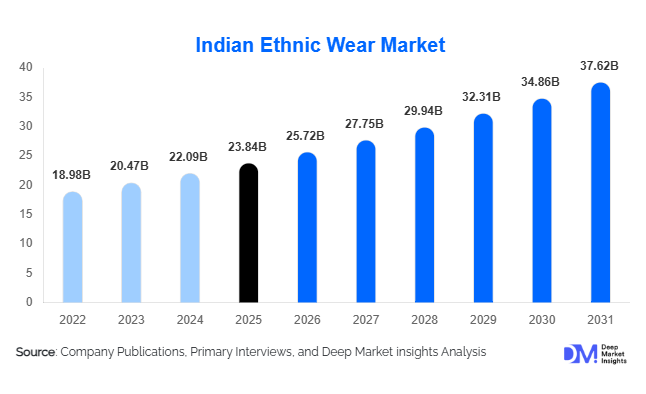
According to Deep Market Insights, the global Indian ethnic wear market size was valued at USD 23.84 billion in 2025 and is projected to grow from USD 25.72 billion in 2026 to reach USD 37.62 billion by 2031, expanding at a CAGR of 7.9% during the forecast period (2026–2031). The Indian ethnic wear market growth is primarily driven by increasing consumer preference for traditional apparel, rising disposable income, expanding wedding and festive spending, growing penetration of organized retail, and the rapid adoption of e-commerce platforms. Demand for premium handcrafted garments, sustainable fabrics, and designer collections is also contributing significantly to long-term market expansion, while digital retail channels and omnichannel strategies continue to enhance accessibility across urban and semi-urban markets.
Key Market Insights
- Women's ethnic apparel continues to dominate the market, accounting for nearly 68% of total revenue, driven by strong demand for sarees, salwar suits, kurtis, and festive collections.
- Online retail is the fastest-growing distribution channel, supported by increasing smartphone penetration, AI-powered personalization, virtual try-on technologies, and expanding digital payment adoption.
- India remains the largest production and consumption hub, supported by a strong textile manufacturing ecosystem, traditional weaving clusters, and increasing investments in branded ethnic fashion.
- Premium and designer ethnic wear is witnessing rapid expansion, fueled by rising wedding expenditures, celebrity endorsements, and increasing demand for customized apparel.
- Sustainable textiles and handcrafted products are gaining popularity, with consumers increasingly preferring organic fabrics, handloom products, and environmentally responsible manufacturing practices.
- Technological integration across retail, including AI-driven recommendations, virtual fitting solutions, omnichannel inventory management, and digital customization, is transforming the customer shopping experience.
Indian Ethnic Wear Market Trends
Premium and Designer Ethnic Fashion Witnessing Strong Demand
Premiumization has emerged as one of the strongest trends across the Indian ethnic wear industry as consumers increasingly prioritize quality, exclusivity, and designer craftsmanship over mass-produced apparel. Wedding celebrations, festive occasions, destination weddings, and premium social gatherings continue to generate substantial demand for luxury sarees, lehengas, sherwanis, and designer kurtas. Fashion brands are expanding their premium collections using silk, Banarasi weaving, Chanderi, linen blends, sustainable cotton, and handcrafted embroidery techniques to differentiate their offerings. Increasing collaborations between fashion designers, celebrity influencers, and organized retail brands are further strengthening premium product visibility. Additionally, growing exports of premium ethnic garments are encouraging manufacturers to invest in advanced textile processing technologies while preserving traditional craftsmanship that appeals to both domestic and international consumers.
Digital Transformation Reshaping Consumer Buying Behavior
Digital commerce continues to redefine the Indian ethnic wear industry through omnichannel retail strategies, AI-enabled customer engagement, and personalized shopping experiences. Leading apparel brands are investing heavily in virtual trial rooms, AI-based size recommendations, live commerce platforms, mobile applications, and social commerce integrations to improve customer satisfaction and reduce product returns. Online-exclusive festive collections, influencer-led marketing campaigns, and regional language digital content have significantly increased customer reach across Tier II and Tier III cities. Integration of data analytics into inventory planning enables retailers to optimize seasonal collections while improving product availability across multiple sales channels. The increasing popularity of direct-to-consumer business models and seamless digital payment infrastructure is expected to accelerate online apparel sales throughout the forecast period.
Indian Ethnic Wear Market Drivers
Growing Wedding and Festive Expenditure Driving Consumer Spending
India's expanding wedding economy remains one of the strongest growth drivers for the Indian ethnic wear market. Millions of weddings organized annually generate significant demand for premium sarees, bridal lehengas, sherwanis, designer kurtas, and customized family apparel. Rising disposable income, urbanization, and increasing spending on lifestyle products have encouraged consumers to purchase multiple ethnic outfits for weddings, festivals, religious ceremonies, and cultural celebrations. Organized retailers continue expanding their festive collections while introducing limited-edition designer collaborations to capitalize on seasonal demand. Simultaneously, government initiatives supporting the textile sector, increasing investments in fashion manufacturing, and growing exports of Indian ethnic apparel continue strengthening industry fundamentals and supporting long-term market expansion.
Expansion of Organized Retail and Digital Commerce
The rapid expansion of organized retail chains and e-commerce platforms has significantly improved product accessibility across metropolitan, suburban, and rural markets. Brand-exclusive stores, shopping malls, online marketplaces, and direct-to-consumer platforms are offering wider product portfolios, competitive pricing, flexible return policies, and personalized shopping experiences. Artificial intelligence-powered recommendation engines, virtual fitting technologies, omnichannel fulfillment systems, and same-day delivery services are enhancing consumer convenience while improving operational efficiency for retailers. Increasing smartphone penetration and digital payment adoption have further accelerated online purchasing behavior, enabling fashion brands to reach new customer segments while strengthening long-term revenue generation.
Indian Ethnic Wear Market Restraints
Volatility in Raw Material Prices and Manufacturing Costs
Fluctuating prices of cotton, silk, dyes, embroidery materials, and synthetic fibers continue to challenge apparel manufacturers across the Indian ethnic wear industry. Rising labor costs, transportation expenses, energy prices, and supply chain disruptions increase overall production costs while reducing profit margins, particularly for small and medium-sized manufacturers. Seasonal fluctuations in raw material availability further affect production planning and inventory management. Additionally, counterfeit products, unorganized retail competition, and imported low-cost garments create pricing pressure, making it difficult for premium manufacturers to maintain profitability while preserving product quality and brand value.
Highly Seasonal Demand Patterns
Consumer purchasing behavior within the Indian ethnic wear industry remains highly dependent on wedding seasons, festivals, and cultural celebrations. Demand fluctuations during off-season periods often result in inventory accumulation, increased discounting, and reduced manufacturing utilization rates. Fashion cycles are becoming shorter due to rapidly changing consumer preferences influenced by social media and celebrity endorsements, requiring manufacturers to continuously introduce new collections. Failure to accurately forecast seasonal demand can lead to excess inventory, higher warehousing expenses, and reduced operational efficiency across the apparel value chain.
Indian Ethnic Wear Market Opportunities
Growing International Demand for Indian Traditional Apparel
Increasing global appreciation for Indian craftsmanship, handloom products, and traditional textiles presents substantial growth opportunities for manufacturers and fashion brands. Rising South Asian diaspora populations across North America, Europe, the Middle East, and Southeast Asia continue generating strong demand for festive apparel, wedding collections, and premium handcrafted garments. Cross-border e-commerce platforms are enabling brands to directly serve international consumers while reducing dependence on traditional distribution channels. Additionally, government initiatives supporting textile exports, geographical indication (GI) products, and traditional weaving clusters are expected to strengthen India's position as a leading supplier of ethnic apparel in international markets.
Sustainable and Handcrafted Fashion Creating New Growth Avenues
Growing environmental awareness among consumers is encouraging fashion brands to adopt sustainable production practices using organic cotton, natural dyes, recycled fibers, biodegradable packaging, and ethical manufacturing processes. Demand for handcrafted products produced by traditional artisans continues to rise as consumers increasingly value authenticity, cultural heritage, and environmentally responsible fashion. Investments in circular fashion, textile recycling technologies, artisan empowerment programs, and transparent supply chains are creating new opportunities for premium ethnic wear manufacturers. These sustainability initiatives are expected to strengthen brand loyalty while supporting long-term growth across domestic and international apparel markets.
Report Scope
| Report Metric | Details |
|---|---|
| Market Size in 2025 | USD 23.84 Billion |
| Market Size in 2026 | USD 25.72 Billion |
| Market Size in 2031 | USD 37.62 Billion |
| CAGR | 7.9% (2026-2031) |
| Base Year for Estimation | 2025 |
| Historical Data | 2022-2024 |
| Forecast Period | 2026-2031 |
| Report Coverage | Revenue Forecast, Competitive Landscape, Supply Chain Disruption, Growth Factors, Environment & Regulatory Landscape and Trends |
| Geographies Covered | North America, Europe, APAC, Middle East and Africa, LATAM |
| Countries Covered | U.S., Canada, U.K., Germany, France, Spain, Italy, Russia, Nordic, Benelux, Rest of Europe, China, Korea, Japan, India, Australia, Singapore, Taiwan, South East Asia, Rest of Asia-Pacific, UAE, Turky, Saudi Arabia, South Africa, Egypt, Nigeria, Rest of MEA, Brazil, Mexico, Argentina, Chile, Colombia, Rest of LATAM |
Explore more data points, trends and opportunities Download Free Sample Report
Product Type Insights
Sarees continue to dominate the Indian ethnic wear market owing to their cultural significance, versatility, and widespread acceptance across all age groups. Premium silk sarees, Banarasi sarees, Kanjeevaram sarees, cotton sarees, and designer collections account for a substantial share of festive and wedding purchases. Manufacturers are introducing lightweight fabrics, digital prints, eco-friendly dyes, and handcrafted embroidery to attract younger consumers while preserving traditional craftsmanship. Salwar Kameez remains one of the most preferred everyday ethnic apparel categories due to comfort, affordability, and regional popularity, particularly across North and Central India. Increasing demand for office-friendly ethnic wear and fusion styling is further supporting segment expansion. Kurtas & Kurtis represent the fastest-growing category as consumers increasingly prefer versatile apparel suitable for office wear, casual outings, festivals, and daily use. Fashion brands continue introducing wrinkle-resistant fabrics, breathable cotton blends, linen collections, and sustainable textiles to meet evolving consumer preferences while expanding premium and designer offerings across both organized retail and digital platforms.
Distribution Channel Insights
Offline retail continues to account for the largest share of the Indian ethnic wear market as consumers prefer physical shopping experiences for weddings, festivals, and premium apparel purchases. Brand-exclusive stores, multi-brand outlets, shopping malls, and local textile retailers offer personalized fitting, fabric inspection, customization services, and immediate product availability, making them the preferred purchasing channels for occasion wear. Online retail is emerging as the fastest-growing distribution channel due to increasing internet penetration, smartphone adoption, secure digital payment systems, and expanding logistics infrastructure. E-commerce platforms provide consumers with wider product selections, competitive pricing, seasonal discounts, virtual trial features, customer reviews, and AI-powered recommendations that enhance shopping convenience. Meanwhile, direct-to-consumer websites are strengthening customer relationships through exclusive collections, loyalty programs, personalized marketing campaigns, and omnichannel fulfillment strategies, allowing brands to improve profitability while delivering seamless customer experiences across multiple touchpoints.
Consumer Category Insights
Women's ethnic apparel represents the largest consumer category, driven by strong demand for sarees, lehengas, salwar suits, kurtis, gowns, and festive collections. Wedding ceremonies, religious festivals, cultural celebrations, and office wear continue supporting consistent purchasing activity throughout the year. Men's ethnic wear is witnessing significant expansion due to increasing popularity of designer kurtas, sherwanis, Nehru jackets, Indo-western apparel, and festive collections. Celebrity endorsements, destination weddings, and premium wedding fashion trends are further strengthening consumer interest in branded men's ethnic clothing. Children's ethnic wear is also expanding steadily as parents increasingly purchase coordinated family outfits for weddings, festivals, and social gatherings. Manufacturers are introducing comfortable fabrics, lightweight materials, skin-friendly textiles, and designer collections specifically designed for infants, children, and teenagers, creating additional revenue opportunities across organized retail and online platforms.
Fabric Type Insights
Cotton remains the most widely utilized fabric across the Indian ethnic wear industry owing to its affordability, breathability, durability, and suitability for India's climatic conditions. Silk continues to dominate premium and luxury ethnic apparel, particularly within bridal sarees, lehengas, and ceremonial garments, where traditional weaving techniques command premium pricing. Linen, rayon, georgette, chiffon, velvet, and blended fabrics are witnessing increasing adoption as consumers seek lightweight, wrinkle-resistant, and easy-to-maintain clothing for everyday use. Sustainable and organic fabrics are also emerging as important growth segments, supported by rising environmental awareness and increasing demand for eco-friendly fashion. Textile manufacturers continue investing in innovative fabric technologies that improve comfort, durability, moisture management, and design flexibility while preserving traditional aesthetics.
Explore more data points, trends and opportunities Download Free Sample Report
Indian Ethnic Wear Market Segmentations
By Product Type
- Sarees
- Salwar Kameez
- Kurtas & Kurtis
By Distribution Channel
- Offline Retail
- Online Retail
- Brand Exclusive Stores
Regional Insights
Asia Pacific
Asia Pacific dominates the Indian ethnic wear market, with India accounting for the overwhelming majority of regional production, consumption, and exports. The country's extensive textile manufacturing ecosystem, rich cultural heritage, skilled artisan workforce, and well-established weaving clusters continue supporting industry leadership. Major manufacturing hubs across Gujarat, Tamil Nadu, Maharashtra, Rajasthan, Uttar Pradesh, Karnataka, and West Bengal specialize in different textile traditions, including silk weaving, cotton production, embroidery, and handcrafted garments. Rising disposable income, rapid urbanization, expanding organized retail, and increasing penetration of digital commerce continue strengthening domestic consumption. Growing exports to neighboring Asian countries and expanding demand among overseas Indian communities further reinforce the region's dominant market position.
North America
North America represents one of the largest international markets for Indian ethnic wear, supported by sizeable South Asian diaspora populations across the United States and Canada. Demand continues to increase for premium bridal collections, festive apparel, designer sarees, and customized ethnic garments used during weddings, religious celebrations, and cultural festivals. Online retail platforms have significantly improved product accessibility by enabling consumers to purchase directly from Indian manufacturers and fashion brands. Increasing multicultural fashion acceptance, celebrity influence, and growing appreciation for handcrafted textiles are further encouraging market expansion throughout the region.
Europe
Europe continues to experience steady growth in Indian ethnic apparel consumption, particularly across the United Kingdom, Germany, France, and the Netherlands. Demand is primarily driven by multicultural communities, destination weddings, international fashion exhibitions, and increasing consumer appreciation for handcrafted textiles and sustainable fashion. European consumers are showing greater preference for premium silk sarees, embroidered kurtas, handcrafted shawls, and fusion ethnic collections that combine traditional Indian aesthetics with contemporary styling. Sustainability regulations and growing demand for ethically sourced textiles are encouraging manufacturers to adopt environmentally responsible production practices while strengthening export opportunities across the region.
Middle East & Africa
The Middle East continues to emerge as a high-value market for Indian ethnic wear due to its large expatriate Indian population, premium consumer spending, and increasing number of destination weddings. Countries including the United Arab Emirates, Saudi Arabia, Qatar, Oman, and Kuwait generate significant demand for luxury bridal collections, designer sarees, and festive apparel. High purchasing power, expanding luxury retail infrastructure, and strong cultural connections with India continue supporting market expansion. African markets are also witnessing gradual growth as organized retail and e-commerce platforms improve product availability while strengthening trade relationships with Indian textile manufacturers.
Latin America
Latin America represents an emerging opportunity for Indian ethnic wear manufacturers, supported by increasing interest in multicultural fashion, international tourism, destination weddings, and cultural exchange. Brazil, Mexico, Argentina, and Chile are gradually witnessing higher demand for premium handcrafted apparel, particularly among fashion-conscious consumers seeking distinctive garments. International online marketplaces are enabling Indian brands to establish direct consumer relationships while reducing distribution barriers. Growing awareness of sustainable textiles and handcrafted fashion is expected to create additional long-term opportunities across the region as premium ethnic apparel gains wider acceptance.
Key Players in the Indian Ethnic Wear Market
- Manyavar
- Biba Fashion Ltd.
- Fabindia Overseas Pvt. Ltd.
- W for Woman
- Aurelia
- Global Desi
- Soch Apparels Pvt. Ltd.
- Nalli Silk Sarees Pvt. Ltd.
- Kalyan Silks
- Meena Bazaar
- Ritu Kumar
- Sabyasachi
- TCNS Clothing Co. Ltd.
- Aditya Birla Fashion and Retail Ltd.
- Shoppers Stop Ltd.